

- Authors

- Name
- Ahmad
- Role
- Senior Marketing Manager, Islamic education • DeenUp
بِسْمِ اللهِ الرَّحْمٰنِ الرَّحِيْمِ
In the name of God, the Most Gracious, the Most Merciful.


The desire to understand the Quran in its own language is one of the most meaningful goals a Muslim can pursue. The Prophet ﷺ recited it in Arabic; the companions received it in Arabic; and something irreplaceable lives in the original that no translation fully captures. Yet many Muslims spend years on and off, never finding a method that fits their schedule and actually works.
What Is the Best Way to Learn Fusha Arabic?
The best way to learn fusha Arabic combines structured grammar study with consistent Quranic reading practice. Start with the Madinah Arabic Reader series or a dedicated Quranic Arabic course for systematic grammar foundations — these build the analytical tools you need. Add daily vocabulary review and 15 minutes of Quran reading alongside your studies. Progress with a tutor if possible. The key is consistency over intensity: 30 minutes daily beats four hours on weekends.
Your personal 28-Day Deen Plan
Learn your deen in 28 days, 5 minutes a day
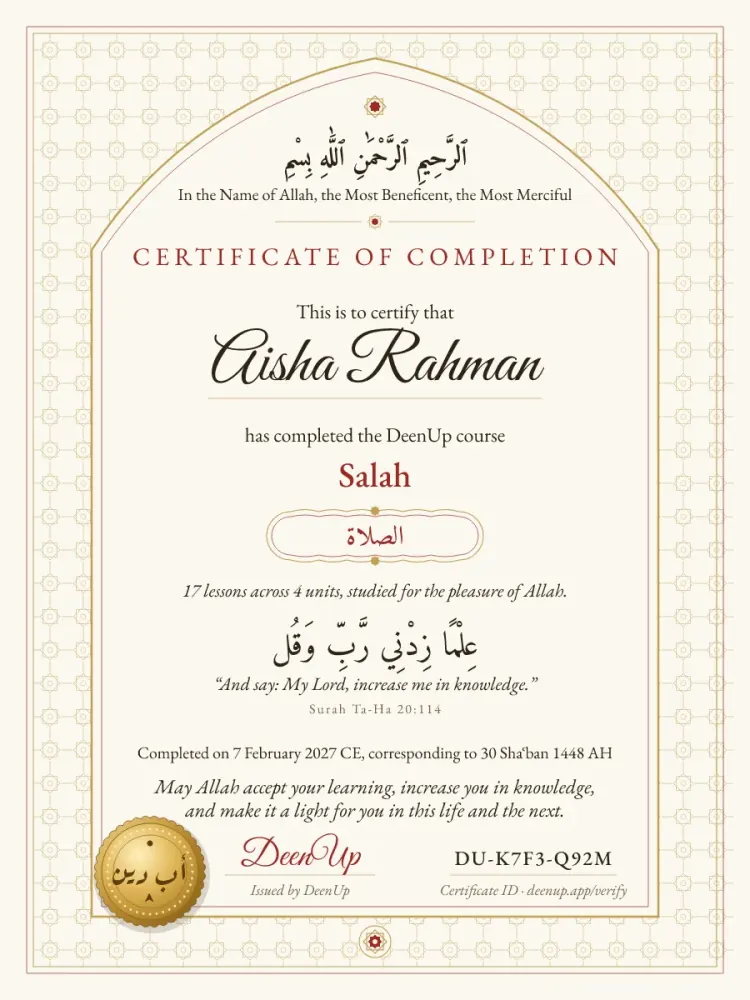
The essentials of salah, fiqh and faith, step by step from authentic sources. Finish all 28 days and earn a verifiable Certificate of Completion.
Take the free quizAnswer a few questions and get your personal plan.
What Is Fusha Arabic and Why Does It Matter?
الفُصحى (al-fusha) literally means "the most eloquent." It refers to the formal, standardized Arabic that connects Muslims across fourteen centuries and sixty countries. There are two registers:
Classical Arabic (Quranic Arabic) — the Arabic of the Quran and early Islamic literature. This is the Arabic Allah chose to reveal His final message:
إِنَّا أَنزَلْنَاهُ قُرْآنًا عَرَبِيًّا لَّعَلَّكُمْ تَعْقِلُونَ
"Indeed, We have sent it down as an Arabic Quran that you might understand." — (Surah Yusuf, 12:2)
Modern Standard Arabic (MSA) — a 20th-century standardization of fusha used in news media, formal speeches, and contemporary literature. MSA adds vocabulary for modern concepts but its grammar is virtually identical to Classical Arabic.
For Muslims, Quranic Arabic is the goal. MSA is a close relative that opens doors to contemporary media and formal communication. Learning one gives you a strong foundation for the other.
Spoken dialects (Egyptian, Levantine, Gulf, Moroccan) are different languages for all practical purposes — useful for conversation in specific countries, but they will not help you read the Quran or Islamic texts.
Fusha Arabic Learning Methods: Honest Comparison
| Method | Best For | Real Strengths | Real Limits |
|---|---|---|---|
| Madinah Arabic Reader | Quranic/Classical Arabic | Systematic, rigorous, free PDF | Slow start; needs discipline |
| Dedicated Quranic Arabic courses | Quran comprehension | Focused on Quranic vocabulary | Varies in quality |
| ArabicPod101 | Listening and MSA | Audio-based, structured levels | Less focus on Quranic Arabic |
| Duolingo Arabic | Script and basic vocab | Low barrier to entry | Very limited grammar depth |
| Private tutor (iTalki) | Speaking and corrections | Personalized, fast feedback | Cost and scheduling |
| University/mosque classes | Structured accountability | Real community and feedback | Fixed schedule, pace |
| YouTube grammar series | Grammar explanation | Free, flexible | Lacks structure alone |
None of these is a complete solution on its own. The methods that produce the best results combine a structured textbook or course with regular Quranic reading practice and, where possible, a tutor for corrections.
A Step-by-Step Beginner Path for Fusha Arabic
Month 1–3: Script, Sounds, and Core Grammar
Before anything else, master the Arabic script. This takes most learners two to four weeks of consistent practice. Then begin the Madinah Arabic Reader (Book 1) or a comparable Quranic Arabic grammar course.
Focus in this phase:
- 28 letters, long and short vowels, sun and moon letters
- Basic sentence structure: subject-predicate (mubtada and khabar)
- Core vocabulary: pronouns, common nouns, basic verbs
- Read one or two short surahs daily with their translation
The goal is not fluency — it is understanding how Arabic sentences are built, which lets you start decoding the Quran from the inside. For a focused reading guide, how to read the Quran for beginners covers the essentials.
Month 4–6: Verb Patterns and Quranic Vocabulary
Arabic verb patterns (awzan) are the most powerful shortcut in the language. Each pattern signals a category of meaning. Learning the ten core patterns allows you to guess the meaning of hundreds of unfamiliar words.
In this phase:
- Study the past, present, and command forms of regular verbs
- Learn the 300 highest-frequency Quranic words (freely available as word lists)
- Begin reading simple Quranic passages without translation, then check your understanding
For tajweed — the rules of correct Quranic recitation — see how to start learning tajweed.
Month 7–12: Sentence Complexity and Reading Stamina
By month six, you should recognize familiar patterns and common vocabulary in Quranic verses. The goal now is building reading stamina and working through grammatically complex passages.
- Begin a systematic study of Quranic Arabic grammar with a commentary (tafsir based study)
- Increase daily Quran reading to two to three pages with active vocabulary tracking
- Use a Quranic Arabic concordance to deepen understanding of key terms
The guide on how to learn Arabic for Quran covers the specific vocabulary and grammar focus that matters most for Quranic comprehension. For those starting to read with meaning, learning Quranic Arabic gives additional structure.
Common Mistakes That Slow Learners Down
Starting with a dialect. Egyptian or Gulf Arabic is conversationally fun, but it will not help you read the Quran. If your goal includes Quranic understanding, start with fusha.
Passive consumption. Watching Arabic TV without active vocabulary practice builds passive listening but not reading comprehension. Fusha requires active study — not just exposure.
Skipping grammar. Arabic grammar is what allows you to decode unfamiliar words. Learners who skip grammar and memorize vocabulary in isolation hit a ceiling quickly.
Inconsistency. Two weeks of intense study followed by a month off resets more than you think. Daily 30-minute sessions are more productive than marathon sessions on weekends.
Relying on phonetic transliteration. Learning to read the Arabic script directly — without transliteration crutches — connects you to the Quran as it was written. Transliteration is a temporary scaffold, not a destination.
Where DeenUp Fits Your Arabic Journey
DeenUp does not teach Arabic grammar or run live language classes. What it does offer is daily Quranic verses with contextual insights grounded in authentic scholarship — which supports your Arabic learning in a specific way. As your vocabulary grows, reading a daily verse with DeenUp's context connects language to meaning in a way pure grammar study does not. It also provides Arabic duas and their translations, which reinforces vocabulary you encounter in classical texts.
For structured Arabic instruction, the online Quran classes for adults guide covers what to look for in a Quranic Arabic teacher. For reading the Quran with correct pronunciation alongside your language study, learn Quran with tajweed explains the rules that govern recitation.
The Deeper Motivation
The Prophet ﷺ received the Quran in Arabic, and his companions understood it in Arabic. The language is inseparable from the message in a way that makes learning it one of the most rewarding forms of Islamic knowledge pursuit. Even partial understanding transforms how you experience salah:
إِنَّا جَعَلْنَاهُ قُرْآنًا عَرَبِيًّا لَّعَلَّكُمْ تَعْقِلُونَ
"Indeed, We have made it an Arabic Quran that you might understand." — (Surah Az-Zukhruf, 43:3)
The word ta'qilun — that you might understand — implies active comprehension, not passive hearing. The Quran is explicitly calling you to understand it. Learning fusha is the most direct response to that call.
For reflection on how language connects to Quranic understanding, the DeenBack guide to learning Arabic for Quran addresses the spiritual dimension of the journey alongside the practical. The Demi Manifest piece on the fusha Arabic path covers how to sustain motivation through the intermediate plateau — which is where most learners stop.
For the Quranic verses cited above: Surah Yusuf 12:2 on quran.com and Surah Az-Zukhruf 43:3 on quran.com.
Your personal 28-Day Deen Plan
Learn your deen in 28 days, 5 minutes a day
The essentials of salah, fiqh and faith, step by step from authentic sources. Finish all 28 days and earn a verifiable Certificate of Completion.
Take the free quizAnswer a few questions and get your personal plan.
Learning fusha Arabic is not a shortcut project. It is a years-long conversation with the Quran, the Prophet ﷺ, and fourteen centuries of Islamic scholarship. Start small, stay consistent, and let each verse you understand be its own reward.
Not sure where to begin your deen journey? Take the free DeenUp quiz and get a plan built around where you are right now — Arabic, prayer, or anything else you are working on.
Frequently Asked Questions
What is fusha Arabic and how is it different from spoken dialects?
Fusha Arabic (الفصحى) is the formal, standardized Arabic of the Quran, classical literature, news media, and formal writing. It differs from spoken dialects like Egyptian, Levantine, or Gulf Arabic, which vary by country and are not mutually intelligible with each other. Fusha is the Arabic that all educated Arabs can understand across borders.
Is Quranic Arabic the same as fusha Arabic?
Quranic Arabic is Classical Arabic — the earliest and purest form of fusha. Modern Standard Arabic (MSA) is a later standardization of fusha used for contemporary media and writing. For Muslims seeking to understand the Quran, Quranic Arabic is the focus. MSA builds on the same foundation but adds modern vocabulary the Quran does not use.
How long does it take to learn fusha Arabic?
With consistent daily study of 30 to 60 minutes, most learners develop basic fusha reading and grammar comprehension in 6 to 12 months. Reaching conversational fluency in MSA typically takes two to three years. Understanding the Quran without translation is a lifelong deepening process, though significant comprehension is achievable within one to two years of focused Quranic Arabic study.
Can I learn fusha Arabic without a teacher?
Yes, self-study is possible with structured resources. The Madinah Arabic Reader series and Quranic Arabic grammar courses provide rigorous self-study paths. A tutor accelerates progress significantly and helps correct pronunciation and grammatical errors, but many Muslims have reached strong Quranic comprehension through disciplined self-study alone.
What is the best free resource for learning fusha Arabic?
The Madinah Arabic Reader series by V. Abdur Rahim is freely available as a PDF and is used in Islamic universities worldwide. It teaches Arabic through Arabic with no translation crutch. Combined with free YouTube explanations of its grammar, it remains one of the most rigorous free paths to Quranic and Classical Arabic.
Should I learn fusha or a dialect first?
For Muslims whose goal is understanding the Quran, start with fusha — specifically Quranic Arabic. Dialects are useful for conversation in specific countries but will not help you read the Quran or Islamic texts. If your goal is both Islamic study and travel, fusha first gives you the foundation for both; dialects can be added later.
How much Arabic do I need to understand the Quran?
Studies of Quranic vocabulary show that understanding approximately 300 of the most frequent words covers about 70 percent of the Quran. The top 500 words cover roughly 85 percent. With a year of focused Quranic Arabic study — covering core grammar and high-frequency vocabulary — you can begin reading with partial comprehension and continue deepening from there.