

- Authors

- Name
- Zeeshan
- Role
- Founder, DeenUp • DeenUp
بِسْمِ اللهِ الرَّحْمٰنِ الرَّحِيْمِ
In the name of God, the Most Gracious, the Most Merciful.
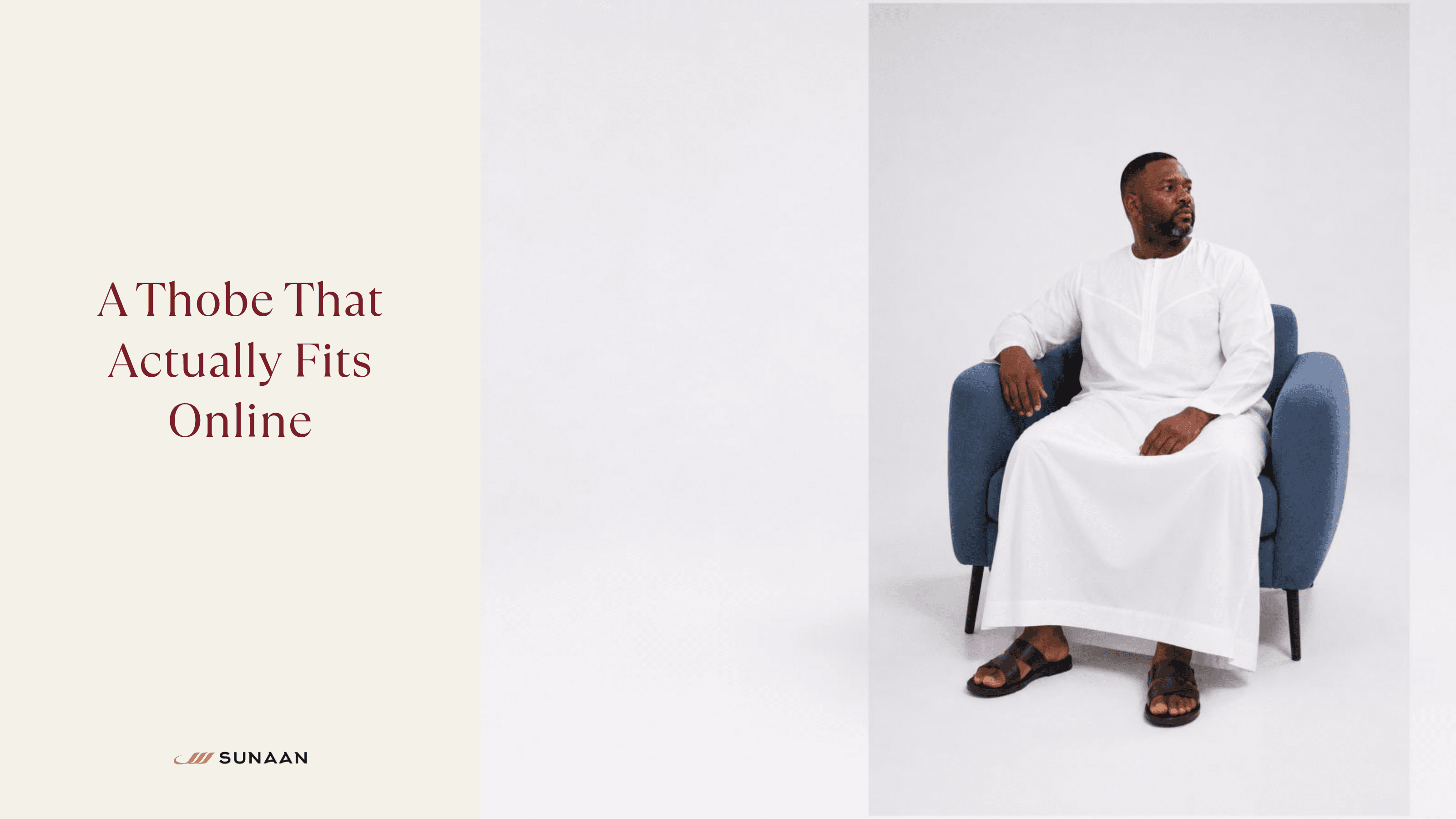
Today we can order almost anything from our phones. Food arrives without a phone call, a banking app can open an account in minutes, and we can learn Qur'an, check prayer times, and study our Deen from wherever we happen to live. So it is strange that buying a properly fitting thobe online still feels so old-fashioned by comparison.
The routine has not really changed in years. You pick a size, hope the length is right, place the order, and wait. Then you try it on and sometimes discover that everything fits except the one measurement that matters most: the length.
For Muslims living far from places where thobe tailoring is common, the alternatives are not much better. Getting a thobe properly tailored can mean tracking down a specialist, taking a long list of body measurements, and then somehow communicating exactly how you want the garment to fit. It makes you wonder why none of this has become simpler.
The Problem With S, M and L
A thobe is not a T-shirt. With a T-shirt, being a few centimetres too long rarely matters. With a thobe, that same difference can completely change how the garment looks and feels.
The trouble is that a single size has to stretch across very different bodies. Two men can both wear Medium while standing at noticeably different heights, which means a standard Medium thobe simply cannot be the ideal length for both of them. Some brands try to work around this by offering combinations of width and length, giving you a few more boxes to fit into—but a boxed size still cannot account for a thobe that fits every height.
Traditional tailors solve the problem in a much more direct way: they make the garment for the person. That produces a far more personalised result, but it introduces a different obstacle the moment you move it online—measurements.
Custom Tailoring Wasn't Designed for the Internet
Visit a good tailor and measurements are never your problem. He measures your shoulders, chest, sleeves, and length while you stand there for a few minutes, and the expertise stays on his side of the counter.
Move that same process online and the roles quietly flip. Suddenly the customer is expected to become the tailor: find a measuring tape, follow a diagram, and carefully work through the chest, the shoulders, the sleeves, and the garment length. Then comes the lingering doubt about whether any of it was measured correctly in the first place.
For someone who just wants a good thobe, that is a lot of work to get through before even reaching checkout. Technology is supposed to remove steps like these, not simply digitise them.
What If the Tailor Did the Difficult Part?
That question is what eventually led to Sunaan, and the idea behind it turned out to be surprisingly simple. Instead of asking customers to provide a full set of tailoring measurements, Sunaan asks for the information people are far more likely to already know: your regular clothing size and your height.
In practice, that might mean choosing Medium and entering a height of 178 cm, and nothing more. The tailoring itself happens behind the interface, where experienced tailors take that information and use it to produce the garment, including working out an appropriate thobe length. The goal is to bring together two experiences that usually do not sit side by side: the simplicity of buying ready-to-wear clothing online and the personalisation of having a thobe made for you. It is the thinking behind Sunaan's tailored thobes online.
A Digital Product Doesn't Have to Be an App
This is also part of something larger happening within Muslim entrepreneurship. Not every Muslim problem calls for another marketplace stacked with thousands of products; sometimes the real opportunity is just removing the friction from something Muslims already do.
DeenUp is a good example. It uses a digital experience to make learning Islam easier to reach, turning it into something Muslims can engage with in small moments throughout the day. Sunaan takes a completely different problem and approaches it with a similar philosophy.
The difference is that Sunaan's final product happens to be physical, while much of the innovation lives in the experience around it—choosing a thobe, communicating your fit, customising it, having it tailored, and receiving it wherever you live. The technology is there to make the complicated parts disappear from the customer's side.
Especially When You Don't Live in a Muslim Country
If you live in Riyadh, Dubai, Doha, or another city with a strong thobe culture, finding a tailor is not unusual at all. For a Muslim living in Stockholm, Tallinn, Toronto, or a small American city, the picture can look very different, and there may be no specialist thobe tailor nearby at all.
That should not mean custom Islamic clothing is reserved for Muslims in particular countries. The internet has already removed geography from Islamic learning, Muslim communities, and countless other services, so there is no real reason tailoring cannot move in the same direction.
That, ultimately, is what Sunaan is trying to build: a tailor that happens to live on the internet. You choose what you like, tell it enough about yourself to make it fit, let the tailor handle the rest, and have it delivered to your door. If you are curious, you can see how online thobe tailoring works.
Building Better Digital Experiences for Muslims
There are nearly endless opportunities to improve everyday Muslim life through thoughtful digital products. Some will help us learn, some will help us worship, and some will help Muslim businesses operate. Others will quietly solve much smaller frustrations, like finally ordering a thobe online without wondering whether it will reach halfway down your shoes.
Not every Muslim problem needs revolutionary technology. Sometimes good technology simply makes an old experience work better, and perhaps the clearest sign that it worked is that the technology itself almost disappears.