

- Authors

- Name
- Ahmad
- Role
- Senior Marketing Manager, Islamic education • DeenUp
بِسْمِ اللهِ الرَّحْمٰنِ الرَّحِيْمِ
In the name of God, the Most Gracious, the Most Merciful.

Quick answer
What is the best dua for stress, anxiety, and depression in Islam?
The most comprehensive dua for stress, anxiety, and depression is from Sahih al-Bukhari 6369, taught by the Prophet Muhammad as a daily supplication: Allahumma inni a'udhu bika minal-hammi wal-hazani. It explicitly names hamm (ongoing worry) and huzn (deep grief and sadness) — the two Arabic terms that map most closely onto anxiety and depression — and was recited by the Prophet every morning as a shield against psychological and spiritual distress.
Stress pulls at you from the outside. Anxiety lives in the future, rehearsing what might go wrong. Depression settles in the past and present, making the ordinary feel unreachable. Many Muslims experiencing all three — sometimes simultaneously — wonder whether faith has specific answers, or only general reassurance.
It has specific answers. The Quran and authentic hadith name these exact states in Arabic — hamm, huzn, ghamm — and the Prophet ﷺ taught daily supplications that address each of them directly. This article gathers the most authentic duas for stress, anxiety, and depression, with their Arabic text, transliteration, source citations, and practical guidance for making them a daily refuge.
What Is the Dua for Stress, Anxiety, and Depression in Islam?
The primary Islamic dua for stress, anxiety, and depression is from Sahih al-Bukhari 6369, taught by the Prophet ﷺ as a daily supplication: Allahumma inni a'udhu bika minal-hammi wal-hazani. This single dua covers hamm (anticipatory worry and stress) and huzn (deep grief and sadness), along with six additional conditions including weakness, inertia, and feeling overwhelmed. It was recited by the Prophet every morning — not as a crisis prayer, but as daily protection against the full spectrum of psychological and spiritual distress.
The Core Duas: Arabic, Transliteration, and Meaning
Dua 1: The Prophet's Daily Refuge from Stress and Grief
Narrated by Anas ibn Malik (may Allah be pleased with him), this was the Prophet's own morning practice:
اللَّهُمَّ إِنِّي أَعُوذُ بِكَ مِنَ الْهَمِّ وَالْحَزَنِ، وَالْعَجْزِ وَالْكَسَلِ، وَالْبُخْلِ وَالْجُبْنِ، وَضَلَعِ الدَّيْنِ وَغَلَبَةِ الرِّجَالِ
Allahumma inni a'udhu bika minal-hammi wal-hazani, wal-'ajzi wal-kasali, wal-bukhli wal-jubni, wa dala'id-dayni wa ghalabatir-rijal
"O Allah, I seek refuge in You from worry and grief, from weakness and laziness, from miserliness and cowardice, from the burden of debts and from being overpowered by people." — (Sahih al-Bukhari 6369)
The precision of this dua is remarkable. Hamm is worry that runs ahead of events — anticipatory anxiety. Huzn is the grief that follows painful events — the heaviness of depression. 'Ajz and kasal name the inertia and exhaustion that accompany both. The Prophet did not treat these as failures of character; he taught a refuge from them.
Dua 2: The Dua of Prophet Yunus — for Moments of Crisis
لَا إِلَهَ إِلَّا أَنتَ سُبْحَانَكَ إِنِّي كُنتُ مِنَ الظَّالِمِينَ
La ilaha illa anta subhanaka inni kuntu minaz-zalimin
"There is no deity but You; glory be to You. Indeed, I have been of the wrongdoers." — (Surah Al-Anbiya, 21:87)
The Prophet ﷺ said: "No Muslim supplicates with it in any matter except that Allah will respond to them." (Tirmidhi 3505). This dua was recited by Yunus ﷺ at the most isolated, overwhelmed moment of his life — in the belly of the whale, in complete darkness. It combines tawhid (acknowledging Allah's sovereignty), tasbih (glorifying Him), and istighfar (acknowledging one's own limits). Together, these three break the cycle of rumination that stress and depression produce.
Dua 3: Seeking Allah's Mercy When Feeling Helpless
اللَّهُمَّ رَحْمَتَكَ أَرْجُو فَلَا تَكِلْنِي إِلَى نَفْسِي طَرْفَةَ عَيْنٍ
Allahumma rahmataka arju fala takilni ila nafsi tarfata 'ayn
"O Allah, I hope for Your mercy, so do not leave me to myself for the blink of an eye." — (Abu Dawud 5090, classified as hasan)
The phrase "do not leave me to myself for the blink of an eye" captures depression's particular loneliness with stunning precision. It acknowledges that left alone with our own minds, we are lost — and that relief comes from remaining within Allah's care even when we cannot feel it.
What the Quran Says About Stress, Anxiety, and Sadness
The Quran addresses psychological distress not as a marginal topic but as a central human reality.
Surah Al-Inshirah (94:5-6) states twice: "For indeed, with every hardship will be ease." The repetition in Arabic carries a specific grammatical meaning: yusr (ease) appears as indefinite while usr (hardship) appears as definite. Scholars explain that this means each hardship comes with its own distinct ease — not one distant promise, but multiple doors of relief, all operating simultaneously.
Surah Ad-Duha (93:3-5) was revealed when the Prophet ﷺ experienced a period of silence from revelation and feared Allah had abandoned him. The divine response was direct: "Your Lord has not forsaken you, nor has He become displeased." These verses were revealed for the Prophet at his most vulnerable moment — they speak directly to anyone who carries the anxiety that they are unseen or forgotten.
For more on how the Quran addresses the experience of grief specifically, dua for depression covers the Islamic understanding of huzn and the supplications that address it.
The Context: Why These Duas Were Taught
The dua of Sahih al-Bukhari 6369 was not revealed in response to a single event. The Prophet ﷺ taught it as a daily practice — meaning he considered these states (worry, grief, weakness, inertia) common enough to warrant protection every morning, not just in extreme situations.
The dua of Yunus comes from a moment of profound disorientation. Yunus ﷺ had left his people without divine permission, was swallowed by a large fish, and found himself in layered darkness — the darkness of the ocean floor, the darkness inside the fish. He had no plan, no way out, and no visible means of rescue. The dua he recited in that moment is the dua the Prophet later confirmed as guaranteed to be answered.
This is significant for people experiencing depression: relief does not require that you first achieve a state of calm or clarity. The dua works in the darkness. It was designed for the darkness.
The Islamic perspective on mental health explores how classical scholars understood these states and how their framework can inform how Muslims approach mental health care today.
Making These Duas Part of Your Daily Life
Anchor Them to Morning Adhkar
The most effective way to use these duas is not as emergency prayers but as daily practice. The Prophet ﷺ recited the Bukhari 6369 dua in his morning adhkar — the set of supplications and dhikr practiced after Fajr. Including it there means you are building a protective practice before the stress of the day arrives.
A simple morning routine:
- After Fajr, stay seated for 5-10 minutes rather than immediately moving on
- Recite Ayatul Kursi (Al-Baqarah 2:255) once
- Recite the Bukhari 6369 dua once, with awareness of what each word means
- If anxiety is active, add the dua of Yunus (Al-Anbiya 21:87) repeatedly until the mind settles
Use the Dua of Yunus as an Active Counter
For stress and anxiety specifically, the dua of Yunus functions as an active counter to anxious thought. When anxious rumination begins — cycling through what could go wrong, what you should have done differently — reciting this dua interrupts the cycle by shifting attention to something true and stable: Allah's sovereignty and your own dependence on Him.
For more on the practical side of building Islamic habits that support mental wellbeing, dua for mental health gathers additional supplications organized around specific emotional states.
Your personal 28-Day Deen Plan
Learn your deen in 28 days, 5 minutes a day
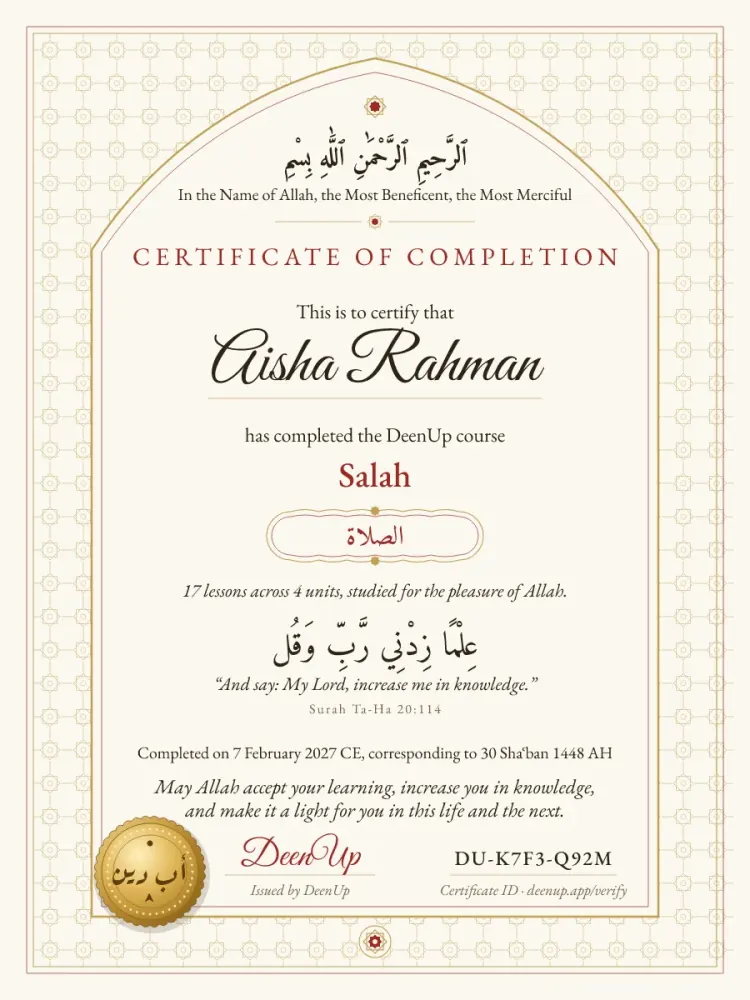
The essentials of salah, fiqh and faith, step by step from authentic sources. Finish all 28 days and earn a verifiable Certificate of Completion.
Take the free quizAnswer a few questions and get your personal plan.
Consistency matters more than intensity. Reciting these duas daily, even on relatively good days, builds the spiritual resilience that makes them more effective when difficult moments arrive. For more on the Islamic understanding of perseverance through hardship, what is sabr in Islam covers the concept of patient endurance as a practice, not just a virtue.
For people experiencing sustained depression, how to deal with anxiety in Islam addresses the broader Islamic framework for navigating mental health challenges — including the role of community, professional care, and spiritual practice working together.
An accessible discussion of how to structure these duas practically can also be found at DeenBack's guide on managing anxiety with daily dhikr and DemiManifest's reflection on spiritual healing through consistent supplication.
Related Duas at a Glance
| Dua | Purpose | Source | Best Time |
|---|---|---|---|
| Allahumma inni a'udhu bika minal-hammi wal-hazani | Stress, anxiety, grief, inertia | Sahih al-Bukhari 6369 | Morning and evening adhkar |
| La ilaha illa anta subhanaka inni kuntu minaz-zalimin | Crisis, despair, overwhelm | Surah Al-Anbiya, 21:87; Tirmidhi 3505 | Any time, repeated freely |
| Allahumma rahmataka arju fala takilni ila nafsi | Helplessness, feeling alone | Abu Dawud 5090 | Morning or before sleep |
| Hasbunallahu wa ni'mal wakeel | Overwhelming circumstances | Surah Al-Imran, 3:173 | When facing what feels too large |
The full Arabic text and transliteration for each of these can be verified at sunnah.com and quran.com.
Common Questions
Can I recite these duas in English if I do not know Arabic?
Allah hears supplication in every language, and a sincere dua in English is valid. That said, scholars recommend learning the Arabic text gradually — these specific words were taught by the Prophet, and the precision of the Arabic carries meaning that translations approximate but do not fully capture. Begin with the dua of Yunus, which is short and can be learned in one sitting.
How many times should I repeat the dua of Yunus?
The hadith in Tirmidhi 3505 does not specify a number — the promise is that Allah responds to whoever recites it sincerely. Many scholars recommend repeating it continuously during moments of acute distress, as long as feels natural. There is no upper limit.
What if I do not feel anything when I recite?
This is a common experience, particularly with depression, which can dull the feeling of connection. Scholars consistently advise continuing the practice even without an emotional response — consistent action is itself an act of trust in Allah, and the effect often builds over time. The goal of daily adhkar is not to feel different immediately; it is to remain in relationship with Allah through all conditions.
Is it permissible to seek professional help for depression alongside making dua?
Yes, and it is encouraged. The Prophet said: "Make use of medical treatment, for Allah has not made a disease without appointing a remedy for it." (Abu Dawud 3855). Professional mental health care is among the remedies Allah has provided. Dua and professional support complement each other.
Where can I find the full text of the morning adhkar?
The complete morning and evening adhkar, including the Bukhari 6369 dua, are gathered in daily adhkar with Arabic text, transliteration, and practice guidance.
Closing
Stress, anxiety, and depression are not new experiences, and they are not foreign to the Islamic tradition. The Quran names them. The Prophet ﷺ experienced and named them. And the duas he left us address them directly — not as emergency prayers for the most extreme moments, but as daily practice for every Muslim who wants to build spiritual resilience before the difficult days come.
Start with the morning routine. The Bukhari 6369 dua takes thirty seconds to recite. The dua of Yunus takes five. Done daily, they build something that cannot be built in a single crisis — a living, practiced relationship with Allah that holds you even when the heaviness does not immediately lift.
Your personal 28-Day Deen Plan
Learn your deen in 28 days, 5 minutes a day
The essentials of salah, fiqh and faith, step by step from authentic sources. Finish all 28 days and earn a verifiable Certificate of Completion.
Take the free quizAnswer a few questions and get your personal plan.
Frequently Asked Questions
What is the best dua for stress, anxiety, and depression in Islam?
The most comprehensive dua for stress, anxiety, and depression is from Sahih al-Bukhari 6369, taught by the Prophet Muhammad as a daily supplication: Allahumma inni a'udhu bika minal-hammi wal-hazani. It explicitly names hamm (ongoing worry) and huzn (deep grief and sadness) — the two Arabic terms that map most closely onto anxiety and depression — and was recited by the Prophet every morning as a shield against psychological and spiritual distress.
Did the Prophet Muhammad teach a dua for all three — stress, anxiety, and depression?
Yes. The dua in Sahih al-Bukhari 6369 covers all three: hamm (anticipatory worry and stress), huzn (the sadness and grief of depression), and several related conditions including weakness and inertia. The Prophet also taught the dua of Yunus — La ilaha illa anta subhanaka inni kuntu minaz-zalimin (Surah Al-Anbiya, 21:87) — confirmed in Tirmidhi 3505 as a supplication Allah answers for every sincere Muslim, particularly in moments of crisis.
How often should I recite the dua for stress and anxiety?
The dua from Sahih al-Bukhari 6369 is best recited as part of the daily morning and evening adhkar — the remembrance routine the Prophet practiced consistently. Scholars recommend making it a morning habit rather than reciting it only during acute episodes, because consistent daily dhikr builds spiritual resilience that prevents stress and anxiety from deepening. The dua of Yunus can be recited at any time and in any amount.
Is feeling stressed, anxious, or depressed a sign of weak iman?
No. The Quran names grief (huzn) and worry (hamm) throughout its text, and the Prophet Muhammad himself experienced deep grief — narrated in what Islamic historians call the Year of Grief, following the deaths of his wife Khadijah and uncle Abu Talib. Islam never treats psychological distress as a failure of faith. These are human conditions acknowledged in scripture; the Prophetic duas exist precisely because these states are real and common.
Can dua replace professional help for depression?
Dua and professional care work together, not as alternatives. Islam encourages seeking all means of healing — the Prophet said, as narrated in Abu Dawud 3855, that Allah has not created a disease without creating a cure for it. Spiritual practice including dua, dhikr, and prayer strengthens the heart and builds resilience, while professional support addresses the clinical dimension. Both are part of a complete response to depression.
What Quranic verse helps most with stress and anxiety?
Surah Al-Inshirah (94:5-6) states: 'For indeed, with every hardship will be ease — indeed, with every hardship will be ease.' The repetition is deliberate; scholars note that in Arabic grammar, ease is indefinite while hardship is definite, meaning each difficulty comes with its own distinct relief, not a single remote promise. This verse is widely recommended as a reflection during periods of sustained stress or worry.
What is the difference between hamm and huzn in the Prophetic dua?
In Sahih al-Bukhari 6369, hamm refers to anticipatory worry — anxiety about what has not yet happened, the kind that weighs on the mind before an event. Huzn refers to grief and sadness over what has already occurred — the emotional heaviness of loss or disappointment. The Prophet's dua covers both directions of psychological distress: worry about the future and grief over the past.