

- Authors

- Name
- Ahmad
- Role
- Senior Marketing Manager, Islamic education • DeenUp
بِسْمِ اللهِ الرَّحْمٰنِ الرَّحِيْمِ
In the name of God, the Most Gracious, the Most Merciful.
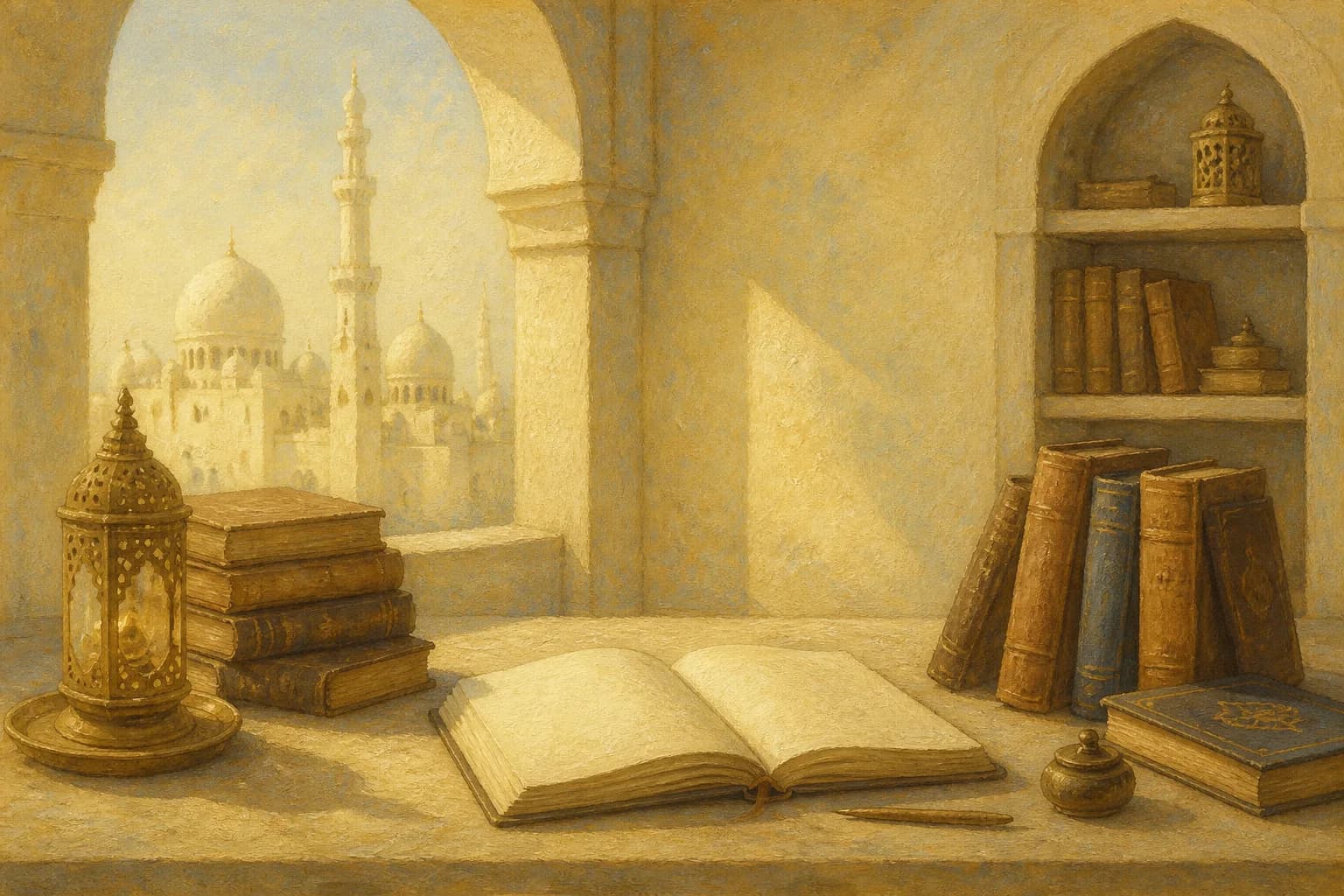

The phrase "golden Islam" carries a weight most of us feel before we fully understand it. Something remarkable happened in the Muslim world between the 8th and 13th centuries — a civilization built not on conquest alone but on curiosity, scholarship, and a profound conviction that understanding the world was itself a form of worship.
Most accounts of the Islamic golden age focus on what it produced: algebra, the decimal number system, systematic medicine, the scientific method applied to optics. These achievements are real and extraordinary. But the more important question is why. What made this civilization golden? What values animated the scholars who founded algebra and mapped the stars?
That question is not only historical. Understanding what made this era golden is directly relevant to how you live as a Muslim today.
What Is Golden Islam?
Golden Islam refers to the Islamic Golden Age, roughly 750 to 1258 CE, when Muslim civilization led the world in science, medicine, mathematics, and philosophy. The age was grounded in the Quranic command "Read in the name of your Lord who created" (Surah Al-Alaq, 96:1) — a directive that scholars at Baghdad's House of Wisdom took not as metaphor but as mission, producing advances that shaped European universities and the foundations of modern science.
What Made This Era Truly Golden?
The most important thing to understand about golden Islam is that its intellectual achievements were not separate from Islamic practice — they grew out of it.
The Quran speaks about knowledge and reflection in various forms hundreds of times. It asks repeatedly, afa-la ta'qilun — "Will you not reason?" It states clearly: "Say: are those who know equal to those who do not know?" (Surah Az-Zumar, 39:9). The Prophet Muhammad ﷺ placed seeking knowledge at the heart of Muslim identity: "Seeking knowledge is an obligation upon every Muslim" (Ibn Majah 224, sunnah.com).
This Quranic environment produced the golden age. When the first revealed word — Iqra (اقرأ), "Read" — commands active engagement with the world, the community that takes that command seriously will learn, explore, and build.
The House of Wisdom (Bayt al-Hikmah, بيت الحكمة) in Baghdad was founded on the conviction that understanding any discipline — mathematics, medicine, astronomy — was an act of reading the signs (ayat) of Allah in creation. The scholars who worked there were not secularists who happened to be Muslim. They were believers who considered their research worship.
Read the full Iqra verse at Quran.com.
The Islamic Civilization Golden Age article covers the specific achievements and institutions in detail. And the Famous Muslims in History article profiles key individuals who defined this era.
Why Does Golden Islam Matter to You Right Now?
There is a widespread assumption among modern Muslims that faith and intellectual achievement belong to separate worlds — that religion is for the masjid and professional life operates by different rules.
Golden Islam completely demolishes this assumption. The scholars who defined this era worked at the precise intersection of faith and inquiry. Their Muslim identity was not incidental to their achievements — it was the source of their motivation.
Ibn Sina (Avicenna) began his major works with bismillah. Al-Khwarizmi framed his foundational algebra text as a practical gift to the Muslim community — originally developed for inheritance calculation, land measurement, and trade. Al-Idrisi's mapmaking was explicitly oriented by the conviction that understanding the earth was an act of devotion.
The divide between "being a good Muslim" and "contributing to your field" is not Islamic. It is modern. Golden Islam shows what a civilization looks like when that divide does not exist.
How Can You Carry the Spirit of Golden Islam Into Daily Life?
The scholars of the golden age were not extraordinary because of rare talent alone. They were embedded in communities, practices, and a Quranic framework that oriented everything they did toward knowledge and benefit.
Here is a reference to who they were and what they built — and what it means for your own field:
| Scholar | Era | Field | Key Contribution |
|---|---|---|---|
| Al-Khwarizmi | 780–850 CE | Mathematics | Founded algebra; his name gave us the word algorithm |
| Ibn Sina (Avicenna) | 980–1037 CE | Medicine | Canon of Medicine taught in European universities for 500 years |
| Ibn al-Haytham | 965–1040 CE | Optics | Founded the modern scientific method; first accurate theory of vision |
| Al-Razi | 854–925 CE | Medicine | First clinical descriptions of smallpox and measles |
| Al-Biruni | 973–1048 CE | Geography/Astronomy | Calculated Earth's circumference with remarkable precision |
Each of these scholars was working within a community that valued what they did. Here is how to build a version of that context in your own life:
Set an intention before learning. Before you study, research, or work, make a niyyah (نية, intention) that this effort is for the benefit of others and for the sake of Allah. This single act transforms purposeless effort into an act of worship — which is exactly how the golden age scholars framed their work.
Engage the Quran as a text that demands thought. The golden age scholars did not read the Quran passively. They read it actively, asking what each verse reveals about the nature of creation. Reading with a commentary (tafsir) once a week builds this habit over time.
Connect your field to the broader community. Al-Khwarizmi developed algebra for practical Islamic community needs. Whatever you do professionally, ask: how does this benefit the ummah? That question is the difference between a career and a contribution.
Build habits that sustain the seeking mind. The prophetic tradition connects remembrance of Allah to clarity of thought and purpose. Morning adhkar, daily Quran reading, and reflection are not separate from intellectual work — they sustain it.
The DeenBack guide to the companions of the Prophet is worth reading here. The sahabah built a community organized around mutual teaching and learning, and their model remains the clearest template for what Islamic intellectual community looks like in practice.
Still searching for a clear Islamic answer?
Explore sourced answers rooted in the Quran, authentic hadith, and respected scholarship—without getting lost in conflicting search results.
Take the Islam Quiz
For a broader perspective on what the companions modeled about learning and faith, the Demi Manifest exploration of lessons from the companions offers a thoughtful companion read.
How Do You Know the Spirit Is Alive in You?
The spirit of golden Islam is present in your life when:
- You enter your professional or academic work with a clear sense of purpose beyond personal gain
- Your curiosity about the world connects naturally to reflection on Allah's creation
- You seek out knowledge beyond what your immediate responsibilities require
- You share what you learn — mentoring or teaching wherever that is possible
- You make niyyah before study, and you feel the difference that intention makes
None of these require you to become a medieval scholar. They require taking the same Quranic commands seriously that the golden age scholars took seriously: that knowledge is an obligation, that reflection is worship, and that contributing to human benefit is one of the clearest expressions of Islamic values.
The Importance of Seeking Knowledge in Islam covers this obligation in depth. And The Early Muslim Community shows what a society built around shared learning actually looked like in its first generation.
For contemporary Islamic scholarship that bridges this historical tradition with modern questions, the Yaqeen Institute is an excellent ongoing resource.
Golden Islam is not a closed chapter. The values that produced it — a community that treated seeking knowledge as worship, connected faith to intellectual contribution, and grounded every discipline in Quranic orientation — are still available to every Muslim.
The House of Wisdom no longer stands. But the Quran that inspired it remains unchanged. The command that launched this golden era — Iqra — is addressed to you as surely as it was addressed to the scholars of Baghdad.
Still searching for a clear Islamic answer?
Explore sourced answers rooted in the Quran, authentic hadith, and respected scholarship—without getting lost in conflicting search results.
Take the Islam QuizFrequently Asked Questions
What does golden Islam mean?
Golden Islam refers to the Islamic Golden Age, roughly 750–1258 CE, when Muslim civilization led the world in science, medicine, mathematics, and philosophy. Rooted in the Quranic command to seek knowledge, Muslim scholars produced foundational advances in algebra, optics, and medicine that shaped the modern world.
Why was Islamic civilization called golden?
Islamic civilization was called golden because it united spiritual and intellectual excellence. The Quran commands believers to reflect, read, and reason. Scholars treated learning as worship, and the Abbasid caliphate created institutions like the House of Wisdom that drew the world's brightest minds to Baghdad.
Who are the most famous scholars of golden Islam?
The most famous scholars of golden Islam include Al-Khwarizmi (founder of algebra), Ibn Sina (whose Canon of Medicine guided European medicine for five centuries), Ibn al-Haytham (who established optical science), Al-Razi (who first described smallpox), and Al-Biruni (mathematician and geographer).
How long did golden Islam last?
Golden Islam lasted roughly five centuries, from approximately 750 CE, when the Abbasid Caliphate established the House of Wisdom in Baghdad, to 1258 CE, when the Mongols sacked Baghdad. Some scholars extend this era to include Andalusian and Persian scholarship through the 15th century.
What does golden Islam teach modern Muslims?
Golden Islam teaches modern Muslims that faith and intellect reinforce each other. The same Quran that inspired Al-Khwarizmi and Ibn Sina is available today. Treating your learning and professional contribution as an act of worship is the essence of what made that civilization extraordinary.
What ended the golden age of Islam?
The Islamic golden age ended primarily when the Mongols sacked Baghdad in 1258 CE, destroying the House of Wisdom and killing vast numbers of scholars. Internal political fragmentation, reduced patronage of scholarship, and the Crusades also contributed to the decline of this extraordinary era.
Can there be a new golden age of Islam?
Many Islamic scholars believe a revival of Muslim intellectual culture is possible. It requires the same foundation as the original: communities that treat knowledge as worship, support scholars, and ground their contributions in Quranic values rather than separating faith from professional excellence.