

- Authors

- Name
- Ahmad
- Role
- Senior Marketing Manager, Islamic education • DeenUp
بِسْمِ اللهِ الرَّحْمٰنِ الرَّحِيْمِ
In the name of God, the Most Gracious, the Most Merciful.

A child's first full recitation of Surah Al-Fatiha, the moment they bow in salah alongside you for the first time, the day they spontaneously make dua without being prompted — these are milestones Muslim parents carry for life. But in an age of constant distraction, building a meaningful Islamic studies routine for children takes more than good intentions. It takes a plan.
The good news: Islam already has one. Surah Luqman dedicates seven consecutive ayahs to a father teaching his son — from belief in Allah to salah to treating people with patience. That ancient blueprint is still the clearest guide available.
What Are Islamic Studies for Kids?
Islamic studies for kids is a structured curriculum covering the five foundations of faith and practice: Quran recitation (tajweed — التَّجْوِيد), Islamic belief (aqeedah — العَقِيدَة), practical rulings (fiqh), the Prophet's biography (seerah), and Islamic character (adab). These are introduced in age-appropriate stages — from learning the Arabic alphabet at age 4 to understanding fiqh rulings at age 10 — following the Quranic model of Luqman teaching his son across a child's natural stages of development (Surah Luqman, 31:13-19).
Unsure where to start with your own Islamic learning or your family's practice? Take the free DeenUp quiz for a personalised plan grounded in Quran and Sunnah.
Your personal 28-Day Deen Plan
Learn your deen in 28 days, 5 minutes a day
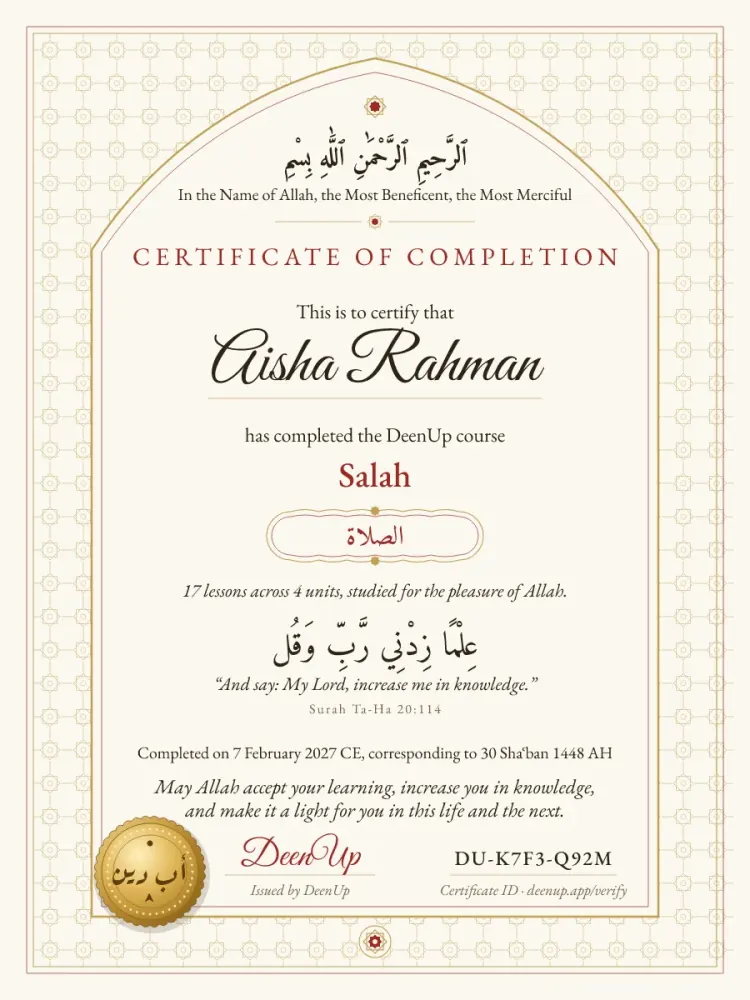
The essentials of salah, fiqh and faith, step by step from authentic sources. Finish all 28 days and earn a verifiable Certificate of Completion.
Take the free quizAnswer a few questions and get your personal plan.
Why Islamic Education Is an Obligation, Not an Option
The Prophet ﷺ said: "Seeking knowledge (العِلْمُ) is an obligation upon every Muslim" (Ibn Majah 224). This is not an aspiration — it is a religious duty that begins in the home, long before any school or madrasah.
Surah Luqman dedicates seven consecutive ayahs (31:13-19) to a father's direct instruction of his son. What does Luqman teach? In sequence: tawhid, gratitude to Allah and parents, awareness that Allah sees all deeds, salah, commanding good and forbidding wrong, and patience under hardship. That sequence — belief, gratitude, accountability, worship, service, resilience — is a child's complete formation.
يَا بُنَيَّ أَقِمِ الصَّلَاةَ وَأْمُرْ بِالْمَعْرُوفِ وَانْهَ عَنِ الْمُنكَرِ وَاصْبِرْ عَلَىٰ مَا أَصَابَكَ
"O my son, establish prayer, enjoin what is right, forbid what is wrong, and be patient over what befalls you." — (Surah Luqman, 31:17)
This is not a checklist for a school exam. It is a father's legacy taught through relationship and repetition.
Five Core Subjects in an Islamic Studies Curriculum for Kids
A well-rounded Islamic education covers these five areas, introduced at the right age and in the right sequence.
| Subject | Arabic Term | What It Covers | When to Start |
|---|---|---|---|
| Quran Recitation | Tajweed | Arabic letters, Quran reading, memorization | Age 4-5 |
| Islamic Belief | Aqeedah | Pillars of Islam, pillars of iman, Allah's names | Age 5-7 |
| Practical Rulings | Fiqh | Wudu, salah, fasting rules, halal and haram basics | Age 7-9 |
| Prophet's Biography | Seerah | Life of the Prophet ﷺ, Companions, Islamic history | Age 6+ |
| Islamic Character | Adab | Manners, honesty, kindness, speech, digital etiquette | From birth |
No subject is learned in isolation. Seerah stories make aqeedah vivid and personal; fiqh gives salah its form; adab turns knowledge into character.
An Age-by-Age Plan for Islamic Studies
Children learn in developmental stages. Forcing advanced material too early produces resistance rather than love.
Ages 3-5: Seeds and Stories
At this age, the most powerful tools are repetition and belonging. Recite Bismillah before every meal together. Listen to Quran recitation in the home and car. Tell simple stories about the Prophet ﷺ as a kind man who loved children and animals.
Formal learning: Arabic letter recognition, Surah Al-Fatiha, Surah Al-Ikhlas, and simple duas for waking, sleeping, and eating. See how to teach Islam to children for a practical week-by-week approach.
Ages 6-9: Practice and Understanding
This is when children approach the age of prayer accountability. The Prophet ﷺ said to command children to pray at age seven and address it gently by ten (Sunan Abu Dawud 495). Focus: joining family salah, learning wudu correctly, memorizing the first ten surahs, and understanding the five pillars.
The key shift here is from performance to meaning — not just reciting Al-Fatiha, but knowing what "Guide us to the straight path" actually means. For step-by-step guidance, see introducing salah to kids and Quran learning for kids.
The duas to teach children collection is a practical companion for this stage — supplications that fit the natural moments of a child's day.
Ages 10-13: Deepening and Ownership
Children this age can read Quran independently with tajweed and understand fiqh rulings at a practical level. Introduce the conditions of valid salah, zakat basics, and fasting preparation. Begin reading seerah in depth — the Hijra, the battles, the Farewell Sermon.
For the full picture of daily Quranic recitation as a habit, benefits of reading Quran daily gives both the evidence and practical guidance.
Ages 14+: Scholarship and Service
Teenagers can engage with tafsir, fiqh differences between madhabs, and contemporary Islamic ethics. At this stage, the goal is a young Muslim who can reason from Islamic principles, not simply recall rules — the living purpose behind the importance of seeking knowledge in Islam.
How to Build a Daily Islamic Learning Habit at Home
Consistency beats intensity every time. The Prophet ﷺ said the most beloved deeds to Allah are the most regular, even if small (Sahih al-Bukhari 6464). Five focused minutes at the same time daily builds more than an occasional hour-long session.
Practical daily anchors:
- After Fajr: one new Arabic letter or one dua revision
- At every meal: Bismillah before and Alhamdulillah after as a family habit
- At bedtime: one seerah story or one Quran ayah with its meaning
- At prayer times: children watch and join salah — the most effective teaching is imitation
The goal is not a child who knows every ruling. It is a child who loves Allah and returns to His guidance when life is hard. DeenBack's reflection on relying on Allah through difficulty captures this well — tawakkul grows from knowledge, and knowledge grows from daily habit.
For parents navigating Islamic parenting decisions, parenting in Islam offers a broader framework rooted in the Prophetic model.
Signs of Progress in a Child's Islamic Education
Progress is not always a full surah memorized or a perfect salah. Watch for:
- Spontaneous duas — a child making dua without being prompted is the clearest sign
- Connecting knowledge to life — asking "Should we say Bismillah before this?" shows internalization
- Genuine curiosity — questions about Islamic rulings signal an engaged learner, not a bored one
- Character changes — more patience, honesty, and care for siblings
As Demi Manifest reflects in facing adversity with faith, the best measure of Islamic education is not what a child recites but how they respond when life gets hard. Build the knowledge; Allah plants the love.
Looking to deepen your own Islamic learning alongside your children? Start the free DeenUp quiz to discover where your practice is strong and where daily study would make the biggest difference for you.
Your personal 28-Day Deen Plan
Learn your deen in 28 days, 5 minutes a day
The essentials of salah, fiqh and faith, step by step from authentic sources. Finish all 28 days and earn a verifiable Certificate of Completion.
Take the free quizAnswer a few questions and get your personal plan.
Frequently Asked Questions
What subjects are included in Islamic studies for kids?
Islamic studies for kids covers five core areas: Quran recitation and memorization, aqeedah (the pillars of Islam and iman), fiqh (practical rulings like wudu and salah), seerah (the Prophet's biography), and adab (Islamic character). Subjects are introduced gradually and made concrete through stories and lived practice at each child's developmental stage.
What age should Islamic education begin for children?
Islamic education begins at birth — the adhan is recited into a newborn ear as the first word they hear. Structured learning starts at age 4 to 5 with the Arabic alphabet, Surah Al-Fatiha, and simple duas. Formal aqeedah and fiqh lessons suit ages 7 to 9, when children approach the age of prayer accountability.
How can I teach Islamic studies to my child at home?
Teach Islamic studies at home through short daily sessions of five to fifteen minutes tied to prayer times. Pray alongside your child, recite duas at their natural moments, and read seerah stories at bedtime. Keep sessions positive and celebratory — a joyful ten-minute habit sustained daily builds far more than an occasional stressful hour.
Is a madrasah necessary or can parents handle Islamic studies?
Both work and many families combine them. A qualified teacher provides structured tajweed and accountability that untrained parents find difficult to offer alone. However, Surah Luqman (31:13) models a father teaching his son directly — parents are primary Islamic educators. Home reinforcement of madrasah lessons dramatically increases long-term retention and love of the deen.
What is the most important subject to teach first in Islamic studies?
Begin with love of Allah and trust in His goodness, not rules. Scholars recommend teaching the shahada and its meaning first, then the names and attributes of Allah, then Prophet Muhammad stories. When a child is attached to Allah from the start, the pillars of salah, fasting, and zakat become joyful expressions rather than external obligations.
How do I keep my child engaged in Islamic studies?
Children stay engaged when Islamic knowledge connects to daily life: reciting Bismillah before meals, making dua in the rain, knowing the Prophet's stories and character. Use visual progress charts, celebrate every surah memorized, and vary the format between stories, recitation, and discussion. Never link Islamic learning to punishment — positive emotional association shapes a lifetime of practice.
What online Islamic studies platforms work well for children?
Look for platforms offering structured one-on-one sessions in Quranic Arabic and tajweed with qualified teachers. Key factors include age-appropriate lesson length (ten to twenty minutes), positive reinforcement systems, and bilingual teachers. DeenUp also provides daily Quranic verses and duas the whole family can reflect on together — a gentle daily Islamic touchpoint at home.