

- Authors

- Name
- Ahmad
- Role
- Senior Marketing Manager, Islamic education • DeenUp
بِسْمِ اللهِ الرَّحْمٰنِ الرَّحِيْمِ
In the name of God, the Most Gracious, the Most Merciful.
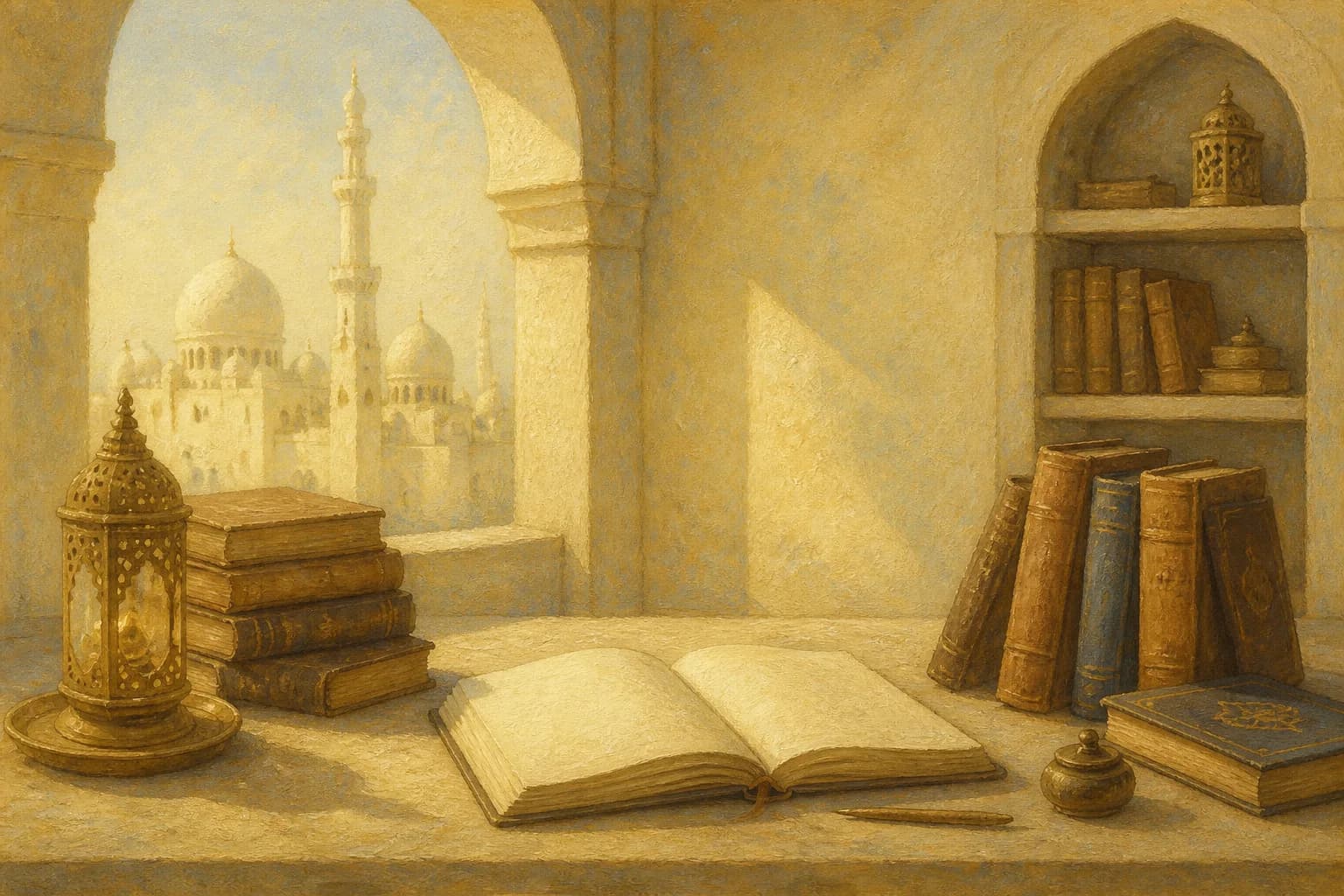

There is a period of history that most Muslims know exists but few have explored in depth — five centuries during which Islamic civilization produced scientific breakthroughs that the rest of the world would not independently reach for hundreds of years. This was not coincidence. It was the direct result of a faith tradition that commanded its followers to read, reflect, and understand the universe Allah had created.
What Were the Most Important Muslim Golden Age Inventions?
The Islamic Golden Age (roughly 750–1258 CE) produced foundational contributions to algebra, optics, medicine, surgery, and astronomy. Al-Khwarizmi of Baghdad gave the world algebra and the concept of the algorithm around 820 CE. Ibn al-Haytham of Basra discovered how vision works and invented the first camera obscura around 1021 CE. Al-Zahrawi of Cordoba wrote a 30-volume surgical encyclopedia and designed instruments surgeons still recognize today. These are not footnotes — they are the foundations of modern science.
The Quran as the Engine of Inquiry
The very first word of Quranic revelation was a command to seek knowledge:
اقْرَأْ بِاسْمِ رَبِّكَ الَّذِي خَلَقَ
Iqraʾ bi-ismi Rabbika alladhī khalaq
"Read in the name of your Lord who created." — (Surah Al-Alaq, 96:1)
The Prophet ﷺ reinforced this: "Seeking knowledge is an obligation upon every Muslim." (Sunan Ibn Majah 224)
For early Muslim scholars, studying the natural world was not a secular distraction from faith — it was a form of worship. Understanding creation meant understanding the Creator. This theological foundation is why the Islamic Golden Age was not a brief flash but a sustained, organized intellectual movement lasting five centuries.
Key Muslim Golden Age Inventions — A Reference Table
| Invention / Contribution | Scholar | Period | Legacy |
|---|---|---|---|
| Algebra | Al-Khwarizmi | ~820 CE | The word "algebra" comes from his book title al-Jabr; "algorithm" from his latinized name |
| Optics and camera obscura | Ibn al-Haytham | ~1021 CE | First systematic study of how vision works; foundation of modern optics and photography |
| Modern surgery | Al-Zahrawi | ~1000 CE | 200+ surgical instruments, techniques used in European medicine for 500+ years |
| Canon of Medicine | Ibn Sina (Avicenna) | ~1025 CE | Standard medical textbook in Europe until the 17th century |
| Precise astronomy | Al-Battani | ~900 CE | Calculated the solar year to within 2 minutes of today's figure |
| Earth's circumference | Al-Biruni | ~1030 CE | Estimated within 1% of modern measurement using trigonometry |
| First public hospitals | Abbasid Caliphate | 805 CE | Bimaristan hospitals with wards, pharmacies, and medical training |
| Coffee | Yemen / Islamic world | ~1450 CE | Coffee houses (qahwa) spread knowledge and conversation across the Muslim world |
Al-Khwarizmi: The Father of Algebra
Muhammad ibn Musa al-Khwarizmi (c. 780–850 CE) was a scholar at the Bayt al-Hikmah (House of Wisdom) in Baghdad. Around 820 CE, he wrote Kitāb al-mukhtasar fī hisāb al-jabr wal-muqābala — the first systematic algebra textbook.
The title's phrase al-jabr (meaning "completion" or "restoring balance") gave European mathematicians the word algebra when the text was translated into Latin. Al-Khwarizmi's own name, latinized as Algoritmi, gave us the word algorithm. Every time a smartphone runs a search, a bank processes a transaction, or a doctor calculates a dosage, it uses a conceptual framework that traces back to a Muslim scholar in 9th-century Baghdad.
Ibn al-Haytham: The Father of Optics
Abu Ali al-Hasan ibn al-Haytham (965–1040 CE), known in the West as Alhazen, was born in Basra (modern Iraq). His seven-volume Kitāb al-Manāzir (Book of Optics, completed c. 1021 CE) overturned a thousand years of Greek theory.
Where ancient philosophers believed the eye emitted light to see, Ibn al-Haytham proved through experiment that light entered the eye from external objects. He built the first camera obscura (dark room) to demonstrate how images form — the direct predecessor of the modern camera. He also articulated what we now call the scientific method: form a hypothesis, test it by observation, revise it. Europe rediscovered these ideas via Latin translation 200 years after his death.
Al-Zahrawi: The Father of Modern Surgery
Abu al-Qasim al-Zahrawi (936–1013 CE), known in the West as Abulcasis, was born in Cordoba, al-Andalus (modern Spain). His 30-volume encyclopedia Kitāb al-Tasrīf included surgical procedures and detailed illustrations of over 200 instruments he designed — including the surgical needle, the scalpel, and the catgut suture for internal wounds.
European medical schools used translations of al-Zahrawi's work as their standard surgical reference until the Renaissance. Surgeons at major hospitals today still use instruments that are functionally identical to designs he documented in 10th-century Cordoba.
The House of Wisdom — Islam's Greatest Institution of Learning
The Bayt al-Hikmah (House of Wisdom) in Baghdad was established under Caliph Harun al-Rashid around 830 CE and reached its peak under Caliph al-Mamun. It was simultaneously a library, translation bureau, and research academy — the most concentrated gathering of scholars the medieval world had ever seen.
Scholars translated Aristotle, Galen, Ptolemy, Archimedes, and Indian and Persian mathematical texts — but crucially, they did not simply preserve. They extended, corrected, and built on what they found. Al-Khwarizmi worked here. So did translators, astronomers, and physicians from across the Muslim world.
When Baghdad fell to the Mongols in 1258 CE, eyewitnesses described the Tigris River running black with ink from hundreds of thousands of manuscripts thrown into the water. Much was lost. What survived, through copies in Cairo, Cordoba, and elsewhere, became the basis for the European Renaissance.
Still searching for a clear Islamic answer?
Explore sourced answers rooted in the Quran, authentic hadith, and respected scholarship—without getting lost in conflicting search results.
Take the Islam Quiz
What Drove This Extraordinary Period?
Three factors aligned to produce the Islamic Golden Age:
Faith as motivation. The Quran explicitly commands reflection on the natural world (Surah Al-Imran, 3:190-191). Scholars like Ibn Sina wrote that seeking medicine to heal the sick was itself a religious duty. The boundary between deen and dunya was, for them, not a wall.
Institutional support. The Abbasid Caliphate funded translation projects, built the House of Wisdom, and created a system of patronage that allowed scholars to dedicate entire lives to research. The state understood that intellectual investment was strategic power.
Synthesis across cultures. Muslim scholars actively sought Greek, Indian, and Persian knowledge and built on it — rather than dismissing non-Muslim sources. The hadith tradition of learning even from distant lands (Utlub al-ʿilm walaw bil-ṣīn — "Seek knowledge even unto China") shaped an open intellectual culture.
What This Means for Muslims Today
The Islamic Golden Age is not nostalgia. It is a theological statement about what faith can build when it takes its own commands seriously. The Quran that commanded Iqraʾ — Read — was not speaking only to the Prophet ﷺ. It was speaking to every Muslim across every generation.
Modern Muslims navigating demanding careers, raising children, and seeking answers to difficult questions can draw on this tradition. Pursuing education, supporting scientific research, and engaging with knowledge — all of these are acts of faith, not distractions from it.
For more on the historical legacy of Muslim civilization, see our guides on the Islamic Golden Age, Islamic civilization and its contributions, and the famous Muslims who shaped history. For profiles of the scholars involved, our Islamic scientists article covers key figures in more depth.
The DeenBack article on seeking Islamic knowledge explores how the prophetic tradition of knowledge-seeking applies to everyday Muslim life today. For a reflection on how Islamic values around purpose and learning shape a meaningful modern life, the Demi Manifest post on Islamic purpose and clarity is worth reading.
For primary sources on the scholars mentioned, the History of Science Museum at Oxford has a detailed overview of Islamic Golden Age science, and Yaqeen Institute's paper on Islam and the intellectual tradition examines the theological foundations of Muslim scholarship. The Quran.com entry for Surah Al-Alaq (96) places the first revelation in its context as a command to knowledge.
Still searching for a clear Islamic answer?
Explore sourced answers rooted in the Quran, authentic hadith, and respected scholarship—without getting lost in conflicting search results.
Take the Islam QuizFrequently Asked Questions
What did Muslim scholars invent during the Islamic Golden Age?
Muslim scholars during the Islamic Golden Age (8th–13th centuries CE) invented algebra, advanced optics, modern surgical techniques, and the first public hospitals. Al-Khwarizmi gave us algebra and algorithms, Ibn al-Haytham pioneered optics, and Al-Zahrawi developed over 200 surgical instruments still recognizable today.
When was the Islamic Golden Age?
The Islamic Golden Age spanned roughly from the 8th to the 13th century CE — from the rise of the Abbasid Caliphate around 750 CE through the Mongol sack of Baghdad in 1258 CE. This five-century period saw extraordinary advances in mathematics, medicine, astronomy, chemistry, and philosophy centered in Baghdad, Cairo, and Cordoba.
Who were the most important Muslim inventors and scientists?
The most important Muslim inventors include Al-Khwarizmi (algebra and algorithms), Ibn al-Haytham (optics and the scientific method), Al-Zahrawi (modern surgery), Ibn Sina or Avicenna (the Canon of Medicine), Al-Biruni (geodesy and earth science), and Al-Battani (precise astronomical calculations). Their works were translated into Latin and shaped European science for centuries.
What Islamic values drove Muslim scientific achievement?
Muslim scientific achievement was driven by the Quranic command to read and reflect — Surah Al-Alaq (96:1) opens with the word Iqra (Read). The Prophet ﷺ taught that seeking knowledge is obligatory for every Muslim (Ibn Majah 224). Scholars saw understanding creation as an act of worship, not a secular pursuit.
Did Islam contribute to mathematics and astronomy?
Yes, Islam contributed foundational work to both. Al-Khwarizmi wrote the first algebra textbook around 820 CE; the word algorithm comes from his latinized name. Al-Battani calculated the solar year to within seconds of modern measurements. Al-Biruni estimated the Earth's circumference to within 1 percent of the modern figure — in the 11th century CE.
What was the House of Wisdom in Baghdad?
The House of Wisdom (Bayt al-Hikmah) was a major intellectual center in Baghdad established under the Abbasid Caliph Harun al-Rashid and greatly expanded by al-Mamun (reigned 813–833 CE). Scholars from across the Muslim world — and beyond — translated Greek, Persian, and Indian texts and built on them. It became the largest repository of books in the world at that time.
Why should modern Muslims care about Islamic Golden Age achievements?
Islamic Golden Age achievements remind modern Muslims that faith and intellectual pursuit are not in conflict — they reinforce each other. The scholars who built algebra, mapped the stars, and wrote surgical manuals did so as acts of worship. Reconnecting with this heritage helps Muslims see knowledge-seeking as a living part of their deen, not just history.