

- Authors

- Name
- Ahmad
- Role
- Senior Marketing Manager, Islamic education • DeenUp
بِسْمِ اللهِ الرَّحْمٰنِ الرَّحِيْمِ
In the name of God, the Most Gracious, the Most Merciful.
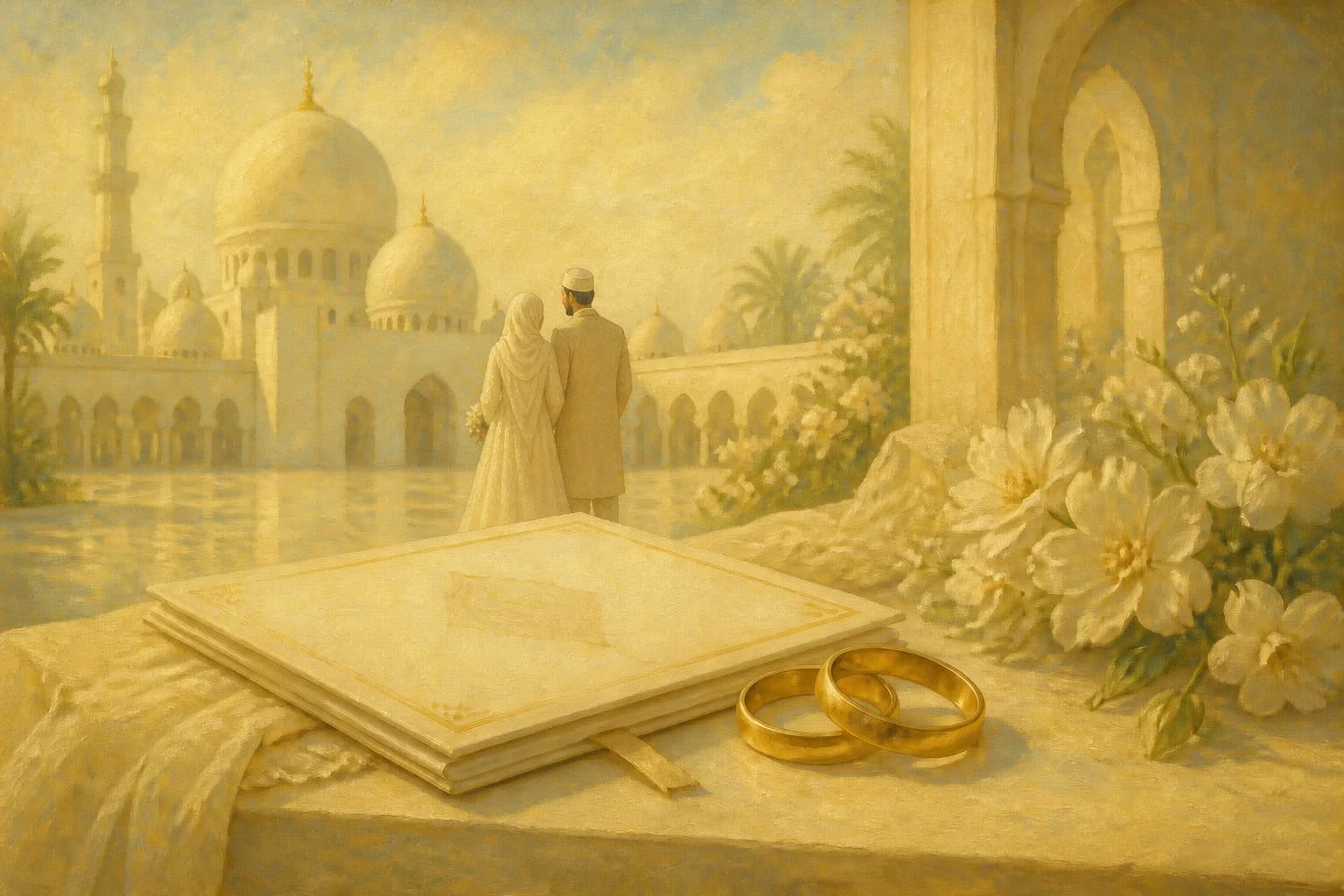

A Muslim wedding is more than a celebration — it is a sacred covenant, the beginning of what the Quran describes as a relationship built on tranquillity, affection, and mercy. Yet for many Muslims, especially those raised in cultures where Islamic and local traditions blend together, it can be difficult to know what is actually required versus what is cultural custom.
This guide walks through the core components of an authentic Islamic wedding: the nikah, the mahr, and the walima — and how to honour each while navigating the real pressures of planning a wedding in the modern world.
The Nikah: The Contract That Makes It Official
النِّكَاح (nikah) is the marriage contract at the heart of every Islamic wedding. Without it, there is no Islamic marriage — regardless of how elaborate the celebration around it.
The nikah requires four elements:
- Offer and acceptance (ijab wa qabool): Both parties state their agreement clearly and freely
- Mahr: The bridal gift from groom to bride
- Two adult Muslim witnesses
- Wali: The bride's guardian — required by the majority of scholars, with the Hanafi school holding a different view
The nikah can be conducted in a mosque, a home, or any lawful setting. Many scholars recommend the mosque, as the Prophet ﷺ encouraged making the marriage public and witnessed by the community. A nikah conducted quietly with the proper conditions in place is just as valid as one held in a grand hall.
The Quran is direct about the rights of the bride within this contract:
"And give women their bridal gifts graciously." (Surah An-Nisa, 4:4)
Before the ceremony arrives, it is worth spending time in sincere supplication. The dua for a marriage proposal and the dua for a good spouse are authentic Prophetic supplications that many Muslims find deeply helpful in the period before nikah.
Mahr and the Walima: Two Pillars of Islamic Marriage
Mahr — مَهْر — is the mandatory gift the groom gives the bride as her exclusive right within the marriage contract. It is not a bride price, not a payment to her family, and not a symbolic gesture. It is a real financial right that belongs to the bride alone — which she can spend, save, or gift entirely as she sees fit.
The amount is determined by mutual agreement. Scholars across all four major schools consistently emphasize that a high mahr does not make a nikah more valid or more blessed. The prophetic tradition cautions against making mahr a source of financial competition between families or a burden that delays marriage unnecessarily. The Prophet ﷺ himself conducted nikah ceremonies with mahr as simple as a man teaching a woman what he knew of the Quran, illustrating that the spirit of the gift matters more than its monetary value.
Walima — وَلِيمَة — is the wedding feast that follows the nikah. This is not a cultural addition to Islamic marriage; it is an established Sunnah that the Prophet ﷺ explicitly commanded and personally participated in.
When Abd al-Rahman ibn Awf informed the Prophet ﷺ of his marriage, the response was clear: "Give a walima feast, even if it is only with one sheep." (Sahih al-Bukhari 5168)
The walima serves a spiritual and communal purpose: it announces the marriage publicly, inviting the blessings and prayers of the wider community for the couple. Scholars agree it should take place within three days of the nikah, ideally on the first or second day.
Guests who are invited should attend unless they have a genuine excuse — declining without reason is considered disliked in Islamic law. The walima is also meant to be inclusive. Narrations specifically note the disliked nature of walimas that invite only the wealthy. A modest feast that includes family, neighbors, and those less fortunate is more aligned with the Sunnah than an exclusive reception focused on appearances.
Muslim Wedding Customs Around the World
The nikah and walima are universal. The cultural traditions layered over them vary enormously across the global ummah — and that diversity reflects the breadth of Islam.
South Asian weddings often include the mehndi (henna) night, the baraat (groom's procession), and elaborate gift exchanges between families. Arab and Gulf weddings typically emphasize gender separation in the celebration, with lavish communal feasts. West African Muslim weddings may feature communal processions and shared meals that draw in the entire neighborhood. Turkish and Central Asian traditions bring distinctive pre- and post-nikah customs that vary by region.
The governing principle is that cultural practices are permissible unless they contradict Islamic rulings — such as the uncontrolled mixing of unrelated men and women, consumption of alcohol, or entertainment that crosses into what is clearly prohibited.
For guidance on Islamic dress at weddings, our article on modest dress in Islam covers the core principles clearly. Many brides and guests also have specific questions about Islamic guidelines on beauty practices — from henna to jewelry. Deen Back's guide on Islamic rulings around body adornment provides helpful perspective grounded in scholarship.
Planning an Islamic Wedding in the Modern World
The gap between ideal and reality is real. Family pressures, financial expectations, competing cultural traditions, and conflicting advice from relatives can make planning feel overwhelming. Here are principles grounded in Islamic scholarship to help navigate it:
Separate what is required from what is cultural. The nikah and walima are Islamic requirements. The type of dress, the food, the decorations, the venue — these have significant room for cultural expression within Islamic principles.
Protect the nikah from unnecessary delay. The prophetic guidance consistently encourages those who are ready not to postpone marriage without genuine reason. If you find yourself indefinitely putting off this step, that hesitation is worth examining honestly.
Guard against haram in celebrations. Immodest dancing, alcohol, and uncontrolled gender mixing are common pressures at modern Muslim weddings. Knowing your positions clearly in advance — and communicating them calmly to family before the day — is far easier than trying to manage these situations in the moment.
Make dua throughout the entire process. Learning how to make dua properly is often overlooked during wedding planning, but this is precisely when sincere supplication matters most. Ask Allah for clarity, ease, and barakah at every stage.
For deeper scholarly guidance on the specific conditions and rulings of nikah, Seekers Guidance's marriage and family archive contains answers from certified scholars on virtually every practical question a couple might have.
Ready to seek marriage?
Explore Quran- and Sunnah-grounded guidance for choosing a spouse, understanding rights, communicating well, and handling difficult decisions.
Take the Marriage Quiz
The Spiritual Purpose of a Muslim Wedding
The Quran frames the entire institution of marriage as one of Allah's most profound signs:
"And of His signs is that He created for you from yourselves mates that you may find tranquillity in them; and He placed between you affection and mercy. Indeed in that are signs for a people who give thought." (Surah Ar-Rum, 30:21)
The Arabic word used for tranquillity — سَكِينَة (sakinah) — carries connotations of divine peace and settling. Marriage in Islam is meant to be a place of spiritual rest, not merely a social arrangement or a life milestone to be checked off.
This spiritual framing shapes everything: the niyyah (intention) with which the nikah is entered, the way spouses treat each other in daily life, and the home they build together. The Prophet ﷺ said: "The most complete of the believers in faith is the one with the best character, and the best of you are the best to your wives." (Tirmidhi 1162)
A couple who begins with a nikah that honors these principles — and who makes consistent dua together — builds a foundation that outlasts any celebration.
Signs of a Marriage Built on Islamic Foundations
A marriage grounded in Islamic principles tends to reveal certain qualities over time. These are not distant ideals — they are practical outcomes of beginning with the right intention and maintaining it:
- Both spouses remind each other of Allah naturally, without lecturing
- Disagreements are handled with the sabr the Quran commands and the rahmah the Prophet ﷺ consistently modeled
- The home is a place where the Quran is recited and morning and evening adhkar are made together
- Both spouses see their marriage as a shared path toward Jannah — not only a partnership for this life
For greetings and etiquette at wedding gatherings, our guide on Islamic greetings and etiquette covers the Prophetic Sunnah in practical detail.
Common Questions About Muslim Wedding Traditions
Can we have music at an Islamic wedding? Scholars differ on this. Most permit the daff (hand drum) for announcing and celebrating marriages, with women singing in gender-appropriate settings. They differ on modern instrumental music. The clearest guideline is to avoid music with indecent lyrics or that leads to prohibited conduct.
Is a civil marriage also necessary? In most countries, the civil registration is separate from the nikah and required for legal recognition. The Islamic nikah is the spiritual and religious contract; the civil registration is required by the state. Both should ideally be completed together.
What if family pressures us to include un-Islamic elements? This is among the most common practical challenges Muslim couples face. Scholars consistently advise maintaining Islamic requirements while showing patience and respect toward family. Clear, calm communication early in the planning process — not confrontations on the day itself — is the most effective approach.
Marriage is one of the greatest gifts in this life and one of the most solemn covenants before Allah ﷻ. May every couple who reads this find ease in their nikah and grow together in faith and mercy.
Ready to seek marriage?
Explore Quran- and Sunnah-grounded guidance for choosing a spouse, understanding rights, communicating well, and handling difficult decisions.
Take the Marriage QuizFrequently Asked Questions
What is the nikah ceremony in Islam?
The nikah is the Islamic marriage contract. It requires the free consent of both parties, the mahr (bridal gift), two Muslim witnesses, and in most scholarly views a wali (guardian for the bride). Once completed, the couple is lawfully married in the sight of Allah.
Is the walima feast obligatory?
Most scholars consider the walima a confirmed Sunnah — highly recommended and not to be abandoned without cause. The Prophet commanded and celebrated it himself. Some scholars hold it obligatory; others hold it strongly recommended.
What is mahr and how is it determined?
Mahr is the mandatory gift given by the groom to the bride as part of the marriage contract. It belongs exclusively to her. The amount is agreed upon by both parties; scholars recommend keeping it modest so it does not burden the groom or create rivalry between families.
Do I need a wali for an Islamic nikah?
The majority of scholars (Shafi, Hanbali, Maliki) require a wali for the bride. The Hanafi school permits a woman to contract her own nikah. If no guardian is available, a local imam or Islamic judge can fulfill this role.
What should guests wear to a Muslim wedding?
Guests should dress modestly according to Islamic guidelines, covering the awrah and avoiding ostentatious or revealing clothing. Cultural traditions vary widely, but the principle of modesty applies throughout the celebration.