

- Authors

- Name
- Ahmad
- Role
- Senior Marketing Manager, Islamic education • DeenUp
بِسْمِ اللهِ الرَّحْمٰنِ الرَّحِيْمِ
In the name of God, the Most Gracious, the Most Merciful.
Walk into a mosque in Kuala Lumpur and then one in Lagos. Attend Friday prayer in Jakarta and then in London. You will hear the same words — the same opening chapter of the Quran, the same Allahu Akbar — spoken by people whose languages, clothing, and food could not be more different. That is the ummah: a community spanning every continent, rooted in a single faith, expressed through an astonishing diversity of cultures.
How Many Muslims Live Around the World?
There are approximately 1.9 billion Muslims in the world as of 2024, making Islam the second-largest religion globally, practiced by roughly 24% of humanity. According to Pew Research Center projections, the global Muslim population is on track to reach 2.76 billion by 2050. The Muslim community is also one of the youngest demographically, with a median age of 24 — seven years younger than the global median — making it one of the fastest-growing faith communities in the world.
The Geography of the Global Muslim Community
One of the most common misconceptions about Islam is that it is primarily an Arab religion. In fact, Arabs represent fewer than 20% of the world's Muslim population. The majority of Muslims live in the Asia-Pacific region.
| Region | Estimated Muslim Population | Share of Global Muslims |
|---|---|---|
| Asia-Pacific | ~1.18 billion | ~62% |
| Middle East & North Africa | ~381 million | ~20% |
| Sub-Saharan Africa | ~248 million | ~13% |
| Europe | ~44 million | ~2.3% |
| Americas | ~8 million | ~0.4% |
The five most populous Muslim-majority countries are Indonesia (~230 million), Pakistan (~220 million), Bangladesh (~150 million), Nigeria (~100 million), and Egypt (~90 million). None of these are Arab-majority nations except Egypt. India, while a Hindu-majority country, has a Muslim population of approximately 200 million — the third-largest in the world.
This geographic spread is not an accident of history but a testament to the faith's reach across fourteen centuries of expansion through trade routes, scholarship, and spiritual encounter.
What Is the Ummah in Islam?
The concept of the ummah (أُمَّة) is central to understanding why these vastly different peoples form one community. The word appears frequently in the Quran and means a community united by shared purpose, values, and allegiance.
Allah describes the Muslim community in Surah Al-Imran (3:110):
كُنتُمْ خَيْرَ أُمَّةٍ أُخْرِجَتْ لِلنَّاسِ تَأْمُرُونَ بِالْمَعْرُوفِ وَتَنْهَوْنَ عَنِ الْمُنكَرِ
"You are the best nation raised for humanity — you enjoin what is right, forbid what is wrong, and believe in Allah."
And in Surah Al-Baqarah (2:143), Muslims are described as:
وَكَذَٰلِكَ جَعَلْنَاكُمْ أُمَّةً وَسَطًا
"And thus We have made you a middle community (ummatan wasatan) — balanced, witnesses over people."
The Prophet Muhammad ﷺ made the ethnic and national diversity of this community explicit in his Farewell Sermon, delivered at Arafat in 10 AH (632 CE): "No Arab has superiority over a non-Arab, nor does a non-Arab have superiority over an Arab; nor does a white person have superiority over a black person, or a black person over a white person — except through taqwa (God-consciousness)." (Musnad Ahmad 23489)
For a deeper look at this concept, see our article on what is the ummah in Islam.
What Unites Muslims Across Cultures
Despite profound cultural differences — in language, dress, cuisine, and custom — Muslims around the world share a remarkable set of unifying practices.
The Five Pillars of Islam form the core:
- Shahada (شَهَادَة) — The declaration of faith: "There is no god but Allah, and Muhammad is His Messenger." Every Muslim, from Senegal to Malaysia, enters Islam through these same words.
- Salah — Five daily prayers performed in Arabic, facing the Kaaba in Mecca, at the same prescribed times regardless of time zone.
- Zakat — Obligatory charity at 2.5% of qualifying wealth, binding across all cultures.
- Sawm — Fasting during the month of Ramadan, observed by over a billion people simultaneously.
- Hajj — The pilgrimage to Mecca, which physically unites Muslims from every nation in one place, performing the same rituals.
The Quran in Arabic serves as another unifying thread. Though only about 300–400 million Muslims are native Arabic speakers, nearly 1.9 billion learn to recite it in its original language. The adhan (call to prayer) sounds the same in Cairo and Karachi. The opening chapter, Al-Fatiha, is recited by every Muslim in every prayer, seventeen times daily.
For background on the foundational beliefs shared across this community, see what is Islam and facts about Islam.
The Diversity Within the Ummah
Unity in faith coexists with an extraordinary diversity of expression. Consider:
- Language: Muslims pray and read the Quran in Arabic, but speak over 60 major languages natively — from Urdu to Hausa, from Turkish to Malay.
- Jurisprudence: Four major schools of Islamic law (madhabs) — Hanafi, Maliki, Shafi'i, Hanbali — represent different scholarly traditions, each dominant in different regions.
- Culture: Wedding traditions, food customs, artistic expression, and local practices vary enormously while remaining within Islamic boundaries.
- Sects: The vast majority of Muslims (~87–90%) identify as Sunni; about 10–13% as Shia, with significant concentrations in Iran, Iraq, Azerbaijan, and Lebanon.
This diversity is not a weakness; it reflects the Quranic principle in Surah Al-Hujurat (49:13): "O humanity, We created you from a male and female, and made you into peoples and tribes so that you may know one another." Different cultures are designed to introduce people to each other, not to separate them.
Your personal 28-Day Deen Plan
Learn your deen in 28 days, 5 minutes a day
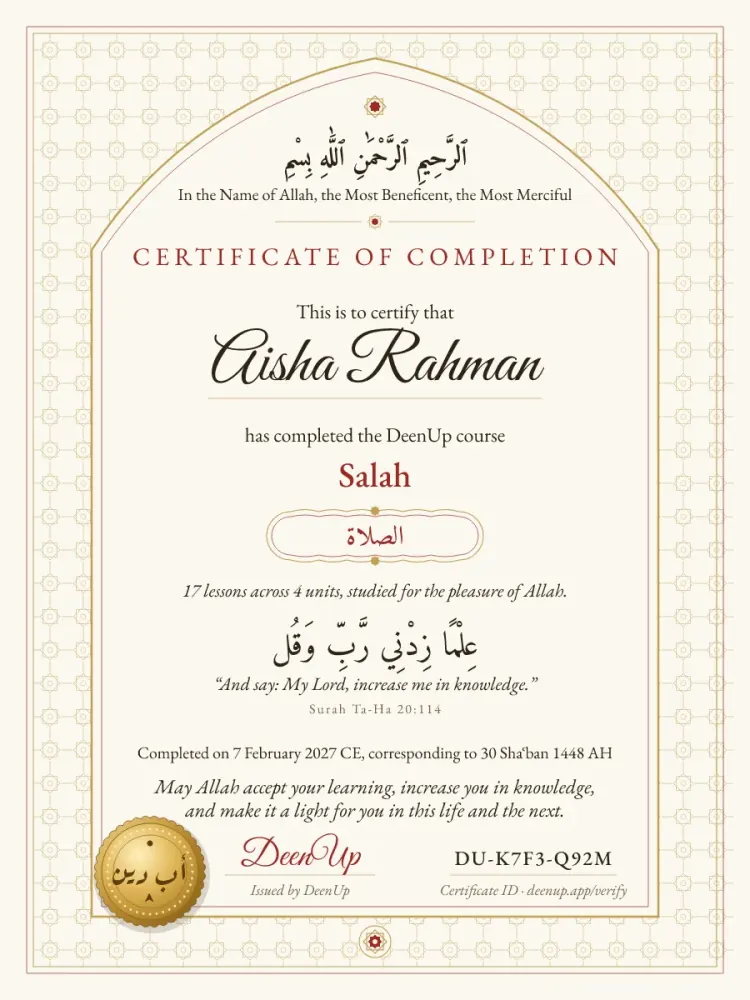
The essentials of salah, fiqh and faith, step by step from authentic sources. Finish all 28 days and earn a verifiable Certificate of Completion.
Take the free quizAnswer a few questions and get your personal plan.
Muslims as Minorities: A Growing Presence
Islam is not only the dominant religion of some 49 countries — it is a growing minority presence in nearly every country on earth.
- France: ~5–6 million Muslims, primarily from North and West Africa, representing about 8–9% of the population
- Germany: ~5 million Muslims, largely from Turkey and the Middle East
- United Kingdom: ~3.9 million Muslims (2021 census), representing 6.5% of England and Wales
- United States: ~3.5–4 million Muslims, the fastest-growing Muslim demographic in the Western world
- China: ~20–25 million Muslims, primarily the Uyghur community in Xinjiang and Hui people across the country
For Muslim minorities, the experience of being a part of the global ummah while navigating daily life in non-Muslim societies is a central spiritual and social reality. It raises questions about identity, practice, and community that the Quran speaks to directly — the concept of being gharib (a stranger in the world) while remaining rooted in faith.
Growth and the Future of the Global Muslim Community
The Pew Research Center's demographic projections tell a striking story. Between 2010 and 2050, the Muslim population is projected to grow by 73% — faster than any other major religious group and faster than the overall global population growth rate of 35%. By 2050:
- Muslims may equal Christianity in total numbers (each at approximately 2.76 billion)
- Sub-Saharan Africa will become an increasingly significant center of global Islam
- Europe's Muslim population is expected to reach 10–15% of the total in many Western European nations
- The Muslim youth bulge — currently 34% of Muslims are under 15 — will reshape the community's global footprint
This growth is a statistical reality, not a political claim. It reflects birth rates, age profiles, and conversion trends documented by independent researchers. For current numbers and demographic breakdowns, the Pew Research Center's Global Religious Futures project provides authoritative data. Quran.com hosts the full text of the Quran, including Al-Imran 3:110 on the nature of the Muslim community.
What It Means to Be Part of This Community
For the individual Muslim, being part of a 1.9 billion-strong ummah carries both comfort and responsibility. The comfort is in knowing that when you stand in prayer, millions of others are doing the same at that moment — each one facing the same Qibla, reciting the same words. That shared practice creates a bond that transcends geography.
The responsibility is captured in the Prophet's ﷺ description of the ummah as one body: "The believers in their mutual love, compassion, and kindness are like one body — if any part of it complains, the rest of the body suffers with sleeplessness and fever." (Sahih al-Bukhari 6011; Sahih Muslim 2586)
That sense of belonging to something larger than yourself — a community stretching across fourteen centuries and six continents — is part of what makes Islam more than a set of personal practices. It is a collective witness, a shared vocation.
Explore more about the foundations of this faith in what is a Muslim and in our overview of how many followers does Islam have.
Common Questions About Muslims Around the World
Is Arabic the native language of most Muslims? No. Only about 300–400 million Muslims are native Arabic speakers. The majority of the world's Muslims speak South and Southeast Asian languages, including Urdu, Bengali, Malay, and Indonesian. Arabic is the sacred language of prayer and Quran recitation for all Muslims, but it is not most Muslims' first language.
Are Sunni and Shia Muslims part of the same ummah? Both Sunni and Shia Muslims affirm the foundational tenets of Islam — the oneness of Allah, the prophethood of Muhammad ﷺ, the Quran, and the five pillars. They differ on questions of historical leadership and some aspects of jurisprudence. Most mainstream scholars in both traditions affirm the shared bond of Islam.
Why is Indonesia the country with the most Muslims? Islam reached the Indonesian archipelago primarily through trade networks in the 13th–16th centuries. It spread largely through merchant and scholarly influence rather than conquest, and over centuries became the dominant faith of the world's largest island nation. Indonesia's population of about 270 million is approximately 87% Muslim.
Can someone become Muslim anywhere in the world? Yes. The shahada — the declaration of faith — is the entry point to Islam, and it can be declared in any place and any language. There is no geographic requirement, no clergy required, and no formal registration. The majority scholarly view is that a sincere declaration before witnesses is sufficient.
Your personal 28-Day Deen Plan
Learn your deen in 28 days, 5 minutes a day
The essentials of salah, fiqh and faith, step by step from authentic sources. Finish all 28 days and earn a verifiable Certificate of Completion.
Take the free quizAnswer a few questions and get your personal plan.
Frequently Asked Questions
How many Muslims are there in the world?
There are approximately 1.9 billion Muslims in the world as of 2024, making Islam the second-largest religion globally. Muslims represent about 24% of the world's population. The Pew Research Center projects that the Muslim population will reach 2.76 billion by 2050, potentially equaling Christianity in size.
Which country has the most Muslims?
Indonesia has the largest Muslim population of any country, with approximately 230 million Muslims — about 87% of its population. Pakistan and Bangladesh follow with roughly 220 million and 150 million Muslims respectively. Despite common perceptions, only about 20% of the world's Muslims live in the Arab world.
What is the ummah in Islam?
The ummah (أُمَّة) is the global community of all Muslims — every believer across nation, language, ethnicity, and culture, united by faith in Allah and the Prophet Muhammad ﷺ. The Quran describes it as 'the best nation raised for humanity' (Surah Al-Imran, 3:110) and 'a middle community' (Surah Al-Baqarah, 2:143).
Where do most Muslims live?
Most Muslims live in the Asia-Pacific region, which is home to about 62% of the world's Muslim population. South Asia alone — comprising Pakistan, Bangladesh, and India — accounts for over 500 million Muslims. The Middle East and North Africa, while culturally central to Islam, contain about 20% of the global Muslim population.
Is Islam growing worldwide?
Yes, Islam is one of the fastest-growing religions globally. The Muslim population is projected to grow by 73% between 2010 and 2050, reaching about 2.76 billion. This growth is driven primarily by high birth rates and a relatively young demographic profile across Muslim-majority countries.
Are there Muslims in every country?
Yes, Muslims are present in virtually every country on earth. While Islam is the majority religion in 49 countries, significant Muslim minority communities exist in countries like India (200 million), China (20–25 million), the United States (3–4 million), France (5–6 million), and Germany (5 million).
What unites Muslims around the world despite their differences?
Muslims across the world are united by the five pillars of Islam: the declaration of faith (shahada), daily prayer (salah), giving to charity (zakat), fasting in Ramadan (sawm), and pilgrimage to Mecca (hajj). The Quran, the Arabic language of prayer, and orientation toward the Kaaba in prayer are shared by every Muslim regardless of culture.