

- Authors

- Name
- Ahmad
- Role
- Senior Marketing Manager, Islamic education • DeenUp
بِسْمِ اللهِ الرَّحْمٰنِ الرَّحِيْمِ
In the name of God, the Most Gracious, the Most Merciful.
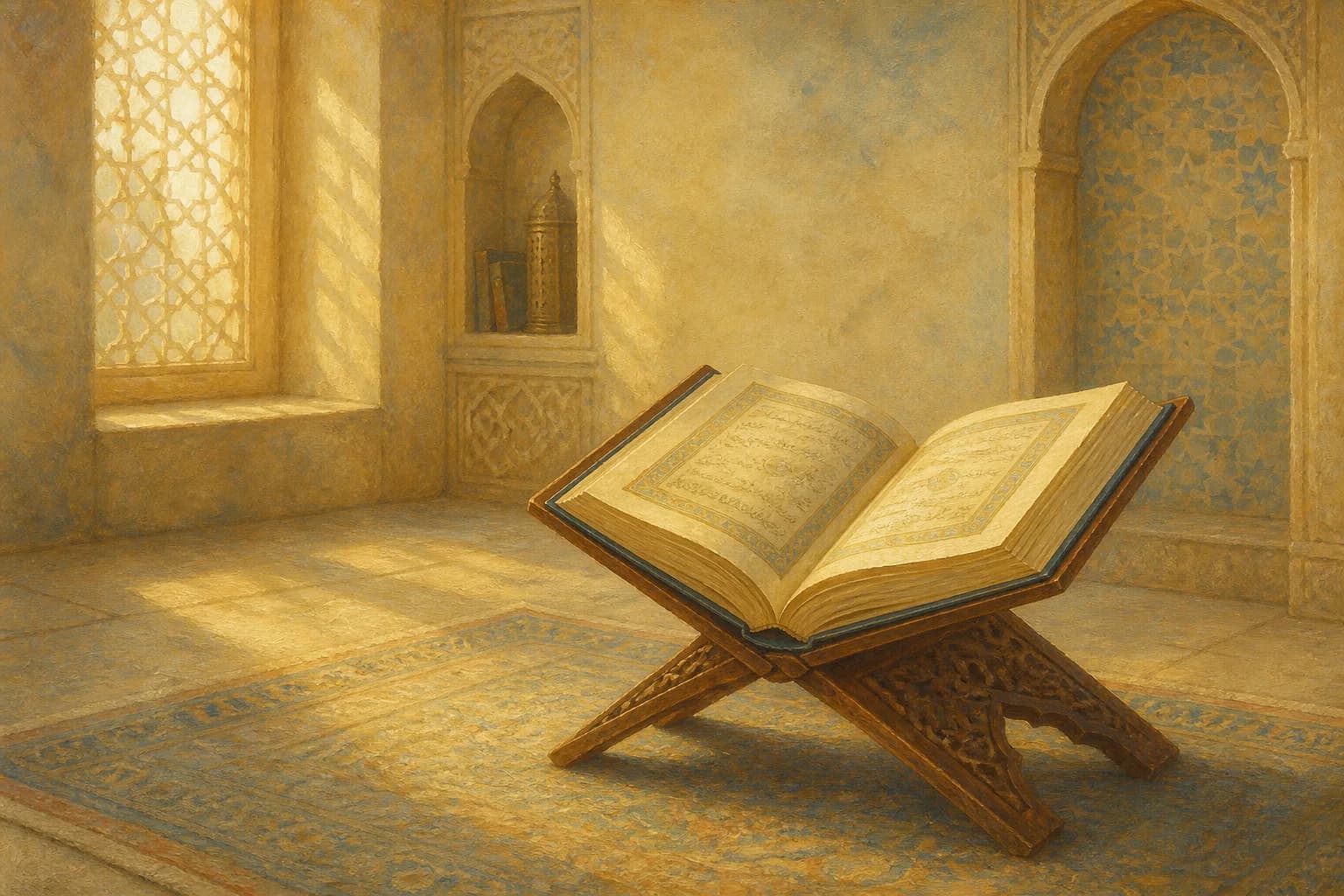

The Living Tradition Behind Every Quran Teacher
Many Muslims grew up hearing the Quran recited beautifully — at home, at the masjid, during Ramadan nights — and carried that sound in their hearts for years. Then came the moment of wanting to recite it themselves, and the gap between listening and reading became real. What closes that gap is a Quran teacher: someone who has received the recitation and can now pass it on.
The Quran was never designed to be learned alone. From the very first revelation — اقْرَأْ (Iqra' — "Recite!") in Surah Al-Alaq (96:1) — the tradition of learning through a human voice began. Every generation since has passed the Quran from teacher to student, mouth to ear, preserving not just the words but the exact way they are spoken.
What Is a Quran Teacher's Role in Islamic Tradition?
A Quran teacher is someone who transmits the Quran's recitation through a verified chain of oral learning called isnad (إسناد). Every qualified teacher holds an ijazah (إجازة) — a formal certificate proving their chain connects back, without interruption, to the Prophet Muhammad ﷺ. This means when you learn from a certified Quran teacher, you are receiving the same recitation the Prophet ﷺ taught his companions.
This matters practically, not just historically. The Quran's recitation rules — tajweed (تجويد) — govern how letters are pronounced, how long vowels are held, and where pauses fall. These rules can only be fully verified through a human voice that has already received them correctly. Written guides and recordings help, but they cannot correct you in real time.
The Prophet ﷺ placed this role at the highest level: "The best of you are those who learn the Quran and teach it" (Sahih al-Bukhari 5027). The Quran itself instructs:
فَاسْأَلُوا أَهْلَ الذِّكْرِ إِن كُنتُمْ لَا تَعْلَمُونَ
"So ask the people of knowledge if you do not know." (Surah An-Nahl, 16:43)
A Quran teacher is not simply a reading instructor. They carry the living recitation of the Prophet ﷺ forward and help each student hear themselves — something no app or recording can do.
What Qualities Define a Good Quran Teacher?
Not every person who teaches Quran recitation holds the same level of qualification. Knowing what to look for protects both your time and your recitation.
| Quality | What to Ask or Observe |
|---|---|
| Ijazah holder | Can they present their certificate and name their chain? |
| Tajweed knowledge | Do they explain why a rule applies, not just model it? |
| Patience and method | Do they correct without discouraging, and build at your pace? |
| Connection to meaning | Do they help you reflect on verses, or only drill sounds? |
| Track record | Can they show students who have progressed from your level? |
| Scheduling reliability | Are sessions consistent, or frequently rescheduled? |
A teacher who meets all six of these is worth committing to. A teacher who is uncertain about their chain of transmission, or who can only model rules without explaining them, will limit your progress over time.
Want the Qur'an to feel easier to understand?
Read with clear contextual insights, revisit the verses that matter to you, and build a steady daily Qur'an habit with DeenUp.
Take the Qur'an Quiz
Online vs. In-Person: What Actually Works?
Both work when done correctly. The question is which your life can support with consistency — because regular sessions over months matter far more than format.
In-person with a local teacher works best for young children learning from scratch, students pursuing serious memorization (hifz), and anyone who benefits from direct physical presence and community accountability.
Online one-on-one lessons work well for adult beginners, people in areas with few local options, and Muslims in diaspora communities far from Islamic centers. The correction quality is the same as in-person when using live video — the teacher hears every pause and mispronunciation in real time.
Group classes provide community motivation and are often more affordable, but offer less individual correction time. They suit students who already have some foundation and are drilling fluency rather than building basic pronunciation.
For a practical guide to finding a teacher in either format, see how to find a Quran teacher which covers platforms, masjid programs, and evaluation steps in depth.
Why the Islamic Tradition Insists on a Teacher
The reason Islamic tradition has always centered a human teacher — rather than books or recordings — is precisely what modern learners sometimes underestimate: we cannot hear our own mistakes clearly. The human ear naturally smooths over what it expects to hear, filling in sounds based on memory rather than what was actually produced.
A qualified teacher has trained their ear to catch what you cannot. They hear the elongation that was half a vowel too short, the nasal sound that was produced in the mouth instead of the nose, the stop where the breath should have continued. These are invisible to the learner but immediately apparent to someone who has received the recitation correctly.
This is why هَلْ يَسْتَوِي الَّذِينَ يَعْلَمُونَ وَالَّذِينَ لَا يَعْلَمُونَ — "Are those who know equal to those who do not know?" (Surah Az-Zumar, 39:9) — applies here. There is no substitute for learning from someone who knows.
Building Your Practice Between Lessons
What you do between sessions matters as much as the sessions themselves. A teacher who meets weekly can correct what went wrong, but the fluency that develops between corrections comes from daily independent practice.
Most programs recommend reciting for thirty to sixty minutes daily — ideally repeating whatever was covered in the last lesson multiple times before moving forward. Some teachers provide audio recordings of correct recitation for that session's material, which you should listen to and imitate before your next class.
Reading about the spiritual and cognitive benefits of daily recitation can also sustain motivation across the months it takes to build fluency. Benefits of reading Quran daily explores what consistent practice produces over time. For those just starting, how to read the Quran for beginners covers the foundational skills to develop before approaching a teacher for advanced correction.
If your goal is hifz (full memorization), the process is longer and more structured — how to memorize Quran explains the method and realistic timelines with a dedicated teacher.
External resources like DeenBack's Quran learning guide offer practical frameworks for building a recitation routine around formal lessons. DemiManifest's Quran habit guide covers how to make daily practice sustainable. For accessing Quranic text and recitations alongside your teacher work, Quran.com provides multiple recitations and translations, and Sunnah.com is the most reliable source for the hadith on Quran teaching referenced above.
What Progress With the Right Teacher Looks Like
A good Quran teacher corrects consistently without discouraging, explains the rules behind corrections so you retain them independently, and challenges you at a pace that is neither too fast to cause confusion nor too slow to lose engagement.
In the first three months with regular lessons, most students solidify Arabic letter recognition and the basic tajweed framework. By six months of consistent practice, reading short surahs without pausing becomes natural. After a year, most adult learners can read a full page without stopping. These are realistic, not optimistic, timelines — provided both teacher and student show up consistently.
For additional supplementary materials to use between sessions, Quran resources and downloads covers tools that support home practice. And if you are still searching for a structured online option, learn Quran online reviews the current landscape of platforms available today.
Common Questions About Quran Teachers
Does a Quran teacher need an ijazah to be effective?
Technically, anyone can teach someone else to read Arabic letters. But for recitation to be authenticated and tajweed to be transmitted correctly, an ijazah is the standard the tradition itself demands. A teacher without one may be enthusiastic and helpful for basics, but they cannot themselves verify that their own recitation is correct.
Can a woman be a Quran teacher?
Yes. Women have taught Quran throughout Islamic history, and many of the most respected Quran teachers worldwide today are women, particularly for other women and children. The same credential standards — ijazah, tajweed knowledge, patient methodology — apply regardless of gender.
What is the difference between a Quran teacher and a hafiz?
A hafiz (حافظ) is someone who has memorized the entire Quran. A Quran teacher is someone qualified to transmit recitation — they may or may not have full memorization. Many Quran teachers are also huffaz, but a hafiz without an ijazah for recitation transmission is not automatically a certified teacher.
Want the Qur'an to feel easier to understand?
Read with clear contextual insights, revisit the verses that matter to you, and build a steady daily Qur'an habit with DeenUp.
Take the Qur'an QuizFrequently Asked Questions
What is a Quran teacher called in Arabic?
A Quran teacher is called a mu'allim (معلم) or shaykh. A specialist in recitation transmission is called a muqri' — one who carries the Quran through a certified chain of oral transmission called isnad, tracing back uninterrupted to the Prophet Muhammad through fourteen centuries of verified teachers.
Can I learn the Quran without a teacher?
Self-study is possible but leaves critical errors uncorrected. The Prophet said the best of people are those who learn the Quran and teach it (Sahih al-Bukhari 5027). A qualified teacher catches tajweed errors in vowel lengths, nasalization, and stop rules that are nearly impossible to identify on your own.
What qualifications should a Quran teacher have?
A qualified Quran teacher should hold an ijazah — a formal certificate proving their chain of transmission. They should demonstrate strong tajweed knowledge, ability to explain rules rather than just model them, patience at your level, and an approach that connects recitation to reflection and meaning.
Is online Quran learning as effective as in-person?
Online Quran learning is highly effective when structured with regular one-on-one sessions and a verified teacher. Modern platforms use live video and real-time correction tools. The same credential standards apply as in-person: verify the ijazah, review teaching methodology, and commit to consistent weekly sessions.
How long does it take to learn Quran with a teacher?
Reading the Quran correctly with tajweed typically takes six months to two years of regular lessons. Full memorization with a dedicated teacher takes two to ten years depending on daily practice frequency. Most teachers recommend thirty to sixty minutes of daily recitation alongside weekly formal lessons.
What is an ijazah in Quran teaching?
An ijazah is a formal certification given by a qualified Quran teacher confirming that a student has received the Quran correctly and can now transmit it. It documents the chain of transmission from teacher to teacher back to the Prophet Muhammad, preserving the oral recitation tradition of Islam.
How do I know if my Quran teacher is qualified?
Ask the teacher to present their ijazah and name their chain of transmission. A qualified teacher can tell you who they studied under and trace that line back through verified teachers. They should also demonstrate knowledge of tajweed rules, explain them clearly, and show a track record with past students.