

- Authors

- Name
- Ahmad
- Role
- Senior Marketing Manager, Islamic education • DeenUp
بِسْمِ اللهِ الرَّحْمٰنِ الرَّحِيْمِ
In the name of God, the Most Gracious, the Most Merciful.
You searched "revert Muslim" because the word caught your attention — or because someone called themselves a revert and you wanted to understand what that means. Maybe you are on the edge of that journey yourself.
The word carries a weight that "convert" does not. This article will explain where it comes from, what Islam teaches about every human soul's relationship with the Creator, and what the first practical steps look like for anyone embracing Islam for the first time.
What Does "Revert Muslim" Mean?
A revert Muslim is a person who embraces Islam as an adult, particularly one who was not raised Muslim. The term comes from the Islamic theological concept of fitrah — the natural disposition toward the recognition of Allah that Islam teaches is built into every human soul at creation. Because every person is born in this state of primordial submission, coming to Islam is understood as a return to one's original nature, not an adoption of something foreign. This is why the community uses the word "revert" rather than "convert," though both terms are used widely and neither is wrong.
Your personal 28-Day Deen Plan
Learn your deen in 28 days, 5 minutes a day
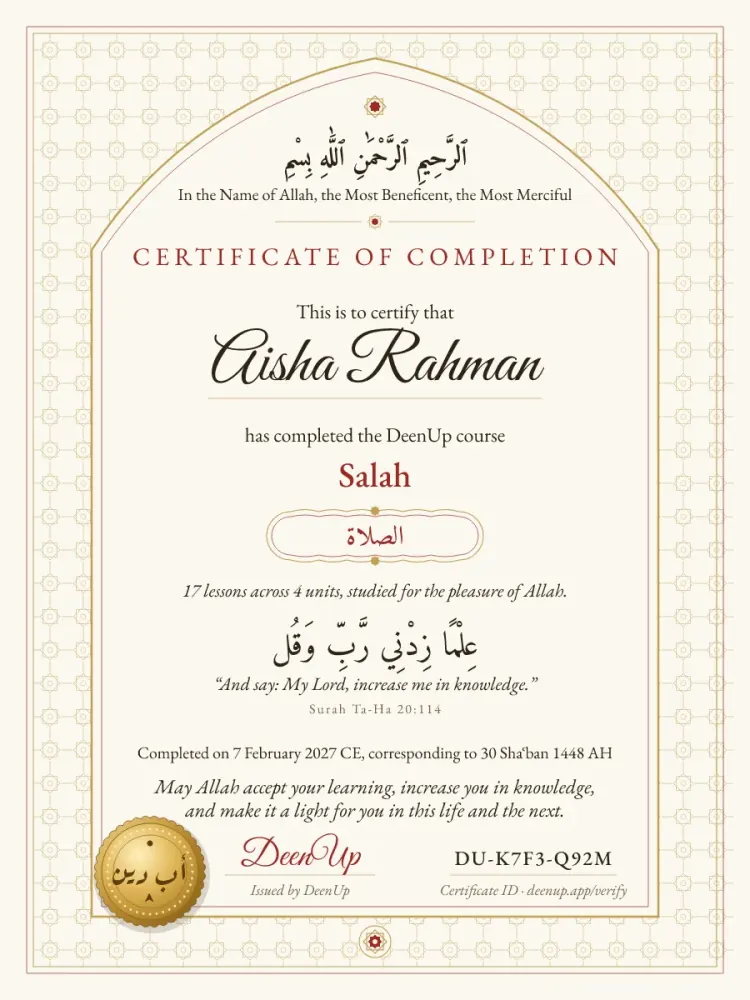
The essentials of salah, fiqh and faith, step by step from authentic sources. Finish all 28 days and earn a verifiable Certificate of Completion.
Take the free quizAnswer a few questions and get your personal plan.
What Is Fitrah — and Why Does It Matter?
The Quran describes Islam as the deen al-fitrah — the religion aligned with human nature:
فَأَقِمْ وَجْهَكَ لِلدِّينِ حَنِيفًا ۚ فِطْرَتَ اللَّهِ الَّتِي فَطَرَ النَّاسَ عَلَيْهَا
"So direct your face toward the religion, inclining to truth. [Adhere to] the fitrah of Allah upon which He has created [all] people. No change should there be in the creation of Allah." — (Surah Ar-Rum, 30:30)
The Prophet ﷺ expanded on this in one of the most cited hadith about human nature:
"Every child is born on the fitrah; it is his parents who make him a Jew, a Christian or a Magian. Just as an animal delivers a perfect offspring, do you find it born with a defect?" — (Sahih al-Bukhari 1358, Sahih Muslim 2658)
The fitrah is not an excuse for disbelief or a guarantee of paradise — it is an orientation, a built-in capacity to recognise the Creator when one encounters the truth clearly. What distorts it is the environment and the choices made over a lifetime.
For reverts, this teaching often resonates deeply. Many describe their path to Islam not as learning something entirely new but as recognising what they had always sensed — that there is one God, that life has a purpose, and that this Book speaks to them directly.
The Quran also confirms, in a verse about the covenant made with every soul before creation, that this recognition was established before birth:
"And [mention] when your Lord took from the children of Adam — from their loins — their descendants and made them testify of themselves, [saying to them], 'Am I not your Lord?' They said, 'Yes, we have testified.'" — (Surah Al-A'raf, 7:172)
The Shahada: The One Essential Step
Becoming Muslim requires one act: the Shahada, the declaration of faith. Everything else — learning to pray, fasting Ramadan, building Islamic habits — comes after.
The Shahada in Arabic:
أَشْهَدُ أَنْ لَا إِلَٰهَ إِلَّا اللهُ وَأَشْهَدُ أَنَّ مُحَمَّدًا رَسُولُ اللهِ
Ashadu an la ilaha ill Allah, wa ashadu anna Muhammadan rasul Allah
"I bear witness there is no god but Allah, and I bear witness that Muhammad is His Messenger."
This declaration, said sincerely with the heart, is what Islam requires. No institutional certificate, no formal ceremony, and no witnesses are strictly necessary — though having witnesses is strongly encouraged because it connects you to a community who can support you.
When a person embraces Islam, the Prophet ﷺ taught, Allah wipes away all previous sins:
"Islam wipes out what came before it." — (Sahih Muslim 121)
This is a fresh beginning — not a condemnation of the past, but an opening toward what is ahead.
Revert Muslim Identity: Common Experiences
The term "revert" is used within Muslim communities because it honours the theological reality described above. For many reverts, it also accurately describes their internal experience: a sense of return rather than arrival.
There is no single "revert experience," but certain themes recur:
| Stage | Common Experience |
|---|---|
| Before the Shahada | Intellectual conviction, spiritual longing, questions about meaning and purpose |
| The Shahada | Relief, peace, sometimes tears — a sense of something clicking into place |
| First weeks | Learning wudu and salah, navigating family responses, finding a mosque |
| First months | Building consistent prayer habits, learning Arabic phrases, meeting the Muslim community |
| Longer term | Deepening study, finding one's place in the ummah, learning to navigate cultural vs. religious distinctions |
What is theologically important is that none of these stages requires perfection. The Prophet ﷺ said: "The religion is easy. And no one will ever make the religion hard except that it will beat them. So be moderate, strive for nearness, give good news." (Sahih al-Bukhari 39)
Practical First Steps for a Revert Muslim
After the Shahada, scholars and experienced Muslims consistently recommend the same gradual path:
1. Learn the five prayers (salah) Salah is the foundation of daily Islamic practice. Start with Fajr — the predawn prayer — and add one prayer at a time until all five become natural. The complete guide to how to pray salah covers every step, posture, and Arabic phrase you need.
2. Learn wudu (ritual purification) Salah requires wudu. Learning this correctly from the beginning saves much confusion. The guide to performing wudu is a good starting point.
3. Learn the Shahada and basic supplications The Shahada you already know. Add the morning and evening adhkar (remembrances) gradually — these short phrases transform the texture of a day. The article on starting to pray as a new Muslim is written specifically for this stage.
4. Connect with the Muslim community Islam is a communal practice. Friday prayer (Jumu'ah), Islamic learning circles, and local mosque communities give reverts access to experienced Muslims who have navigated the same path.
5. Learn at your own pace The Quran was revealed over 23 years. Faith deepens incrementally. Trying to learn everything at once leads to overwhelm; learning one thing deeply leads to transformation.
If you want a structured guide for your first steps, take the free DeenUp quiz at /start and get a personalized learning path based on where you are right now.
For the foundational theological pillars of Islamic belief, the pillars of iman, what iman means, and the five pillars of Islam give you the essential framework. The converting to Islam guide walks through the practical process in more detail.
"Revert" vs "Convert": Does the Word Matter?
Both terms are used. "Convert" is the standard English word and carries no theological weight. "Revert" is the community term that carries the theological meaning described above.
What matters is not the word but the sincerity. A person who says the Shahada sincerely — believing in the heart, saying it on the tongue — is Muslim, regardless of which label others apply. Allah knows what is in the heart.
The community uses "revert" as a form of tawqir — honouring the person — recognising that they did not simply choose a new religion but found their way back to what every soul was created to recognise.
What Islam Says About a Fresh Start
One of the most comforting teachings for reverts is that embracing Islam is not just about adding new obligations — it is about beginning with an entirely clean slate:
"Say: 'O My servants who have transgressed against themselves [by sinning], do not despair of the mercy of Allah. Indeed, Allah forgives all sins. Indeed, it is He who is the Forgiving, the Merciful.'" — (Surah Az-Zumar, 39:53)
For those coming to Islam after decades of other life experiences, this verse is not an abstraction. It is a direct address to the soul standing at the door.
DeenBack's guide to beginning an Islamic spiritual practice and DemiManifest's piece on faith and identity for new Muslims offer practical community perspectives alongside the theological framework.
For the Quranic verses on fitrah, quran.com/ar-rum/30 has the full context of Surah Ar-Rum 30:30 with multiple translations. The hadith on fitrah and the clean slate after Islam are available at sunnah.com/bukhari:1358 and sunnah.com/muslim:121.
For scholarly exploration, Yaqeen Institute's research on revert Muslim experiences covers both theological foundations and community support.
Your personal 28-Day Deen Plan
Learn your deen in 28 days, 5 minutes a day
The essentials of salah, fiqh and faith, step by step from authentic sources. Finish all 28 days and earn a verifiable Certificate of Completion.
Take the free quizAnswer a few questions and get your personal plan.
The Journey Continues
Coming to Islam is a beginning, not a destination. The Quran addresses believers as people actively engaged with the message — learning, applying, returning when they fall short, and moving forward.
For a new Muslim or revert, the path forward is simply this: one prayer at a time, one dua at a time, one piece of knowledge at a time. The Prophet ﷺ said: "The most beloved of deeds to Allah are those done consistently, even if they are small." (Sahih al-Bukhari 6464)
Take the free DeenUp quiz to find out where to start — and get a plan that grows with you.
Frequently Asked Questions
What does "revert" mean in Islam?
In Islam, a "revert" is someone who embraces Islam as an adult, in contrast to being born into a Muslim family. The term comes from the Islamic belief that every person is born on fitrah — a natural disposition toward tawhid (the oneness of Allah). Embracing Islam is thus described as returning to one's original state, not adopting something new.
Is "revert" or "convert" the correct Islamic term?
Revert reflects the theological concept that every soul was created in submission to Allah (Surah Al-Araf, 7:172) and that Islam is the natural religion of humanity (Surah Ar-Rum, 30:30). Convert is the more common secular term. Both are used in Muslim communities; neither is incorrect, though revert carries a specific theological meaning many find meaningful.
What is fitrah in Islam?
Fitrah is the innate natural disposition Allah places in every human soul — an inclination toward recognising and worshipping the Creator. The Prophet described it in a hadith: "Every child is born on the fitrah; it is his parents who make him a Jew, a Christian or a Magian." (Sahih al-Bukhari 1358). Fitrah is why reverts often describe coming to Islam as "coming home."
What is the first step to becoming Muslim?
The first step is saying the Shahada — the declaration of faith: "Ashadu an la ilaha ill Allah, wa ashadu anna Muhammadan rasul Allah" (I bear witness there is no god but Allah, and I bear witness that Muhammad is His Messenger). This sincere declaration is what makes a person Muslim. Everything else is learned gradually after.
Do you need a witness to become Muslim?
Becoming Muslim requires only sincere belief in the heart and the Shahada on the lips — no witnesses are strictly necessary for the declaration to be valid before Allah. Having witnesses is recommended because it connects you to a community and helps others support your journey, but Islam has never required a formal ceremony or institutional approval.
What challenges do revert Muslims typically face?
Common challenges include learning Arabic for prayer, explaining the decision to non-Muslim family, finding a supportive Muslim community, and navigating the gap between understanding a ruling and building the habit. Most reverts find that starting with the Shahada, learning wudu and salah, and connecting with other Muslims is a sustainable path that unfolds gradually.
Does Allah accept the deeds of a new Muslim before they knew Islam?
According to a sound hadith, when a person embraces Islam, Allah wipes out all their previous sins (Sahih Muslim 121). The Prophet also taught that good deeds done sincerely before Islam may still be credited (Sahih al-Bukhari 1458). The transition to Islam is an act of mercy — it marks a fresh beginning, not a reckoning for the past.