

- Authors

- Name
- Ahmad
- Role
- Senior Marketing Manager, Islamic education • DeenUp
بِسْمِ اللهِ الرَّحْمٰنِ الرَّحِيْمِ
In the name of God, the Most Gracious, the Most Merciful.
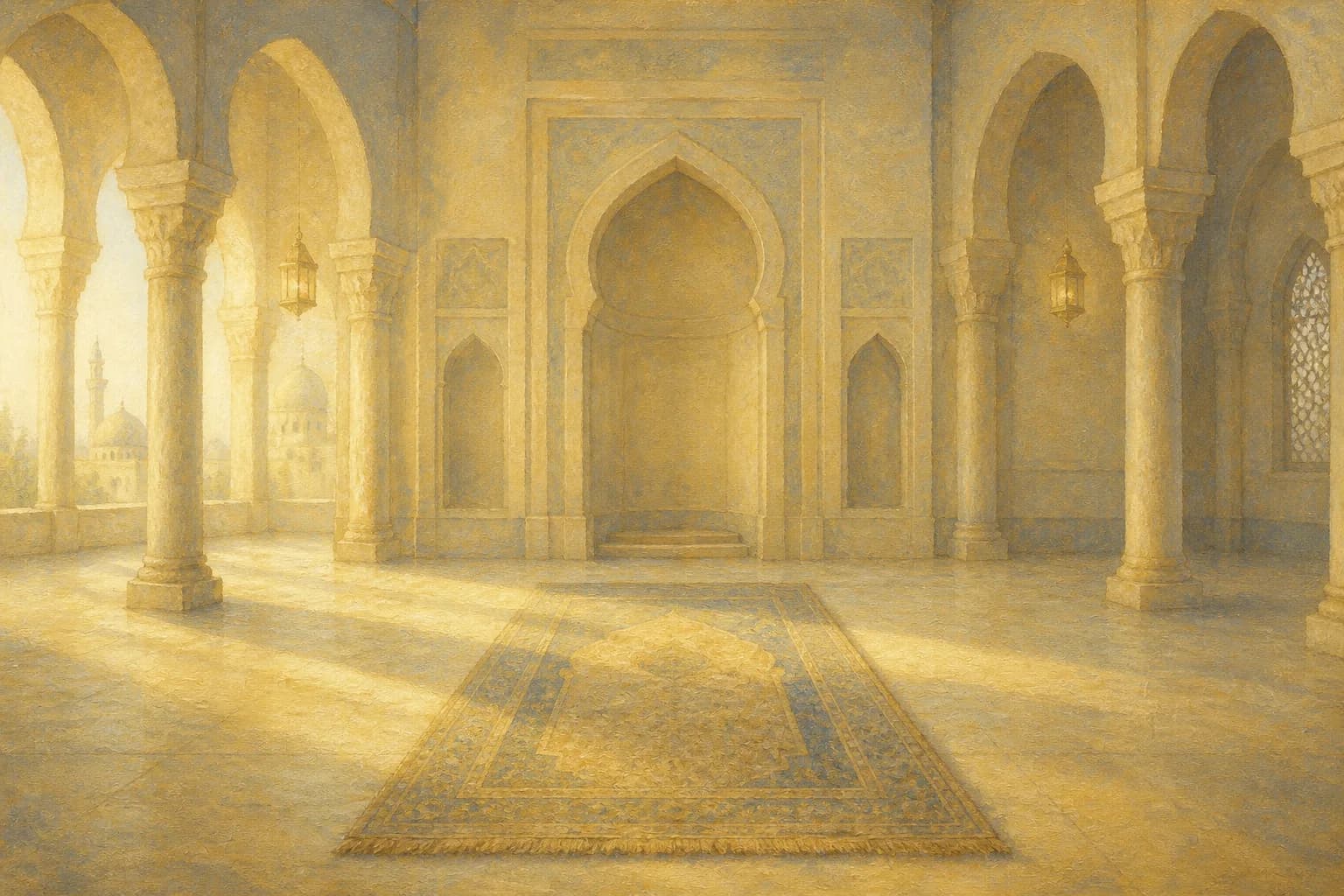

Salat al-Asr in the Heart of Your Afternoon
Of the five daily prayers, Salat al-Asr (salat al-'asr, صَلَاةُ الْعَصْرِ) falls in the one window that modern life most reliably swallows — the afternoon rush of work, school, meetings, and tasks. Knowing precisely how many rakats it requires, what the scholars agree on, and when the prayer window opens gives you the clarity to protect it rather than scramble for it.
How Many Rakats Is Salat al-Asr?
Salat al-Asr is 4 obligatory Fard rakats, prayed silently in the late afternoon. All four major Sunni madhabs agree on this count without exception. An additional 4 voluntary Sunnah rakats before the Fard are recommended, based on the Prophet's ﷺ statement: "May Allah have mercy on one who prays four rakats before Asr prayer." (Abu Dawud 1271) Including the Sunnah, the full practice totals 8 rakats — though only the 4 Fard are required of every adult Muslim.
What Does "Salat al-Asr" Mean in Arabic?
The term صَلَاةُ الْعَصْرِ (salat al-'asr) combines two words that each carry weight. Salat (صَلَاة) derives from a root connected to turning and connection — not merely a physical sequence of movements but a conscious turning of the heart toward Allah. Asr (عَصْر) literally means "pressing" or "squeezing" — the demanding, compressed time of the afternoon when the world presses in on a believer's attention.
The Quran directly singles out a prayer called "the middle" (al-wusta, الْوُسْطَى) for special protection:
حَافِظُوا عَلَى الصَّلَوَاتِ وَالصَّلَاةِ الْوُسْطَىٰ وَقُومُوا لِلَّهِ قَانِتِينَ
"Guard strictly the five obligatory prayers — especially the middle prayer — and stand before Allah with devotion." — (Surah Al-Baqarah, 2:238)
The vast majority of scholars identify al-salat al-wusta as Asr. This identification is made explicit in authentic hadith: during the Battle of the Trench, the Prophet ﷺ declared, "They occupied us from the middle prayer — Asr — until the sun set." (Sahih al-Bukhari 596)
What Do the Four Sunni Madhabs Say About Asr Rakats?
All four major Sunni schools of law agree on the Fard count and on the absence of Sunnah after Asr. Their only difference lies in the emphasis placed on the pre-Asr voluntary prayer:
| Madhab | Sunnah Before (Voluntary) | Fard | Sunnah After | Status of Pre-Asr Sunnah |
|---|---|---|---|---|
| Hanafi | 4 rakats | 4 rakats | None | Strongly emphasized (muakkad) |
| Maliki | 4 rakats | 4 rakats | None | Recommended (mustahabb) |
| Shafi'i | 4 rakats | 4 rakats | None | Recommended (mustahabb) |
| Hanbali | 4 rakats | 4 rakats | None | Recommended (mustahabb) |
There is no madhab disagreement on the 4 Fard rakats or the absence of Sunnah after Asr — those are points of consensus. The Hanafi position that the 4 pre-Asr Sunnah are muakkad (strongly emphasized) makes them more significant in that school; skipping them repeatedly carries greater moral weight there than in the others.
For the complete rakat picture across all five prayers — including Fajr, Dhuhr, Maghrib, and Isha — our guide on how many rakats are in each prayer lays out the full daily count in a single reference table.
When Does Salat al-Asr Time Begin and End?
The Asr prayer window has defined boundaries:
- Start: When the shadow of an upright object equals its own height plus the length of its midday shadow. Most prayer-time apps mark this precisely for your location.
- Preferred window (ikhtiyari): From Asr start until the sun begins to turn yellow — roughly 45–60 minutes before sunset depending on the season.
- Disliked but valid (dharuri): From when the sun turns yellow until just before sunset. The prayer is still valid but praying in this window is discouraged.
- Time expires: At the moment of sunset.
The Prophet ﷺ said: "Whoever catches one rakat of Asr before the sun sets has caught Asr." (Sahih al-Bukhari 579) Even a single rakat before sunset counts — though the spirit of "guard strictly" is to pray early, not to barely make it.
How to Structure Salat al-Asr Step by Step
Salat al-Asr consists of 4 Fard rakats prayed silently. Here is the complete structure, beginning with the optional Sunnah:
- Optional: Pray 4 Sunnah rakats before the Fard, intending them as pre-Asr Sunnah.
- Intention (niyyah): In your heart: "I intend to pray 4 rakats of Fard Salat al-Asr for Allah."
- Opening Takbeer: Allahu Akbar (اللَّهُ أَكْبَرُ) — raise hands to earlobes or shoulders.
- Rakats 1 and 2: Recite Surah Al-Fatihah, then an additional surah — all silently in Asr.
- After Rakat 2: Sit for the first Tashahhud.
- Rakats 3 and 4: Recite Al-Fatihah only — no additional surah in the final two rakats.
- Final Tashahhud and Salawat on the Prophet ﷺ.
- Tasleem: As-salamu alaykum wa rahmatullah — right, then left.
After completing Asr, the post-prayer remembrances (adhkar) take only 5–10 minutes and carry significant reward. Our collection of duas to read after salah has the full sequence the Prophet ﷺ consistently observed after prayer.
Still struggling to perform salah properly?
Learn each prayer step by step, understand what you are saying, and build a consistent salah habit with clear, scholar-approved lessons in DeenUp.
Take the Salah Quiz
Why Protecting Salat al-Asr Matters Today
The afternoon is when modern Muslim life most directly competes with prayer. Unlike Fajr — which has the clarity of the early morning — or Isha — which falls after the workday — Asr lands squarely in the busiest hours. That is not an accident; it is precisely why Allah specifically commanded its protection.
The Prophet ﷺ connected consistent Asr observance to the highest reward: "Whoever prays the two cool prayers (al-bardayn) — Fajr and Asr — will enter paradise." (Sahih al-Bukhari 574) The two prayers that bookend the working day are the two most likely to be lost; guarding both is a path to Jannah.
DeenBack's guide on building a consistent salah practice addresses the mental architecture that keeps afternoon prayer protected even on heavy workdays. Demi Manifest's piece on mindful prayer explores what it means to be genuinely present in salah rather than physically going through the motions — a quality the Prophet ﷺ called khushoo (خُشُوع).
For that inner dimension of prayer specifically, our guide on what is khushoo in salah and the full treatment of fajr prayer benefits both deepen the context for why Asr and Fajr are repeatedly singled out in the authentic sources. Understanding how to improve concentration in salah helps make each rakat of Asr a genuine act of ibadah rather than a mechanical habit.
Signs You Are Genuinely Guarding Salat al-Asr
You know Asr has become a protected part of your day — not just an obligation you remember — when:
- You check the Asr time in your city each morning before the day begins
- Afternoon plans are built around the prayer window rather than hoping it fits
- Missing Asr for a non-emergency genuinely unsettles you for the rest of the day
- You feel the afternoon is incomplete without those 4 rakats
That inner accountability is the beginning of qunoot (قُنُوتٌ) — the devoted standing before Allah that the verse in Surah Al-Baqarah calls us to immediately after commanding the prayer's protection.
Still struggling to perform salah properly?
Learn each prayer step by step, understand what you are saying, and build a consistent salah habit with clear, scholar-approved lessons in DeenUp.
Take the Salah QuizFrequently Asked Questions
How many rakats is Salat al-Asr?
Salat al-Asr consists of 4 obligatory Fard rakats. Sunni scholars also recommend 4 voluntary Sunnah rakats before the Fard, based on a hadith in Abu Dawud 1271. Praying all 8 rakats is praiseworthy, but only the 4 Fard are obligatory for every adult Muslim across all four Sunni madhabs.
What does Salat al-Asr mean in Arabic?
Salat al-Asr (صَلَاةُ الْعَصْرِ) means "the afternoon prayer." Salat (صَلَاة) refers to the formal ritual prayer, and Asr (عَصْر) designates the late-afternoon time. The Quran references this prayer in Surah Al-Baqarah (2:238) by commanding believers to guard the middle prayer — which the overwhelming majority of scholars identify as Asr.
When does Salat al-Asr time begin and end?
Salat al-Asr begins when the shadow of any upright object equals its own height plus the length of the midday shadow. The preferred time ends when the sun turns yellow. Praying after that point is disliked but valid until sunset. The Prophet described deliberate delay until the sun turns yellow as a sign of the hypocrite (Sahih al-Bukhari 553).
Do all four Sunni madhabs agree on Asr's rakat count?
All four major Sunni madhabs — Hanafi, Maliki, Shafi'i, and Hanbali — agree Salat al-Asr has exactly 4 Fard rakats and no Sunnah after Asr. Their difference is in the emphasis placed on the voluntary 4 pre-Asr Sunnah: the Hanafi school considers it strongly emphasized (muakkad), while the other three view it as generally recommended (mustahabb).
What happens if I miss Salat al-Asr?
Missing Salat al-Asr unintentionally — due to sleep or forgetfulness — requires making it up immediately upon remembering, praying all 4 Fard rakats. The Prophet warned that missing Asr is like losing family and wealth (Sahih al-Bukhari 553). Deliberate abandonment is considered a major sin in the view of most Sunni scholars.
Is Salat al-Asr prayed aloud or silently?
Salat al-Asr is prayed silently — all recitations, including Al-Fatihah and additional surahs, are spoken internally rather than aloud. This is the unanimous position of all four Sunni madhabs, confirmed by authentic hadith. Only Fajr, Maghrib, and Isha are prayed aloud; Asr and Dhuhr are both performed as silent prayers.
Can I combine Salat al-Asr with Dhuhr while traveling?
Yes. Sunni scholars permit combining Asr with Dhuhr during travel. The traveler may pray Dhuhr and Asr together at Dhuhr time (jam' taqdeem) or both at Asr time (jam' ta'kheer). This is confirmed by authentic hadiths in Sahih Muslim (703-705), which record the Prophet combining these two prayers on journeys.