

- Authors

- Name
- Ahmad
- Role
- Senior Marketing Manager, Islamic education • DeenUp
بِسْمِ اللهِ الرَّحْمٰنِ الرَّحِيْمِ
In the name of God, the Most Gracious, the Most Merciful.
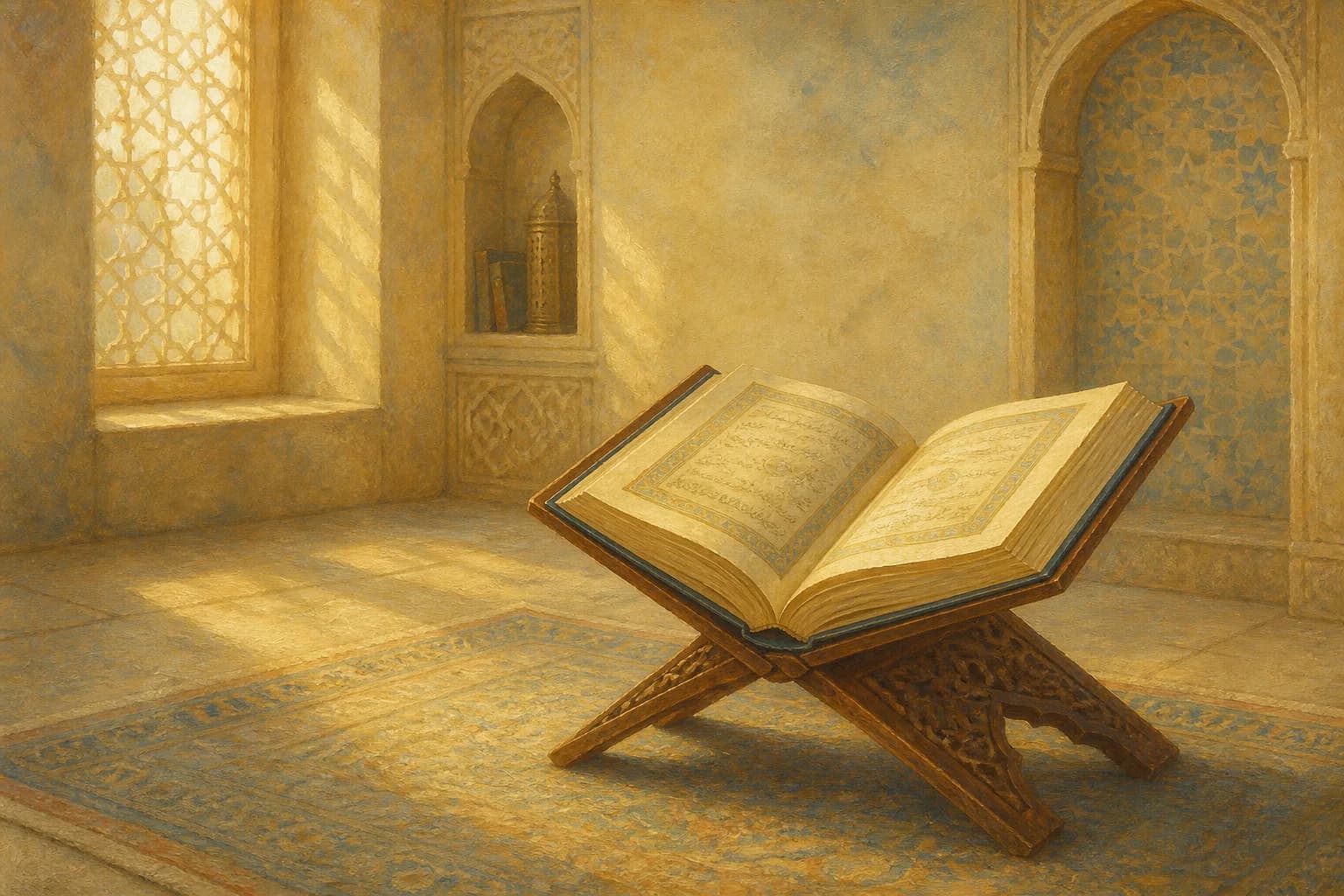

Four verses. Seventeen words in Arabic. And yet the Prophet (ﷺ) said it equals one-third of the Quran.
That is not a metaphor for effort or difficulty. Surah Al-Ikhlas is short enough to memorize in minutes, and many Muslims recite it dozens of times each day without stopping to consider what those four lines actually contain — or why they carry such extraordinary weight.
This article is about slowing down enough to understand it.
What Surah Al-Ikhlas Actually Contains
Surah Al-Ikhlas is the 112th chapter of the Quran. It was revealed in response to those who asked the Prophet (ﷺ) to describe his Lord. The four verses that came down are a complete theological statement:
قُلْ هُوَ اللَّهُ أَحَدٌ
"Say: He is Allah, [who is] One." — (Surah Al-Ikhlas, 112:1)
اللَّهُ الصَّمَدُ
"Allah, the Eternal Refuge." — (Surah Al-Ikhlas, 112:2)
لَمْ يَلِدْ وَلَمْ يُولَدْ
"He neither begets nor is born." — (Surah Al-Ikhlas, 112:3)
وَلَمْ يَكُن لَّهُ كُفُوًا أَحَدٌ
"Nor is there to Him any equivalent." — (Surah Al-Ikhlas, 112:4)
Each verse eliminates a category of error. Verse one rules out polytheism and partnership. Verse two rules out independence from Allah — everything needs Him, and He needs nothing. Verse three rules out the idea that Allah is like a parent or child, rooted in time and relationship the way we are. Verse four closes every remaining door: there is simply nothing comparable to Him.
Together, these four verses constitute tawhid — the oneness of Allah — in its most concentrated form. You can read the surah in full with multiple translations at quran.com/112.
For a broader foundation in Islamic belief, see what iman means and how to build it — the faith framework that Surah Al-Ikhlas sits at the heart of.
Why It Equals One-Third of the Quran
The hadith about Surah Al-Ikhlas is among the most well-authenticated in the collections:
"Is one of you not able to recite one-third of the Quran in a single night? They asked: Who among us is able to do that? He said: Qul huwallahu Ahad equals one-third of the Quran." — (Sahih Bukhari 5013; the full text is available at sunnah.com/bukhari:5013)
The scholars explain this in terms of the Quran's thematic structure. The Quran covers: the names and attributes of Allah (asma wa sifat), the stories of prophets and nations, and the legal and ethical rulings. Surah Al-Ikhlas covers the first category in its entirety and with unmatched clarity. It is al-ikhlas — pure sincerity in describing the Lord — distilled into the smallest possible space.
There is also the story of the companion who used to recite only Surah Al-Ikhlas in every prayer cycle. When asked why, he said: "It is the description of Ar-Rahman and I love to recite it." The Prophet (ﷺ) did not correct him; instead he said: "Inform him that Allah loves him." (Sahih Bukhari 7375)
This is the surah of people who love what they are saying — not just reciting.
Why This Matters for Every Muslim Today
Tawhid — genuine conviction in the oneness of Allah — is not a theological checkbox. It is the filter through which every decision, fear, and hope passes. When your understanding of tawhid is clear, you do not fear what people think of you more than you fear Allah. You do not place your ultimate trust in your income, your health, or your status. You do not fall into shirk of the subtle kind: giving your heart fully to something other than Allah.
Surah Al-Ikhlas, recited with attention, is one of the most accessible ways to reinforce that filter daily.
As you deepen your knowledge of Allah's 99 names, you will find that the names Al-Ahad (The One) and Al-Samad (The Eternal Refuge) are foundational. Every other name flows from these two realities. Understanding them is not optional background — it shapes how you make dua, how you face hardship, and how you relate to everyone around you.
Surah Al-Ikhlas also connects to the power of Ayatul Kursi, another anchor verse that describes the totality of divine knowledge and sovereignty. Together, these two texts form a strong daily practice.
How to Use Surah Al-Ikhlas in Your Daily Life
Morning and Evening Adhkar
The Prophet (ﷺ) taught: "Recite Qul huwallahu Ahad, Qul audhu bi rabb al-falaq, and Qul audhu bi rabb al-nas three times in the morning and evening; they will suffice you for everything." (Sunan Abu Dawud 5082)
This means reciting Surah Al-Ikhlas three times — along with Al-Falaq and An-Nas — as part of your morning and evening routine. It takes under two minutes, but the compound effect of doing this consistently over months and years is hard to overstate.
DeenBack's guide to morning dua routines is a useful companion if you are building this habit from scratch — it covers how to sequence your morning adhkar practically.
After Every Obligatory Prayer
Reading Surah Al-Ikhlas, Al-Falaq, and An-Nas once after each obligatory prayer is well-established in the Sunnah. Some scholars recommend reading them three times after Fajr and Maghrib specifically. Either way, pairing them with the prayer you are already committed to is the most sustainable approach.
Before Sleeping
The Prophet (ﷺ) used to cup his hands, recite the three Quls (Al-Ikhlas, Al-Falaq, An-Nas), blow into his hands, and wipe over his body — beginning with the head and face. He did this three times before sleeping. (Sahih Bukhari 5017)
This practice is both protective and reflective: ending the day by affirming what you believe about Allah.

Keep learning your deen with short, sourced lessons in DeenUp.
For building a sustainable Quran habit that includes surahs like Al-Ikhlas, Demi Manifest covers exactly this challenge. And for a broader picture of what consistent Quran reading does for your faith, see the benefits of reading the Quran daily.
Signs That Al-Ikhlas Is Shaping Your Faith
When you recite Surah Al-Ikhlas with genuine attention — not just as syllables to complete — you begin to notice shifts:
- You catch yourself placing less emotional weight on what people think of you, because Al-Ahad is the only one whose judgment ultimately matters
- You turn to Allah first in moments of need, because Al-Samad means every other door leads back to Him anyway
- Subtle forms of depending on creation — money, status, health — loosen their grip, not because you stop valuing them, but because you see them more clearly as gifts rather than foundations
- Your dua becomes more direct and less anxious, because you are speaking to the one who needs nothing from you and can give everything
These shifts are gradual. The surah is not a quick fix — it is a continuous correction.
Common Questions
Does reciting Surah Al-Ikhlas three times literally count as a full Quran recitation? The hadith means that Surah Al-Ikhlas carries the spiritual weight of one-third of the Quran because of what it covers thematically. Reciting it three times does not replace the full Quran in terms of the act of recitation itself. They are different forms of worship with different rewards.
Is it authentic that Surah Al-Ikhlas provides protection? Yes — the three Quls (Al-Ikhlas, Al-Falaq, An-Nas) are mentioned together in authenticated hadith in the context of morning, evening, and pre-sleep adhkar. Al-Falaq and An-Nas specifically address seeking refuge, and reciting them as a set is the established practice. The protection is from Allah; the surah is the means of asking for it.
Can children memorize Surah Al-Ikhlas first? It is one of the most common first surahs taught to children precisely because it is short and its meaning is foundational. Starting with it and explaining the meaning simply — "this is how we describe Allah" — builds both memory and belief together.
Closing
Surah Al-Ikhlas is four verses, but it answers the most important question a human being can ask: what is Allah actually like?
The answer — One, Eternal, unbegotten and not begetting, without equal — is not just theology. It is the ground on which everything else rests. Recite it in the morning and mean it. Recite it before sleep and rest in it. Recite it in prayer and let it shape how you think about the One you are addressing.
Keep learning your deen with short, sourced lessons in DeenUp.
Frequently Asked Questions
Why is Surah Al-Ikhlas equal to one-third of the Quran?
The Prophet explained that the Quran encompasses three main themes: the names and attributes of Allah, stories of the prophets, and legal rulings. Surah Al-Ikhlas covers the first — the pure, complete description of Allah — in four verses.
How many times should I recite Surah Al-Ikhlas?
Three times each in morning and evening adhkar. Once after every obligatory prayer. Three times before sleeping as part of the three Quls. Consistency matters more than quantity — start with one context and build from there.
What does Al-Samad mean in Surah Al-Ikhlas?
Al-Samad (الصَّمَد) means the Eternal Refuge — the one to whom all creation turns in need, who depends on nothing and no one. It is one of the most complete descriptions of divine self-sufficiency in the entire Quran.
Can reciting Surah Al-Ikhlas three times replace reading the full Quran?
The hadith about it equaling one-third refers to spiritual weight and reward, not literal replacement. Reading the full Quran remains its own act of worship. Reciting Al-Ikhlas three times carries the reward equivalent to a full recitation in terms of its thematic weight.