

- Authors

- Name
- Ahmad
- Role
- Senior Marketing Manager, Islamic education • DeenUp
بِسْمِ اللهِ الرَّحْمٰنِ الرَّحِيْمِ
In the name of God, the Most Gracious, the Most Merciful.
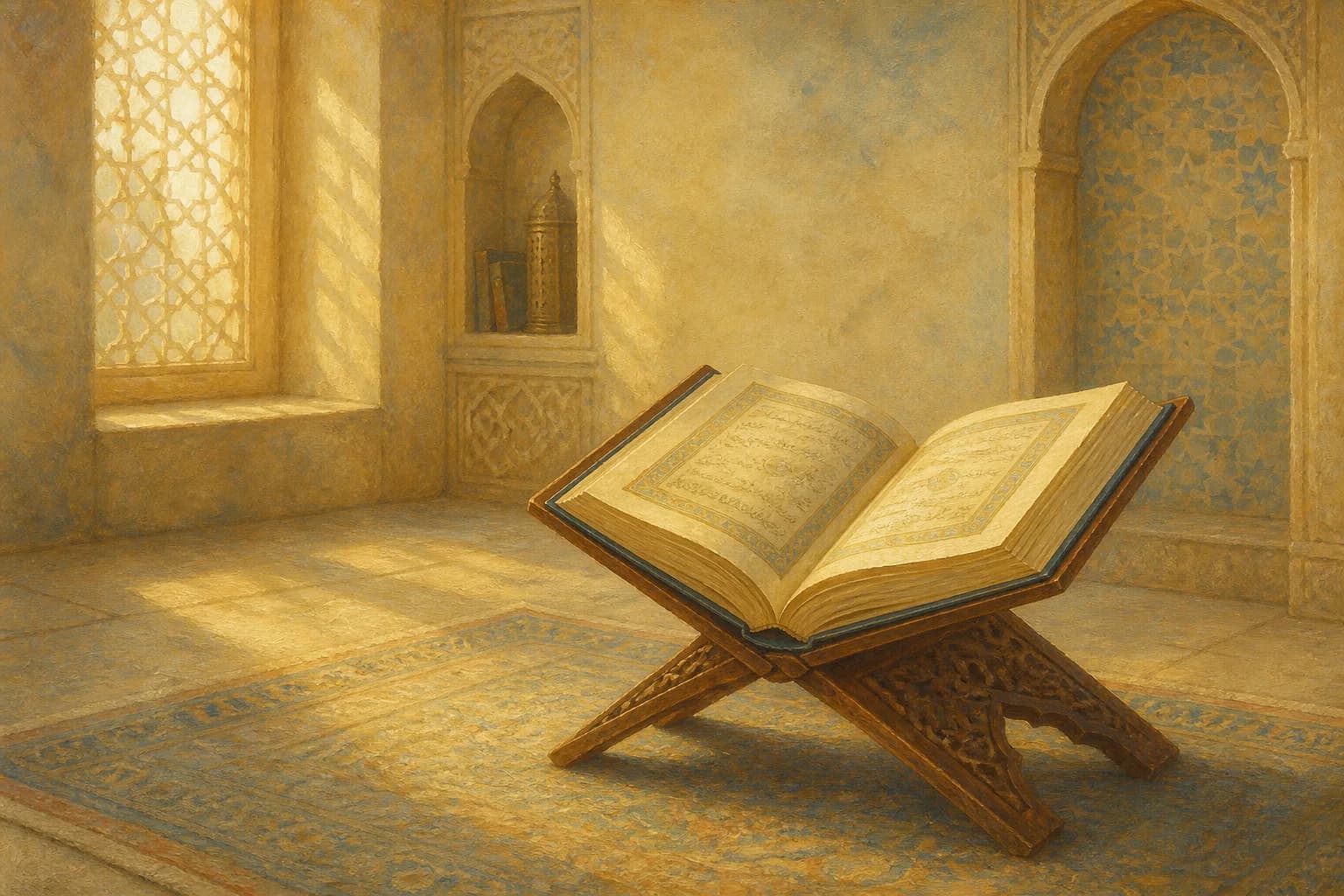

The Quran You Hold Has a History Worth Knowing
Every Muslim who opens a Quran — whether a pocket edition on a shelf or a digital copy on a phone — is holding a text whose exact form was established over 1,400 years ago through a careful, deliberate act of preservation.
That act is known as the compilation of the Uthmani mushaf. And understanding it is not just an academic exercise — it deepens your relationship with the book itself. When you know how the Quran was protected, what it took to standardize it across a rapidly expanding civilization, you read it differently.
What Is the Uthmani Quran?
The Uthmani Quran (مصحف عثمان, Mushaf Uthman) is the standardized written text of the Quran compiled under Caliph Uthman ibn Affan around 650 CE (approximately 25 AH). Named after the third caliph of Islam who ordered its production, it is the master standard from which every copy of the Quran in the world today is derived. The text has remained consistent and verifiable through an unbroken chain of transmission since the time of the Prophet Muhammad ﷺ, making it one of the most carefully preserved texts in human history.
The Compilation That Came Before: Abu Bakr's Initiative
To understand the Uthmani mushaf, you need to start slightly earlier — with a crisis that Abu Bakr as-Siddiq faced in the year 11 AH (633 CE).
The Battle of Yamama and the Risk to Quranic Preservation
In the wars of apostasy (ridda) that followed the Prophet's ﷺ death, the Battle of Yamama proved devastating. Among the estimated 1,200 to 1,500 Muslims killed in that battle were many huffadh — those who had memorized the entire Quran. Umar ibn al-Khattab رضي الله عنه, alarmed by this, approached Abu Bakr with an urgent concern:
"Casualties were heavy among the Qurra (reciters of the Quran) at the Battle of Yamama, and I am afraid that more heavy casualties may take place among the Qurra at other battlefields, whereby a large part of the Quran may be lost." — (Sahih al-Bukhari 4986)
Abu Bakr, initially hesitant — "How can I do something that the Prophet ﷺ did not do?" — was persuaded that this was an act of preservation, not innovation. He commissioned Zayd ibn Thabit, one of the Prophet's ﷺ primary scribes, to collect the Quran into a single written mushaf.
Zayd gathered all written fragments — from bones, leather, flat stones, and palm stalks — and verified each piece against the memories of those who had heard it directly from the Prophet ﷺ. This first compilation was kept by Abu Bakr, then passed to Umar ibn al-Khattab, and then to Umar's daughter Hafsa رضي الله عنها after his death.
Why Uthman Standardized It Further
By the time of Uthman ibn Affan's caliphate (644–656 CE), Islam had spread dramatically. Muslims from Arabia, Persia, Syria, and Egypt were reciting the Quran — but in different regional dialects and with variant pronunciations. Hudhayfah ibn al-Yaman رضي الله عنه, returning from the conquest of Armenia and Azerbaijan, was alarmed at the disputes he witnessed and came directly to Uthman:
"Uthman! Save this nation before they differ about the Book as Jews and Christians have differed." — (Sahih al-Bukhari 4987)
Uthman convened a committee of senior Companions — led again by Zayd ibn Thabit, along with Abdullah ibn Zubayr, Said ibn al-As, and Abd al-Rahman ibn Harith — and instructed them to produce multiple identical copies using the master mushaf held by Hafsa رضي الله عنها. Each copy was verified against the memories of those who had learned it from the Prophet ﷺ directly.
What Uthman Did With Variant Copies
Once the standardized copies were produced and sent to Mecca, Medina, Kufa, Basra, Damascus, and other major cities, Uthman ordered that all other written compilations — those using different regional orthographies or variant orderings — be destroyed. This was not censorship: it was deliberate standardization to prevent the very fragmentation that had befallen the scriptures of earlier communities.
The Quran itself had already been revealed in seven ahruf (modes of recitation). The Uthmani script, through its specific spelling conventions, accommodated multiple valid recitations within the same written text — a deliberate feature, not a limitation.
The Uthmani Script: What Makes It Different
| Feature | Uthmani Script | Modern Standard Arabic |
|---|---|---|
| Spelling conventions | Preserves historical Hijazi orthography | Follows modern standardized rules |
| Alif omission | Some words written without alif (e.g., الرحمن) | Alif typically written out in full |
| Vowel marks (tashkeel) | Added by later scholars (7th–8th century) | Standard in all printed texts |
| Accommodates qiraat | Yes — one written form, multiple valid readings | Single reading assumed |
| Pagination | Standardized (mushaf) editions in use globally | Varies by publisher and purpose |
The Uthmani script's preserved historical spellings can look unusual to someone trained in standard modern Arabic. For example, salat (الصلاة) is sometimes spelled in the mushaf with a waw instead of an alif — a historical convention that is preserved intentionally because it is part of the original written form.
If you are beginning to read the Quran, How to Read the Quran for Beginners is an accessible guide to understanding the script, tajweed, and where to start.
What Recitation Is Paired With the Uthmani Mushaf?
The Uthmani text supports multiple valid qiraat (recitation traditions), each traced through an unbroken chain of transmission (isnad) back to the Prophet ﷺ. The most widely used globally is Hafs an Asim, which is the reading found in virtually all Qurans printed in Saudi Arabia and most of the Muslim world.
Other valid recitations include Warsh an Nafi (used widely in North and West Africa) and Qalun an Nafi (common in Libya and Tunisia). The Uthmani spelling system was designed to accommodate all of these — a single written form that contains, through its deliberate ambiguities, the full range of authentic prophetic recitations.
To deepen your recitation with correct pronunciation, read How to Start Learning Tajweed and explore the Quran with Learn Quran with Tajweed.
How the Uthmani Quran Connects to Allah's Promise
The preservation of the Quran in this form is not a historical accident — it is, from the Islamic perspective, a fulfillment of a direct divine promise. Allah says in the Quran:
إِنَّا نَحْنُ نَزَّلْنَا الذِّكْرَ وَإِنَّا لَهُ لَحَافِظُونَ
"Indeed, it is We who sent down the Quran and indeed, We will be its guardian." — (Surah Al-Hijr, 15:9)
The Uthmani compilation is one of the instruments through which that guardianship operated in human history. The committee worked with reverence and rigor, accepting nothing as Quranic unless it was attested by at least two Companions who had heard it directly from the Prophet ﷺ. No verse was included on memory alone.
Why Reading the Uthmani Quran Matters for Your Practice
Most Muslims read the Quran without thinking about its textual history — and that is fine. But those who do understand it often describe a shift in their relationship with the text. You are not just reading words. You are reading the exact letters that Zayd ibn Thabit wrote down under Abu Bakr, reviewed again under Uthman, and dispatched to the cities of the early Islamic world.
That continuity is remarkable. The benefits of reading Quran daily extend well beyond the spiritual reward of each individual recitation — they include the experience of connecting to an unbroken chain that reaches back to the Prophet ﷺ himself.
For those memorizing the Quran, knowing the Uthmani script is essential. The unique spellings, once understood, make memorization more precise and connected to tradition. See How to Memorize the Quran for structured approaches to this goal.
The DeenBack guide to daily dhikr habits explores how regular Quran recitation — even a page or a few verses a day — fits into a morning dhikr practice rooted in prophetic example. The Demi Manifest guide to the Islamic morning routine also reflects on how consistent engagement with the Quran anchors the rest of the day.
Want the Qur'an to feel easier to understand?
Read with clear contextual insights, revisit the verses that matter to you, and build a steady daily Qur'an habit with DeenUp.
Take the Qur'an Quiz
The Uthmani Quran and Islamic Scholarship
Scholars of Islamic sciences study the Uthmani mushaf as the foundational text for all of Quranic science (ulum al-Quran). Every branch — tafsir (exegesis), tajweed (recitation rules), qiraat (variant readings), rasm (script study) — traces back to this standardized text.
The transmission is documented through an independently verified chain. Each of the major reciters — Asim, Nafi, Ibn Kathir, Ibn Amir, Abu Amr, Hamza, Al-Kisa'i — traced their recitation through an unbroken line of teachers back to the Companions of the Prophet ﷺ. Modern institutions like Dar al-Ulum in Egypt and Al-Madinah International University in Saudi Arabia preserve these chains as living scholarly traditions today.
Reading Best English Translation of the Quran can help you find a translation that pairs well with the Uthmani Arabic text for comparative study. Resources on Quran learning technology also show how digital tools can bring the Uthmani text to learners in new ways while remaining true to the traditional source.
Signs of Progress in Your Relationship With the Quran
Understanding the Uthmani Quran's history changes what you look for when you sit with the text:
- You notice the preserved spellings and appreciate what they protect
- You recite with more intentionality, knowing the chain of transmission behind each word
- You approach the Quran as a living connection to the Prophet ﷺ, not just a historical document
- Your recitation becomes more careful, more reverent — closer to the tajweed that preserves the sound as it was heard
The Quran was protected through extraordinary human effort — scribes, memorizers, scholars, caliphs — each acting as stewards of a divine trust. When you read it today, you step into that chain.
Want the Qur'an to feel easier to understand?
Read with clear contextual insights, revisit the verses that matter to you, and build a steady daily Qur'an habit with DeenUp.
Take the Qur'an QuizFrequently Asked Questions
What is the Uthmani Quran?
The Uthmani Quran (مصحف عثمان, Mushaf Uthman) is the standardized written text of the Quran compiled under Caliph Uthman ibn Affan around 650 CE. It established a single authoritative manuscript that all copies worldwide have followed for over 1,400 years, preserving the Quran with complete textual consistency.
Why did Uthman standardize the Quran?
Uthman ibn Affan ordered the standardization to resolve disputes over pronunciation and recitation that arose as Islam spread to non-Arab regions. After consulting senior Companions, he produced multiple identical copies and sent them to major cities, asking that variant manuscripts be brought to one standard.
What is the difference between the Uthmani script and modern Arabic?
The Uthmani script uses historical Arabic spelling conventions that predate modern orthographic norms. Some words omit certain letters (like alif) in ways that look unusual to readers of standard Arabic today. These preserved spellings are intentional — the tashkeel (vowel marks) added later guide correct pronunciation.
Is the Uthmani Quran the same Quran Muslims read today?
Yes. Every printed Quran in the world today — whether published in Saudi Arabia, Egypt, Pakistan, or elsewhere — follows the Uthmani mushaf text. The standardization Uthman established in the 7th century is precisely what ensures that Qurans read by Muslims in different countries and languages are identical in content.
What recitation is used with the Uthmani Quran?
The Uthmani mushaf was transcribed according to the recitation of the Quraysh dialect. Today, the most widely used recitation worldwide is Hafs an Asim, which follows this same standard. Other recitations (qiraat) such as Warsh an Nafi are also valid and traced to the Prophet ﷺ through authentic chains of transmission.
How was the Quran compiled before Uthman?
Under Abu Bakr as-Siddiq, Zayd ibn Thabit collected and wrote down the Quran after the Battle of Yamama (633 CE) where many memorizers were martyred. This first written compilation was kept by Abu Bakr, then Umar ibn al-Khattab, then Hafsa رضي الله عنها. Uthman later used it as the master copy for standardization.
How does reading the Uthmani Quran today connect to the Prophet?
Reading the Uthmani Quran today connects directly to the Prophet Muhammad ﷺ because the text was compiled from authenticated memorizers and written manuscripts verified by senior Companions who heard the Quran from the Prophet ﷺ personally. The chain of transmission is unbroken and independently attested.