

- Authors

- Name
- Ahmad
- Role
- Senior Marketing Manager, Islamic education • DeenUp
بِسْمِ اللهِ الرَّحْمٰنِ الرَّحِيْمِ
In the name of God, the Most Gracious, the Most Merciful.
The Question Every New Muslim Faces
Taking your shahada is a profound moment. And almost immediately, practical questions arrive. Among the first: what do I actually wear now?
This is not a trivial concern. Dress is visible. It signals something to yourself and to others. For a new Muslim navigating both a changed faith identity and their existing wardrobe, knowing what is required, what is recommended, and what is a matter of personal pace can remove a great deal of unnecessary anxiety.
This guide lays out what Islam actually requires about dress — for men and women — and how to approach the transition with intention rather than pressure.
What Should You Wear When You Convert to Islam?
Islamic dress is rooted in the principle of modesty (hayaa). For men, the core obligation is covering from the navel to the knee; for women, it is covering the entire body except the face and hands in public, including the hair. Both requirements come from Quran and authenticated hadith. Beyond the minimum, scholars recommend loose, non-transparent clothing that does not reveal body shape. Western modest clothing fully satisfies these requirements.
How Does Islam Define Modesty in Dress?
Before the specific rules, there is a principle. Allah says in the Quran:
يَا بَنِي آدَمَ قَدْ أَنزَلْنَا عَلَيْكُمْ لِبَاسًا يُوَارِي سَوْءَاتِكُمْ وَرِيشًا وَلِبَاسُ التَّقْوَىٰ ذَٰلِكَ خَيْرٌ
Ya bani Adama qad anzalna alaykum libasan yuwari saw'atikum wa reeshaan wa libasu al-taqwa dhalika khayr
"O children of Adam, We have bestowed upon you clothing to conceal your private parts and as adornment. But the clothing of righteousness — that is best." — (Surah Al-A'raf, 7:26)
The phrase "clothing of righteousness" (libas al-taqwa) tells us something important: outward dress is linked to inner God-consciousness. Modesty in Islam is not about shame — it is about dignity, intentionality, and protecting the sacredness of the body.
Modest dress is one of the first visible expressions of taqwa (God-consciousness) in a Muslim's life — alongside prayer and remembrance. For new Muslims, it is part of the same daily commitment that the DeenUp quiz at /start helps you map out from the beginning.
Islamic Dress for Men: What Is Actually Required?
The obligation for men centers on the awrah — the parts of the body that must be covered. For free adult Muslim men, scholars universally agree that the awrah is at minimum from the navel to the knee.
The Prophet ﷺ instructed: "Cover your thigh, for it is part of the awrah." (Sunan Abu Dawud, 4014)
Beyond the navel-to-knee minimum, scholars recommend:
- Loose, non-tight clothing that does not reveal body shape
- Non-transparent fabrics — the covering must actually conceal
- Modest overall appearance — not drawing attention through extravagance or immodesty
The Prophet ﷺ himself wore a thobe (a long, loose garment), but this is a cultural expression, not an obligation. A new Muslim man wearing clean jeans and a loose long-sleeved shirt is fully meeting the Islamic requirement. No new wardrobe is required immediately.
Islamic Dress for Women: Hijab and Modest Dress
For women, the Quran is explicit. Allah commands:
وَقُل لِّلْمُؤْمِنَاتِ يَغْضُضْنَ مِنْ أَبْصَارِهِنَّ وَيَحْفَظْنَ فُرُوجَهُنَّ وَلَا يُبْدِينَ زِينَتَهُنَّ إِلَّا مَا ظَهَرَ مِنْهَا وَلْيَضْرِبْنَ بِخُمُرِهِنَّ عَلَىٰ جُيُوبِهِنَّ
"And tell the believing women to lower their gaze and guard their private parts, and not to display their adornment except that which ordinarily appears, and to draw their head-covers over their chests." — (Surah An-Nur, 24:31)
And:
"O Prophet, tell your wives and your daughters and the women of the believers to bring down over themselves part of their outer garments. That is more suitable that they will be known and not be abused." — (Surah Al-Ahzab, 33:59)
Based on these verses and hadith, the scholarly consensus is that Muslim women must cover:
- The hair and neck
- The entire body except the face and hands (this is the agreed minimum across the four main schools)
- With clothing that is loose, non-transparent, and does not reveal body shape
The Arabic word khimar (خمار) used in Surah An-Nur refers to a head-cover drawn over the chest. The word jilbab (جلباب) in Surah Al-Ahzab refers to a loose outer garment worn over clothing. Together they describe what most Muslims call hijab today — though hijab as a concept encompasses the entire dress requirement, not just the headscarf.
For a deeper look at the meaning and historical context of hijab, see our guide on hijab in Islam — meaning and purpose.
What to Wear as a New Muslim: Men vs Women
Here is a quick-reference comparison of the core dress requirements:
| Requirement | Men | Women |
|---|---|---|
| Minimum covered area | Navel to knee | Entire body except face and hands |
| Hair covering | Not required | Required in public |
| Clothing fit | Loose, modest | Loose, non-revealing |
| Fabric opacity | Non-transparent | Non-transparent |
| For salah (prayer) | Navel to knee covered, clean | Full body covered except face and hands |
| Cultural style | Any modest style | Any modest style |
| Gradual adoption | Immediate (requirements are basic) | Phased transition is accepted by many scholars |
The cultural expression of these requirements varies widely across the Muslim world — from Indonesian batik to West African boubou to South Asian shalwar kameez. Modest dress does not mean Arab dress. It means clothing that meets the Islamic principles wherever you live.
Your First Week as a Muslim: Practical First Steps
For new Muslim men, the dress change is minimal. If you own trousers that cover the thigh and a shirt, you are already meeting the basic requirement. Focus instead on building your first prayers — learn how to pray salah step by step first, and your clothing will naturally evolve as your practice deepens.
For new Muslim women, the transition is more significant but does not need to happen in a single day. Here is a sensible starting approach:
- For salah right away: A large scarf or prayer dress covers the head and body for your first prayers. Many Muslim women begin here before adopting hijab in public.
- For going out: Start with what feels comfortable — longer hemlines, covered arms, and a larger scarf loosely worn. Progress steadily rather than all at once.
- For a full modest wardrobe: This is a process of months or even years for many converts. The important thing is consistent, sincere movement in that direction.
DeenBack's reflection on how new Muslims navigate faith identity captures why this gradual, rooted approach actually builds stronger practice than a sudden external overhaul. The Demi Manifest piece on conscious faith looks at the same shift — from inherited or external identity to genuine, lived conviction — which is what modest dress becomes when you internalize its purpose.
Your personal 28-Day Deen Plan
Learn your deen in 28 days, 5 minutes a day
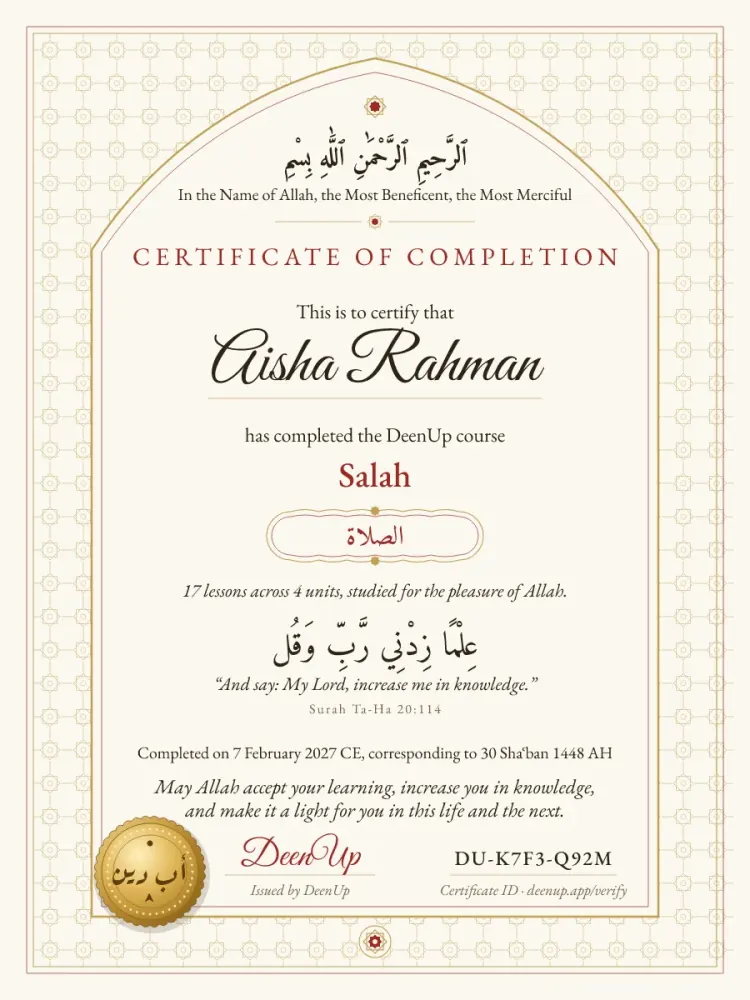
The essentials of salah, fiqh and faith, step by step from authentic sources. Finish all 28 days and earn a verifiable Certificate of Completion.
Take the free quizAnswer a few questions and get your personal plan.
What if I Am in a Western or Non-Muslim Country?
Islam does not require you to look visibly different from your surroundings at the cost of safety or hardship. What it requires is modesty — and modest Western clothing satisfies that requirement entirely.
A Muslim woman in Western Europe who wears a loose blouse, long trousers, and a simple headscarf is meeting the Islamic dress standard. A Muslim man who wears clean, modest jeans and a long-sleeved shirt is also meeting it.
The question is not "Do I look like a Muslim from X country?" — it is "Am I covering what Islam requires, with clothing that is modest and not drawing undue attention through immodesty?"
For a broader guide to navigating life as a new Muslim — including everything from prayer to community — see our complete guide to converting to Islam.
Does Dress Change Over Time?
For most converts, yes. What you wear six months into your practice will likely be different from your first week. This is expected and healthy.
Modest dress is part of a broader transformation of habits and outlook. It develops alongside prayer, Quran reading, and deepening knowledge of Islamic values — all of which shape how you think about how you present yourself. If you want to track that journey intentionally, start with the DeenUp quiz to build a plan for your daily Islamic practice that grows with you.
The guide to modest dress in Islam covers how Muslims across different backgrounds approach this transformation and what scholars say about the wisdom behind these requirements.
Common Questions About Islamic Dress for Converts
Is the niqab (face veil) required? The majority scholarly position is that the face veil is recommended (Sunnah) but not obligatory for most women. The Hanbali school considers it obligatory, while the Hanafi, Maliki, and Shafi'i schools generally hold that covering the face and hands is not required. A new Muslim woman does not need to adopt the niqab immediately — or at all — to practice Islam fully.
What about hair at work? Many Muslim women navigate this with practical solutions — a professional headscarf, a turban-style wrap, or styles that meet the covering requirement while fitting a workplace context. Islam gives room for practical wisdom in how the requirement is fulfilled, not just in whether it is fulfilled.
Can men wear shorts in private? Yes. The awrah requirement applies in the presence of unrelated adults (non-mahram). Within the privacy of your own home with family, the standard relaxes. The main scholars note that covering the thigh remains recommended even in private.
What about nail polish or makeup? Neither is prohibited. What matters for salah is that water reaches the skin during wudu (ablution) — standard nail polish may prevent this, so many Muslim women remove it before wudu or use water-permeable nail polish. For daily life outside salah, modest makeup and regular adornment are permitted.
Closing
What you wear is one of the first visible signs of your new identity as a Muslim — but it is a sign that grows with you, not a standard you must immediately meet in full before you are truly Muslim.
You took your shahada. That is what makes you a Muslim. The clothing follows the conviction, and the conviction deepens with practice.
Explore our guide on what it means to be a Muslim in your daily life and what hijab means in Islam beyond the headscarf to continue building your understanding. And whenever you are ready to build a full plan for your daily Islamic practice — prayer, Quran, dhikr, and more — the DeenUp app is there to support it.
Your personal 28-Day Deen Plan
Learn your deen in 28 days, 5 minutes a day
The essentials of salah, fiqh and faith, step by step from authentic sources. Finish all 28 days and earn a verifiable Certificate of Completion.
Take the free quizAnswer a few questions and get your personal plan.
Frequently Asked Questions
Do I have to start wearing hijab the moment I convert to Islam?
Scholars agree that hijab is obligatory for Muslim women, but many also acknowledge that newly converted women may need time to transition. The priority for a new Muslim is building a relationship with Allah through prayer and learning — consistent modest progress matters more than an immediate complete overhaul.
What is the minimum dress requirement for Muslim men?
Muslim men must keep the area between the navel and knee covered at all times. Many scholars also recommend loose, modest clothing that does not reveal body shape. The Prophet Muhammad wore a thobe, but clean modest Western clothing — trousers and a shirt — is entirely acceptable for men.
Is wearing hijab the only change women need to make?
Hijab in its full sense covers the hair, neck, and body with loose clothing that does not reveal body shape. Many women start with head covering and work toward full modest dress over time. A prayer dress or abaya with scarf is often the simplest first step for both daily life and salah.
What should I wear for my first salah as a new Muslim?
For salah, men need clean clothing covering from navel to knee; women need clothing covering everything except the face and hands. A loose prayer dress and scarf is a simple, affordable solution for women. Men can begin with any clean, modest clothing they already own and perform valid prayers immediately.
Does Islamic dress differ between schools of thought?
On the fundamentals, the four main schools (Hanafi, Maliki, Shafi'i, Hanbali) agree: women must cover all except the face and hands in public, and men must cover the navel to knee. Differences exist mainly on the face veil (niqab) — some schools consider it obligatory, others see it as highly recommended.
Can I wear Western clothing as a Muslim?
Yes. Islam does not require specific cultural clothing — it requires modesty. A Muslim man can wear jeans and a shirt if they are modest and cover the awrah. A Muslim woman can wear modest Western clothing — covered arms, loose fit, headscarf. What matters is the principle of modesty, not a cultural style.
What if I cannot afford new Islamic clothing right away?
Start with what you have. Men: modest, loose-fitting trousers and long-sleeved shirts. Women: layer longer skirts or trousers with long tops, and use a large scarf for head covering. Islamic dress is about intention and modesty, not about spending money on new clothes. Gradual, sincere change is what matters.