

- Authors

- Name
- Ahmad
- Role
- Senior Marketing Manager, Islamic education • DeenUp
بِسْمِ اللهِ الرَّحْمٰنِ الرَّحِيْمِ
In the name of God, the Most Gracious, the Most Merciful.


Every Muslim carries sins. Not because of weakness alone, but because human nature, as the Quran acknowledges, is inclined toward forgetfulness (Surah Ta-Ha 20:115). The question is not whether you sin, but whether you know how to return.
The Prophet Muhammad ﷺ did not leave this to chance. When he wanted to teach the most comprehensive, most weighty way to seek forgiveness from Allah, he taught one specific dua — and called it Sayyid al-Istighfar (سَيِّدُ الاسْتِغْفَار): the Master of Forgiveness-Seeking Duas.
Its opening line — "Allahumma anta rabbi la ilaha illa anta khalaqtani" — contains within it a complete declaration of faith, an acknowledgment of creation, a reaffirmation of covenant, and a humble confession of falling short. No other dua packages this much meaning in so few words. And Allah reminds us: "Indeed, Allah forgives all sins" (Surah Az-Zumar 39:53) — but reaching for that forgiveness requires knowing how to ask.
What Is "Allahumma Anta Rabbi La Ilaha Illa Anta Khalaqtani"?
"Allahumma anta rabbi la ilaha illa anta khalaqtani" is the opening line of Sayyid al-Istighfar (سَيِّدُ الاسْتِغْفَار) — the Master Dua of Seeking Forgiveness. Narrated by Shaddad ibn Aws and recorded in Sahih al-Bukhari 6306, the Prophet ﷺ declared it the greatest forgiveness dua. Reciting it in the morning or evening with sincere belief carries a promise of Paradise.
The Full Dua: Arabic, Transliteration, and Meaning
The complete Sayyid al-Istighfar:
اللَّهُمَّ أَنْتَ رَبِّي لَا إِلَهَ إِلَّا أَنْتَ خَلَقْتَنِي وَأَنَا عَبْدُكَ وَأَنَا عَلَى عَهْدِكَ وَوَعْدِكَ مَا اسْتَطَعْتُ أَعُوذُ بِكَ مِنْ شَرِّ مَا صَنَعْتُ أَبُوءُ لَكَ بِنِعْمَتِكَ عَلَيَّ وَأَبُوءُ لَكَ بِذَنْبِي فَاغْفِرْ لِي فَإِنَّهُ لَا يَغْفِرُ الذُّنُوبَ إِلَّا أَنْتَ
Allahumma anta rabbi la ilaha illa anta, khalaqtani wa ana abduka, wa ana 'ala 'ahdika wa wa'dika mastata'tu, a'udhu bika min sharri ma sana'tu, abu'u laka bini'matika 'alayya, wa abu'u laka bidhanbi, faghfir li, fa innahu la yaghfiru al-dhunuba illa anta.
"O Allah, You are my Lord, there is no god but You. You created me and I am Your servant, and I am upon Your covenant and promise as much as I am able. I seek refuge in You from the evil of what I have done. I acknowledge Your blessings upon me and I acknowledge my sin. So forgive me, for indeed no one forgives sins but You."
— (Sahih al-Bukhari 6306)
When to recite: In the morning (after Fajr, before sunrise) or in the evening (after Asr, before Maghrib). The essential condition is sincerity — the Prophet ﷺ specified saying it with yaqin (certainty), meaning fully believing each word as you say it.
Notice the structure of this dua. It does not open with a request. It opens with five acknowledgments before asking for a single thing: You are my Lord. There is no god but You. You created me. I am Your servant. I am upon Your covenant as best I can. Only after that groundwork does the dua ask for anything at all — and even then, it asks through acknowledgment of blessing and admission of sin, not through claiming merit.
The Story Behind Sayyid al-Istighfar
The companion Shaddad ibn Aws (رضي الله عنه) narrated that the Prophet ﷺ said: "Shall I not teach you the greatest supplication for forgiveness?" He then recited what we know as Sayyid al-Istighfar and explained: "Whoever recites it in the morning with certainty and dies that day before evening, he will be from the people of Paradise. And whoever recites it in the evening with certainty and dies that night before morning, he will be from the people of Paradise." (Sahih al-Bukhari 6306)
The Prophet ﷺ himself called this dua the sayyid — the master — of all duas for seeking forgiveness. This is a remarkable designation. The Prophet ﷺ taught hundreds of duas; to single one out as the master implies that it covers what others may leave uncovered.
That covering is in its structure. Notice how it moves: acknowledging Allah as your Lord → affirming His uniqueness and your createdness → affirming servitude → admitting imperfection → acknowledging blessings → confessing sin → asking only after all this groundwork is laid. The dua teaches you how to approach Allah before you even finish reciting it.
For a deeper understanding of why istighfar is central to Muslim practice, our guide on the benefits of istighfar explains the spiritual and practical dimensions of regular forgiveness-seeking. And our collection of the best duas for forgiveness provides additional context for where Sayyid al-Istighfar fits within the broader forgiveness toolkit.
How to Make Sayyid al-Istighfar Part of Your Morning and Evening
The hadith specifies morning and evening — the two bookends of the Muslim day, already home to morning and evening adhkar (remembrances). This is not coincidental. By placing Sayyid al-Istighfar within an existing adhkar routine, it becomes sustainable rather than aspirational.
Start with the morning adhkar routine. Many Muslims already recite other morning remembrances after Fajr. Sayyid al-Istighfar belongs there. Our guide to morning adhkar in Islam outlines a complete morning dhikr sequence where it fits naturally after the core duas.
Connect it to waking up. Reciting it before you pick up your phone — before you encounter the first distraction of the day — sets the tone for God-consciousness throughout the morning. Our guide to dua for waking up in the morning outlines how to build this transition intentionally.
Memorize it line by line. The dua is longer than most single adhkar, but its structure makes it memorable. Work through one phrase per day until it flows without effort. For a complete approach to building a forgiveness dua practice, see our guide to dua for forgiveness and repentance.
Say it with conviction. The hadith does not say "whoever recites it" — it says "whoever recites it with certainty." This is not a magical formula. It is a sincere conversation with Allah. Slow down enough to mean what you say.
Your personal 28-Day Deen Plan
Learn your deen in 28 days, 5 minutes a day
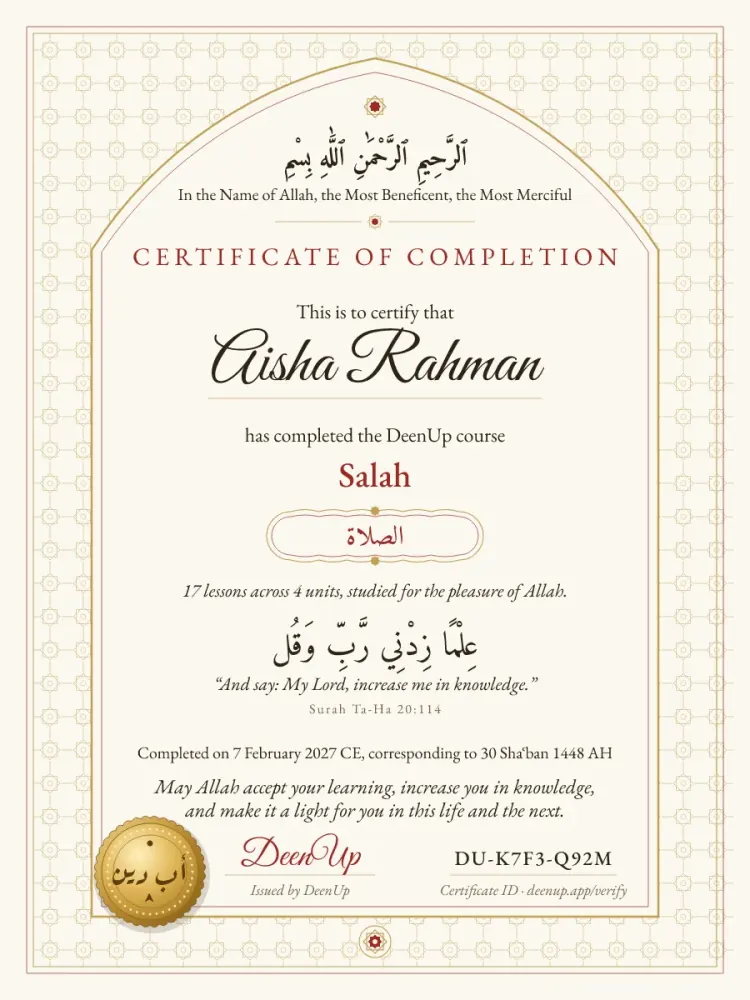
The essentials of salah, fiqh and faith, step by step from authentic sources. Finish all 28 days and earn a verifiable Certificate of Completion.
Take the free quizAnswer a few questions and get your personal plan.
The key is consistency over intensity. One sincere recitation each morning, every morning, is worth far more than ten rushed ones followed by days of forgetting. Building a consistent morning habit of this kind is a practice explored in depth at DeenBack's morning adhkar guide and in DemiManifest's guide to sincere repentance in Islam.
Related Duas for Forgiveness and Repentance
Sayyid al-Istighfar does not stand alone. Islamic tradition provides a network of forgiveness duas suited to different moments and needs:
| Dua | Arabic | When to Recite | Source |
|---|---|---|---|
| Astaghfirullah al-Azim | أَسْتَغْفِرُ اللَّهَ الْعَظِيمَ | Throughout the day, especially after salah | Tirmidhi 3577 |
| Dua of Adam | رَبَّنَا ظَلَمْنَا أَنفُسَنَا | After wrongdoing, seeking restoration | Surah Al-Araf 7:23 |
| Dua of Yunus | لَا إِلَهَ إِلَّا أَنتَ سُبْحَانَكَ إِنِّي كُنتُ مِنَ الظَّالِمِينَ | In difficulty, distress, or spiritual darkness | Surah Al-Anbiya 21:87 |
For a broader toolkit of forgiveness duas and understanding of their context, our guides on the greatest dua for forgiveness and the astaghfirullah dua for forgiveness provide additional depth and practical guidance.
A Daily Return to the Beginning
The opening phrase — "Allahumma anta rabbi" — means "O Allah, You are my Lord." Saying this every morning is not a performance. It is the quietest, most honest declaration a person can make: You are in charge. I am not. I failed yesterday. Here I am again.
That humility is not weakness. It is exactly the disposition Allah describes as worthy of His mercy. Allah loves those who are constantly repentant (Surah Al-Baqarah 2:222), and there is no more complete expression of repentance than a dua that begins with acknowledgment and ends with trust in the One who forgives all sins.
Your personal 28-Day Deen Plan
Learn your deen in 28 days, 5 minutes a day
The essentials of salah, fiqh and faith, step by step from authentic sources. Finish all 28 days and earn a verifiable Certificate of Completion.
Take the free quizAnswer a few questions and get your personal plan.
Sources and further reading:
Frequently Asked Questions
What is Sayyid al-Istighfar?
Sayyid al-Istighfar (سَيِّدُ الاسْتِغْفَار) translates as the Master of Forgiveness-Seeking Duas. It is the dua recorded in Sahih al-Bukhari 6306, narrated by Shaddad ibn Aws. The Prophet Muhammad (peace be upon him) designated it as the greatest dua for seeking forgiveness and promised Paradise to whoever recites it with sincere certainty in the morning or evening.
When should I recite allahumma anta rabbi la ilaha illa anta?
Sayyid al-Istighfar is recited in the morning — after Fajr, before sunrise — or in the evening, after Asr, before Maghrib. These are the same windows as morning and evening adhkar. The hadith specifies reciting it once with yaqin (certainty), sincerely believing every word as you say it. Both windows carry the same reward.
What does allahumma anta rabbi la ilaha illa anta khalaqtani mean in English?
"Allahumma anta rabbi la ilaha illa anta khalaqtani" means "O Allah, You are my Lord, there is no god but You, You created me." It opens Sayyid al-Istighfar by establishing three foundations: acknowledgment of Allah as Lord, affirmation of His uniqueness, and acceptance that every human being is a created servant entirely dependent on Him.
Is Sayyid al-Istighfar authentic?
Sayyid al-Istighfar is authentically narrated in Sahih al-Bukhari 6306, the most reliable collection of hadith in Islam. It is narrated by Shaddad ibn Aws (may Allah be pleased with him) and accepted by hadith scholars without reservation. No authenticity concerns have been raised about this narration by classical or contemporary scholarship.
What if I cannot memorize the full dua yet?
Learning Sayyid al-Istighfar does not need to happen all at once. Work through one phrase per day: start with "Allahumma anta rabbi la ilaha illa anta," then add "khalaqtani wa ana abduka," and continue adding phrases over a week. Reading from a written copy is acceptable while memorizing — sincerity of meaning matters more than memorization speed.
Can I recite Sayyid al-Istighfar at any time of day?
Sayyid al-Istighfar can be recited at any time, but the hadith in Sahih al-Bukhari 6306 specifically describes its special status when recited in the morning or evening with certainty. Outside those times, reciting it remains a valuable act of remembrance and repentance — the core meaning of the dua is beneficial whenever said with sincerity.
How is this dua different from just saying Astaghfirullah?
Astaghfirullah is a brief, constant form of remembrance suitable throughout the day. Sayyid al-Istighfar is a comprehensive dua that moves through acknowledgment of Allah, affirmation of servitude, admission of falling short, and a formal request for forgiveness. Where Astaghfirullah is a frequent whisper, Sayyid al-Istighfar is a deliberate, structured return to Allah — both have their place in a complete forgiveness practice.