

- Authors

- Name
- Ahmad
- Role
- Senior Marketing Manager, Islamic education • DeenUp
بِسْمِ اللهِ الرَّحْمٰنِ الرَّحِيْمِ
In the name of God, the Most Gracious, the Most Merciful.
Islam is one of the world's great traditions, yet many people — including Muslims who have grown up in the faith — are surprised by how much depth, history, and richness it holds. Whether you are exploring your faith for the first time or strengthening a lifelong practice, understanding these facts about Islam as a religion can open new doors of appreciation and connection.
What Makes Islam a Remarkable Religion?
Islam is the second-largest religion in the world, with approximately 1.9 billion followers — about 25 percent of humanity. Revealed to the Prophet Muhammad ﷺ beginning in 610 CE in Mecca, it is built on the Quran (114 surahs, 6,236 verses) and the authentic Sunnah. It encompasses a complete way of life, from daily prayer and charitable giving to community, scholarship, and devotion to Allah.
Islam at a Glance: Key Facts
| Fact | Detail |
|---|---|
| Founded | 610 CE (Hijri calendar starts 622 CE) |
| Final Prophet | Muhammad ﷺ |
| Holy Scripture | The Quran — 114 surahs, 6,236 ayahs |
| Global followers | ~1.9 billion (~25% of world population) |
| Language of worship | Arabic |
| Daily prayers | 5 (Fajr, Dhuhr, Asr, Maghrib, Isha) |
| Five Pillars | Shahada, Salah, Zakat, Sawm, Hajj |
| Holy city | Mecca, Saudi Arabia |
| Weekly congregational day | Friday (Yawm al-Jumu'ah) |
| Obligatory charity rate | 2.5% of qualifying savings above nisab |
25 Interesting Facts About Islam Religion
1. The Name Islam Is a Statement of Peace
The word Islam comes from the Arabic root s-l-m, meaning submission, peace, and wholeness. The word Muslim literally means "one who submits to Allah." This linguistic connection between faith and peace is not coincidental — the Quran teaches that true tranquility comes through the remembrance of Allah (Surah Ar-Ra'd, 13:28).
2. Islam Is the Second-Largest Religion on Earth
With 1.9 billion believers across every continent, Islam is the second-largest religion in the world. It is also the fastest-growing major religion, with Muslim communities expanding rapidly in sub-Saharan Africa, South and Southeast Asia, and Western countries.
3. The Quran Was Revealed Over 23 Years
The Quran was not delivered all at once. Allah revealed it to the Prophet Muhammad ﷺ incrementally over 23 years — from 610 CE in Mecca until 632 CE in Medina — allowing the message to meet specific situations and guide the growing Muslim community step by step (Surah Al-Isra, 17:106). You can read the full text at Quran.com.
4. Millions Have Memorized the Entire Quran
One of the most striking facts about Islam religion is the tradition of hifz — memorizing the entire Quran. Those who complete this feat are called huffaz (singular: hafiz). There are millions of huffaz worldwide, spanning every language and culture, preserving the Quran's exact text exactly as it was revealed.
5. Islam Is Built on Five Foundational Pillars
The five pillars of Islam form the structure of a Muslim's practice: the Shahada (declaration of faith), Salah (five daily prayers), Zakat (obligatory charity), Sawm (fasting during Ramadan), and Hajj (pilgrimage to Mecca). The Prophet Muhammad ﷺ described them as the foundation on which the house of Islam is built (Sahih al-Bukhari 8).
6. Muslims Pray Five Times Every Day
Salah, performed five times daily, is one of the most distinctive features of Muslim life. The prayers — Fajr (dawn), Dhuhr (midday), Asr (afternoon), Maghrib (sunset), and Isha (night) — punctuate every day with remembrance of Allah. For more on the structure and blessings of these prayers, see our guide to Islamic night prayers.
7. Zakat Is Precisely 2.5 Percent
The obligatory annual charity in Islam, Zakat, is calculated at exactly 2.5% of qualifying savings and assets held above the nisab (minimum threshold) for one full lunar year. Zakat is not a suggestion but a pillar — mentioned alongside prayer more than 30 times in the Quran (Surah Al-Baqarah, 2:43).
8. The Islamic Calendar Is Lunar
The Hijri calendar follows the cycles of the moon, making it approximately 354 days long — about 11 days shorter than the Gregorian solar year. This is why Islamic events like Ramadan and Eid shift earlier in the Western calendar each year. The calendar begins in 622 CE with the Prophet's migration (Hijrah) from Mecca to Medina.
9. Allah Has 99 Beautiful Names
Islam teaches that Allah has 99 beautiful names, each describing one of His divine attributes — Al-Rahman (the Most Merciful), Al-Khaliq (the Creator), Al-Wadud (the Loving), and more. The Prophet ﷺ said, "Allah has ninety-nine names... whoever memorizes them will enter Paradise" (Sahih al-Bukhari 2736).
10. The Quran Has Been Recited by More People Than Any Other Book
Beyond the billions who read it in translation, hundreds of millions recite the Quran in its original Arabic daily during prayer. The preservation of its text — unchanged since the time of the Prophet ﷺ — is itself one of the remarkable facts of Islam religion. The Quran promises its own preservation: "Indeed, it is We who sent down the reminder, and indeed, We will be its guardian" (Surah Al-Hijr, 15:9).
11. Islam's Golden Age Shaped Modern Science
Between the 8th and 13th centuries CE, Muslim scholars preserved and advanced human knowledge at a time when much of the world had not yet systematized scientific inquiry. Al-Khwarizmi created algebra (the word comes from his work Al-Kitab al-mukhtasar fi hisab al-jabr), Ibn Sina wrote The Canon of Medicine used in European universities for centuries, and Al-Biruni contributed foundational work to geography and anthropology.
12. Hajj Is the Largest Annual Pilgrimage in the World
Every year during the month of Dhul Hijjah, between 2 and 3 million Muslims gather in Mecca for the Hajj pilgrimage — the largest annual human gathering on earth. Hajj reenacts the trial of Ibrahim (Abraham) عليه السلام and the journey of Hajar (Hagar), and concludes with Eid al-Adha, celebrated by Muslims worldwide.
13. Friday Is the Sacred Day of Congregational Prayer
The Quran devotes Surah Al-Jumu'ah (Chapter 62) to the importance of Friday congregational prayer. Muslim men are obligated to attend the Jumu'ah prayer, where an imam delivers a khutbah (sermon) on a topic of spiritual or communal relevance. The Prophet ﷺ described Friday as the best day of the week (Sahih Muslim 854).
14. The Concept of Halal Covers All of Life
Halal (permissible) in Islam extends far beyond food. It encompasses how Muslims earn money, conduct business, treat others, and live. The halal dietary laws prohibit pork and alcohol and require specific slaughter methods — rooted in the principle that Muslims are stewards of what Allah has provided, not simply consumers.
15. Modesty Is a Spiritual Value, Not Just a Dress Code
The concept of hayaa (modesty or shyness) in Islam covers behavior, speech, and clothing for both men and women. Modest dress — including the hijab for women and modest attire for men — is rooted in the Quran (Surah An-Nur, 24:30-31) and understood as an expression of dignity and taqwa, not restriction.
16. Islam Has Six Articles of Faith
Alongside the five pillars of practice, Muslims hold six core beliefs (arkan al-iman): belief in Allah, in His angels, in the revealed scriptures, in the prophets, in the Day of Judgment, and in divine decree (qadar). The Quran summarizes these in Surah Al-Baqarah (2:177).
17. The Prophet Muhammad ﷺ Was the Final Prophet
Muslims believe the Prophet Muhammad ﷺ (born ~570 CE in Mecca) was the last of a long chain of prophets beginning with Adam عليه السلام and including Ibrahim, Musa, and Isa (Jesus). The Quran describes him as the "Seal of the Prophets" — Khatam an-Nabiyyin (Surah Al-Ahzab, 33:40).
18. Islam Emphasizes Seeking Knowledge
One of the most distinctive facts about Islam as a religion is its foundational command to learn. The first word revealed in the Quran was Iqra — "Read" (Surah Al-Alaq, 96:1). The Prophet ﷺ made seeking knowledge an obligation on every Muslim, regardless of gender (Ibn Majah 224). The benefits of reading the Quran daily go far beyond spiritual reward — they include clarity of mind and strengthened character.
19. Ramadan Is the Holiest Month
During Ramadan, the ninth month of the Islamic calendar, Muslims fast from dawn to sunset — refraining from food, drink, and marital relations. Ramadan marks the month in which the Quran was first revealed (Surah Al-Baqarah, 2:185). It ends with the celebration of Eid al-Fitr, one of the two major Islamic holidays.
20. Islam Places Major Emphasis on Charity
Beyond the obligatory 2.5% Zakat, Islam strongly encourages Sadaqah (voluntary charity). The Prophet ﷺ said that charity does not decrease wealth (Sahih Muslim 2588). The Quran promises multiple reward for spending in the way of Allah: "The example of those who spend their wealth in the way of Allah is like a seed of grain that sprouts seven spikes, in each spike a hundred grains" (Surah Al-Baqarah, 2:261).
21. Islamic Architecture Is Among the World's Most Refined
From the Great Mosque of Cordoba to the Blue Mosque in Istanbul and the Masjid al-Haram in Mecca, Islamic architecture reflects the values of the faith: orientation toward the qiblah (direction of Mecca), geometric patterning that expresses divine order, and spaces designed to quiet the heart and invite reflection.
22. Dhikr Is a Daily Practice for Every Muslim
Dhikr (remembrance of Allah) includes reciting phrases like Subhanallah (Glory be to Allah), Alhamdulillah (All praise is for Allah), and Allahu Akbar (Allah is the Greatest). The Prophet ﷺ recommended specific adhkar (plural of dhikr) for morning, evening, before sleeping, and after prayer — building a constant interior awareness of Allah throughout the day.
23. Islam Has Always Had a Strong Legal Tradition
Islamic jurisprudence (fiqh) developed sophisticated legal schools — the Hanafi, Maliki, Shafi'i, and Hanbali madhabs — each applying the Quran and Sunnah to the situations of their time and place. This tradition of scholarly reasoning (ijtihad) ensured that Islamic guidance could address the complexity of human life across centuries and cultures.
24. Dua Is a Direct Line to Allah
One of the most beautiful facts about Islam religion is that every Muslim has direct access to Allah through dua (supplication). There is no intermediary, no clergy to petition, no ritual required beyond sincerity. The Quran promises: "And when My servants ask you about Me — indeed I am near. I respond to the invocation of the supplicant when he calls upon Me" (Surah Al-Baqarah, 2:186).
25. Islam Is a Living, Global Community
The ummah — the global community of Muslims — transcends nationality, ethnicity, and language. The Prophet Muhammad ﷺ declared in his Farewell Sermon that no Arab is superior to a non-Arab, and no non-Arab to an Arab, except through taqwa (God-consciousness). This vision of human equality rooted in faith is one of Islam's most distinctive and enduring contributions to human civilization.
Why These Facts Matter for Your Faith
Understanding the breadth of your faith is not trivia — it is the foundation of a living practice. When you know that the Quran took 23 years to reveal, every verse feels more personal. When you understand the Islamic Golden Age, you see that intellectual curiosity is a Muslim virtue. The Quran itself calls believers to reflect: "Do they not contemplate the Quran, or are there locks on their hearts?" (Surah Muhammad, 47:24).
Learning deepens love, and love drives practice.
Connecting These Facts to Daily Life
Islam is not a list of facts to memorize — it is a living relationship with Allah. Here are practical ways to move from knowing these facts to living them:
- Start with the Quran: Commit to reading or reflecting on even one verse each day. The impact compounds over months (Surah Az-Zumar, 39:9).
- Establish all five prayers: Each prayer is an appointment with Allah. Missing one is like missing a conversation with someone you love.
- Learn the 99 names of Allah: Each name reveals a different facet of who you are worshipping — deepening your dua and your gratitude.
- Give Sadaqah regularly: The Prophet ﷺ said charity does not decrease wealth (Sahih Muslim 2588). Make giving a weekly habit.
- Read Islamic history: Understanding the Sahaba, the Golden Age, and the spread of Islam roots your faith in real human stories.
Your personal 28-Day Deen Plan
Learn your deen in 28 days, 5 minutes a day
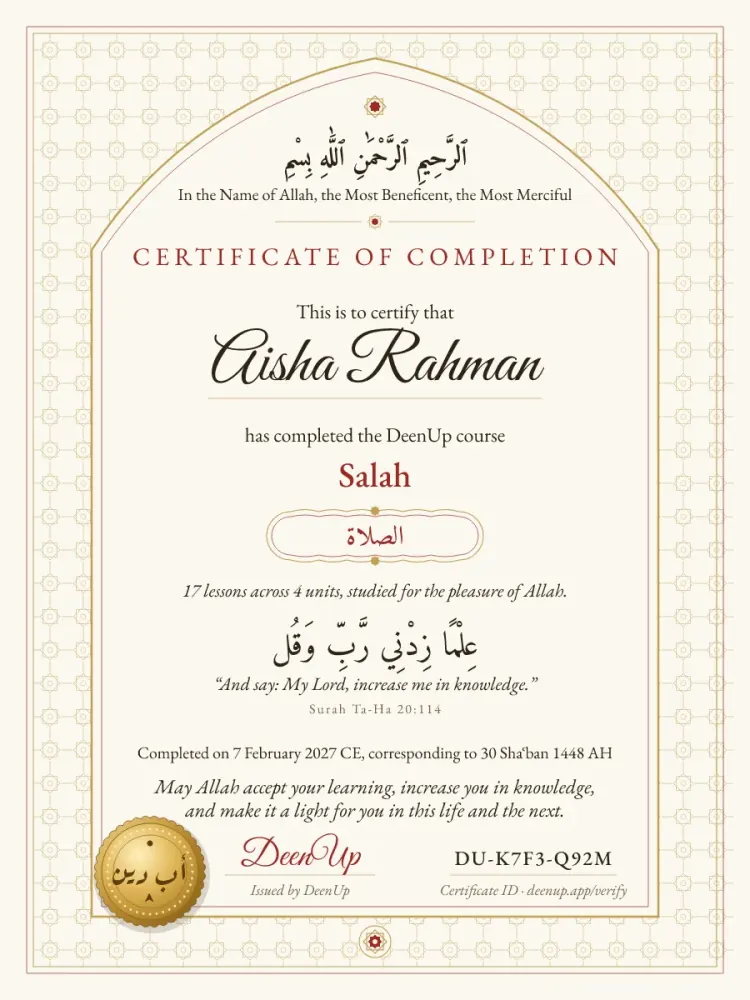
The essentials of salah, fiqh and faith, step by step from authentic sources. Finish all 28 days and earn a verifiable Certificate of Completion.
Take the free quizAnswer a few questions and get your personal plan.
Signs You Are Growing in Your Knowledge of Islam
The believer's faith is meant to grow. Some signs of genuine progress:
- You find yourself thinking about Allah throughout the day, not only during prayer.
- Learning new facts about Islam makes you want to act, not just know.
- The Quran's verses connect to your daily life in ways you had not noticed before.
- You feel drawn toward more consistency — in prayer, in dhikr, in giving.
Growth does not happen overnight. It is built through small, consistent acts aligned with sincere intention, repeated until they become second nature.
Common Questions About Interesting Facts of Islam
What is the meaning of the word Islam?
The word Islam comes from the Arabic root s-l-m, meaning submission and peace. Islam means submission to Allah, and a Muslim is one who submits. The Quran describes this as the natural state of the human soul — called the fitrah — through which a believer finds true peace (Surah Ar-Rum, 30:30).
How many Muslims are there in the world today?
There are approximately 1.9 billion Muslims worldwide, making Islam the second-largest religion after Christianity and accounting for about 25 percent of the global population. Islam is also the fastest-growing major religion, with Muslim communities expanding rapidly across Africa, Southeast Asia, and Western countries.
What are the five pillars of Islam?
The five pillars of Islam are the Shahada (declaration of faith), Salah (five daily prayers), Zakat (obligatory charity at 2.5% of savings), Sawm (fasting during Ramadan), and Hajj (pilgrimage to Mecca, once in a lifetime for those able). The Prophet Muhammad described them as the foundation of Islam (Sahih al-Bukhari 8).
What is the Quran and how many verses does it have?
The Quran is the holy scripture of Islam, believed by Muslims to be the direct word of Allah revealed to the Prophet Muhammad over 23 years beginning in 610 CE. It contains 114 surahs (chapters) and 6,236 ayahs (verses), covering guidance for all aspects of human life, morality, and worship.
When did Islam begin as a religion?
Islam began in 610 CE when the Prophet Muhammad received the first Quranic revelation in the Cave of Hira near Mecca. The Islamic (Hijri) calendar begins in 622 CE, the year of the Prophet's migration from Mecca to Medina, known as the Hijrah. Islam is thus approximately 1,400 years old.
What is the Islamic Golden Age?
The Islamic Golden Age (8th to 13th centuries CE) was a period of remarkable achievement in the Muslim world. Muslim scholars advanced mathematics, medicine, astronomy, and philosophy. Al-Khwarizmi created algebra, Ibn Sina wrote foundational medical texts used in European universities, and Al-Biruni contributed to geography and anthropology.
What is the significance of Friday in Islam?
Friday, called Yawm al-Jumu'ah in Arabic, is the most important day of the week in Islam. The Quran devotes Surah Al-Jumu'ah (Chapter 62) to it. Muslim men are required to attend the congregational Jumu'ah prayer, which replaces the Dhuhr prayer, and listen to the khutbah (sermon) delivered by an imam.
A Faith Worth Knowing More Deeply
Islam is one of the richest traditions in human history — in scholarship, in art, in spiritual depth, and in community. Every fact in this article is a door into a deeper appreciation of a faith that has shaped and continues to shape over a billion lives around the world.
The Quran invites every believer: "Read in the name of your Lord who created" (Surah Al-Alaq, 96:1). That command to read and reflect is the foundation of everything Islam has achieved — and everything you are still becoming.
Your personal 28-Day Deen Plan
Learn your deen in 28 days, 5 minutes a day
The essentials of salah, fiqh and faith, step by step from authentic sources. Finish all 28 days and earn a verifiable Certificate of Completion.
Take the free quizAnswer a few questions and get your personal plan.
Frequently Asked Questions
What is the meaning of the word Islam?
The word Islam comes from the Arabic root s-l-m, meaning submission and peace. Islam means submission to Allah, and a Muslim is one who submits. The Quran describes this as the natural state of the human soul — called the fitrah — through which a believer finds true peace (Surah Ar-Rum, 30:30).
How many Muslims are there in the world today?
There are approximately 1.9 billion Muslims worldwide, making Islam the second-largest religion after Christianity and accounting for about 25 percent of the global population. Islam is also the fastest-growing major religion, with Muslim communities expanding rapidly across Africa, Southeast Asia, and the West.
What are the five pillars of Islam?
The five pillars of Islam are the Shahada (declaration of faith), Salah (five daily prayers), Zakat (obligatory charity at 2.5% of savings), Sawm (fasting during Ramadan), and Hajj (pilgrimage to Mecca, once in a lifetime for those able). The Prophet Muhammad described them as the foundation of Islam (Sahih al-Bukhari 8).
What is the Quran and how many verses does it have?
The Quran is the holy scripture of Islam, believed by Muslims to be the direct word of Allah revealed to the Prophet Muhammad over 23 years beginning in 610 CE. It contains 114 surahs (chapters) and 6,236 ayahs (verses), covering guidance for all aspects of human life, morality, and worship.
When did Islam begin as a religion?
Islam began in 610 CE when the Prophet Muhammad received the first Quranic revelation in the Cave of Hira near Mecca. The Islamic (Hijri) calendar begins in 622 CE, the year of the Prophet's migration from Mecca to Medina, known as the Hijrah. Islam is thus approximately 1,400 years old.
What is the Islamic Golden Age?
The Islamic Golden Age (8th to 13th centuries CE) was a period of remarkable achievement in the Muslim world. Muslim scholars advanced mathematics, medicine, astronomy, and philosophy. Al-Khwarizmi created algebra, Ibn Sina wrote foundational medical texts used in European universities, and Al-Biruni contributed to geography and anthropology.
What is the significance of Friday in Islam?
Friday, called Yawm al-Jumu'ah in Arabic, is the most important day of the week in Islam. The Quran devotes Surah Al-Jumu'ah (Chapter 62) to it. Muslim men are required to attend the congregational Jumu'ah prayer, which replaces the Dhuhr prayer, and listen to the khutbah (sermon) delivered by an imam.