

- Authors

- Name
- Ahmad
- Role
- Senior Marketing Manager, Islamic education • DeenUp
بِسْمِ اللهِ الرَّحْمٰنِ الرَّحِيْمِ
In the name of God, the Most Gracious, the Most Merciful.
You do not have to wait for a formal prayer to speak with Allah. Between the five daily prayers, in traffic, before sleep, in a moment of anxiety or gratitude — zikr is the continuous thread of remembrance that keeps the heart connected to its Creator. The Prophet ﷺ himself never stopped doing zikr: he remembered Allah in every situation, standing, sitting, and lying down (Sahih Muslim 373). This is what dhikr al-dawa'm — constant remembrance — looks like in practice.
What Is Islamic Zikr?
Islamic zikr (ذِكْر, also written dhikr) is the practice of remembering Allah through verbal phrases, reflection, or dedicated acts of worship. The Quran commands it directly: "O you who believe, remember Allah with much remembrance" (Surah Al-Ahzab, 33:41), and identifies it as the source of inner peace: "Verily, in the remembrance of Allah do hearts find rest" (Surah Ar-Ra'd, 13:28). Zikr encompasses short repeated phrases like SubhanAllah, extended supplications, Quran recitation, and even salah itself — any act that keeps the heart turned toward Allah rather than away from Him.
The Four Core Zikr Phrases
The Prophet ﷺ identified four phrases as the most beloved to Allah:
"The most beloved words to Allah are four: SubhanAllah, Alhamdulillah, La ilaha illallah, and Allahu Akbar." (Sahih Muslim 2137)
These four form the backbone of Islamic zikr:
| Phrase | Arabic | Meaning | Key Occasion |
|---|---|---|---|
| SubhanAllah | سُبْحَانَ اللَّهِ | "Glory be to Allah" — affirms His perfection and freedom from all defect | After prayer, in amazement or surprise |
| Alhamdulillah | الْحَمْدُ لِلَّهِ | "All praise belongs to Allah" — acknowledges His blessings in all circumstances | After eating, sneezing, any blessing |
| Allahu Akbar | اللَّهُ أَكْبَرُ | "Allah is the Greatest" — affirms that nothing rivals Him in greatness | Opening takbir of prayer, moments of awe |
| La ilaha illallah | لَا إِلَهَ إِلَّا اللَّهُ | "There is no god but Allah" — the declaration that all sovereignty belongs to Him | Morning/evening adhkar, in difficulty |
These are not empty syllables. Each one is a theological statement. SubhanAllah says Allah is beyond all imperfection. Alhamdulillah says every good thing originates with Him. Allahu Akbar says no worldly concern is bigger than He is. La ilaha illallah says there is no other object worth ultimate allegiance. Saying them consciously — not just reciting — is what transforms a habit into worship.
The Zikr After Each Prayer
The most reliably practiced form of zikr is the tasbih after the five daily prayers. The Prophet ﷺ instructed:
"Whoever says SubhanAllah 33 times, Alhamdulillah 33 times, and Allahu Akbar 33 times, and completes the hundred with La ilaha illallahu wahdahu la sharika lah, lahul mulku wa lahul hamdu wa huwa ala kulli shay'in qadir — his sins will be forgiven even if they were as plentiful as the foam of the sea." (Sahih al-Bukhari 843, Sahih Muslim 597)
لَا إِلَهَ إِلَّا اللَّهُ وَحْدَهُ لَا شَرِيكَ لَهُ، لَهُ الْمُلْكُ وَلَهُ الْحَمْدُ وَهُوَ عَلَى كُلِّ شَيْءٍ قَدِيرٌ
La ilaha illallahu wahdahu la sharika lah, lahul mulku wa lahul hamdu wa huwa ala kulli shay'in qadir
"There is no god but Allah alone with no partner; to Him belongs all sovereignty and all praise, and He is over all things capable."
This one hundred-count after each prayer takes approximately 90 seconds. Done five times a day, that is 7.5 minutes of guaranteed zikr, every day, anchored to prayer — the most sustainable way to build the practice.
For the morning and evening zikr routines that extend this practice through the full day, our guides on morning adhkar in Islam and evening adhkar in Islam cover each supplication with Arabic, transliteration, and meaning.
The Spiritual Power of Zikr: What the Quran and Sunnah Say
The benefits of zikr are not vague — the Quran and hadith describe specific, concrete effects:
Zikr cleanses sins. The Prophet ﷺ said: "Whoever says SubhanAllah wa bihamdihi 100 times in a day, his sins are erased even if they were as much as the foam of the sea" (Sahih al-Bukhari 6405). The phrase SubhanAllah wa bihamdihi (Glory and praise be to Allah) requires less than a minute if said at a normal pace — yet its spiritual weight is extraordinary.
Zikr brings divine reciprocity. Allah says in a hadith qudsi: "I am with My servant when he remembers Me. If he remembers Me within himself, I remember him within Myself. If he mentions Me in an assembly, I mention him in a better assembly" (Sahih al-Bukhari 7405). This direct divine response is unmatched in any other act of worship.
Zikr protects the heart from heedlessness. The Quran contrasts the remembering heart with the heedless one: "And do not be of those who forget Allah, so He makes them forget themselves" (Surah Al-Hashr, 59:19). Heedlessness (ghaflah) is the spiritual state where the heart is occupied with everything except Allah — the root cause of most spiritual problems. Zikr is its antidote.
Zikr is the best of all deeds. The Prophet ﷺ was asked what deed is the best and most purifying. He answered: "The remembrance of Allah" (Sunan Ibn Majah 3790). Not fasting, not voluntary prayer, not charity — dhikr. Because every other deed carries the risk of showing off or hidden motives, while sincere internal zikr is between the servant and Allah alone.
Your personal 28-Day Deen Plan
Learn your deen in 28 days, 5 minutes a day
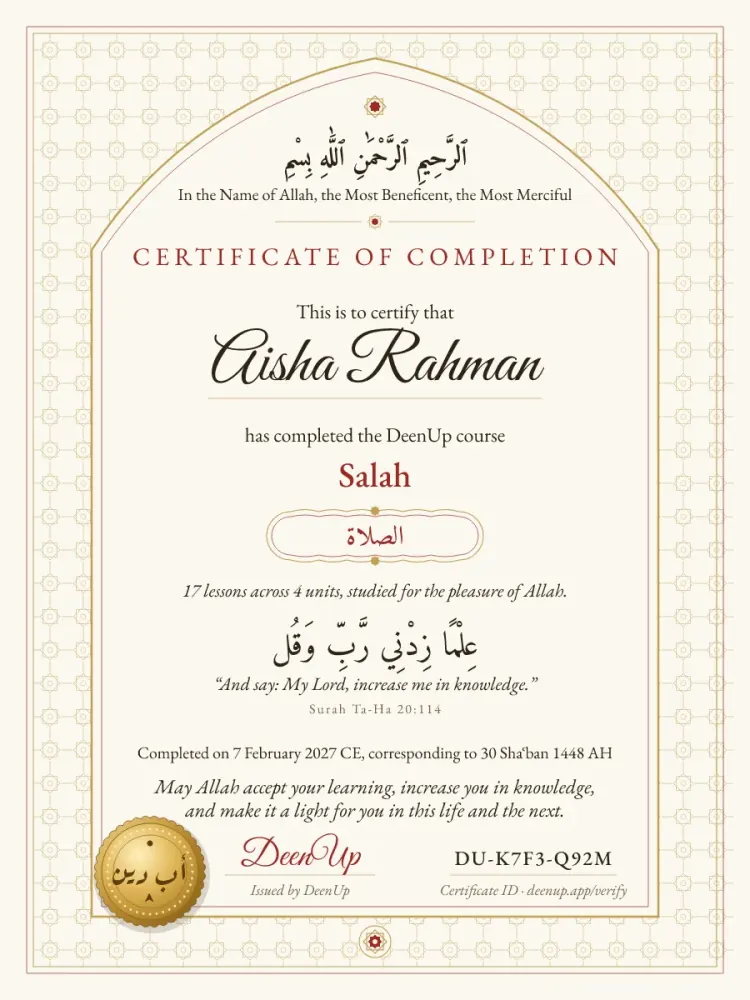
The essentials of salah, fiqh and faith, step by step from authentic sources. Finish all 28 days and earn a verifiable Certificate of Completion.
Take the free quizAnswer a few questions and get your personal plan.
Forms of Islamic Zikr Beyond the Core Phrases
Zikr is broader than the four phrases. The scholars identified four main categories:
Verbal zikr (zikr bil-lisan): The most familiar form — reciting SubhanAllah, Alhamdulillah, Astaghfirullah, and similar phrases aloud or under the breath. This includes the post-prayer tasbih, the morning/evening adhkar, and duas for daily activities.
Heart-based zikr (zikr bil-qalb): Reflecting on Allah's names and attributes — His mercy, His power, His knowledge — without necessarily speaking. The Quran calls this tafakkur (reflection) and pairs it with physical observation: "Who remember Allah while standing, sitting, and lying on their sides and reflect upon the creation of the heavens and the earth" (Surah Al-Imran, 3:191).
Zikr through action: Acts of worship performed entirely for Allah — salah, fasting, Quran recitation, feeding the poor — are themselves forms of remembrance. This is why the Quran says salah prevents indecency and wrongdoing (Surah Al-Ankabut, 29:45): prayer performed as genuine zikr reshapes behavior.
Istighfar (seeking forgiveness): The Prophet ﷺ himself sought forgiveness more than 70 times a day (Sahih al-Bukhari 6307) and 100 times per day according to Sahih Muslim 2702. For a detailed practice guide, our guide to the benefits of istighfar explains the conditions for accepted repentance and the specific forms the Prophet ﷺ used most.
Building a Daily Zikr Practice That Lasts
The most common failure in zikr practice is trying to do too much too fast, then abandoning it when consistency slips. The Prophet ﷺ's principle was the opposite: "The most beloved deed to Allah is the most regular, even if it is small" (Sahih al-Bukhari 6464).
A sustainable starting structure:
After Fajr (10 minutes): Morning adhkar + 100x Astaghfirullah. This anchors the day before the world's noise begins.
After each prayer (2 minutes): 33x SubhanAllah, 33x Alhamdulillah, 33x Allahu Akbar, 1x La ilaha illallah... This gives you 10 minutes of post-prayer zikr daily with almost no additional time cost.
After Asr (5 minutes): Evening adhkar. These function as a protective shell for the second half of the day.
Before sleep (2 minutes): 33x SubhanAllah, 33x Alhamdulillah, 34x Allahu Akbar — the bedtime tasbih of Fatimah (Sahih al-Bukhari 3113), which the Prophet ﷺ said is better than a servant.
This totals less than 20 minutes daily. Within weeks, zikr begins spilling naturally into the spaces between — waiting for a meeting, sitting in traffic, standing in a queue. That transition from scheduled practice to spontaneous habit is the goal of every dhikr tradition.
For a broader framework of daily Islamic remembrance — combining dhikr with salah and dua into one consistent routine — our guide to dhikr after salah and the importance of dhikr offer complementary perspectives. The Sunnah.com hadith collection on remembrance of Allah gives the primary sources for the Prophet's ﷺ own daily practice. The SeekersGuidance overview of dhikr and its categories clarifies the scholarly position on silent versus vocal remembrance for those with further questions.
Your personal 28-Day Deen Plan
Learn your deen in 28 days, 5 minutes a day
The essentials of salah, fiqh and faith, step by step from authentic sources. Finish all 28 days and earn a verifiable Certificate of Completion.
Take the free quizAnswer a few questions and get your personal plan.
Closing: The Heart That Never Goes Quiet
Zikr is not a task on a list. It is the natural state of a heart that knows who it belongs to. The Prophet ﷺ's zikr was not a performance — it was an overflow of a heart that never stopped being aware of Allah. That awareness is what we are building, one SubhanAllah at a time, one Alhamdulillah after another.
Start with the post-prayer tasbih. Add the morning adhkar one phrase at a time. Let each small act of remembrance root itself until it no longer requires effort — until the absence of zikr is what feels strange. That is the state the Quran is pointing toward when it says: "Verily, in the remembrance of Allah do hearts find rest."
Frequently Asked Questions
What is zikr in Islam?
Zikr (also spelled dhikr) is the Islamic practice of remembering Allah through verbal phrases, heartfelt reflection, or actions dedicated to Him. The Quran commands it in Surah Al-Ahzab 33:41 — 'O you who believe, remember Allah much' — and identifies it as the foundation of a heart at peace (Surah Ar-Ra'd, 13:28).
What are the most powerful zikr phrases in Islam?
The most emphasized zikr phrases are: SubhanAllah (Glory be to Allah), Alhamdulillah (All praise is for Allah), Allahu Akbar (Allah is the Greatest), and La ilaha illallah (There is no god but Allah). The Prophet ﷺ said the four most beloved phrases to Allah are SubhanAllah, Alhamdulillah, La ilaha illallah, and Allahu Akbar (Sahih Muslim 2137).
How many times should I recite zikr?
Common authenticated counts are: SubhanAllah, Alhamdulillah, and Allahu Akbar 33 times each after every prayer (Sahih al-Bukhari 843), and SubhanAllah wa bihamdihi 100 times per day to erase sins (Sahih al-Bukhari 6405). Istighfar (Astaghfirullah) 100 times per day was the Prophet's ﷺ own practice (Sahih Muslim 2702). There is no obligatory number for voluntary zikr — more is better.
Can I do zikr silently?
Yes — both silent (in the heart) and verbal zikr are valid and recommended. The Quran encourages humble, non-loud remembrance: "Remember your Lord within yourself in humility and fear, and without loudness in words" (Surah Al-Araf, 7:205). Silent heart-based zikr is often considered deeper in sincerity, while verbal zikr makes the remembrance more intentional and consistent.
What is the best time to do zikr?
The best times for zikr are: after each of the five daily prayers, in the morning after Fajr and evening after Asr (the morning and evening adhkar), during sujood, and in the last third of the night. The Prophet ﷺ also made abundant zikr throughout ordinary daily activities — entering and leaving the home, eating, traveling, and sleeping — turning every moment into worship.
Is counting zikr on a tasbih (prayer beads) allowed?
Yes — using tasbih (prayer beads) or any other counting method is permissible and was practiced by some companions. The Prophet ﷺ said counting on the fingers is preferred (Sunan Abu Dawud 1501), since the fingers will testify on the Day of Judgment. Both methods are valid; use whichever helps you remain consistent and present.
Does zikr replace salah?
No. Zikr and salah are complementary, not interchangeable. Salah is an obligatory formal prayer with specific conditions and structure; zikr is an ongoing informal remembrance woven throughout the day. Salah itself contains zikr — Al-Fatiha, tashahhud, and the tasbih of ruku/sujood are all forms of dhikr. Missing obligatory salah cannot be compensated for by extra zikr.