

- Authors

- Name
- Ahmad
- Role
- Senior Marketing Manager, Islamic education • DeenUp
بِسْمِ اللهِ الرَّحْمٰنِ الرَّحِيْمِ
In the name of God, the Most Gracious, the Most Merciful.
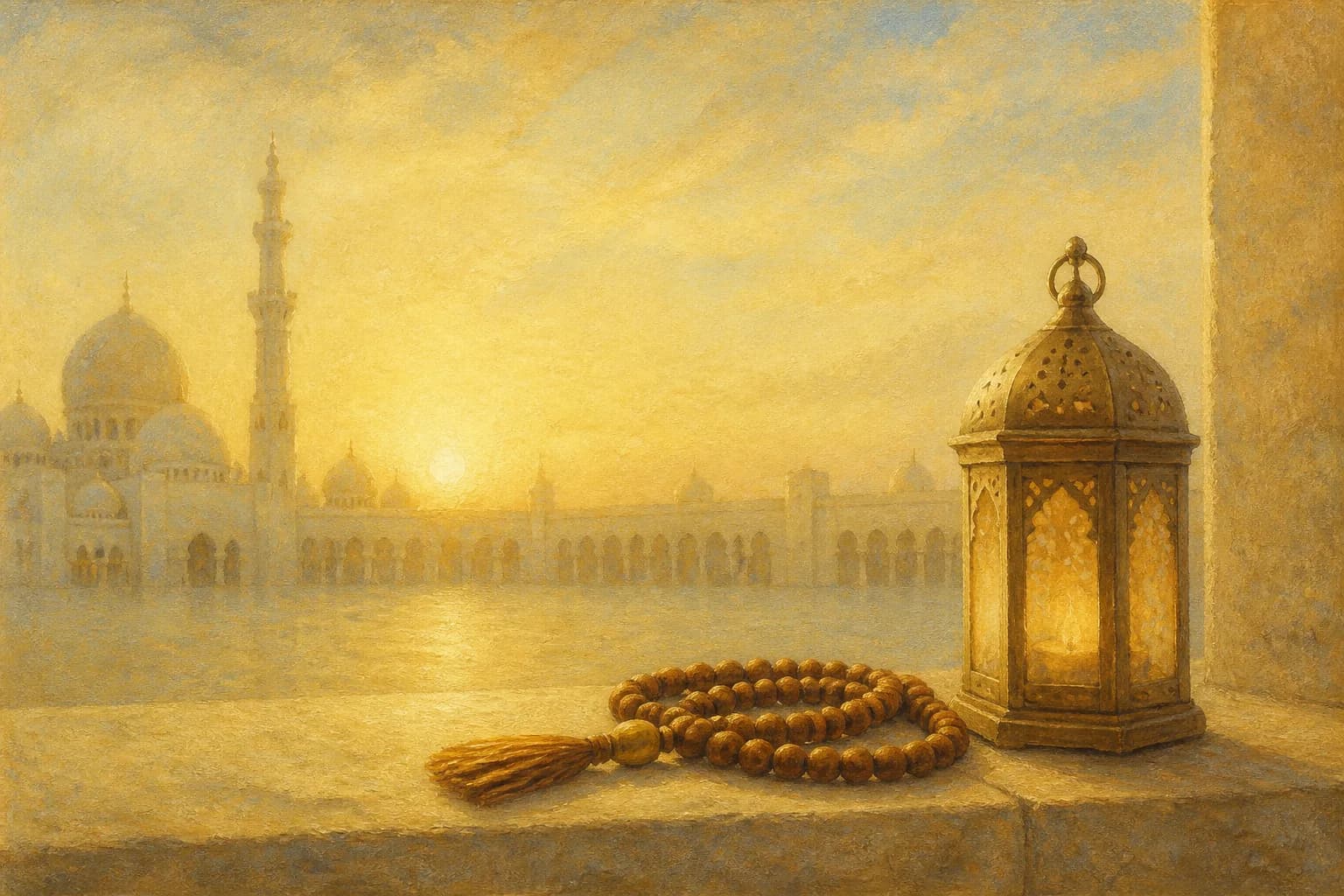

The Prophet ﷺ never let the evening come without marking it. After the Asr prayer, as the day moved toward its close and the light began to shift, he would recite the adhkar al-masa' (أَذْكَارُ الْمَسَاءِ): the evening remembrances. A set of authenticated supplications that seal the day and seek divine protection for the night ahead.
If the morning adhkar open the day under the name of Allah, the evening adhkar close it the same way. Together, they form a complete frame around the waking hours — a deliberate daily practice of turning toward Allah at both ends of the daylight and trusting Him with what lies in between.
What the Evening Adhkar Are and When to Say Them
The evening adhkar (adhkar al-masa') are the counterpart to the morning adhkar (adhkar al-sabah). They are primarily drawn from the same hadith collections — Abu Dawud, Tirmidhi, Sahih Muslim, Sahih Bukhari — with many of the same formulas adjusted for the evening context.
The traditional time for evening adhkar is after Asr prayer. The Quran marks this transition:
أَقِمِ الصَّلَاةَ لِدُلُوكِ الشَّمْسِ إِلَىٰ غَسَقِ اللَّيْلِ وَقُرْآنَ الْفَجْرِ
"Establish prayer at the decline of the sun until the darkness of the night, and [recite] the Quran of dawn." — (Surah Al-Isra, 17:78)
The decline of the sun marks Asr time — the opening of the evening adhkar window. This continues until just before sunset (Maghrib), though some scholars permit it until the start of the night.
The Core Evening Adhkar with Arabic and Translations
The Evening Opening Supplication
اللَّهُمَّ بِكَ أَمْسَيْنَا، وَبِكَ أَصْبَحْنَا، وَبِكَ نَحْيَا، وَبِكَ نَمُوتُ، وَإِلَيْكَ الْمَصِيرُ
Allahumma bika amsayna, wa bika asbahna, wa bika nahya, wa bika namutu, wa ilaykal-masir
"O Allah, by You we enter the evening, by You we enter the morning, by You we live, by You we die, and to You is the destination." — (Abu Dawud 5068, Tirmidhi 3391)
Notice the subtle shift from the morning version: in the morning, the closing phrase is wa ilaykan-nushur ("to You is the resurrection"). In the evening, it becomes wa ilaykal-masir ("to You is the destination"). The morning looks toward judgment; the evening looks toward the journey. Both ground the believer in what is real.
Seeking Refuge with the Complete Words of Allah
أَعُوذُ بِكَلِمَاتِ اللَّهِ التَّامَّاتِ مِنْ شَرِّ مَا خَلَقَ
A'udhu bi kalimatillahit-tammati min sharri ma khalaq
"I seek refuge in the complete words of Allah from the evil of what He has created."
The Prophet ﷺ said: "Whoever says this in the evening three times — nothing will harm him that night." (Sahih Muslim 2709)
This is one of the clearest protective promises in the hadith literature. Three repetitions. A few seconds each time. Protection for the entire night.
The Bismillah Shield — Three Times
بِسْمِ اللَّهِ الَّذِي لَا يَضُرُّ مَعَ اسْمِهِ شَيْءٌ فِي الْأَرْضِ وَلَا فِي السَّمَاءِ وَهُوَ السَّمِيعُ الْعَلِيمُ
Bismillahil-ladhi la yadurru ma'as-mihi shay'un fil-ardi wa la fis-sama'i wa huwas-sami'ul-alim
"In the name of Allah, with whose name nothing on earth or in heaven can cause harm, and He is the All-Hearing, the All-Knowing."
Said three times in the morning and evening, the Prophet ﷺ promised: "Nothing will harm him." (Abu Dawud 5088, Tirmidhi 3388) This supplication specifically invokes the divine name as a shield — the name itself as protection.
SubhanAllah wa Bihamdihi — 100 Times
سُبْحَانَ اللَّهِ وَبِحَمْدِهِ
SubhanAllahi wa bihamdihi
"Glory be to Allah and all praise is for Him."
As with the morning, saying this 100 times in the evening carries enormous weight: "No one will come on the Day of Resurrection with better deeds — except one who said the same or more." (Sahih Muslim 2692)
This is the same formula and the same reward in both morning and evening. The Prophet ﷺ taught it for both, which signals that it is not a practice for spiritual emergencies — it is daily currency.
The Three Quls and Ayatul Kursi
Reciting Surah Al-Ikhlas, Al-Falaq, and An-Nas three times each in the evening provides comprehensive protection — they "suffice you against everything." (Abu Dawud 5082) Ayatul Kursi (Al-Baqarah 2:255) in the evening offers the same divine guardianship it does in the morning, bridging the gap until the next obligatory prayer.
Why the Evening Adhkar Have Their Own Character
The morning adhkar are about beginning — you open the day by handing it to Allah. The evening adhkar have a different quality: they are about closing. The day is done, with whatever it contained — the good deeds and the mistakes, the moments of gratitude and the moments of heedlessness. The evening adhkar do not pretend the day was perfect. They seal it, seek protection for the night, and return everything to Allah.
This is why several evening adhkar carry a particular quality of tawakkul — trust and reliance. The supplication "to You is the destination" (wa ilaykal-masir) is an acknowledgment that the day was borrowed. The night belongs to Allah just as the day did.
There is a rhythm the Quran points to: morning remembrance, evening remembrance, and everything in between shaped by that bracketing. "Remember Allah with much remembrance, and exalt Him morning and afternoon." (Surah Al-Ahzab, 33:41-42) The morning and evening adhkar are the direct expression of this command — not a metaphor, but a practice.
Building the Evening Adhkar Habit
Most Muslims who struggle with evening adhkar face the same challenge: by Asr time, the day is fully in motion. The quiet of the morning has long passed. Obligations, conversations, and fatigue compete for the minutes between Asr and sunset.
The simplest fix is pairing: complete the evening adhkar immediately after Asr prayer ends, before leaving the prayer space. What gets deferred usually gets skipped. What gets done in sequence gets done.
Start with the minimum protection set: the evening opening supplication (Allahumma bika amsayna), A'udhu bi kalimatillahit-tammati three times, and the three Quls once each. This takes under two minutes and covers the most emphasized protective remembrances. Build from there.
Use the commute if Asr is during the work day. Many Muslims pray Asr at work or school. The drive, walk, or journey home can hold the evening adhkar. Keep a reference on your phone and use the transition time deliberately.
For the full paired practice — opening and closing the day in remembrance — our guide to morning adhkar in Islam covers the other half of this daily frame. And our broader article on the importance of dhikr gives the theological context that makes both morning and evening adhkar more than a routine.

Keep learning your deen with short, sourced lessons in DeenUp.
DeenBack's piece on finding inner peace through dhikr explores the connection between consistent dhikr and emotional steadiness — particularly relevant in the evening when the weight of the day tends to accumulate. And the tawakkul in daily life guide from Demi Manifest complements evening adhkar by exploring what genuine reliance on Allah looks like when the day ends.
For source verification, the protection hadith is available at sunnah.com and the Quranic command for evening remembrance at quran.com.
The Transition the Evening Adhkar Create
Something changes in the quality of an evening when it is bracketed by adhkar. This is not a claim about emotional states — it is an observation about where attention goes.
An evening spent moving directly from work to screen to sleep leaves no hinge point. The day bleeds into the night without orientation. The evening adhkar insert a deliberate pause: this is the end of the day, this is where I am, this is who I belong to.
The seeking of refuge from harm, the praise of Allah, the explicit acknowledgment that life and death are in His hands — these are not performance. They are a recalibration. And the night that follows a recalibrated evening is different from the night that follows distraction.
Our guide on dua for sleeping covers the specific supplications for the moment of settling into sleep, which flows naturally from evening adhkar. The two practices together — evening adhkar after Asr, sleep supplications at bedtime — create the full prophetic evening practice. And benefits of istighfar is worth reading alongside both, because seeking forgiveness in the evening is specifically mentioned in hadith as a key practice before night.
A Feed Worth Scrolling
Swipe through short, scholar-approved Islamic lessons instead of mindless doom-scrolling.
Learn Through Play
Bite-sized lessons, quizzes, levels, and daily streaks make growing your Deen a habit.
Scholar-Approved
Every lesson is rooted in the Quran and authentic Sunnah and reviewed by qualified scholars.
Closing
The day does not have to end the way it drifted — scattered, distracted, carrying whatever the last notification brought. Evening adhkar are a choice to end it deliberately, in the remembrance of the One who gave it.
A'udhu bi kalimatillahit-tammati min sharri ma khalaq — three times. That is the minimum. That is the foundation. Everything else builds on it.
The morning and the evening, bracketed by remembrance: this is the shape of a day lived in conscious Islam.
Keep learning your deen with short, sourced lessons in DeenUp.
Frequently Asked Questions
When exactly should I recite evening adhkar?
Evening adhkar are traditionally recited after Asr prayer and can continue until the sun sets. Some scholars extend the window until just before Maghrib. Consistency with the Asr time builds the best habit.
Are the evening adhkar the same as morning adhkar?
Many are nearly identical but use evening-specific wording. Allahumma bika asbahna in the morning becomes Allahumma bika amsayna in the evening. Some supplications are unique to the evening alone.
What is the most important evening dhikr?
Scholars often highlight seeking refuge with the complete words of Allah from the evil of creation, the three Quls, and Ayatul Kursi — these together form a comprehensive nighttime protection.
Can I combine morning and evening adhkar if I missed one set?
Each set has its appointed time and purpose. If the morning window has closed, those adhkar are not repeated in the evening. Resume with the evening adhkar at their proper time and maintain consistency from there.
What if I fall asleep before finishing evening adhkar?
If sleep overtakes you before completing them, scholars say there is no sin. Effort and intention count. A shorter consistent set is better than aiming for the full collection and often skipping entirely.