

- Authors

- Name
- Ahmad
- Role
- Senior Marketing Manager, Islamic education • DeenUp
بِسْمِ اللهِ الرَّحْمٰنِ الرَّحِيْمِ
In the name of God, the Most Gracious, the Most Merciful.
Quick answer
Is there a specific dua to help you wake up for Fajr?
There is no single hadith with a dua exclusively for waking up for Fajr. However, the Sunnah provides two paths: bedtime duas that set the intention and ask Allah for a blessed morning, and the Prophet's teaching that sincere intention before sleep is recorded as worship even if you sleep through (Sunan al-Nasai 1787).
Wanting to pray Fajr and actually praying Fajr consistently are two different things. Most Muslims who miss it do not miss it because they do not care — they miss it because the gap between sincere intention and the alarm going off at 4am is harder to close than it looks.
One of the most overlooked tools for this is dua. Not a vague "help me wake up" but actual, specific supplications — the bedtime duas the Prophet ﷺ taught, the dua upon waking, and the practice of making personal supplication to Allah before sleeping, asking Him specifically to help you rise for His prayer.
What Is the Dua to Wake Up for Fajr?
There is no single hadith that records a specific dua exclusively for the purpose of waking up for Fajr. What the Sunnah gives us is better: a full set of bedtime adhkar that orient your night toward Allah's care, the guidance to make sincere personal du'a for any specific need including this one, and the assurance that sincere intention before sleep is recorded as worship. The Prophet ﷺ said: "Whoever goes to sleep intending to pray the night prayer but oversleeps, his sleep is a sadaqah from his Lord, and what he intended is written for him." (Sunan al-Nasai 1787)
The Bedtime Duas That Set Your Night Right
Dua Before Sleeping
The first step is to go to sleep with your mouth in the right place. The established bedtime dua is:
بِسْمِكَ اللَّهُمَّ أَمُوتُ وَأَحْيَا
Bismika Allahumma amutu wa ahya
"In Your name, O Allah, I die and I live." — (Sahih al-Bukhari 6312)
This is not a figure of speech. Sleep is described in the Quran as a minor death — wafat — and waking is ba'th, resurrection. By beginning sleep in Allah's name, you are entrusting your waking to Him.
The Personal Du'a for Fajr
After your bedtime adhkar, make a brief personal supplication. There is no fixed formula — this is du'a al-mas'alah, asking Allah directly for what you need:
"O Allah, I want to pray Fajr. Wake me for it. Help me rise before the sun. I place my night in Your hands."
The Quran encourages exactly this kind of direct asking:
وَقَالَ رَبُّكُمُ ادْعُونِي أَسْتَجِبْ لَكُمْ
"And your Lord says: Call on Me, and I will respond to you." — (Surah Ghafir, 40:60)
Scholars note that this personal supplication is itself an act of worship — it acknowledges that your ability to wake up for Fajr comes from Allah, not from your alarm clock or your own willpower.
Ayat al-Kursi Before Sleeping
Reciting Ayat al-Kursi before sleeping is established in Sahih al-Bukhari 2311. A man once came to the Prophet and taught him to recite it before sleeping, and the Prophet confirmed: "He spoke the truth, though he is a liar — that was Shaytan." The effect noted is that a guardian (angel) protects the person through the night and Shaytan cannot approach until morning.
اللَّهُ لَا إِلَهَ إِلَّا هُوَ الْحَيُّ الْقَيُّومُ...
"Allah — there is no deity except Him, the Ever-Living, the Sustainer of existence..." — (Surah Al-Baqarah, 2:255)
Starting your night protected from Shaytan is not a small thing — it is Shaytan who makes Fajr feel impossible.
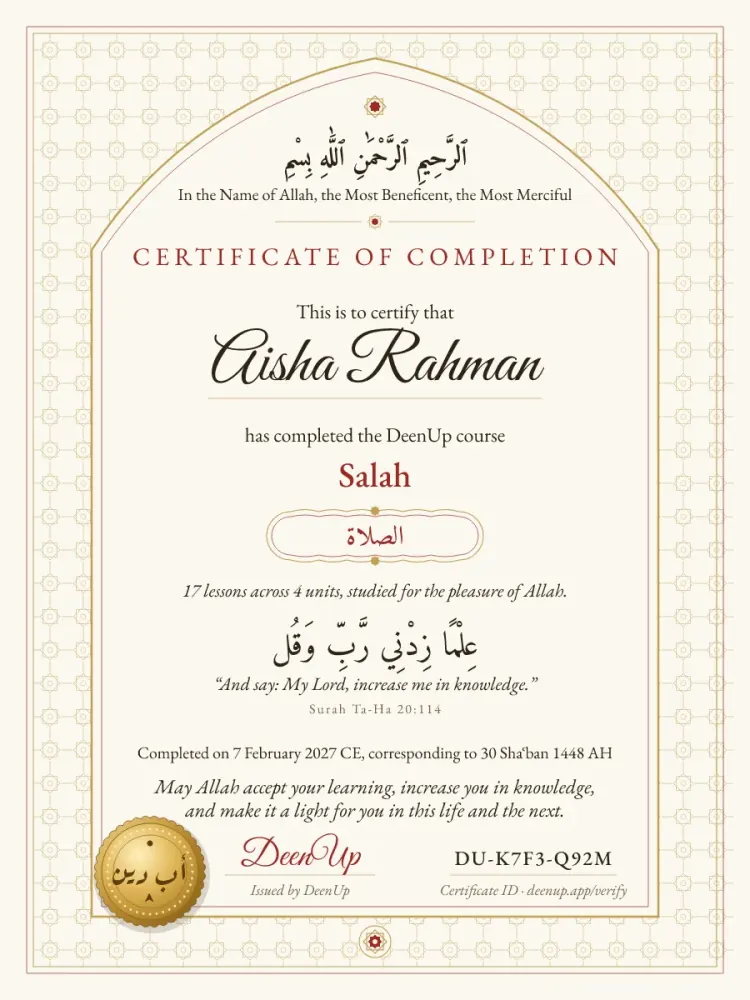
Your personal 28-Day Deen Plan
Learn your deen in 28 days, 5 minutes a day
The essentials of salah, fiqh and faith, step by step from authentic sources. Finish all 28 days and earn a verifiable Certificate of Completion.
Take the free quizAnswer a few questions and get your personal plan.
The Dua When You Wake Up
The transition from sleep to Fajr is its own moment of worship. The established Sunnah dua immediately upon waking is:
الْحَمْدُ لِلَّهِ الَّذِي أَحْيَانَا بَعْدَ مَا أَمَاتَنَا وَإِلَيْهِ النُّشُورُ
Alhamdulillah alladhi ahyana ba'da ma amatana wa ilayhi al-nushur
"Praise be to Allah who gave us life after causing us to die, and to Him is the resurrection." — (Sahih al-Bukhari 6312)
This dua does something specific: it reframes waking up as a gift. Instead of the first thought being "already?" or a scroll through your phone, the first words out of your mouth acknowledge that you woke up at all because of Allah — not because your body decided to.
The dua wake up article covers the full set of waking adhkar and their contexts.
Bedtime Adhkar Reference
| Adhkar | Source | When to Recite |
|---|---|---|
| Bismika Allahumma amutu wa ahya | Sahih al-Bukhari 6312 | Immediately before sleeping |
| Ayat al-Kursi (2:255) | Sahih al-Bukhari 2311 | Before sleeping — protection through the night |
| Surah Al-Mulk (67) | Sunan al-Tirmidhi 2891 | Before sleeping — protection from punishment of the grave |
| Subhanallah (33x), Alhamdulillah (33x), Allahu Akbar (34x) | Sahih al-Bukhari 3113 | Before sleeping — the tasbih Fatimah |
| Personal dua for Fajr | General principle — Ghafir 40:60 | After bedtime adhkar, in your own words |
| Alhamdulillah alladhi ahyana... | Sahih al-Bukhari 6312 | Immediately upon waking |
The Intention Before Sleep
The hadith about intention is worth sitting with:
"Whoever goes to sleep intending to pray qiyam al-layl and then wakes up for it — the reward is written for him. And if he sleeps until morning, the reward for what he intended is written, and his sleep is a sadaqah from his Lord." — (Sunan al-Nasai 1787, Sunan Ibn Majah 1344)
This does not mean intention excuses habitually sleeping through Fajr. It means that when you genuinely try — when you go to sleep early, make your dua, set your alarm — and your body still fails you, Allah does not hold you to a standard He did not give you the capacity for in that moment. The merciful aspect of this teaching is that it removes the guilt spiral that stops people from trying again the next night.
Building the Fajr Dua Habit
The bedtime dua routine only works as a habit, not as a one-time effort. Here is a practical structure:
Before sleeping:
- Complete wudu if you can (the Prophet often slept in a state of purity)
- Recite Ayat al-Kursi
- Recite Surah Al-Ikhlas, Al-Falaq, Al-Nas (three times each — Sahih al-Bukhari 5017)
- Recite the tasbih of Fatimah (33 Subhanallah, 33 Alhamdulillah, 34 Allahu Akbar)
- Recite Bismika Allahumma amutu wa ahya
- Make personal du'a asking Allah to wake you for Fajr
When the alarm goes off:
- Say Alhamdulillah alladhi ahyana...
- Splash cold water on your face before prayer hesitation sets in
- Begin wudu
The how to wake up for Fajr guide covers the practical side — sleep timing, alarm placement, and the habit architecture — in detail. The duas here are the spiritual dimension that the practical side sits inside of.
For the full morning adhkar sequence after Fajr, see morning adhkar in Islam.
The DeenBack guide to morning adhkar covers how the daily morning routine of remembrance transforms the whole day, and how to build it as a consistent practice. The DemiManifest piece on the Islamic morning routine looks at how consistent morning practice builds the inner architecture for an intentional Muslim life.
Fajr and Its Reward
Understanding what you are waking for matters. The Quran distinguishes Fajr by name:
أَقِمِ الصَّلَاةَ لِدُلُوكِ الشَّمْسِ إِلَى غَسَقِ اللَّيْلِ وَقُرْآنَ الْفَجْرِ إِنَّ قُرْآنَ الْفَجْرِ كَانَ مَشْهُودًا
"And the recitation of dawn — indeed, the recitation of dawn is ever witnessed." — (Surah Al-Isra, 17:78)
The word mashhud — "witnessed" — means the angels of the night and the angels of the day both gather at Fajr. The Prophet confirmed: "Angels come to you in succession by night and by day, and they all assemble at the time of Fajr prayer and Asr prayer." (Sahih al-Bukhari 555)
You are not just waking up early. You are stepping into a moment that has the full attention of the angelic realm.
For more on the significance of Fajr, see Fajr prayer benefits and the full step-by-step guide at how to pray Fajr.
Common Questions
What if I keep trying and still miss Fajr? Examine the cause honestly. Is it sleep time? Go to bed 30 minutes earlier. Is it the alarm? Put it across the room. Is it going back to sleep after waking? Make wudu immediately — it is very hard to fall asleep again after wudu. The Prophet's household woke each other; having an accountability partner or family member who calls you works far better than relying on yourself alone.
Does making dua at night count as extra worship? Yes. Making dua before sleeping is itself ibadah. The Prophet said: "The supplication of a Muslim for his brother in his absence is answered." (Sahih Muslim 2733) When you ask Allah to help you wake for Fajr, you are turning a sleep routine into an act of worship.
Can I make the dua in English if I do not know Arabic? Yes. Personal du'a — asking Allah for your specific needs — can be in any language. Allah understands all tongues and knows what is in your heart before you speak. The fardh (obligatory) salah requires Arabic; personal du'a does not.
Closing
The dua to wake for Fajr is not a magic phrase. It is the act of going to sleep in a state of intention — having asked Allah for the gift of rising before the sun, having placed your night under His care, and having reminded yourself of what the morning prayer means. Every night you do this, you are building a relationship with Fajr, one honest supplication at a time.
"And from the night, pray with it as additional worship for you; it is expected that your Lord will resurrect you to a praised station." — (Surah Al-Isra, 17:79)
Your personal 28-Day Deen Plan
Learn your deen in 28 days, 5 minutes a day
The essentials of salah, fiqh and faith, step by step from authentic sources. Finish all 28 days and earn a verifiable Certificate of Completion.
Take the free quizAnswer a few questions and get your personal plan.
Frequently Asked Questions
Is there a specific dua to help you wake up for Fajr?
There is no single hadith with a dua exclusively for waking up for Fajr. However, the Sunnah provides two paths: bedtime duas that set the intention and ask Allah for a blessed morning, and the Prophet's teaching that sincere intention before sleep is recorded as worship even if you sleep through (Sunan al-Nasai 1787).
What dua do you say when you wake up for Fajr?
Upon waking, say: Alhamdulillah alladhi ahyana ba'da ma amatana wa ilayhi al-nushur (Praise be to Allah who gave us life after causing us to die, and to Him is the resurrection). This is from Sahih al-Bukhari 6312 and is the established Sunnah dua immediately upon waking.
What is the bedtime dua to say before sleeping for Fajr?
The Prophet taught several bedtime duas. One comprehensive supplication is: Bismika Allahumma amutu wa ahya (In Your name, O Allah, I die and I live) — Sahih al-Bukhari 6312. Making personal dua asking Allah specifically to wake you for Fajr is also authentic; the Prophet encouraged direct personal supplication to Allah for all needs.
Does making intention to wake for Fajr count if I oversleep?
Yes. The Prophet said: 'Whoever goes to sleep intending to pray qiyam al-layl but oversleeps — his sleep is a sadaqah from his Lord, and what he intended is written for him' (Sunan al-Nasai 1787, Sunan Ibn Majah 1344). Missing Fajr due to genuine deep sleep after sincere intention is not sinful.
What surah or dhikr before sleeping helps with waking for Fajr?
Reciting Ayat al-Kursi before sleeping is established in Sahih al-Bukhari 2311, with the effect of protection through the night. Reciting Surah Al-Mulk is also from the Sunnah (Sunan al-Tirmidhi 2891). Both are part of the bedtime adhkar that set your night under Allah's protection and care.
Is it a sin to miss Fajr even after making dua to wake up?
Missing Fajr due to genuine oversleeping after sincere intention is forgiven. The Prophet said the pen is lifted for the sleeping person. What matters is what you do when you wake up — pray as soon as you remember, without delay. Consistently neglecting Fajr through avoidance, not accident, is a different and more serious matter.
Can I ask Allah in dua to wake me up for Fajr specifically?
Yes, absolutely. Personal dua (du'a al-mas'alah) is for exactly this kind of specific need. Ask Allah in your own words before sleeping: tell Him you want to pray Fajr, ask Him to wake you, and trust that He hears. The Quran says: 'Your Lord says: Call on Me, and I will respond to you' (Ghafir 40:60).