

- Authors

- Name
- Ahmad
- Role
- Senior Marketing Manager, Islamic education • DeenUp
بِسْمِ اللهِ الرَّحْمٰنِ الرَّحِيْمِ
In the name of God, the Most Gracious, the Most Merciful.
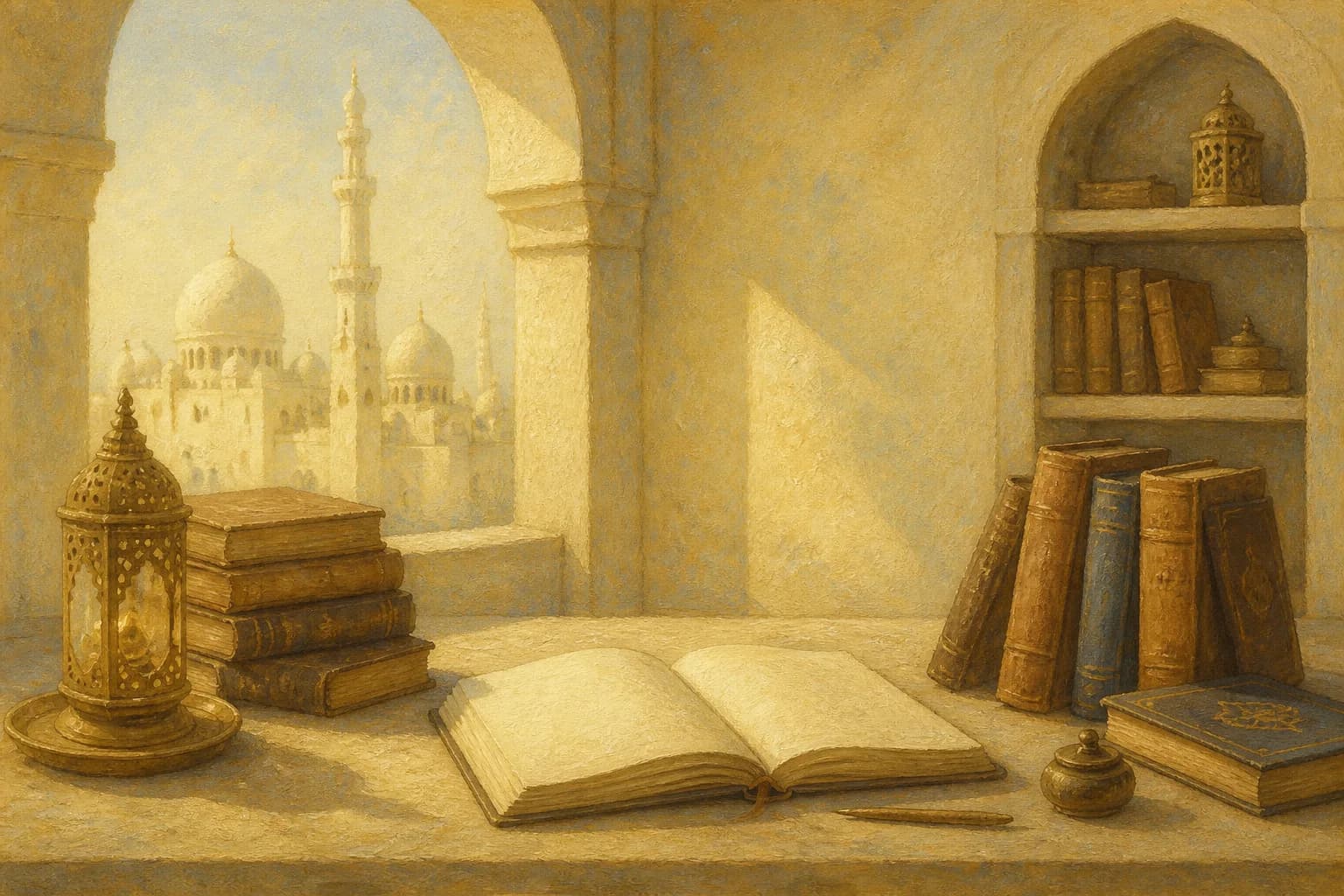

When you read about the Islamic Golden Age — the algebra, the hospitals, the translations that kept Greek philosophy alive — you are reading about the consequences of a single historical event: the rise of unified Islamic states. Within a century of the Prophet Muhammad's ﷺ death in 632 CE, a civilisation had formed that would shape medicine, mathematics, law, and trade for hundreds of years. Understanding what those states produced helps you understand not just history, but the faith that drove it.
What Were the Effects of the Rise of Islamic States?
The rise of Islamic states produced unified governance across three continents, a network of trade routes linking West Africa to Central Asia, and one of history's great intellectual bursts — the Islamic Golden Age (750–1258 CE). Within a century of the Prophet ﷺ, caliphates had extended from the Iberian Peninsula to Persia. Scholars at institutions like the House of Wisdom in Baghdad preserved and advanced human knowledge in mathematics, astronomy, medicine, and philosophy, transmitting much of it to medieval Europe.
What the Rise of Islamic States Actually Produced
The first Islamic state emerged in Medina in 622 CE, when the Prophet ﷺ signed the Constitution of Medina — one of the earliest pluralistic governance documents in history, establishing mutual rights and responsibilities between Muslim and Jewish communities. After his death in 632 CE, the Rashidun Caliphate continued that work: Abu Bakr RA unified the Arabian Peninsula, Umar RA established administrative provinces, and Uthman RA oversaw the compilation of the Quran into one authoritative text.
The Umayyad Caliphate (661–750 CE) expanded the state westward into Spain and North Africa and eastward into Central Asia, carrying Arabic language, Islamic law, and trade infrastructure across those regions. The Abbasid Caliphate (750–1258 CE) then turned inward to consolidate that knowledge. The Caliph Harun al-Rashid and his son Al-Mamun funded the House of Wisdom (Bayt al-Hikmah) in Baghdad, commissioning translations of Greek, Persian, Sanskrit, and Syriac texts into Arabic.
The Quran itself had set the intellectual tone. Allah says:
هَلْ يَسْتَوِي الَّذِينَ يَعْلَمُونَ وَالَّذِينَ لَا يَعْلَمُونَ
"Are those who know equal to those who do not know?" — (Surah Az-Zumar, 39:9)
That verse, combined with the Prophet's ﷺ hadith — "Seeking knowledge is an obligation upon every Muslim" (Ibn Majah 224) — produced a culture of inquiry that generated concrete, lasting civilisational output.
Key Effects of Islamic State Formation: A Reference
| Domain | Key Development | Period | Lasting Impact |
|---|---|---|---|
| Governance | Constitution of Medina; codification of Sharia | 622–661 CE (Rashidun) | Pluralistic civic law; property and contract frameworks |
| Science | House of Wisdom; algebra, optics, astronomy | 750–1100 CE (Abbasid) | Foundation of European Renaissance science |
| Medicine | Ibn Sina's Canon of Medicine (c. 1025 CE) | Abbasid | Standard medical text in European universities to the 17th c. |
| Mathematics | Al-Khwarizmi's algebra (c. 820 CE) | Abbasid | The word "algebra" derives from his Al-Kitab al-mukhtasar |
| Trade | Unified trade routes; standardised commercial law | Umayyad–Abbasid | Linked West Africa, Europe, South Asia, and China |
| Preservation | Translation of Greek, Persian, Indian texts | 750–1000 CE | Saved ancient knowledge that Europe later rediscovered |
What Knowledge Did Islamic States Preserve and Create?
The contribution to human knowledge was not only preservation — it was original creation. Al-Khwarizmi developed algebra around 820 CE, and the word "algorithm" derives from a Latin rendering of his name. Ibn al-Haytham (965–1040 CE) wrote the Book of Optics, establishing the modern science of light. Ibn Sina's Canon of Medicine (c. 1025 CE) remained a standard medical text in European universities until the 17th century. Al-Biruni calculated the circumference of the Earth in the 11th century to within a fraction of a modern reading.
These were Muslims motivated by a direct reading of the Quran. Allah describes the purpose of knowledge:
يُؤْتِي الْحِكْمَةَ مَن يَشَاءُ ۚ وَمَن يُؤْتَ الْحِكْمَةَ فَقَدْ أُوتِيَ خَيْرًا كَثِيرًا
"He gives wisdom to whom He wills, and whoever has been given wisdom has certainly been given much good." — (Surah Al-Baqarah, 2:269)
Wisdom (hikmah) in this tradition was not abstract speculation — it was knowledge applied to the service of humanity and the worship of Allah. The Islamic states created an institutional environment in which that vision became science, medicine, law, and literature.
Why Does This History Matter for Muslims Today?
Modern Muslims sometimes encounter a narrative that frames Islam as a religion of restriction rather than flourishing. The historical record of what Islamic states produced is one clear answer to that misreading. The faith that gave algebra to the world, that established hospitals with paid staff and separate wards for different conditions, that unified trade across three continents through commercial law rooted in fairness — that is the same faith you practice today.
The Quran declares:
كُنتُمْ خَيْرَ أُمَّةٍ أُخْرِجَتْ لِلنَّاسِ تَأْمُرُونَ بِالْمَعْرُوفِ وَتَنْهَوْنَ عَنِ الْمُنكَرِ
"You are the best nation produced for mankind, enjoining what is right, forbidding what is wrong." — (Surah Al-Imran, 3:110)
That verse was not a prediction of effortless greatness — it was a calling. The Islamic states that rose after the Prophet ﷺ answered that calling by building institutions of governance, scholarship, and justice. Understanding their legacy is not nostalgia. It is knowing who you are and what you are capable of.
Still searching for a clear Islamic answer?
Explore sourced answers rooted in the Quran, authentic hadith, and respected scholarship—without getting lost in conflicting search results.
Take the Islam Quiz
How to Connect This Legacy to Your Daily Practice
Connecting Islamic history to your own life is not a matter of being a scholar — it is a matter of embodying the same values that drove those scholars. A few practical ways to carry the legacy forward:
- Pursue knowledge in your field with intention (niyyah). The scholars of the Golden Age were doctors, astronomers, and mathematicians who understood their work as an act of worship. Naming your professional work as service to Allah changes its character.
- Read the Quran with context, not just recitation. Many of the Quranic verses that drove Islamic civilisation are short and familiar — 39:9 (those who know vs. those who don't), 2:269 (wisdom as a great gift). Reading them with historical awareness deepens their meaning.
- Learn the names and stories of Muslim scholars. Al-Kindi, Al-Farabi, Ibn Rushd, Ibn Battuta, Ibn Khaldun — these are your tradition's giants. Knowing them is part of knowing yourself as a Muslim. The famous Muslims in history article goes deeper on this.
- Trace your current knowledge back to its roots. Algebra, the decimal number system, much of medieval medicine — these passed into the modern world through Islamic hands. That awareness gives daily study a different weight.
Signs You Are Engaging Seriously with This Legacy
You know you are genuinely connecting with Islamic civilisational history when you can:
- Name two or three Muslim scholars and explain their specific contributions
- Explain the difference between the Rashidun, Umayyad, and Abbasid caliphates and what each is known for
- Cite the Quranic verses that drove Islamic scholarship — and understand why they motivated scientists, not just theologians
- Explain how Islamic commercial law shaped global trade, not just how the state expanded militarily
- Connect your own work or study to the same imperative that drove the House of Wisdom
These are not examination questions — they are signs of a Muslim who treats their tradition as a living inheritance, not just a historical artifact.
Explore Further
For a fuller picture of the civilisational arc from the Prophet's ﷺ time to the Golden Age:
- The Expansion of Islam — how the early caliphates spread across three continents
- How Did Islam Spread? — trade, scholarship, and the role of Sufi missionaries
- The Islamic Civilization Golden Age — the Abbasid era in depth
- The Golden Period of Islam — what made the Golden Age possible
- The Arab Conquest — the military campaigns that opened the early caliphates
- The Abbasid Caliphate — the dynasty that produced the Islamic Golden Age
A Feed Worth Scrolling
Swipe through short, scholar-approved Islamic lessons instead of mindless doom-scrolling.
Learn Through Play
Bite-sized lessons, quizzes, levels, and daily streaks make growing your Deen a habit.
Scholar-Approved
Every lesson is rooted in the Quran and authentic Sunnah and reviewed by qualified scholars.
Still searching for a clear Islamic answer?
Explore sourced answers rooted in the Quran, authentic hadith, and respected scholarship—without getting lost in conflicting search results.
Take the Islam QuizFrequently Asked Questions
What were the main effects of the rise of Islamic states?
The rise of Islamic states produced unified governance, expanded trade networks, and a scientific golden age. Within a century of the Prophet Muhammad ﷺ, Islamic caliphates stretched from Spain to Central Asia, preserving Greek texts, founding hospitals, and advancing algebra, astronomy, and medicine.
How did Islamic states contribute to science and knowledge?
The Abbasid Caliphate established the House of Wisdom (Bayt al-Hikmah) in Baghdad around 830 CE, where scholars translated Greek, Persian, and Indian texts. Al-Khwarizmi developed algebra around 820 CE. Ibn Sina wrote the Canon of Medicine, used in European universities until the 17th century.
What is the Islamic Golden Age?
The Islamic Golden Age (roughly 750–1258 CE) was a period of extraordinary intellectual flourishing under the Abbasid Caliphate. Muslim scholars made foundational advances in mathematics, astronomy, medicine, philosophy, and geography that later shaped the European Renaissance.
What role did Islamic states play in trade and economics?
Islamic states unified vast trade networks across the Middle East, North Africa, and Central Asia, standardising weights, currency, and commercial law. The Quran and hadith encouraged honest trade, and Muslim merchants carried goods and ideas along routes from West Africa to China.
How did the rise of Islamic states affect law and governance?
The early caliphates codified Islamic law (Sharia) as a framework for governance, property, contracts, and personal rights. The Constitution of Medina (622 CE) established one of the earliest pluralistic civic charters, governing Muslims and Jewish tribes under shared principles of justice.
Why does the history of Islamic states matter for Muslims today?
Understanding this history grounds Muslim identity in a tradition of excellence, justice, and scholarship. The Prophet ﷺ taught that seeking knowledge is obligatory for every Muslim (Ibn Majah 224). The Islamic states that rose from that teaching left a civilisational legacy every Muslim inherits.
Which caliphate is considered the greatest in Islamic history?
Scholars differ, but many consider the Abbasid Caliphate (750–1258 CE) the peak of Islamic civilisation because of its intellectual output and governance. Others emphasise the Rashidun Caliphate's (632–661 CE) closeness to the Prophet's ﷺ era and the companions' direct application of Quranic principles.