

- Authors

- Name
- Ahmad
- Role
- Senior Marketing Manager, Islamic education • DeenUp
بِسْمِ اللهِ الرَّحْمٰنِ الرَّحِيْمِ
In the name of God, the Most Gracious, the Most Merciful.
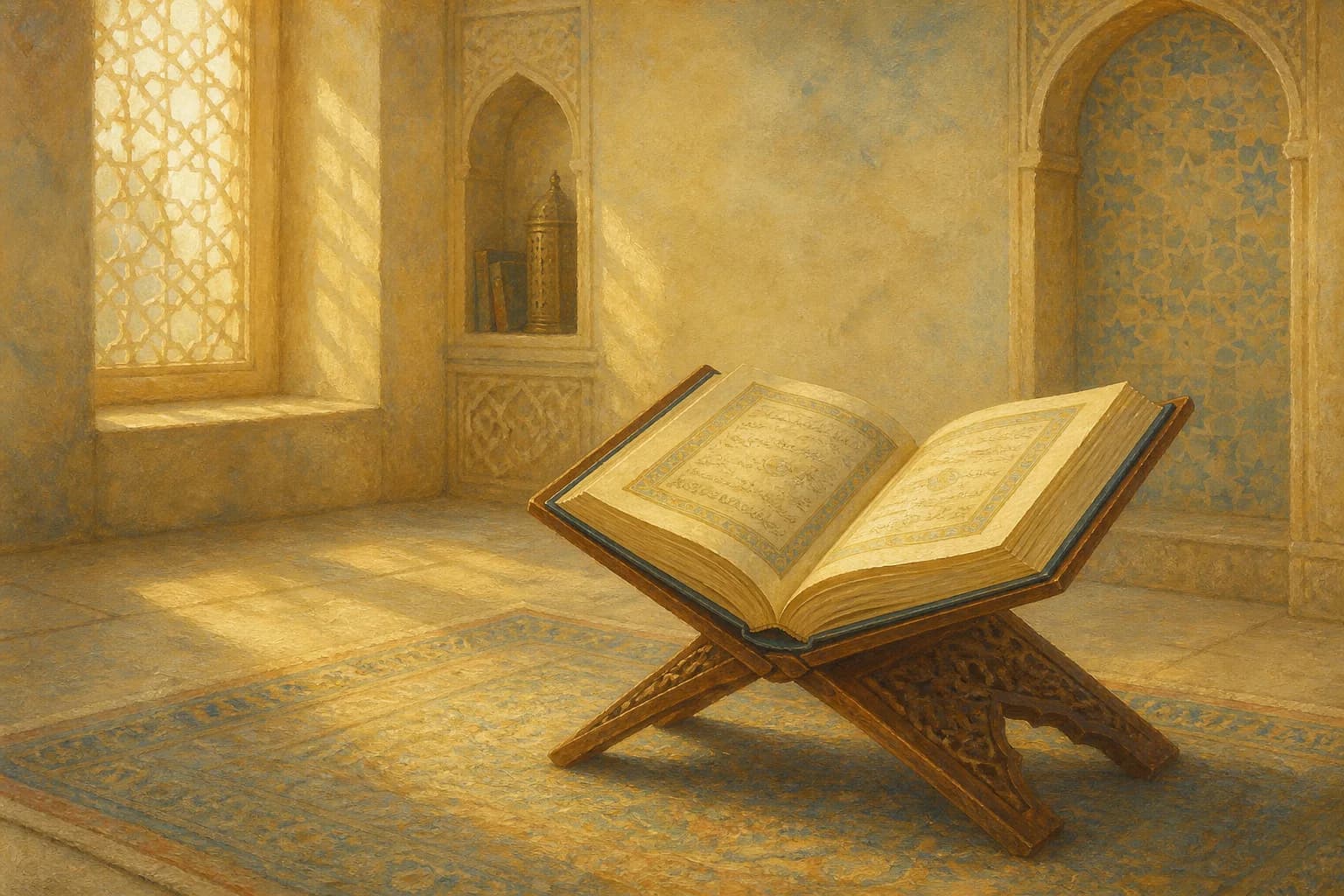

When someone asks "is the Quran the original text?" they are asking one of the most important questions in Islamic faith — and the answer shapes everything about how Muslims approach their daily relationship with the Book of Allah. Whether you grew up reciting it or you are encountering the Quran for the first time, understanding why it can be trusted changes the act of opening it.
What Is the Original Quran?
The original Quran is the complete, unchanged Arabic text of the divine revelation given to Prophet Muhammad ﷺ between 610 and 632 CE. Unlike other world scriptures that have passed through multiple authors, translations, and revisions, the Quran has been preserved through an unbroken chain of oral memorization and written documentation going back to the Prophet ﷺ himself. Every copy of the Quran on earth today contains the same Arabic text that was recited in the seventh century.
How Was the Quran Revealed and Recorded?
The Quran was not written as a single book during the Prophet's ﷺ lifetime — it was revealed gradually through the Angel Jibreel (Gabriel) over 23 years. Yet preservation began the moment each verse was revealed.
The Prophet's Own System
Prophet Muhammad ﷺ established two parallel methods of preservation from the very beginning:
Written documentation: He maintained a team of designated scribes (Kuttab al-Wahy), including Zayd ibn Thabit, Ali ibn Abi Talib, and Muawiyah ibn Abi Sufyan, who wrote down every verse on whatever materials were available — parchment, palm leaves, flat stones, and the shoulder blades of camels.
Oral memorization: The Prophet ﷺ recited the Quran aloud in daily prayers, in private teaching circles, and during the annual review (Ard) with Jibreel. Thousands of Companions — men and women — memorized portions or the entire text. Those who memorized it completely are called Huffaz (حفاظ).
The Prophet ﷺ himself specified the exact order of verses and chapters, telling his scribes precisely where each new revelation belonged within the growing text.
What Does "Mutawatir" Mean?
Islamic scholars use the term mutawatir (متواتر) to describe transmission that has been narrated by so many people at every generation that collective fabrication is impossible. The Quran's text is the highest example of mutawatir narration in history — verified simultaneously by written copies and the living memories of thousands of people who heard it directly from the Prophet ﷺ.
The Compilation Under Abu Bakr and Uthman
The Quran's history of formal compilation happened in two key stages, both driven by a concern to protect the original text.
The Battle of Yamama (632 CE)
Shortly after the Prophet's ﷺ passing, around 70 Huffaz were martyred at the Battle of Yamama. Umar ibn al-Khattab (may Allah be pleased with him) approached Caliph Abu Bakr with a concern: if more Huffaz died in battle, portions of the Quran could be lost.
Abu Bakr commissioned Zayd ibn Thabit — the Prophet's ﷺ personal scribe — to compile the complete written text. Zayd's methodology was rigorous:
| Stage | Method |
|---|---|
| Collection | Gathered all written records: parchments, stones, palm leaves |
| Verification | Each verse required at least two independent written witnesses |
| Cross-reference | All written material was confirmed by living Huffaz |
| Final text | A master codex was produced and entrusted to Hafsa bint Umar |
The Uthmanic Standardization (644–656 CE)
Under Caliph Uthman ibn Affan (may Allah be pleased with him), as Islam spread rapidly across different regions, minor dialectal variations in recitation began to appear. To prevent any fragmentation, Uthman ordered a committee — again led by Zayd ibn Thabit — to produce several identical copies of the master codex, which were sent to major Muslim cities with authoritative reciters. The original regional copies were gathered and, once the standard was established, recalled.
This is why the Arabic Quran is called the Mushaf Uthmani (مصحف عثماني) — the Uthmanic codex — and it is the text all printed Qurans are based on today.
Why This Matters for Every Muslim Today
The preservation of the Quran is not just a historical fact — it is the foundation of every Muslim's daily practice.
When you recite Bismillah ir-Rahman ir-Rahim (بِسْمِ اللَّهِ الرَّحْمَٰنِ الرَّحِيمِ) — "In the name of Allah, the Most Gracious, the Most Merciful" — you are saying the exact words that thousands of Companions memorized directly from the Prophet ﷺ. That chain of transmission has not broken.
Allah promised this directly:
إِنَّا نَحْنُ نَزَّلْنَا الذِّكْرَ وَإِنَّا لَهُ لَحَافِظُونَ
"Indeed, it is We who sent down the Dhikr and indeed, We will be its guardian." — (Surah Al-Hijr, 15:9)
This promise has been fulfilled in observable, historical fact: no other religious scripture has the same density of scholarly authentication, continuous memorization across 14 centuries, and cross-validated preservation.
For a Muslim who reads the Quran daily, this is not a small thing. You are not reading a reconstruction or a translation of something lost. You are reading what was revealed.
How to Build Your Daily Quran Connection
Knowing the Quran is the preserved word of Allah should deepen your desire to engage with it, not just in Ramadan or on Fridays, but every day.
Here are practical ways to build that habit:
- Start with Surah Al-Fatihah: Understanding the meaning of the opening chapter — which you recite in every prayer — grounds your daily worship in conscious engagement with Allah's words. You can read the full explanation in our guide to Surah Al-Fatihah.
- Learn what you recite: Even a single new verse per day, understood in its original context, transforms how you experience salah. Our guide to how to read Quran for beginners walks you through building this from scratch.
- Memorize Ayatul Kursi: This single verse from Al-Baqarah contains more divine attributes of Allah than almost any other verse in the Quran. Read about its meaning in our Ayatul Kursi guide.
- Make Quran recitation a daily habit: Research shows that consistent daily practice, even 5–10 minutes, produces more lasting connection than occasional long sessions. Track this habit alongside your prayers.
Want the Qur'an to feel easier to understand?
Read with clear contextual insights, revisit the verses that matter to you, and build a steady daily Qur'an habit with DeenUp.
Take the Qur'an Quiz
The DeenBack guide to building daily Islamic habits offers a practical framework for weaving Quran recitation into a sustainable daily structure. The Demi Manifest piece on cultivating wisdom in Muslim life explores how this kind of consistent, reflective engagement with Islamic texts builds genuine understanding over time.
For further academic and scholarly reading on Quran preservation, the Yaqeen Institute has published detailed research on both the historical transmission and the manuscript evidence. The Sahih al-Bukhari narrations on the revelation of the Quran provide the primary hadith sources for the compilation process.
Recognizing Preservation in Your Practice
You can tell your relationship with the Quran is deepening when:
- You begin to notice the precision of word choice in familiar verses you have recited for years
- Questions about authenticity give way to confidence — you know what you are reciting is exactly what was revealed
- The act of memorization feels less like rote repetition and more like custodianship — you are one of the links in the chain of preservation
- You read the benefits of reading Quran daily and find your practice already reflecting those benefits naturally
The Quran is not a text you study until you understand it and then move on. It is a companion for life — and knowing its preservation is intact gives you every reason to return to it, day after day.
Closing
The original Quran is the Quran you hold in your hand today. The same words that were recited in the cave of Hira, memorized by the Companions, compiled by Abu Bakr, and standardized by Uthman are the words you recite in Fajr this morning. That is not an accident — it is a fulfilled divine promise.
If you want to explore the Quran more deeply — understanding the context behind verses, connecting them to authentic scholarship, and building the daily habit of recitation — DeenUp is designed to help with exactly that.
Want the Qur'an to feel easier to understand?
Read with clear contextual insights, revisit the verses that matter to you, and build a steady daily Qur'an habit with DeenUp.
Take the Qur'an QuizFrequently Asked Questions
Is the Quran we have today the same as the one revealed to Prophet Muhammad ﷺ?
Yes. The Quran Muslims recite today is the same text revealed to Prophet Muhammad ﷺ over 23 years (610–632 CE). It was preserved simultaneously through oral memorization by thousands of Companions and through written records dictated by the Prophet ﷺ himself, then compiled into a single codex by Caliph Abu Bakr and standardized by Caliph Uthman.
How was the Quran preserved before it was written into a single book?
Before a single written compilation existed, the Quran was preserved through oral transmission. The Prophet ﷺ had designated scribes who recorded every revelation, and thousands of Companions — the Huffaz — committed the entire text to memory. This dual preservation, written and oral, meant the Quran was protected from the moment of revelation.
Who first compiled the Quran into a single book?
Caliph Abu Bakr (may Allah be pleased with him) commissioned the first complete written compilation after the Battle of Yamama in 632 CE, during which around 70 Huffaz were martyred. The task was carried out by Zayd ibn Thabit, the Prophet's ﷺ personal scribe, who cross-referenced every verse with at least two written witnesses and multiple memorizers.
Are there different versions of the Quran in different countries?
No. There is only one Quran. Copies printed in Egypt, Saudi Arabia, Turkey, Indonesia, or Malaysia all contain the same Arabic text. What may vary is the font, the tajweed color-coding used to assist learners, or the accompanying translation — none of which alter a single letter of the original Arabic revelation.
How many Huffaz (people who have memorized the Quran) exist today?
Estimates place the number of living Huffaz — people who have memorized the entire Quran — at over 10 million worldwide, making it the most widely memorized book in human history. This unbroken chain of memorization, from the Prophet ﷺ to the present, is itself a form of divine preservation that no other scripture shares.
What does Allah say in the Quran about its own preservation?
Allah directly promises the preservation of the Quran in Surah Al-Hijr (15:9): 'Indeed, it is We who sent down the Dhikr and indeed, We will be its guardian.' This divine guarantee is unique among scriptures and is reflected in the historical fact that the Quran's text has remained unchanged for over 1,400 years.
Why do Muslims recite the Quran in Arabic even if they do not speak Arabic?
The Quran was revealed in Arabic, and the divine meaning, rhythm, and precision are bound to its original language. Muslims recite in Arabic to preserve the exact wording of the revelation, while translations serve as explanatory aids. The act of reciting the original Arabic is itself worship, and every letter carries specific rewards as mentioned in authentic hadith.