

- Authors

- Name
- Ahmad
- Role
- Senior Marketing Manager, Islamic education • DeenUp
بِسْمِ اللهِ الرَّحْمٰنِ الرَّحِيْمِ
In the name of God, the Most Gracious, the Most Merciful.
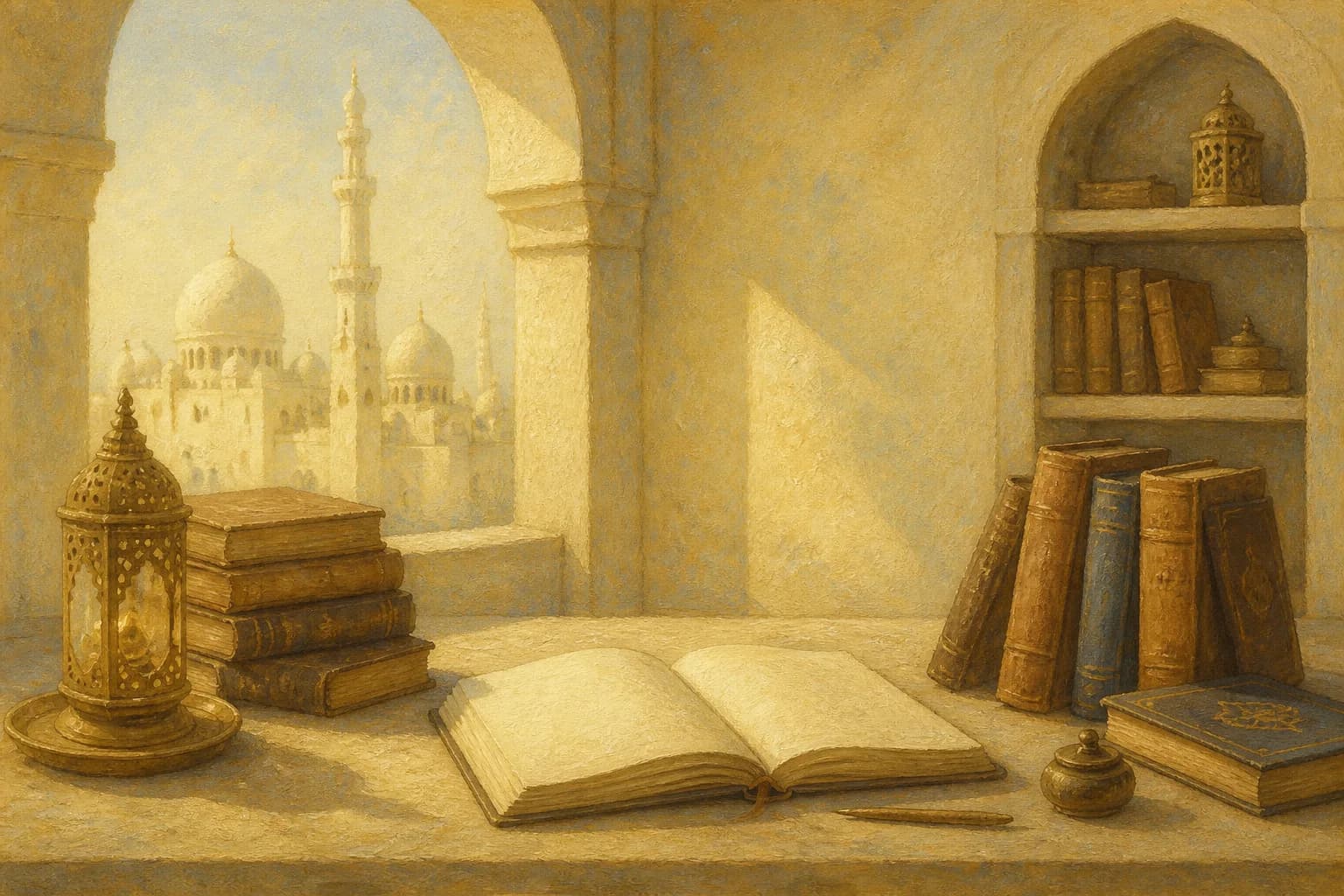

For centuries, while much of the world was in intellectual stagnation, the Muslim world was building hospitals, mapping the stars, solving equations, and preserving the wisdom of ancient civilizations. From roughly 750 to 1258 CE, the Islamic Golden Age produced breakthroughs that still shape medicine, mathematics, and science today.
Yet many Muslims do not know this history — or do not realize how deeply it was rooted in Quranic values. Understanding what your ancestors contributed is not just about pride. It is about recognizing the Islamic tradition of knowledge, and what it means for you today.
What Were the Major Achievements of the Islamic Golden Age?
The Islamic Golden Age (750–1258 CE) produced algebra, modern optics, the hospital system, systematic medical textbooks, and precise astronomy. Key figures include Al-Khwarizmi who invented algebra, Ibn Sina whose Canon of Medicine was taught in Europe for 700 years, and Ibn al-Haytham who founded the science of optics through systematic experimentation — all rooted in the Quranic command to seek knowledge (Surah Al-Alaq, 96:1).
What Was the Islamic Golden Age?
The Islamic Golden Age refers to the period of scientific, cultural, and intellectual flourishing under the Abbasid Caliphate and related Muslim dynasties, roughly from 750 CE to 1258 CE. Its center was Baghdad, where Caliph Harun al-Rashid and later Al-Mamun established the Bayt al-Hikmah — the House of Wisdom.
The House of Wisdom employed Muslim, Christian, Jewish, and Zoroastrian scholars side by side, translating the works of Aristotle, Galen, Euclid, and Ptolemy into Arabic — and then going far beyond them. This was not passive preservation. It was active transformation: Muslim scholars corrected errors, made original discoveries, and created entirely new fields of study.
Allah's words in Surah Al-Alaq (96:1–5) — the very first revelation to the Prophet ﷺ — begin with the command to read and learn:
اقْرَأْ بِاسْمِ رَبِّكَ الَّذِي خَلَقَ
"Read in the name of your Lord who created." — (Surah Al-Alaq, 96:1)
For the scholars of the Golden Age, studying creation was a form of worship. Understanding how the body worked, how stars moved, how numbers related — all of it was tafakkur (reflection on Allah's signs).
Key Achievements of the Islamic Golden Age
Here is a quick-reference table of the most impactful contributions:
| Field | Scholar | Period | Contribution |
|---|---|---|---|
| Mathematics | Al-Khwarizmi | 780–850 CE | Invented algebra; introduced algorithms |
| Optics | Ibn al-Haytham | 965–1040 CE | Founded modern optics; precursor to scientific method |
| Medicine | Ibn Sina | 980–1037 CE | Canon of Medicine — used in Europe for 700 years |
| Astronomy | Al-Battani | 858–929 CE | Precise solar year; trigonometry |
| Chemistry | Jabir ibn Hayyan | 721–815 CE | Distillation, mineral acids, alkalis |
| Geography | Al-Idrisi | 1100–1165 CE | World map; used by European navigators |
| Philosophy | Ibn Rushd | 1126–1198 CE | Major commentator on Aristotle; influenced European thought |
| Engineering | Al-Jazari | 1136–1206 CE | Mechanical devices, early automata, water clocks |
Mathematics and Algebra
Al-Khwarizmi's ninth-century treatise Al-Kitab al-mukhtasar fi hisab al-jabr wal-muqabala ("The Compendious Book on Calculation by Completion and Balancing") gave us the word algebra — from al-jabr in its title. His work systematized how to solve quadratic equations and laid the foundation for everything from high school mathematics to modern computer science. The word algorithm itself comes from the Latin transliteration of his name.
Medicine and the Hospital System
Ibn Sina's five-volume Qanun fi al-Tibb (Canon of Medicine) remained a primary medical textbook in European universities until the 17th century. It covered the four humors, infectious disease, quarantine principles (he understood that some illnesses spread through water and soil), surgery, and a detailed pharmacopeia of hundreds of drugs.
Beyond individual scholarship, Muslim civilization created the world's first bimaristans (hospitals) — dedicated medical institutions with separate wards for different diseases, medical staff, and even psychiatric care. The first known teaching hospital opened in Baghdad around 805 CE.
Optics and the Scientific Method
Ibn al-Haytham's Kitab al-Manazir (Book of Optics) disproved the dominant Greek theory that the eye emits rays to see, demonstrating instead that light enters the eye from external objects. More significantly, he developed a method of systematic experimentation — hypothesis, observation, testing, conclusion — that historians of science regard as a forerunner of the modern scientific method. He wrote:
"The duty of the man who investigates the writings of scientists is to make himself an enemy of all that he reads."
Astronomy and Navigation
Al-Battani calculated the solar year to 365 days, 5 hours, 46 minutes, and 24 seconds — remarkably close to the modern measurement. Muslim astronomers named dozens of stars still known by their Arabic names today: Aldebaran (the follower), Betelgeuse (the hand of Orion), Rigel (the foot), Vega, Altair, and hundreds more. The astrolabe, perfected by Muslim engineers, enabled navigation across the world's oceans centuries before European exploration.
Why This Matters for Modern Muslims
The Prophet ﷺ said: "Seeking knowledge is an obligation upon every Muslim" (Ibn Majah 224). This hadith was not a vague encouragement. For the scholars of the Golden Age, it was a mandate.
Quran Surah Al-Zumar (39:9) poses a direct question that still challenges every believer:
هَلْ يَسْتَوِي الَّذِينَ يَعْلَمُونَ وَالَّذِينَ لَا يَعْلَمُونَ
"Are those who know equal to those who do not know?" — (Surah Al-Zumar, 39:9)
For modern Muslims, the Golden Age demonstrates what an ummah rooted in Islamic values can achieve when it takes knowledge seriously. The same tradition that produced Ibn Sina and Al-Khwarizmi continues — in every Muslim student, researcher, and professional who brings niyyah (intention) to their work.
This is not nostalgia. It is a live inheritance. You are the heir of that tradition.
Still searching for a clear Islamic answer?
Explore sourced answers rooted in the Quran, authentic hadith, and respected scholarship—without getting lost in conflicting search results.
Take the Islam Quiz
How the Islamic Legacy Shapes Modern Life
The practical legacy of the Islamic Golden Age is all around us:
- Every time you solve for an unknown variable, you are using Al-Khwarizmi's algebra.
- Every time a doctor performs a systematic physical exam, they are working from a tradition Ibn Sina helped codify.
- Every time a computer executes an algorithm, the name traces back to a Muslim scholar in ninth-century Baghdad.
- The names of stars you see in the sky tonight are Arabic names — named by Muslim astronomers who mapped the heavens in service of Allah and His creation.
The Quran's call to reflect on creation — tafakkur — was answered by generations of scholars who saw no contradiction between science and faith. They understood that understanding Allah's world was part of understanding Allah. As Surah Al-Imran (3:190) teaches:
"Indeed, in the creation of the heavens and the earth and the alternation of the night and the day are signs for those of understanding."
You can read more about how Muslims contributed to world history and scholarship, explore what made the Arab Golden Age so distinctive, and learn about the remarkable inventions of Muslim Golden Age scholars. For the Islamic imperative behind all of this, see our guide on the importance of seeking knowledge in Islam.
For further historical context, the Islamic Golden Age on Quran.com connects directly to the revelation that inspired it. You can also explore how Islamic civilization developed through the Abbasid period overview at Deenback and read about how Islamic science shaped the modern world at Demi Manifest.
Connecting the Past to Your Daily Practice
The most important lesson from the Golden Age is not what Muslims achieved in the past — it is the why that drove it. They sought knowledge because the Quran commanded it. They served people through medicine and mathematics because the Prophet ﷺ taught that the best of people are those who benefit others most (Sunan al-Tirmidhi 1628).
Read more about what tawakkul means for daily practice — the same trust in Allah that the Golden Age scholars carried into their investigations, writing Bismillah before every experiment and every treatise.
Allah invites every believer to seek increase in knowledge:
رَّبِّ زِدْنِي عِلْمًا
"My Lord, increase me in knowledge." — (Surah Ta-Ha, 20:114)
This is your inheritance. The Golden Age did not end — it was interrupted. And in every Muslim today who seeks knowledge with niyyah, it continues.
Still searching for a clear Islamic answer?
Explore sourced answers rooted in the Quran, authentic hadith, and respected scholarship—without getting lost in conflicting search results.
Take the Islam QuizFrequently Asked Questions
What were the major achievements of the Islamic Golden Age?
The Islamic Golden Age (750–1258 CE) produced algebra by Al-Khwarizmi, the Canon of Medicine by Ibn Sina, the foundation of modern optics by Ibn al-Haytham, and precise astronomical catalogs. Muslims also introduced hospitals, translated Greek philosophy, and advanced chemistry, engineering, and geography across the known world.
Who was Ibn Sina and why does he matter?
Ibn Sina (Avicenna, 980–1037 CE) was a Persian Muslim physician whose Canon of Medicine systematized medical knowledge across diagnosis, pharmacology, and surgery. Used in European universities for over 700 years, it remains one of the most influential medical textbooks in history, rooted in both Greek learning and Islamic scholarship.
What did Al-Khwarizmi contribute to mathematics?
Al-Khwarizmi (780–850 CE) invented algebra — the word itself comes from his treatise Al-Kitab al-mukhtasar fi hisab al-jabr. He also introduced the concept of the algorithm (his name became the word "algorithm") and helped transmit the Hindu-Arabic numeral system, including zero, to the Western world.
What role did the Quran play in inspiring Islamic Golden Age achievements?
The Quran's first revealed words — Read! In the name of your Lord (Surah Al-Alaq, 96:1) — established knowledge-seeking as a religious duty. Scholars understood studying the natural world as understanding Allah's creation. This inspired centuries of investigation into astronomy, medicine, mathematics, and philosophy across the Muslim world.
Which city was the center of the Islamic Golden Age?
Baghdad, capital of the Abbasid Caliphate, was the world's intellectual center during the Golden Age. The House of Wisdom (Bayt al-Hikmah), established around 830 CE under Caliph Al-Mamun, employed hundreds of scholars to translate, preserve, and expand Greek, Persian, and Indian knowledge into Arabic.
When did the Islamic Golden Age end?
The Islamic Golden Age peaked from approximately 750 to 1258 CE, ending when Mongol forces under Hulagu Khan sacked Baghdad in 1258, destroying the House of Wisdom. While scholarship continued in Cairo, Andalusia, and Persia, the destruction marked a turning point for centralized Islamic intellectual leadership.
How can modern Muslims connect to the Islamic Golden Age?
Modern Muslims can honor the Golden Age by embodying the same commitment to learning the Prophet described: Seeking knowledge is an obligation upon every Muslim (Ibn Majah 224). This means reading Quran with reflection, pursuing education in any field, and using knowledge to serve the ummah in ways that matter today.