

- Authors

- Name
- Ahmad
- Role
- Senior Marketing Manager, Islamic education • DeenUp
بِسْمِ اللهِ الرَّحْمٰنِ الرَّحِيْمِ
In the name of God, the Most Gracious, the Most Merciful.
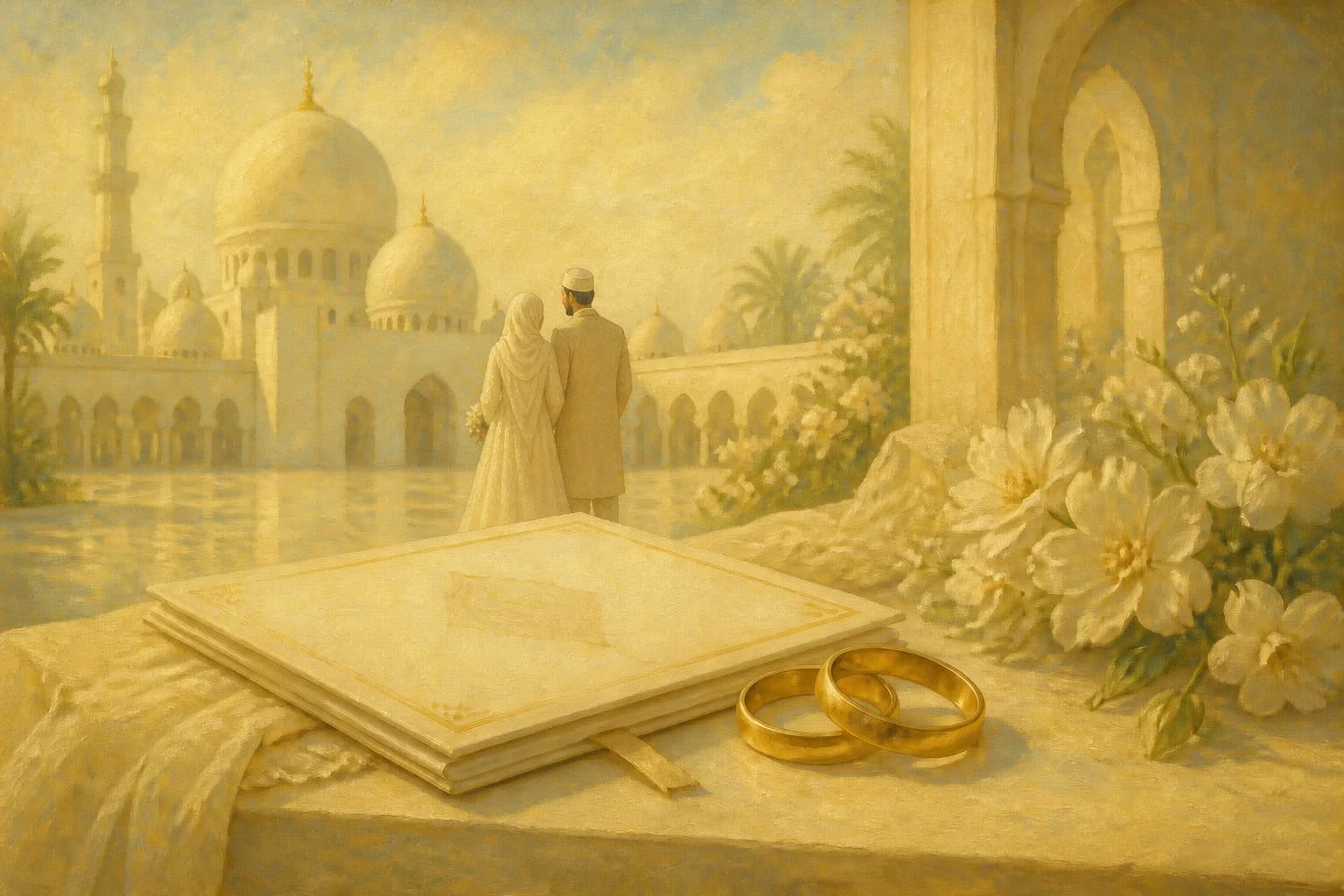

Marriage occupies a unique place in Islam — not merely a legal arrangement or a social convention, but an act of worship described by the Prophet ﷺ as half of one's faith. The hadith about marriage are not a list of rulings to memorize. They are a window into how the Prophet ﷺ thought about love, partnership, and the kind of home that invites barakah.
Reading them carefully changes not just how you approach marriage, but how you understand the purpose of building a family.
What the Quran Says About Marriage
The Quran's most frequently quoted verse on marriage is also one of its most expansive:
وَمِنْ آيَاتِهِ أَنْ خَلَقَ لَكُم مِّنْ أَنفُسِكُمْ أَزْوَاجًا لِّتَسْكُنُوا إِلَيْهَا وَجَعَلَ بَيْنَكُم مَّوَدَّةً وَرَحْمَةً ۚ إِنَّ فِي ذَٰلِكَ لَآيَاتٍ لِّقَوْمٍ يَتَفَكَّرُونَ
"And of His signs is that He created for you from yourselves mates that you may find tranquility in them; and He placed between you affection and mercy. Indeed in that are signs for a people who give thought." — (Surah Ar-Rum, 30:21)
Three words anchor this verse: sukun (tranquility), mawadda (affection, warmth), and rahma (mercy). Scholars note that each describes a different stage of a lasting marriage. Sukun is the ease you feel with someone who is home to you. Mawadda is the active love that sustains daily life together. Rahma is what remains when the initial warmth cools — the mercy and tenderness that carries couples through difficulty.
That Allah calls all of this a sign (aya) — the same word used for Quranic verses — tells you how seriously the Quran treats the institution of marriage.
Key Hadith on Marriage and Choosing a Spouse
Marry to Guard Your Faith
The most urgent of the Prophet's hadith on marriage comes from Ibn Masud (may Allah be pleased with him):
يَا مَعْشَرَ الشَّبَابِ مَنِ اسْتَطَاعَ مِنْكُمُ الْبَاءَةَ فَلْيَتَزَوَّجْ فَإِنَّهُ أَغَضُّ لِلْبَصَرِ وَأَحْصَنُ لِلْفَرْجِ وَمَنْ لَمْ يَسْتَطِعْ فَعَلَيْهِ بِالصَّوْمِ فَإِنَّهُ لَهُ وِجَاءٌ
"O young men, whoever among you can afford to marry should marry, for it lowers the gaze and protects chastity. Whoever cannot afford it should fast, for fasting is a shield for him." — (Sahih Bukhari 5063)
This hadith frames marriage not as a luxury but as a protection — for your sight, your private life, and your spiritual integrity. The Prophet's recommendation of fasting as an alternative is not a second-best option. It is a practical pathway for those not yet ready, while the direction of travel remains clear.
Choose for Character and Religion
The most frequently cited hadith on spouse selection is direct and frank:
"A woman is married for four things: her wealth, her lineage, her beauty, and her religion. Marry the one with religion, or you will be a loser." — (Sahih Bukhari 5090)
The Prophet ﷺ did not say the other three factors are irrelevant — he named them because they are real. But he ranked deen above all of them and attached a sharp warning to ignoring it. Scholars note this hadith applies symmetrically: the same advice holds for those choosing a husband.
A related narration elaborates from the other side:
"When someone whose religion and character you are satisfied with proposes to your daughter, then give in marriage to him. If you do not do so, there will be tribulation on earth and widespread corruption." — (Sunan Tirmidhi 1084)
This hadith is addressed to guardians, not only to those seeking a spouse. It pushes back against the cultural tendency to reject otherwise suitable proposals based on social status, tribe, or wealth alone — at the expense of real deen and character.
Marriage as Half of Faith
One of the most widely quoted teachings on marriage is reported from Anas ibn Malik, narrated in various hadith collections and authenticated by several scholars: "When a person marries, he has completed half of his religion. Then let him have taqwa of Allah regarding the remaining half." This teaching, cited in Al-Bayhaqi's Shu'ab al-Iman and considered hasan by numerous scholars, captures the Islamic understanding that marriage is not peripheral to the spiritual life — it is a central arena in which taqwa, patience, and love are built and tested daily.
How to Build a Marriage on Prophetic Guidance
Understanding the hadith about marriage is one thing. Letting them shape how you approach a spouse, a proposal, or a long-term relationship is another.
Pray istikhara throughout the process. The Prophet ﷺ taught salat al-istikhara — the prayer for guidance — for any significant decision. Choosing a spouse is the clearest application. Our guide on dua for istikhara covers the full text and how to practice it correctly.
Prioritize character over circumstances. Circumstances change. Character tends to reveal itself more fully over time. The Prophet's criterion — religion and akhlaq — is not romantic in the conventional sense, but it is deeply practical for a marriage meant to last decades.
Make dua specifically for your future or current spouse. The authenticated supplications are a meaningful daily practice. Our guide on dua for a good spouse compiles the relevant prayers, including the ones the Prophet taught for those seeking marriage.
Observe the wedding Sunnah. From the walima (marriage feast) to the dua said over newlyweds, the Prophet established a complete framework for how marriages begin. Our overview of Muslim wedding traditions covers the key practices and their significance.
The Prophet ﷺ also left a specific dua for blessing a new marriage:
بَارَكَ اللَّهُ لَكَ وَبَارَكَ عَلَيْكَ وَجَمَعَ بَيْنَكُمَا فِي خَيْرٍ
"May Allah bless you, and shower His blessings upon you, and unite you both in goodness." — (Sunan Abu Dawud 2130)
This dua is said to the newlyweds by those congratulating them — it replaces the pre-Islamic phrases that were common at the time. Notice that it asks for barakah (divine blessing) rather than merely happiness. The distinction matters.
Ready to seek marriage?
Explore Quran- and Sunnah-grounded guidance for choosing a spouse, understanding rights, communicating well, and handling difficult decisions.
Take the Marriage Quiz
Demi Manifest's piece on barakah in the home explores how the practices you build together inside a marriage — the adhkar, the shared intentions, the small acts of worship — are where divine blessing actually enters. And DeenBack's guide on home adhkar gives you the specific morning and evening remembrances that the Prophet recommended for households.
Give your marriage room to grow through hardship. The verse's promise of mawadda and rahma is not a guarantee that marriage will always feel easy. It is a description of what Allah places in the relationship as a resource — and one that grows with intentional use. Our guide on dua for marriage proposal covers prayers for those still in the seeking stage.
Signs of Barakah in a Marriage
Barakah in a marriage does not always look like ease. Some markers that scholars and the Sunnah point to:
- Spouses are honest with each other — there is no sustained performance
- Both partners increase in their deen, not decrease, because of the marriage
- Disagreements are resolved with fairness and forgiveness rather than contempt
- The home is a place where Quran is recited, dua is made, and guests feel welcomed
- Each spouse actively makes dua for the other
These are not ideals reserved for spiritual paragons. They are practical habits within reach of any couple willing to take the Prophet's guidance seriously.
Common Questions
Is marriage obligatory in Islam?
Scholars distinguish based on individual circumstances. For someone with strong desire and the means to marry, the majority view is that marriage is highly recommended — considered wajib by some, sunnah muakkadah by others. Where someone genuinely fears falling into sin without marriage, it moves toward obligation. For those whose circumstances make marriage burdensome or harmful to others, scholars recommend caution.
What makes a nikah valid?
The minimum conditions are: offer and acceptance (ijab and qabul), the presence of a wali (guardian) for the bride, and at least two witnesses. A mahr (dower) must also be agreed upon. Opinions vary on specific details — consulting a scholar in your local context is advisable.
What about marrying someone from a different faith?
Classical jurisprudence permits a Muslim man to marry a Jewish or Christian woman (People of the Book). However, the majority of contemporary scholars advise caution given the complexities of raising children and maintaining Islamic practice in mixed-faith households. A Muslim woman marrying a non-Muslim man is not permitted in classical jurisprudence.
How do I find a spouse in a way that honors these hadith?
Start with sincere dua and istikhara. Then use your community — family, friends, the masjid network — as the primary avenue. If using matrimonial services, choose those that facilitate proper introductions with a wali involved. Throughout the process, keep the Prophet's criterion — religion and character — as the primary filter, while also being realistic and kind in your expectations.
Ready to seek marriage?
Explore Quran- and Sunnah-grounded guidance for choosing a spouse, understanding rights, communicating well, and handling difficult decisions.
Take the Marriage QuizThe Prophet ﷺ described marriage as completing half of the faith — not because the other five pillars matter less, but because the daily work of a marriage is where so much of that faith is practiced: patience, generosity, honesty, forgiveness, and the quiet choice to keep choosing your spouse. The hadith about marriage are not rules imposed from outside. They are a map drawn by someone who understood what it takes to build something that lasts.
Frequently Asked Questions
Is marriage obligatory in Islam?
Scholars distinguish based on individual circumstances. For someone who has strong desire and the means, the majority view is that marriage is highly recommended (wajib for some, sunnah muakkadah for others). It becomes obligatory when one fears falling into sin without it.
What makes a nikah valid in Islam?
The minimum conditions are: offer and acceptance (ijab and qabul), the presence of a wali (guardian) for the bride, and at least two witnesses. A mahr (dower) must also be agreed upon, though its amount is flexible.
Can a Muslim man marry a non-Muslim woman?
Classical scholars permit a Muslim man to marry a Jewish or Christian woman (People of the Book). However, the majority advise strongly against it in contexts where it may harm the faith or upbringing of children, and many contemporary scholars add further conditions.
How should I look for a spouse in Islam?
The Prophet advised prioritizing religion and character above wealth, lineage, and appearance (Sahih Bukhari 5090). Many Muslims use family networks, community introductions, or halal matrimonial services. Praying istikhara throughout the process is a well-established Sunnah.