

- Authors

- Name
- Ahmad
- Role
- Senior Marketing Manager, Islamic education • DeenUp
بِسْمِ اللهِ الرَّحْمٰنِ الرَّحِيْمِ
In the name of God, the Most Gracious, the Most Merciful.


Many Muslims carry a quiet ache — a sense that their faith is real, their belief is genuine, but the felt closeness to Allah is missing. Prayer feels like going through motions. Dua feels like talking into silence. The gap between believing in Allah and genuinely feeling near to Him can be one of the most disorienting experiences in a Muslim's life.
The good news is that this gap is not permanent, and the path out of it is not mysterious. Allah Himself described it — in a hadith qudsi reported by the Prophet ﷺ — in remarkably specific terms.
How Can You Get Closer to Allah?
Getting closer to Allah (قُرْبٌ, qurb) follows a clear hierarchy described in a famous hadith qudsi: "My servant draws near to Me through nothing I love more than what I have made obligatory upon him, and My servant continues to draw near to Me through voluntary acts until I love him" (Sahih al-Bukhari 6502). The roadmap is: establish the five obligatory prayers first, then add voluntary acts — Quran, dhikr, charity, fasting — layer by layer. Closeness is built, not discovered.
Take the free DeenUp quiz to find out where your daily Islamic practice stands and get a personalized plan to close the gap.
Why This Matters: What the Quran and Sunnah Say About Closeness
Allah's proximity to His servants is not a metaphor — it is a core Quranic teaching:
"And when My servants ask you about Me — I am indeed near. I respond to the invocation of the supplicant when he calls upon Me." — (Surah Al-Baqarah, 2:186)
This verse was revealed in the middle of Ramadan instructions, in response to a companion who asked whether Allah was close or far so they would know whether to call quietly or loudly. Allah's answer was immediate and unambiguous — He is near.
Surah Qaf adds: "We created the human being and We know what his soul whispers to him, and We are closer to him than his jugular vein" (50:16). This closeness is Allah's side of the relationship — it is constant. The question is whether the servant turns toward it.
The hadith qudsi in Sahih al-Bukhari 6502 makes the two-step process explicit: first, fulfill the obligations. Then, add voluntary acts. This is not an accidental sequence — it reflects the Islamic principle that consistency in fard creates the foundation on which everything else rests.
Your personal 28-Day Deen Plan
Learn your deen in 28 days, 5 minutes a day
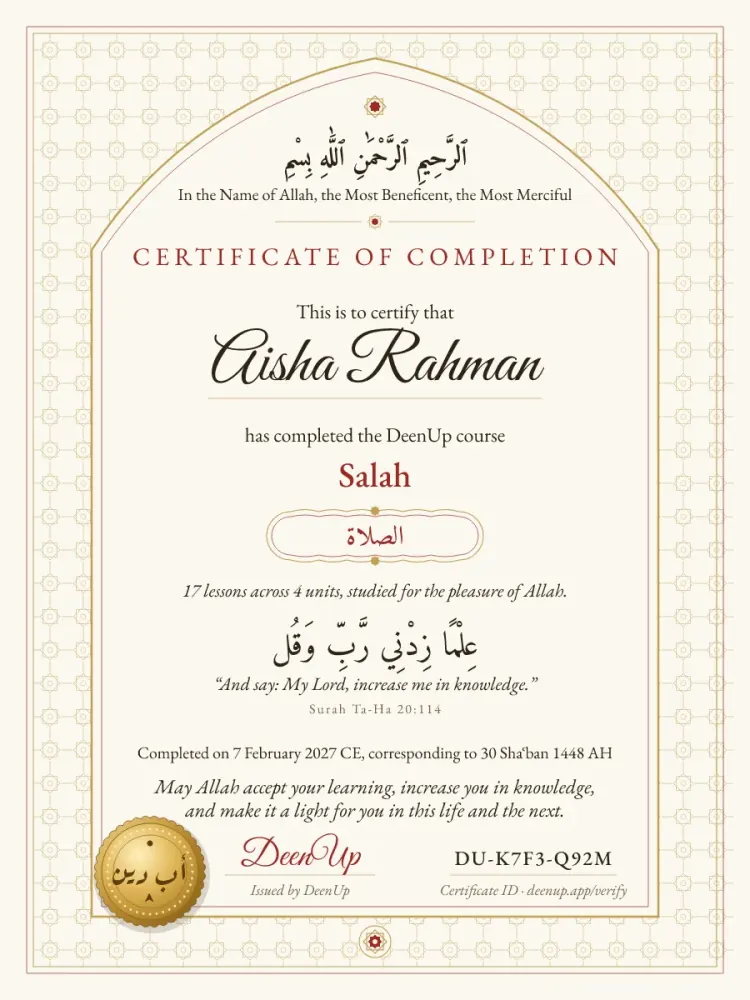
The essentials of salah, fiqh and faith, step by step from authentic sources. Finish all 28 days and earn a verifiable Certificate of Completion.
Take the free quizAnswer a few questions and get your personal plan.
Step-by-Step: How to Get Closer to Allah
Step 1 — Guard the Five Daily Prayers
The five salah are the non-negotiable foundation. The Prophet ﷺ said the first thing a servant will be asked about on the Day of Judgment is their prayer (Sunan al-Tirmidhi 413). Before adding anything else, make the five prayers consistent. That means praying on time, with wudu done properly, and with at least one moment of genuine khushoo (attentiveness) in each prayer.
If your prayers have been inconsistent, start there. Not with extra dhikr. Not with more Quran. The hadith qudsi is clear: obligatory acts first.
Step 2 — Read Quran Daily, Even a Little
Allah describes the Quran as the clearest rope between Him and His servants: "Hold fast to the rope of Allah together and do not become divided" (Surah Al-Imran, 3:103). Ten verses a day — read slowly, in Arabic, with an English translation open beside you — accomplishes more than rushing through ten pages without understanding.
The benefits of reading the Quran daily go beyond blessing: regular Quran recitation restructures how you think, recall Allah's words during difficulty, and find meaning in routine situations.
Step 3 — Practice Morning and Evening Adhkar
The مَصْدَر (masdar) of remembrance in the Quran is used in contexts of drawing near. "O you who have believed, remember Allah with much remembrance and exalt Him morning and afternoon" (Surah Al-Ahzab, 33:41-42). The morning and evening adhkar — which the Prophet ﷺ taught as a set of daily remembrances — take roughly ten to fifteen minutes and create two anchors of Allah-consciousness in your day.
For the full set of supplications to build into this routine, the guide on the importance of dhikr in Islam explains both the content and the why.
Step 4 — Make Specific, Sincere Dua
Dua is not only asking for things — it is the act of turning toward Allah. The Prophet ﷺ said: "Dua is worship" (Sunan al-Tirmidhi 3371). This means that each time you make dua, you are performing an act of ibadah that draws you closer.
Make your duas specific: name the actual thing you need, acknowledge your dependence, and ask with the expectation that Allah hears you — because He said He does (2:186). Dua for guidance provides specific supplications for the journey of seeking closeness.
Step 5 — Add Voluntary Acts Incrementally
Once the obligatory acts are consistent, the hadith qudsi gives explicit permission to build: voluntary prayers (nawafil), extra Quran, charity, voluntary fasts. The key word is incrementally — adding one thing at a time and stabilizing it before adding the next. Spiritual overwhelm creates the opposite of closeness.
| Practice | Islamic Term | Level | Quranic Basis |
|---|---|---|---|
| Five daily prayers | Salah fard | Obligatory — start here | Surah Al-Baqarah, 2:238 |
| Quran recitation | Tilawah | Obligatory / daily habit | Surah Al-Muzammil, 73:4 |
| Morning/evening adhkar | Adhkar | Strongly recommended | Surah Al-Ahzab, 33:41 |
| Supplication | Dua | Anytime — essence of worship | Surah Al-Baqarah, 2:186 |
| Voluntary prayers | Nawafil | After fard are established | Sahih al-Bukhari 6502 |
| Voluntary charity | Sadaqah | Whenever possible | Surah Al-Baqarah, 2:261 |
Step 6 — Reflect and Hold Yourself Accountable
Muhasabah — self-accounting — is the practice of honestly reviewing your spiritual state at the end of each day. Umar ibn al-Khattab (may Allah be pleased with him) said: "Call yourselves to account before you are called to account." This daily review closes the gap between intention and action, and creates the kind of consistent growth that feels like movement rather than stagnation.
The guide on how to build Islamic habits gives a practical structure for making this accountability sustainable across weeks and months.
Common Mistakes That Create Distance Instead of Closeness
Waiting until you feel ready. Closeness follows action — it does not precede it. The feeling of connection usually comes after consistent practice, not before it motivates you to start.
Making dua only in crisis. Allah taught us to call on Him in ease and in difficulty (Surah Yunus, 10:12 describes those who call only in hardship). Regular dua in ordinary moments builds the felt relationship that makes crisis dua far more grounded.
Adding voluntary acts before the obligatory ones are solid. This is the most common structural mistake. Extra tahajjud does not compensate for inconsistent fard prayers. The hadith qudsi sequence is not incidental — build the foundation first.
A Dua for Closeness
The Prophet ﷺ taught this supplication, which captures the entire request in one breath:
اللَّهُمَّ أَعِنِّي عَلَى ذِكْرِكَ وَشُكْرِكَ وَحُسْنِ عِبَادَتِكَ
"O Allah, help me to remember You, to thank You, and to worship You in the best of ways." — (Abu Dawud 1522)
Reciting this after every fard prayer is a small, sustainable act that keeps the intention of closeness alive throughout the day.
Building Momentum Over Time
The scholars of the Islamic spiritual tradition consistently teach one principle: istiqamah (steadiness) over intensity. A short daily practice maintained for months achieves more than a single day of intense worship followed by weeks of nothing. The how to increase iman guide explores what consistent iman growth looks like from a practical standpoint.
DeenBack's exploration of daily dhikr habits captures the same idea from a practical angle: the most transformative changes in spiritual life are usually incremental, not dramatic. And the DemiManifest piece on trusting Allah through hardship addresses what closeness looks like when circumstances are genuinely difficult — a necessary counterpart to the ideal-conditions framing.
The goal is not a single spiritual breakthrough. The goal is a direction: consistently moving toward Allah, one prayer, one verse, one moment of remembrance at a time.
If you want to know where you are on that path and what your next step should be, take the free DeenUp quiz. It takes under a minute and gives you a personalized plan based on where you actually are.
Your personal 28-Day Deen Plan
Learn your deen in 28 days, 5 minutes a day
The essentials of salah, fiqh and faith, step by step from authentic sources. Finish all 28 days and earn a verifiable Certificate of Completion.
Take the free quizAnswer a few questions and get your personal plan.
Frequently Asked Questions
How do I get closer to Allah when I feel spiritually distant?
Start with the obligatory prayers rather than waiting to feel ready. The Prophet ﷺ said nothing draws a servant closer to Allah than what He has made obligatory (Sahih al-Bukhari 6502). Re-establish salah consistently, add morning dhikr, and make sincere dua — closeness follows action, not the other way around.
What is the fastest way to feel closer to Allah?
Scholars consistently point to sincere, attentive salah as the fastest path. The Quran says Allah is close to those who call on Him (2:186). Making your five prayers the non-negotiable anchor of your day, and spending a minute after each one in heartfelt dua, creates the most direct channel of closeness.
Can I get closer to Allah after committing major sins?
Yes. The Quran is explicit that Allah accepts sincere tawbah at any time before death (Surah Az-Zumar, 39:53). Distance caused by sin is reversible. The process is sincere regret, stopping the sin, making tawbah, and replacing the habit with a good one — the door of closeness is never closed to someone who sincerely returns.
Does reciting the Quran help you get closer to Allah?
Yes, Quran recitation is among the clearest paths to closeness. Allah says the Quran was revealed as guidance and mercy for believers (Surah Al-Isra, 17:9). The Prophet ﷺ described it as a rope from Allah — when you hold it, you hold on to Him. Even ten verses a day, read with presence, shifts your state over time.
Is making a lot of dua a sign of closeness to Allah?
Dua is both a path to closeness and a sign of it. The Prophet ﷺ called dua the essence of worship (Sunan al-Tirmidhi 3371). When you turn to Allah frequently — in ease and difficulty alike, not only in crisis — it reflects a heart that recognises its dependence on Him, which is the foundation of closeness.
What role does dhikr play in getting closer to Allah?
Dhikr (remembrance) is one of the most direct acts of closeness. Allah says in a hadith qudsi: "I am with My servant when he remembers Me and his lips move with My remembrance" (Sahih al-Bukhari 7405). Morning and evening adhkar, tasbeeh after salah, and brief phrases of remembrance throughout the day all build this connection incrementally.