

- Authors

- Name
- Ahmad
- Role
- Senior Marketing Manager, Islamic education • DeenUp
بِسْمِ اللهِ الرَّحْمٰنِ الرَّحِيْمِ
In the name of God, the Most Gracious, the Most Merciful.
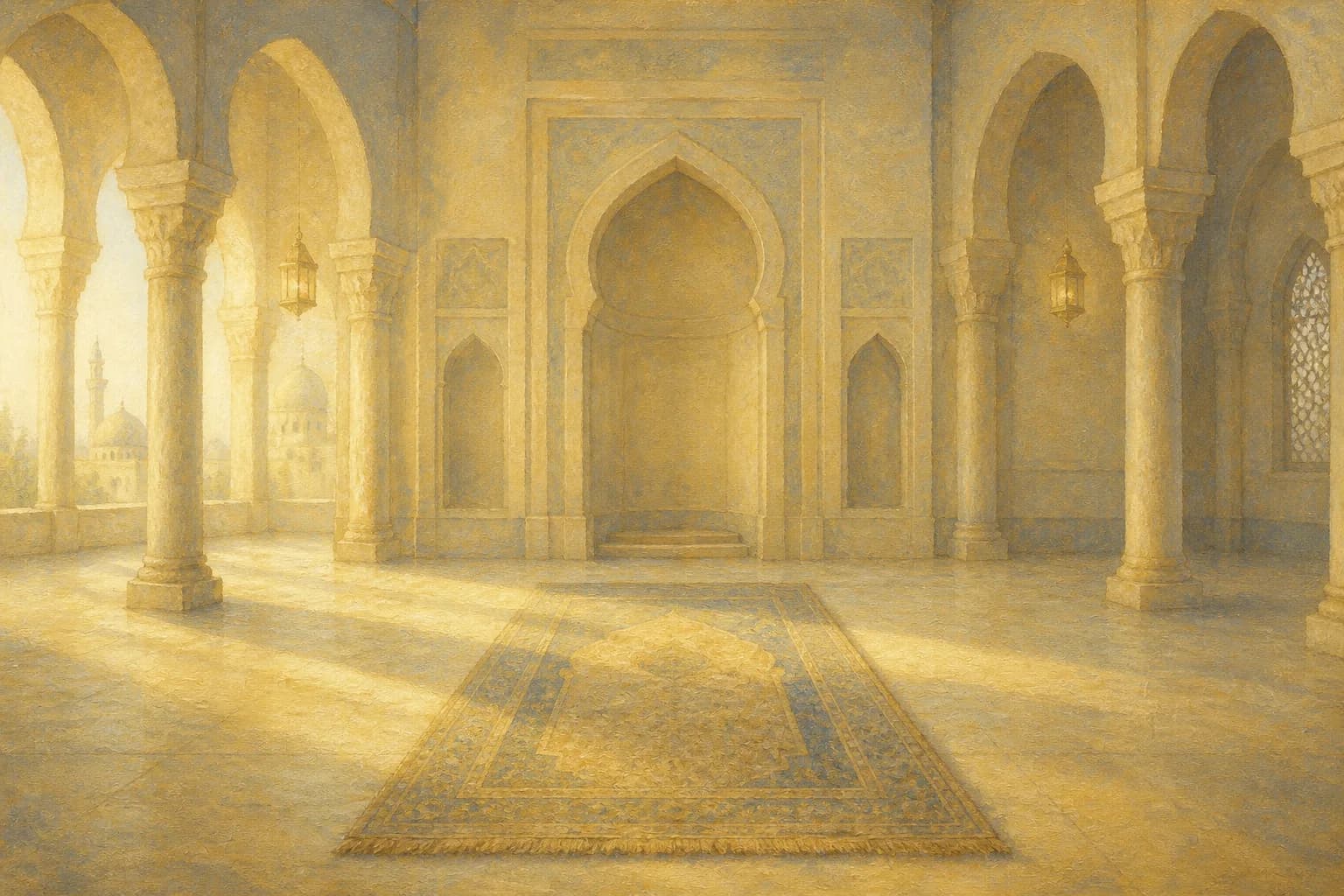

Most Muslims know about the benefits of praying Fajr. Fewer know about what can happen in the 20 minutes immediately after it. The Prophet ﷺ described a specific morning practice — staying in the masjid in dhikr after Fajr, then praying two rakaat when the sun has risen — and gave it a reward that stops you in your tracks: the equivalent of a complete Hajj and Umrah.
This prayer is salat al-ishraq (صَلَاةُ الإِشْرَاق) — the post-sunrise prayer, named for the time of ishraq, when the sun first rises and its light spreads across the sky. It is one of the most rewarding voluntary prayers in Islam, and one of the least practised.
Why Salat al-Ishraq Matters
The foundation of this prayer comes from a hadith of the Prophet ﷺ that combines congregation, dhikr, and voluntary prayer into a single morning practice:
مَنْ صَلَّى الْفَجْرَ فِي جَمَاعَةٍ ثُمَّ قَعَدَ يَذْكُرُ اللَّهَ حَتَّى تَطْلُعَ الشَّمْسُ ثُمَّ صَلَّى رَكْعَتَيْنِ كَانَتْ لَهُ كَأَجْرِ حَجَّةٍ وَعُمْرَةٍ تَامَّةٍ تَامَّةٍ تَامَّةٍ
"Whoever prays Fajr in congregation, then sits remembering Allah until the sun has risen, then prays two rakaat, will have a reward like that of a complete Hajj and Umrah — complete, complete, complete." — Jami' at-Tirmidhi (graded hasan)
The repetition of "complete, complete, complete" (tāmman, tāmman, tāmman) was not casual. The Prophet ﷺ wanted no ambiguity about the scale of this reward. It is one of the clearest prophetic invitations to a specific voluntary practice that most Muslims can reasonably do every day.
This prayer also connects to Allah's command for morning praise throughout the Quran. In Surah Qaf, Allah says:
"So be patient over what they say and exalt [Allah] with praise of your Lord before the rising of the sun and before its setting." — Surah Qaf (50:39)
The time of ishraq — just after sunrise — is one of the most blessed periods of the day. It begins the part of the morning where Allah's light is new and the world is just starting. Beginning it in worship carries a weight that is hard to overstate.
How to Perform Salat al-Ishraq: Step by Step
Step 1: Pray Fajr in congregation
The full reward of ishraq begins here. The Prophet ﷺ's description specifically mentions praying Fajr in congregation (fi jama'ah). If you pray at the masjid, you are in the right position. If you pray at home, you can still pray ishraq, though the combined reward described in the hadith is specifically tied to congregational Fajr.
For guidance on building a consistent Fajr routine, the importance of jamaah prayer covers both the spiritual and practical dimensions of praying with the congregation regularly.
Step 2: Remain seated after Fajr in dhikr
This is the often-missed piece. After the Fajr prayer concludes — including the post-salah adhkar — remain in your place and engage in remembrance of Allah until the sun has risen.
The morning adhkar recited during this sitting include:
- SubhanAllah wa bihamdihi (سُبْحَانَ اللَّهِ وَبِحَمْدِهِ) — 100 times
- Allahu Akbar (اللَّهُ أَكْبَرُ) — 33 times
- Ayatul Kursi (Al-Baqarah, 2:255) — once
- Surah Al-Ikhlas, Al-Falaq, and An-Nas — three times each
- The morning protective duas from the Sunnah
The point is not to sit idle until sunrise — it is to fill that time with remembrance. The heart that arrives at sunrise having spent 20-40 minutes in dhikr is in a completely different state than one that spent that time on a phone.
Step 3: Wait for the prohibited prayer time to pass
There is a period immediately after sunrise when prayer is not permitted. Scholars describe this as the time when the sun is rising — roughly 10 to 15 minutes after sunrise, or until the sun is "a spear's height" above the horizon. In practical terms, most people wait about 15 to 20 minutes after sunrise before praying.
You can use this time to continue dhikr or Quran recitation. The waiting is itself part of the practice.
Step 4: Pray two rakaat
When the time has passed, perform two rakaat with the intention of salat al-ishraq. The prayer itself follows the standard structure:
- Make your intention for the voluntary ishraq prayer
- Begin with Allahu Akbar (takbirat al-ihram)
- Recite Al-Fatihah and any surah in each rakaat
- Complete the prayer with tashahhud and tasleem
There is no specific surah required for ishraq. Many scholars recommend reciting longer surahs since you are already in a state of focused worship, but any Quranic recitation is valid. Scholars such as Ibn al-Qayyim note that this prayer is most virtuous when performed in a state of complete presence and focus.
Step 5: Make dua after the prayer
The period immediately after the ishraq prayer is a time of answered dua. Having spent the morning in congregation, dhikr, and prayer, you arrive at this supplication in an ideal spiritual state. Ask for what matters — your deen, your family, your sustenance, your hereafter.
For the how to pray sunnah prayers guide on structuring voluntary prayers generally, that resource covers the broader landscape of optional prayers and their times.
Building the Ishraq Habit
The biggest obstacle to salat al-ishraq is not the prayer itself — it is staying at the masjid after Fajr rather than rushing home. Modern life applies pressure immediately after Fajr: work, children, commute, phones. The practice requires a specific decision to protect that window.
A few practical approaches:
Keep a book or Quran at the masjid. Having something to read during the waiting time removes the temptation to check a phone. The goal is to fill the time with something that keeps the heart oriented.
Tell your family about the practice. If leaving immediately after Fajr is expected at home, communicating the intention to stay for dhikr and ishraq helps everyone adjust to the 30-40 minute block.
Start with two or three days per week. You do not have to make it every single day immediately. Build the habit at a pace that sticks, then expand. Consistency in how to pray salat al-duha offers a related framework — the duha prayer complements ishraq and together they bookend the morning with voluntary worship.
A Feed Worth Scrolling
Swipe through short, scholar-approved Islamic lessons instead of mindless doom-scrolling.
Learn Through Play
Bite-sized lessons, quizzes, levels, and daily streaks make growing your Deen a habit.
Scholar-Approved
Every lesson is rooted in the Quran and authentic Sunnah and reviewed by qualified scholars.

Keep learning your deen with short, sourced lessons in DeenUp.
Build your Islamic knowledge with short lessons in DeenUp. Start today.
In-app purchases. Full access requires a subscription.
The DeenBack guide to Fajr morning routines is a useful companion here — particularly for structuring the dhikr period between Fajr and sunrise. And the Demi Manifest piece on Islamic morning routines offers a practical framework for integrating ishraq, duha, and morning adhkar into a single morning block.
Salat al-Ishraq and Salat al-Duha: Understanding the Difference
One common question: is ishraq the same as duha?
The two are related in that they both fall in the morning and involve voluntary prayer. The distinction:
Salat al-ishraq is prayed just after sunrise — about 15 to 20 minutes after the sun appears above the horizon. Its reward is specifically connected to the full morning sequence: congregational Fajr, dhikr until sunrise, then prayer.
Salat al-duha can be prayed from about 20 minutes after sunrise until approximately 15 to 20 minutes before midday. It is a broader window and does not require the continuous practice from Fajr.
Some scholars treat ishraq as the earliest form of duha; others consider them two distinct prayers. Practically speaking, if you have completed the full sequence — Fajr in congregation, dhikr until sunrise, two rakaat at ishraq time — you have earned the described reward regardless of how scholars categorize it.
For a complete look at the salat al-duha prayer separately, including its time, minimum rakaat, and hadith backing, that guide covers the full practice.
Common Mistakes
Leaving the masjid immediately after Fajr. This is the most common one. The entire structure of the ishraq reward is built around staying — the dhikr between Fajr and sunrise is what makes the two rakaat carry such weight. Rushing out loses the chain.
Praying too early. Praying immediately as the sun rises — before the prohibited time has passed — is not valid. Waiting the 15-20 minutes matters, both for the prayer to be valid and for the dhikr to be complete.
Treating it as a performance rather than connection. The Prophet ﷺ described a practice built entirely around remembrance and presence. Sitting in the masjid while scrolling through a phone is not the dhikr the hadith describes. The tool for the time is Quran, remembrance, and supplication.
Skipping it on days when it feels too early. Fajr is already an early start. Extending it by 30-40 minutes can feel difficult, especially at first. The answer here is in the reward itself — the Prophet ﷺ's repetition of "complete, complete, complete" was his way of communicating that this is worth the adjustment.
Common Questions
Can I pray ishraq at home instead of the masjid? Yes, and it is still valid as a voluntary prayer. The full reward described in the hadith is specifically tied to congregational Fajr and remaining in the masjid, but the prayer itself can be offered anywhere. Consult a qualified scholar for your specific circumstance.
Can women pray salat al-ishraq? Yes. The prayer is not restricted to men. Women who pray Fajr at home can also perform the ishraq practice — praying Fajr, sitting in dhikr until sunrise, then praying two rakaat. The congregational dimension may look different, but the overall practice applies.
What if I miss the Fajr congregation but want to pray ishraq? Pray ishraq as a standalone voluntary prayer. You will not have the specific reward described in the hadith, but the voluntary prayer in a blessed time still carries its own reward. Missing the congregation should not be a reason to skip the prayer entirely.
Does the ishraq prayer replace duha? No — they are connected but not the same. If you pray ishraq, you have covered the earliest duha time, but you can also pray additional duha rakaat later in the morning. Both practices are Sunnah and can be combined in a single morning.
A Morning That Sets the Rest
The morning routine the Prophet ﷺ described — congregation, dhikr, sunrise, two rakaat — is not difficult. It takes roughly 30 to 40 minutes beyond the Fajr prayer itself. What it produces is a morning that begins entirely in worship: prayer, remembrance, praise, and supplication.
That kind of beginning changes the quality of everything that follows. Not because of any metaphysical guarantee, but because a heart that has spent its first hour in the presence of Allah enters the rest of the day in a different state.
The Quran's invitation to praise Allah at the beginning of the day is not incidental. The morning is the foundation. Salat al-duha extends that foundation. And the sunnah prayers throughout the day build on it further. Ishraq is where it all begins.
Keep learning your deen with short, sourced lessons in DeenUp.
Build your Islamic knowledge with short lessons in DeenUp. Start today.
In-app purchases. Full access requires a subscription.
Frequently Asked Questions
What is salat al-ishraq?
Salat al-ishraq is a voluntary Sunnah prayer performed shortly after sunrise, following the Fajr prayer. The Prophet (peace be upon him) described its reward as equivalent to a complete Hajj and Umrah for those who pray Fajr in congregation and then remain in dhikr until sunrise.
When is salat al-ishraq prayed?
Salat al-ishraq is prayed approximately 15 to 20 minutes after sunrise, once the sun has risen fully and is no longer at the horizon. This marks the end of the prohibited prayer time that begins at sunrise.
How many rakaat is salat al-ishraq?
The minimum is two rakaat. Many scholars and practitioners pray two or four rakaat. There is no specific surah required beyond the standard recitation of Al-Fatihah plus an additional surah in each rakaat.
Is salat al-ishraq the same as salat al-duha?
They are related but not identical in timing. Salat al-ishraq is prayed just after sunrise, while salat al-duha is prayed later in the late morning. Some scholars treat ishraq as the earliest time for duha; others distinguish them as two separate prayers.
Do I need to pray Fajr in congregation to pray ishraq?
The full reward described in the hadith — equivalent to Hajj and Umrah — is linked to praying Fajr in congregation and then sitting in dhikr until sunrise. Ishraq can be prayed on its own as a voluntary prayer, but the combined practice carries the greatest reward.