

- Authors

- Name
- Ahmad
- Role
- Senior Marketing Manager, Islamic education • DeenUp
بِسْمِ اللهِ الرَّحْمٰنِ الرَّحِيْمِ
In the name of God, the Most Gracious, the Most Merciful.
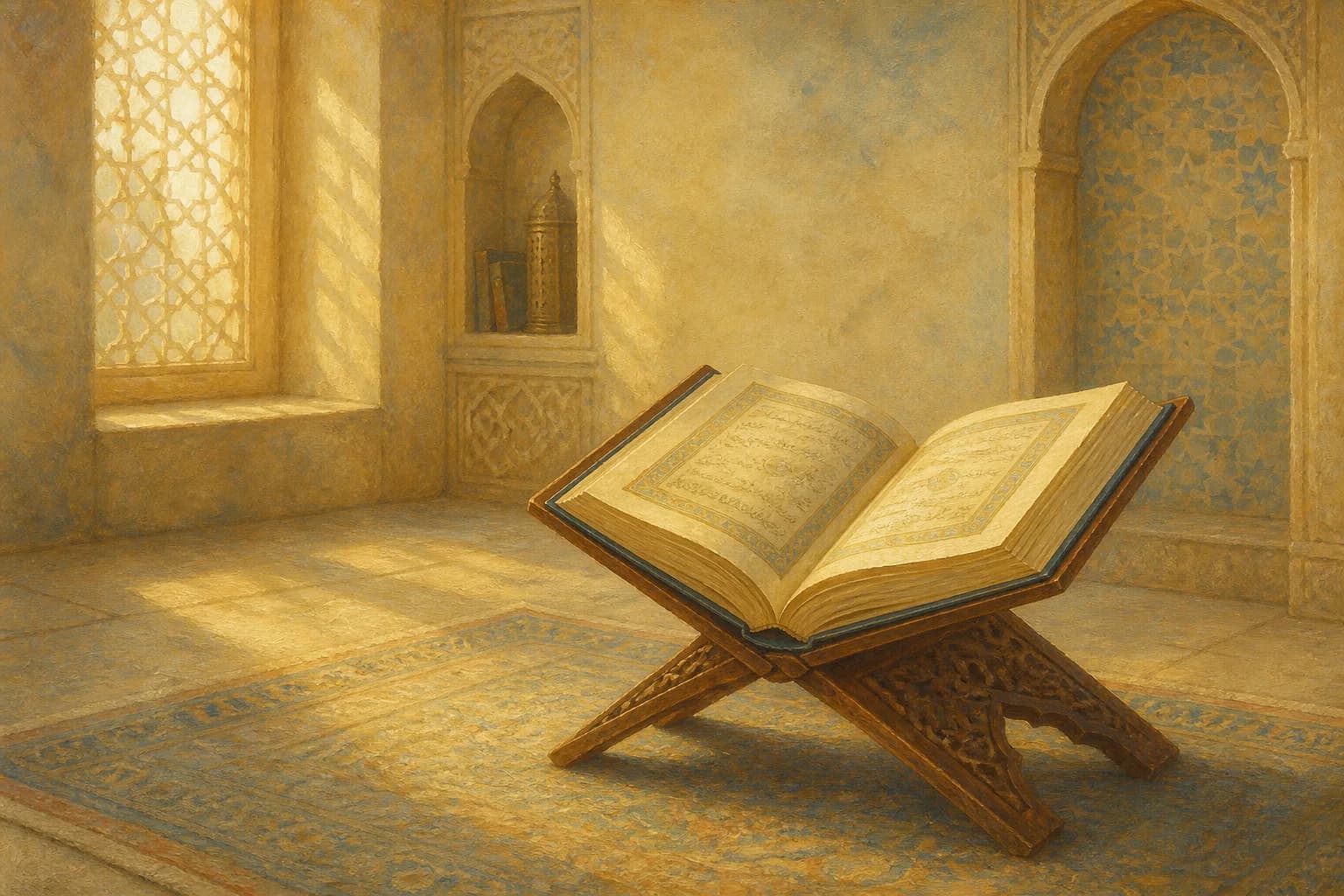

If you have searched for Islam's holy book online, you have probably encountered two different spellings: "Koran" and "Quran." Some older books, news articles, and academic texts use one; Muslim communities and contemporary scholarship use the other. This is not a trivial difference in punctuation — the spelling reflects how closely a word has been transliterated from the Arabic original, and understanding it opens a door to understanding what the book actually is, where its name comes from, and why Muslims treat it as unlike any other text in the world.
Is It Koran or Quran? Which Spelling Is Correct?
The correct modern spelling is Quran (also written Qur'an with diacritical marks). The word comes directly from the Arabic القرآن (al-Qur'an), from the root قَرَأَ (qara'a), meaning "to recite" or "to read." "Koran" is an older English transliteration — common in European texts from the 17th through 19th centuries — that reflects earlier conventions for rendering Arabic sounds into Latin script. Today, "Quran" is standard across Islamic scholarship, academic publishing, and Muslim communities worldwide.
What Is the Quran, and Why Does Its Name Matter?
The Quran is the word of Allah revealed to the Prophet Muhammad ﷺ through the angel Jibril (Gabriel) over approximately 23 years, beginning in 610 CE. Its very name — "the Recitation" — reflects the oral nature of its first transmission: the first revelation was not a written text but a spoken command.
Allah says in the Quran: "Read in the name of your Lord who created — created the human being from a clot. Read, and your Lord is the Most Generous" (Surah Al-Alaq, 96:1-3). This was the first ayah revealed, and the word "read" — iqra — shares the same root as Qur'an itself. The book begins by naming itself as an act of recitation.
The Quran's preservation is also Quranic. Allah promises: "Indeed, it is We who have sent down the Quran and it is We who shall safeguard it" (Surah Al-Hijr, 15:9). No other scripture in human history has been preserved with the same textual integrity: millions of Muslims have memorized it in full across every generation, and the written text has remained consistent since the standardized Uthmani manuscript compiled around 650 CE under Caliph Uthman ibn Affan.
The Quran contains 114 surahs (chapters) and 6,236 ayahs (verses). It is divided into 30 juz (parts) for ease of recitation. The Prophet ﷺ taught: "The best among you is the one who learns the Quran and teaches it" (Sahih al-Bukhari 5027). Engagement with the Quran is not just recommended — it is described as among the highest acts a Muslim can perform.
Why This Spelling Distinction Matters for Modern Muslims
The shift from "Koran" to "Quran" is more than orthographic preference — it reflects a shift in who gets to name the text. When European scholars transliterated the book's name in the 17th century, the Arabic sound of the letter qaf (ق) was rendered as "K," and the hamza in Qur'an was dropped entirely. The result was a spelling built for European readers, not for accuracy to the source language.
Using "Quran" — and ideally "Qur'an" — is a small but meaningful act of linguistic accuracy. It acknowledges that the book has its own name in its own language, and that name carries theological weight: this is a book that names itself as an act of recitation, authored by Allah, and preserved through an unbroken chain of oral and written transmission.
For new Muslims and non-Muslims asking about Islam, understanding this spelling distinction also helps with sourcing: resources, apps, and websites that use "Quran" rather than "Koran" tend to be more current and more closely aligned with how contemporary Muslim scholarship presents the text.
How to Engage with the Quran Daily
You do not need to be a hafiz (one who has memorized the full Quran) or a fluent Arabic speaker to build a meaningful daily relationship with the Quran. Here are practical approaches, matched to where you are:
| Approach | Best for | What it looks like |
|---|---|---|
| Arabic recitation only | Those who can read Arabic; tajweed focus | Daily recitation of one to three pages with correct pronunciation |
| Arabic + English side-by-side | Bilingual learners building comprehension | Reading the Arabic with a reliable translation like Sahih International or Yusuf Ali |
| Transliteration alongside Arabic | New Muslims learning to recite before reading the script | Phonetic guide used alongside a line-by-line Arabic text |
| Word-by-word translation | Those beginning to learn Quranic Arabic | Quran.com's word-by-word feature links each Arabic word to its meaning |
| Tafsir study | Muslims seeking deeper understanding | Working through a tafsir (Quran commentary) such as Ibn Kathir available in English |
Start where you are, not where you wish you were. If you cannot read Arabic yet, reciting Al-Fatiha — the opening surah, seven verses, recited in every unit of every prayer — is itself a complete act of Quran engagement. Learning how to read Quran for beginners covers exactly how to build this foundation step by step.
Make it consistent, not just occasional. The Prophet ﷺ valued consistent, modest practice over large bursts of sporadic worship. Five ayahs read with reflection and an attempt to understand the meaning every day is more valuable than fifty ayahs read without attention once a week.
Use tools that bring the text to life. The benefits of reading Quran daily are well documented in both hadith and in the experience of Muslims who make it a habit — clarity of mind, spiritual stability, and a growing sense of connection with Allah. The DeenBack guide to Quran recitation tips covers practical approaches to improving your recitation alongside your comprehension.
Want the Qur'an to feel easier to understand?
Read with clear contextual insights, revisit the verses that matter to you, and build a steady daily Qur'an habit with DeenUp.
Take the Qur'an Quiz
How to Deepen Your Quran Engagement Over Time
Once you have a basic daily habit in place, these steps help it grow:
Learn even a little Quranic Arabic. You do not need fluency — even learning 100 of the most frequent Quranic words covers a large percentage of the text. How to learn Arabic for Quran is a practical guide to starting this journey at any level.
Memorize short surahs. Begin with Al-Ikhlas (three verses affirming Allah's oneness), Al-Falaq (protection from external harm), and An-Nas (protection from internal whispers). These surahs are used in daily prayer and their memorization immediately enriches every salah you pray.
Study at least one ayah in depth. Ayatul Kursi (the Throne Verse, Surah Al-Baqarah 2:255) is one of the most frequently recited and most deeply studied ayahs in the Quran. The meaning and benefits of Ayatul Kursi explores what this single verse contains — it is a masterclass in how dense Quranic meaning can be.
Work toward memorization. The Quran occupies a unique status in Islamic practice — those who memorize it are called huffaz and carry a sacred trust. How to memorize Quran covers the structured approaches that generations of Muslims have used to accomplish this.
For practical strategies on making Quran recitation consistent over time, the Demi Manifest guide to reading the Quran consistently offers a grounded perspective on building the kind of daily rhythm that sustains Quran engagement through busy schedules and life transitions.
Signs of a Growing Connection with the Quran
Engaging with the Quran is not measured in pages read or chapters memorized alone — it is measured in how the text changes you:
- Ayahs you have recited hundreds of times begin to speak to specific situations in your life.
- You find yourself returning to familiar verses with new eyes as your understanding deepens.
- Your salah changes — knowing what you are reciting makes each prayer a conscious conversation rather than a recitation of memorized sounds.
- You feel something shift when you sit with the Quran — a quality of stillness that is distinct from any other kind of reading.
The Prophet ﷺ described the Quran as "the rope of Allah extended from the heavens to the earth" (Mustadrak al-Hakim, authenticated by al-Albani). Reaching for it daily — even just a few verses — is reaching for that connection.
Common Questions About the Koran and Quran
Are there different versions of the Quran? There are different authorized qira'at (recitation traditions), but all agree on the text's meaning and content. The Uthmani script is the most widely used. There is one Quran — the variation in recitation traditions reflects different oral transmission chains authorized by the Prophet ﷺ himself.
Can non-Muslims read the Quran? Yes. The Quran is a public text and has been translated into hundreds of languages. Many non-Muslims read it for study or out of curiosity. Muslims believe that reading the Quran, even without faith, can be a path toward understanding Islam on its own terms.
What is the best English translation of the Quran? No translation is perfect, but the Sahih International translation is widely regarded as clear and accurate. Yusuf Ali's translation is older and more literary. For word-by-word study, the resources at Quran.com are valuable. Many Muslims keep multiple translations to compare.
Is it true the Quran was memorized before it was written? Yes. The primary mode of preservation during the Prophet's ﷺ lifetime was oral — the huffaz (memorizers) carried the text. Written records existed on materials like parchment and bone, but the complete compilation into a single mushaf (bound volume) occurred under Caliph Abu Bakr after the Prophet's ﷺ death.
Want the Qur'an to feel easier to understand?
Read with clear contextual insights, revisit the verses that matter to you, and build a steady daily Qur'an habit with DeenUp.
Take the Qur'an QuizWhether you first encountered this book as "the Koran" or "the Quran," what matters most is what you do with it. The spelling question has a clear answer: Quran, from Arabic, from the root meaning "to recite." But the deeper invitation the word carries is just as clear — this is a book meant to be read, recited, understood, and lived. Open it today, even if it is just one verse. The connection you build with it, slowly and consistently, is one of the most valuable things you can cultivate in your life as a Muslim.
Frequently Asked Questions
Is it spelled Koran or Quran?
The accepted modern spelling is Quran (also written Qur'an). Koran is an older English transliteration common in 17th-to-19th-century texts. Both refer to Islam's holy scripture revealed to the Prophet Muhammad ﷺ. Quran more accurately reflects the Arabic pronunciation and is now standard in Islamic scholarship and academic writing worldwide.
What does the word Quran mean in Arabic?
The word Quran comes from Arabic القرآن (al-Qur'an), derived from the root قَرَأَ (qara'a) meaning 'to recite' or 'to read.' The Quran is literally 'the recitation' — a name reflecting how it was first revealed through the angel Jibril with the command 'Read' (Surah Al-Alaq, 96:1).
How many chapters and verses are in the Quran?
The Quran contains 114 surahs (chapters) and 6,236 ayahs (verses). It is divided into 30 equal parts called juz, which many Muslims use to complete a full recitation over 30 days — especially during Ramadan. The longest surah is Al-Baqarah with 286 verses; the shortest is Al-Kawthar with 3 verses.
Is a Quran translation the same as the original Arabic?
No translation can fully replace the Arabic Quran. The Quran in Arabic is considered the literal word of Allah; translations are scholarly interpretations of the meaning. Salah must be recited in Arabic. However, reading a reliable translation alongside the Arabic is strongly encouraged to deepen understanding and connection with the Quran's meanings.
What is the best way to start reading the Quran?
Start with short surahs you may already know — Al-Fatiha, Al-Ikhlas, Al-Falaq, and An-Nas. Read a few verses daily with a reliable translation. If you cannot yet read Arabic, a transliteration helps you begin recitation while you learn the script. Consistency matters more than volume — five ayahs read with reflection daily builds lasting connection.
Is the Quran the same as the Bible or Torah?
The Quran, Bible, and Torah all belong to the Abrahamic tradition and Muslims regard all three as originally revealed books. However, Muslims believe earlier scriptures were altered over time, while the Quran remains preserved exactly as revealed. The Quran itself refers to the Torah (Tawrah) and Gospel (Injil) as originally divine revelations.
When was the Quran revealed to Prophet Muhammad?
The Quran was revealed to Prophet Muhammad ﷺ over approximately 23 years — from 610 CE in Mecca to 632 CE in Medina. The first revelation was the opening verses of Surah Al-Alaq (96:1-5). It was compiled into written form under Caliph Abu Bakr and standardized under Caliph Uthman ibn Affan around 650 CE.