

- Authors

- Name
- Ahmad
- Role
- Senior Marketing Manager, Islamic education • DeenUp
بِسْمِ اللهِ الرَّحْمٰنِ الرَّحِيْمِ
In the name of God, the Most Gracious, the Most Merciful.
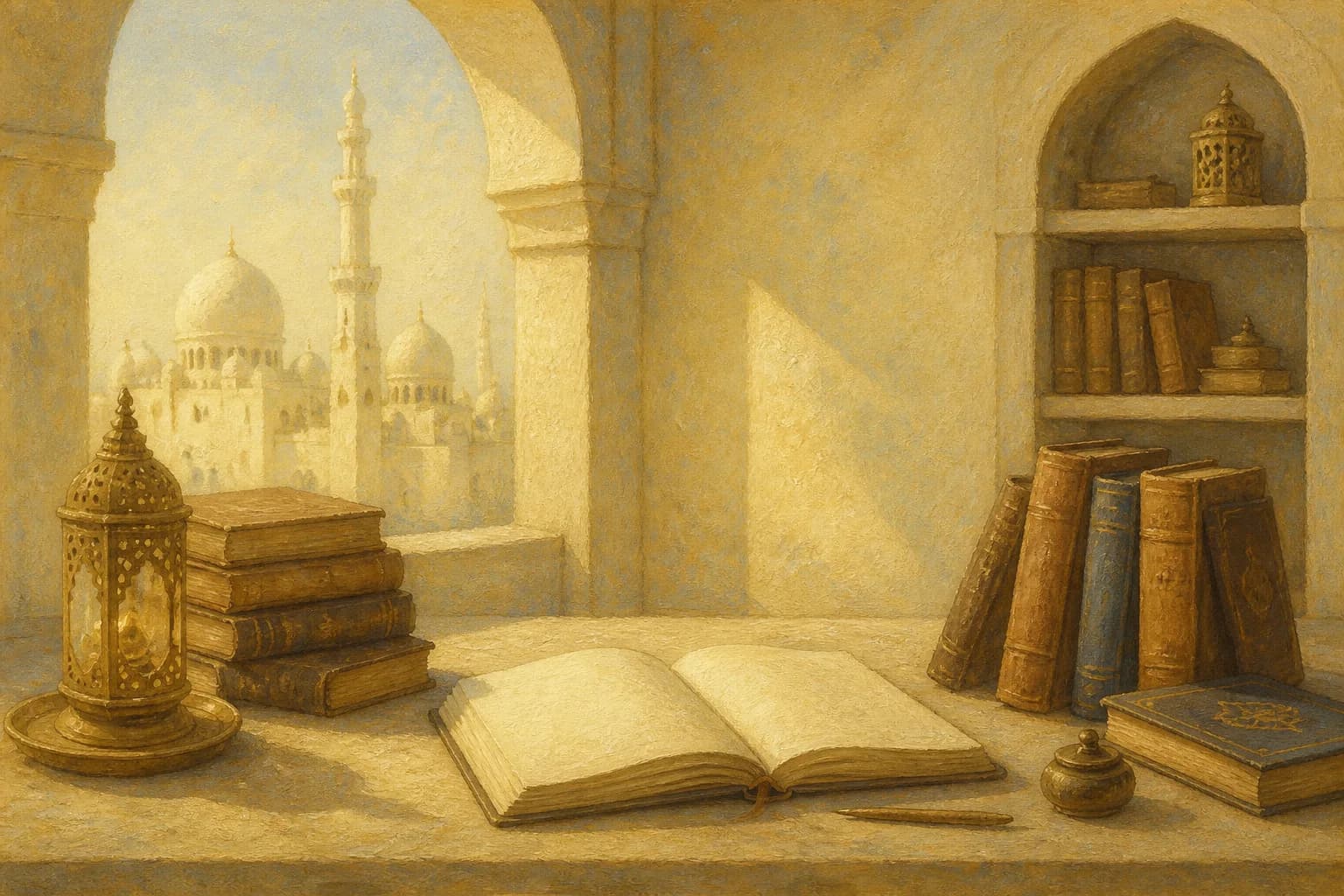

Most people know the Islamic Empire as a period of conquest and expansion. Far fewer know that it was also the era that gave algebra its name, saved Aristotle from oblivion, and built the world's oldest continuously operating university. The civilization that stretched from Spain to Central Asia between the 7th and 15th centuries did not just rule — it thought, discovered, and taught.
Understanding this legacy is not an exercise in historical pride. It is a reminder of what Islamic values look like when they animate a civilization.
What Is the Lasting Impact of the Islamic Empire?
The lasting impact of the Islamic Empire spans mathematics, medicine, astronomy, philosophy, and education. Muslim scholars of the 8th–13th centuries preserved and advanced Greek, Persian, and Indian knowledge at a time when much of Europe had lost access to it. Key contributions include algebra (al-Khwarizmi, 820 CE), systematic optics (Ibn al-Haytham, 1011 CE), canonical medicine (Ibn Sina, 1025 CE), and the founding of the world's oldest university, Al-Qarawiyyin, in 859 CE.
The Foundation: Why Islam Commanded Inquiry
The Islamic Empire's intellectual tradition was not incidental — it grew from a theological imperative. The first revelation to Prophet Muhammad ﷺ was a single command:
اقْرَأْ بِاسْمِ رَبِّكَ الَّذِي خَلَقَ
"Read in the name of your Lord who created." — Surah Al-'Alaq, 96:1
The Quran also asks directly: "Are those who know equal to those who do not know?" (Surah Az-Zumar, 39:9). This framework made the pursuit of knowledge an act of worship, not a secular ambition.
The Prophet ﷺ reinforced this: "When a person dies, his deeds come to an end except for three things: ongoing charity, knowledge that others benefit from, or a righteous child who prays for him" (Sahih Muslim 1631). Knowledge with lasting benefit was placed alongside charity as a path to continued reward.
This theological grounding explains why, at the height of the Abbasid Caliphate, caliphs funded translation projects, built libraries, and paid scholars. The Islamic Golden Age was not a historical coincidence — it was Islamic values applied at institutional scale.
The House of Wisdom and the Translation Movement
The House of Wisdom (Bayt al-Hikmah, بيت الحكمة) in Baghdad became the intellectual capital of the world under Caliph al-Ma'mun (813–833 CE). Scholars were paid the weight of their translated books in gold. Greek medical texts by Galen and Hippocrates, philosophical works by Plato and Aristotle, Indian mathematical manuscripts — all were translated, studied, annotated, and extended.
This was not mere preservation. Muslim scholars disagreed with, corrected, and improved upon what they translated. Ibn al-Haytham (965–1040 CE) read Ptolemy's flawed theory of vision and replaced it with the correct one: light enters the eye, not the reverse. His Kitab al-Manazir (Book of Optics) was translated into Latin in the 13th century and influenced Roger Bacon, Leonardo da Vinci, and eventually Kepler. The scientific method itself — hypothesis, experiment, conclusion — owes a significant debt to his systematic approach.
What Islamic Scholars Gave the World
The following table summarizes the major fields of contribution and their specific, verifiable legacies:
| Field | Scholar | Date | Legacy |
|---|---|---|---|
| Mathematics | Al-Khwarizmi | 820 CE | Algebra; algorithms (his name became "algorithm") |
| Optics | Ibn al-Haytham | 1011 CE | Correct model of vision; foundations of the scientific method |
| Medicine | Ibn Sina (Avicenna) | 1025 CE | Canon of Medicine — European university text until 1600s |
| Medicine | Al-Razi (Rhazes) | 865–925 CE | First clinical distinction of smallpox and measles |
| Philosophy | Ibn Rushd (Averroes) | c. 1169–1195 CE | Aristotle commentaries that unlocked European scholasticism |
| Astronomy | Al-Battani | 858–929 CE | Precise calculation of the solar year; improved Ptolemy's tables |
| Education | Fatima al-Fihri | 859 CE | Founded Al-Qarawiyyin in Fez — oldest university in the world |
For more on the individuals behind these achievements, see our overview of Islamic achievements and the lives of Islamic scientists.
Still searching for a clear Islamic answer?
Explore sourced answers rooted in the Quran, authentic hadith, and respected scholarship—without getting lost in conflicting search results.
Take the Islam Quiz
The Path from Baghdad to the Renaissance
When the Abbasid Caliphate fell to the Mongols in 1258 CE and the House of Wisdom burned, much Islamic scholarship had already been transmitted westward through Andalusia (Islamic Spain). The expansion of Islam into the Iberian Peninsula created the city of Córdoba — a city of 500,000 people, 70 libraries, and thousands of mosques in the 10th century, at a time when London had fewer than 20,000 inhabitants.
European scholars traveled to Toledo and Córdoba to learn Arabic and access translations they could not find at home. The Islamic civilization's golden age was, for Europe, a window into classical knowledge they had lost — and an introduction to new knowledge Muslim scholars had generated themselves.
Ibn Rushd's (Averroes) commentaries on Aristotle were so foundational to 13th-century European scholasticism that Thomas Aquinas referred to him simply as "The Commentator." Without Islamic scholarship bridging ancient Greek philosophy and medieval European thought, the Renaissance as we know it would not have had its raw material.
Why This Legacy Matters for Modern Muslims
The Islamic Empire's history is sometimes studied as a source of cultural pride, and sometimes avoided as too entangled with conquest. Neither response engages with what it actually demonstrates: that a civilization built on Quranic values produced world-changing intellectual work, across fields, for centuries.
This matters for modern Muslims navigating a world that sometimes presents Islam and scientific thinking as opposites. They are not opposites. They were, for several centuries, the same project.
The Prophet ﷺ said: "Seeking knowledge is an obligation upon every Muslim" (Ibn Majah 224). The scholars of the golden age took this literally and globally. Their legacy is evidence that the command to read — the first word of revelation — was always meant to be taken seriously.
For a deeper look at how this history unfolded, see our article on important historical events in Islam.
Frequently Asked Questions
See the FAQ section above for answers to common questions about the Islamic Empire's lasting impact.
Still searching for a clear Islamic answer?
Explore sourced answers rooted in the Quran, authentic hadith, and respected scholarship—without getting lost in conflicting search results.
Take the Islam QuizFrequently Asked Questions
What is the lasting impact of the Islamic Empire on science?
The Islamic Empire gave the world algebra (from al-Khwarizmi, 820 CE), the scientific method for optics (Ibn al-Haytham, 1011 CE), and a systematic approach to medicine through Ibn Sina whose Canon of Medicine was a standard European university text until the 17th century. These contributions remain foundational to modern science.
What was the House of Wisdom and why was it important?
The House of Wisdom (Bayt al-Hikmah) was a research and translation center established in Baghdad under Caliph Harun al-Rashid (786 CE) and expanded by al-Ma'mun. It translated Greek, Persian, and Indian knowledge into Arabic, preserving works that would otherwise have been lost and transmitting them to the European Renaissance.
How did the Islamic Empire contribute to mathematics?
Muhammad ibn Musa al-Khwarizmi wrote Al-Kitab al-mukhtasar fi hisab al-jabr wal-muqabala around 820 CE, giving the world algebra — the very word comes from al-jabr. Islamic scholars also developed algorithms (algorithm derives from al-Khwarizmi's name) and advanced trigonometry, which underpins modern engineering and GPS.
What is the oldest university in the world and is it Islamic?
Al-Qarawiyyin in Fez, Morocco, founded in 859 CE by Fatima al-Fihri, is recognized by UNESCO and the Guinness World Records as the oldest continuously operating university in the world. It was founded over 200 years before the University of Bologna (1088 CE) and remains active today.
How did Islamic scholars influence European philosophy?
Ibn Rushd (Averroes, 1126–1198 CE) wrote detailed commentaries on Aristotle that were translated into Latin and became the primary way medieval European scholars accessed Aristotelian thought. He was so influential that Thomas Aquinas called him simply "The Commentator." Without Islamic scholarship, the European Renaissance would have had far less to build on.
What did the Islamic Empire contribute to medicine?
Ibn Sina (Avicenna) completed Al-Qanun fi al-Tibb (The Canon of Medicine) around 1025 CE. It systematized medical knowledge, described contagious disease and quarantine, and was used as a university textbook across Europe until the 1600s. Al-Razi (Rhazes) earlier distinguished smallpox from measles in clinical writing (865–925 CE).
How does the Islamic Empire's legacy connect to Muslim identity today?
The Islamic Empire's legacy shows that Islamic values — the command to read (Surah Al-Alaq, 96:1), to seek knowledge — have historically driven civilization-level advancement. For modern Muslims, this history is not a source of nostalgia but an evidence-backed reminder that the deen and intellectual excellence are inseparable.