
- Authors

- Name
- Ahmad
- Role
- Senior Marketing Manager, Islamic education • DeenUp
بِسْمِ اللهِ الرَّحْمٰنِ الرَّحِيْمِ
In the name of God, the Most Gracious, the Most Merciful.
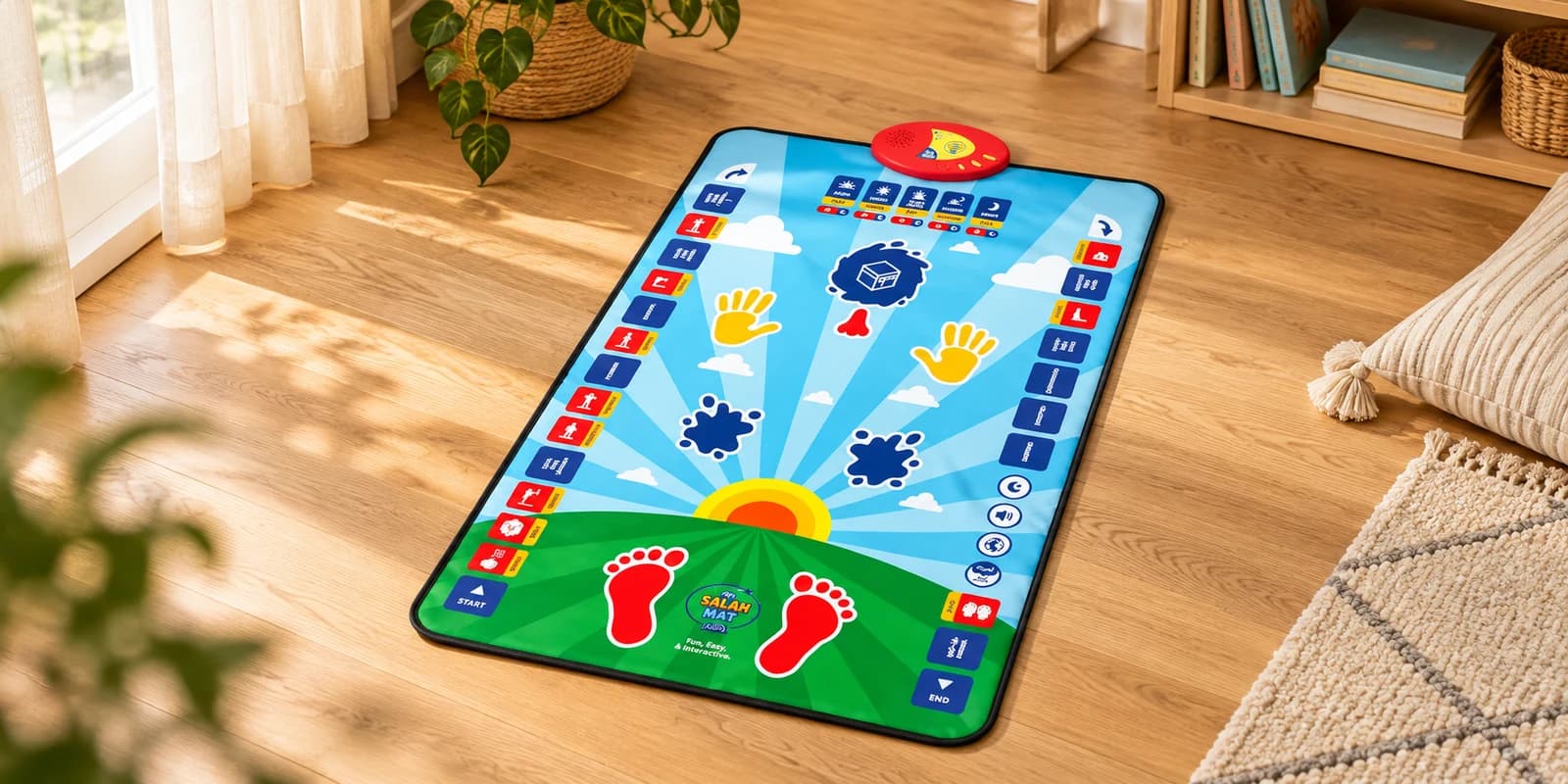
Learning to pray involves more than remembering what comes next. A beginner is learning movements, unfamiliar Arabic sounds and the meaning of the prayer at the same time. A child may want to join in but lose track of the sequence. An adult beginning salah may want to repeat a step privately, without having to restart a video or keep looking at a phone.
My Salah Mat builds educational products around that learning process. Its best-known resource is an interactive prayer mat that combines physical position markers with recorded audio. The idea is to put guidance where the learner is practising: beneath their hands and feet, with the next instruction available as they move.
A parent's question became a learning tool
The brand's founding story begins with Kamal watching his four-year-old son, Hamzah, struggle with sujood. His son was unsure where to place his hands, knees, forehead and nose. Drawing on his product-design background, Kamal began sketching a mat with those positions marked out.
The first concept was visual. Adding sound came later, as the design developed into a touch-sensitive mat. The story describes a year of development and more than twenty prototypes before production.
That origin helps explain the product: it breaks a movement that an experienced adult performs automatically into cues a beginner can recognise. The mat gives a learner something concrete to follow while an adult or teacher explains what they are doing.
How the interactive prayer mat works
The official FAQ describes touch-sensitive areas within the fabric that activate recorded guidance. Instead of only watching a demonstration, a learner can connect an instruction with a physical position on the mat.
The system brings together three parts of learning:
- Position: markings help the learner locate the places used during prayer.
- Sound: recorded instructions, recitations and duas provide something to listen to and repeat.
- Sequence: guided steps help connect individual actions into a prayer.
The brand describes its products as self-contained and screen-free, without an app or Wi-Fi requirement. That can be useful for a family looking for a practice session that does not depend on handing over a phone. Power requirements and controls still depend on the particular model.
The children's mat: learning through touch and repetition
The blue children's interactive mat has a colourful layout with visible hand, knee and foot markers. Its product page describes guidance for all five daily prayers, alongside learning material for wudu, surahs and duas. A translation function helps connect the Arabic recitation with its meaning.
These features address different questions a child might have:
| A learner's question | The kind of support the mat offers |
|---|---|
| Where do my hands and feet go? | Visible position markers and touch-sensitive areas |
| What do I say here? | Recorded recitations and duas to hear and repeat |
| Which step comes next? | Guidance through the selected prayer |
| What do these words mean? | Translation support on the relevant model |
My Salah Mat's children's product introduction also shows the accompanying activity book and manual. These extend the session beyond the mat with illustrated instructions, short recitations, puzzles and activities. A parent can revisit a page after practice or use it to answer a question that came up while learning.
Check the exact product listing for the recommended age, language options and included accessories. The brand offers different versions, so the details of one mat should not be assumed to apply to every model.
A separate range for adults and reverts
The adult and revert collection is designed for people building their own foundation in salah. It focuses on the movements, recitations and flow of prayer, rather than presenting every learning resource as something intended for young children.
That distinction matters. Someone new to Islam may already understand why they want to pray while still finding the sequence unfamiliar. A returning Muslim may remember parts of the prayer but want to rehearse others. A guided resource can provide a repeatable starting point for either person.
A useful approach is to identify the part that feels least familiar, practise it, and then put it back into the wider sequence. If a question concerns a prayer ruling or a difference in practice, bring it to a knowledgeable teacher. A device can provide prompts; a conversation can address the question behind them.
Free resources are a useful first step
A family does not have to begin by buying a mat. My Salah Mat's free Salah and Surah recitation PDFs offer a way to look through prayer-learning material first. A printable can also sit beside a lesson as a reference, without adding another screen to the room.
The website includes a wider range of educational resources, but the starting question can stay simple: does the learner need help with a movement, a recitation or its meaning? Choose a resource that answers that question, rather than trying to introduce everything at once.
Making the resource part of an ordinary routine
A short practice session can be easier to repeat than an ambitious lesson. Choose one step, listen together and leave time to ask what it means. The next session can begin with the same step before adding something new.
For a child, that might mean finding the hand positions and repeating a familiar phrase with a parent. For an adult, it might mean rehearsing the sequence until they can move through it with fewer prompts. Progress is easier to notice when the task is specific.
The purpose remains prayer itself. Surah Taha, 20:14 connects salah with remembering Allah, while 20:132 speaks of encouraging the household to pray and persevering in it. A learning aid is most useful when it supports that understanding as well as the physical steps.
For readers who want a written explanation alongside a practical resource, our step-by-step salah guide and wudu guide cover the two subjects separately. The Fajr guide is a focused next reference for the dawn prayer.
My Salah Mat's contribution is a hands-on way to connect listening with doing. Used alongside patient explanation and opportunities to ask questions, it gives beginners another route into a practice they can gradually make their own.
Frequently Asked Questions
What is My Salah Mat?
My Salah Mat is an Islamic educational brand known for interactive prayer mats. Its range includes mats for children, adults and reverts, alongside books, audio learning products and printable resources.
How does an interactive prayer mat work?
Touch-sensitive areas activate built-in audio guidance. Learners can practise prayer movements and listen to recitations, with the precise controls and learning options depending on the model.
Do the prayer mats need an app or Wi-Fi?
According to the official FAQ, the products are self-contained and do not require a mobile app or Wi-Fi. Check the specific model for its battery or charging requirements.
Is there a version for adults learning to pray?
Yes. My Salah Mat has a separate collection for adults and reverts, designed to support learning the movements, recitations and sequence of salah.
Can I start with a free resource?
The official website offers a free Salah and Surah recitation PDF collection. It is a useful place to explore the learning material before deciding whether a physical mat would help.