

- Authors

- Name
- Ahmad
- Role
- Senior Marketing Manager, Islamic education • DeenUp
بِسْمِ اللهِ الرَّحْمٰنِ الرَّحِيْمِ
In the name of God, the Most Gracious, the Most Merciful.
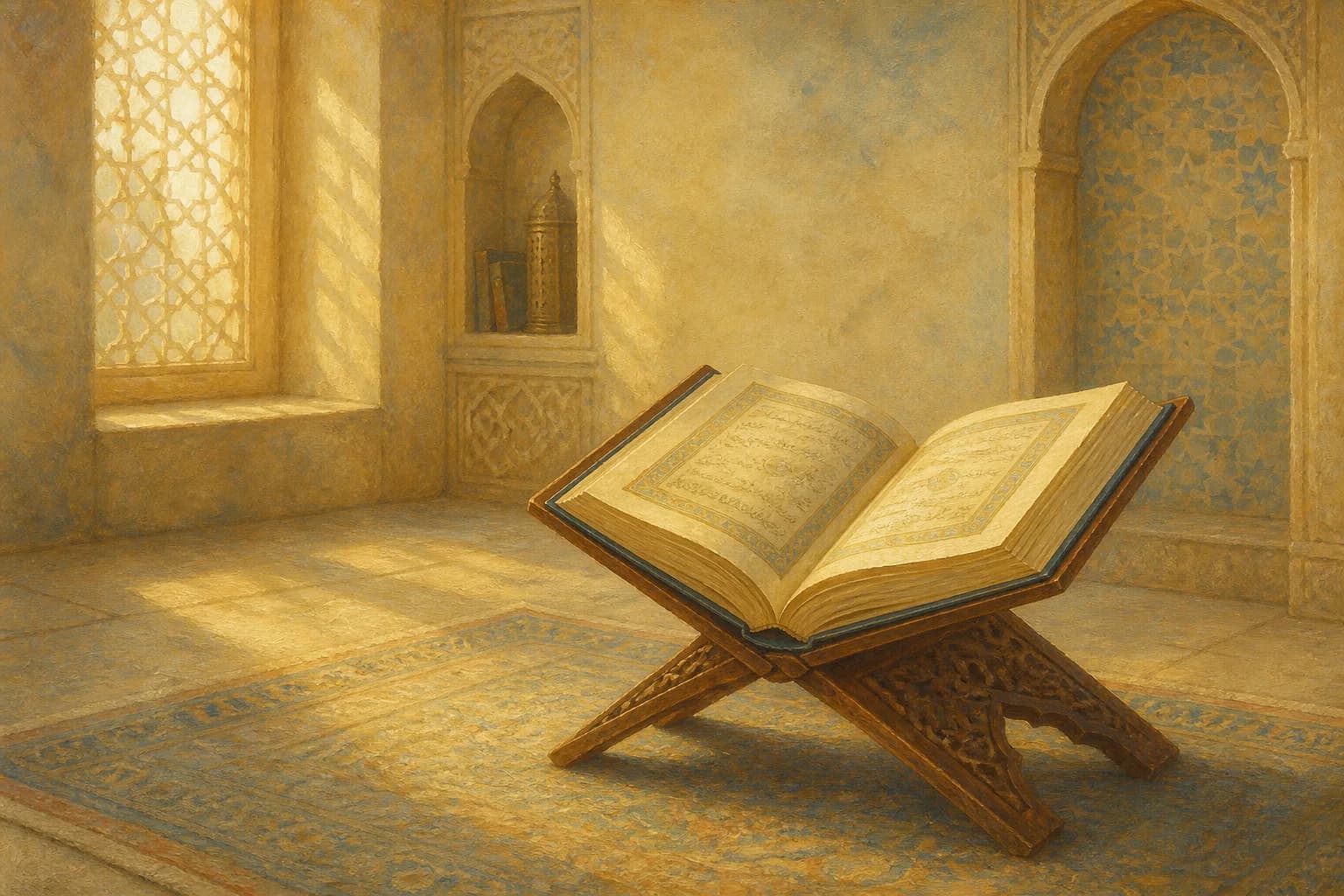

There are 1.9 billion Muslims on earth, and nearly every one of them owns at least one physical copy of the same book. Not a translation. Not an adaptation. The same text, in the same language, preserved letter for letter across fourteen centuries. That book is the mushaf — the bound written copy of the Quran — and understanding what it is, where it came from, and how to engage with it daily is one of the most grounding things a Muslim can do.
Whether you are new to Islam, returning after a long gap, or simply wanting to deepen your relationship with the Quran, this guide walks through the mushaf from its origins in revelation to its place in your daily life.
What Is a Mushaf in Islam?
A mushaf (مُصْحَف) is the complete written copy of the Quran — all 114 surahs and 6,236 ayahs bound between two covers. The word comes from the Arabic root related to suhuf (صُحُف), meaning pages or sheets. The mushaf is not simply a book in the ordinary sense: it contains the direct, verbatim speech of Allah as revealed to the Prophet Muhammad ﷺ over 23 years. The text preserved in the mushaf today is identical to the Uthmanic codex standardized in approximately 646 CE, distributed to Muslim cities, and upheld by the scholarly tradition without interruption.
How the Quran Was Compiled Into One Mushaf
The Quran was first preserved through oral transmission — the Prophet ﷺ would recite each new revelation, his companions would memorize it, and scribes would write it on whatever materials were available: parchment, bones, palm leaves. By the time of the Prophet's death in 632 CE, the entire Quran had been memorized by thousands of Huffaz (those who commit the Quran to memory), but no single compiled volume existed.
The first crisis came at the Battle of Yamama in 633 CE, where approximately 70 Huffaz were martyred. The companion Umar ibn al-Khattab (RA) urged the Caliph Abu Bakr (RA) to commission a written compilation before the oral tradition was threatened. Abu Bakr entrusted this monumental task to Zayd ibn Thabit (RA), the Prophet's principal scribe, who compiled the first complete written mushaf from both oral reports and written fragments, verified by at least two witnesses.
This compilation remained under Abu Bakr's safekeeping and then with Hafsa bint Umar (RA). Approximately a decade later, Caliph Uthman ibn Affan (RA) recognized that regional dialectal variations in recitation were creating confusion as Islam spread. He ordered Zayd ibn Thabit and a team of senior Quran scholars to produce a standardized mushaf based on the Qurayshi dialect — the tongue of the revelation. Copies were distributed to major Muslim cities, and regional variants were withdrawn. This is the Uthmanic mushaf: the foundation of every mushaf in use today.
| Period | Event | Key Figure | Significance |
|---|---|---|---|
| 610–632 CE | Revelation sent down over 23 years | Prophet Muhammad ﷺ | Quran preserved orally by Huffaz and in written fragments |
| 633 CE | First written compilation commissioned | Abu Bakr (RA) / Zayd ibn Thabit | Response to the martyrdom of 70 Huffaz at Yamama |
| ~646 CE | Standardized Uthmanic mushaf produced | Uthman ibn Affan (RA) | Single authorized text distributed to Muslim cities |
| Present | 1.9 billion Muslims | Global ummah | The same text preserved letter-for-letter across 14 centuries |
The uthmani quran article explores this script in more detail if you want to understand why the Uthmanic orthography looks different from modern Arabic.
Why the Mushaf Matters for Muslims Today
The Quran declares its own preservation directly: "Indeed, it is We who sent down the Reminder, and indeed, it is We who will be its guardian" (Surah Al-Hijr, 15:9 — Quran.com). The mushaf is the physical embodiment of that promise — a book that has been copied by hand across continents and centuries and arrived at your hands unchanged.
This is not a claim other religious books make with the same historical backing. The manuscript tradition behind the Quran — including the earliest complete manuscripts such as the Tashkent Quran and the Birmingham Quran manuscript — consistently confirms the integrity of what you hold. For modern Muslims navigating a world of shifting information and contested truths, the mushaf is an anchor.
Beyond historical preservation, the act of reciting from the mushaf carries its own reward. The Prophet ﷺ said: "Whoever reads a letter from the Book of Allah will receive a hasanah (good deed) for it, and a hasanah has the reward of ten like it" (Tirmidhi 2910). He also said: "The one who is skilled in the Quran will be with the noble and righteous scribes, and the one who recites it with difficulty will receive a double reward" (Sahih al-Bukhari 4937).
The benefits of reading Quran daily extend beyond spiritual reward — regular recitation from the mushaf builds a relationship with the text that transforms how you see every other aspect of your life.
How to Engage with the Mushaf Daily
The Etiquette of Handling the Mushaf
The Quran states: "None can touch it except the purified" (Surah Al-Waqiah, 56:79). Scholars have applied this principle to the physical mushaf, and the majority position is that wudu is required before touching it. This is not a burden — it is a reminder that you are picking up something extraordinary.
Beyond purity, the traditional etiquette includes:
- Face the qiblah when possible while reciting.
- Hold the mushaf with respect — at chest level, not dangling at your side.
- Store it in a clean, elevated place — never on the floor or under other books.
- Do not write in the margins unless it is a study mushaf intended for annotation.
- Dispose of a worn mushaf with dignity — bury it in clean ground or place it in running water.
Building a Daily Quran Reading Habit
The Prophet ﷺ encouraged completing the Quran regularly. The Companions typically completed it once a month, and some completed it in a week. For most Muslims today, a sustainable pace begins small.
A practical daily framework:
- Set a fixed time. After Fajr is the most recommended: "Establish prayer at the decline of the sun until the darkness of night and the Quran of Fajr. Indeed, the recitation of Fajr is ever witnessed" (Surah Al-Isra, 17:78).
- Start with Surah Al-Fatihah. Before reading any session, recite Surah Al-Fatihah — the opening chapter, the most recited ayahs in the Quran, and a reminder of why you are reading.
- Even one page is enough to begin. One page daily equals a complete reading of the Quran every two to three years. Two pages equals a completion every year.
- Read with understanding. The how to read Quran for beginners guide walks through the basics of recitation, the letters, and how to access translations alongside the Arabic text.
- Use AI-powered insights. Modern tools for Quran learning — including apps that provide contextual tafsir alongside the text — have made daily engagement accessible for Arabic learners at every level.
For building the consistent habit, the DeenBack guide on seeking Islamic knowledge includes practical advice on how to protect a learning routine from being crowded out by daily life. The Demi Manifest piece on cultivating wisdom in Muslim life explores how regular Quran engagement shapes the quality of thought and decision-making over time.
Want the Qur'an to feel easier to understand?
Read with clear contextual insights, revisit the verses that matter to you, and build a steady daily Qur'an habit with DeenUp.
Take the Qur'an Quiz
Digital Mushaf or Physical Mushaf?
Both are valid, and many scholars encourage keeping a physical mushaf accessible even if you primarily read on a device. The physical mushaf reinforces the etiquette of intentional engagement — you pick it up, you sit properly, you know you are doing something set apart from scrolling a news feed. Reading from a digital screen without wudu is permitted under most scholarly opinions, which makes the phone a practical tool for reciting throughout the day.
The Ayatul Kursi is a good starting point for daily memorization — a single powerful ayah that rewards recitation, offers protection, and anchors the larger habit of Quran engagement.
Signs That Your Relationship with the Mushaf Is Growing
Building a relationship with the mushaf takes time. Here is what genuine progress looks like:
- You reach for it at Fajr before your phone most mornings.
- Ayahs you have recited begin to surface in your thoughts during the day.
- You feel the absence of a day's recitation rather than treating it as a relief.
- You begin asking questions about specific verses — what context they were revealed in, what the scholars said about them.
- You start teaching a family member or child to read, which is itself a form of sadaqah jariyah.
The Prophet ﷺ said: "The best of you are those who learn the Quran and teach it" (Sahih al-Bukhari 5027, Sunnah.com). This is not only about academic expertise — it includes the parent who sits with a child and teaches the Fatihah, the person who shares a single ayah with a friend. Every act of transmission is part of the chain that has kept the mushaf alive for fourteen centuries.
Common Questions About the Mushaf
Is a digital Quran app considered a mushaf?
Scholars generally do not classify a phone or tablet as a mushaf in the classical legal sense. This means the strict rules — such as requiring wudu to touch it — do not apply to a digital device. The Quran on a screen is still the Quran and deserves reverence, but the technical category of mushaf refers to the bound physical copy. Many contemporary scholars, including those of Al-Azhar and the Permanent Committee for Scholarly Research in Saudi Arabia, support this distinction.
How do I dispose of an old or damaged mushaf?
A damaged or old mushaf should never be thrown in ordinary rubbish. The classical position is to bury it in clean ground in a place that will not be walked over — wrapping it beforehand is recommended. Some scholars permit burning the mushaf in clean circumstances as an alternative, based on the precedent of Uthman (RA) burning non-standard copies. Placing it in flowing water is also permitted. Many mosques accept old masahif for proper disposal if you are unsure.
Can a non-Muslim touch or read the Quran?
Scholars permit non-Muslims to handle and read the Quran for the purpose of learning about Islam or engaging with its message. The verse "none can touch it except the purified" (56:79) is interpreted by most scholars as referring primarily to the heavenly preserved tablet rather than imposing a blanket prohibition on non-Muslims reading the text. Inviting a non-Muslim to read from the Quran is considered an act of dawah.
Closing: The Book That Waits for You
The mushaf on your shelf, the one on your bedside table, the one your grandmother read until the cover wore thin — it contains the same words that were revealed to the Prophet ﷺ in a cave above Mecca more than fourteen hundred years ago. It has been copied by hand, preserved by memory, defended by scholarship, and carried across oceans. It is waiting to be read again — today, in the time between Fajr and sunrise, or in the quiet after the children are asleep.
One page. One ayah. One word. Start where you are.
Want the Qur'an to feel easier to understand?
Read with clear contextual insights, revisit the verses that matter to you, and build a steady daily Qur'an habit with DeenUp.
Take the Qur'an QuizFrequently Asked Questions
What is a mushaf in Islam?
A mushaf (مُصْحَف) is the physical written copy of the Quran — the complete text of all 114 surahs and 6,236 ayahs bound between two covers. The word comes from the Arabic root meaning pages or sheets. The mushaf we use today descends from the standardized Uthmanic codex compiled under Caliph Uthman ibn Affan around 646 CE.
Do I need wudu to read the Quran on my phone or tablet?
The majority of scholars hold that a phone or tablet is not a mushaf in the classical sense, so it may be held and read without wudu — though having wudu is always recommended out of respect for the Quran. However, the ruling is different for a physical mushaf: the majority position is that the mushaf should not be touched without wudu, based on Quran 56:79.
How was the Quran compiled into a single mushaf?
The Quran was preserved orally during the Prophet's life. After the Battle of Yamama in 633 CE, where around 70 Huffaz were martyred, Abu Bakr (RA) ordered Zayd ibn Thabit to compile the written fragments into one volume. Uthman (RA) later standardized this into the official Uthmanic mushaf around 646 CE and distributed it to major Muslim cities.
What is the ruling on touching a mushaf without wudu?
The majority of scholars, drawing on Quran 56:79 and the hadith that only the purified may touch the Quran, hold that wudu is required before touching the mushaf. The Maliki, Shafi'i, and Hanbali schools agree on this. The Hanafi school holds the same with some nuance. Reading from memory or via a digital device without wudu is permitted under most scholarly opinions.
Can women read the Quran during menstruation?
Scholars differ on this question. The majority Maliki, Shafi'i, and Hanbali position is that women during menstruation should not touch the physical mushaf. However, they may read the Quran from memory, listen to recitation, and — according to many scholars — read from a digital screen. The Maliki school permits reading short ayahs with the intention of dhikr rather than recitation.
What is the proper way to store a mushaf at home?
The mushaf should be stored in a clean, elevated place — not on the floor or beneath other books. It should not be placed in a bathroom or taken there. Traditionally, Muslims store the mushaf on a dedicated shelf or wrapped in a clean cloth. When damaged or worn out, the mushaf should not be thrown in regular rubbish — it should be buried in clean ground or placed in running water.
Why do Muslims treat the mushaf with such reverence?
Muslims treat the mushaf with reverence because it contains the literal words of Allah — not a paraphrase or summary, but the direct speech of the Creator preserved letter for letter. The Quran describes itself as a noble book (Surah Al-Waqiah 56:77) and commands that it be handled with purity. This reverence is an expression of taqwa: awareness that you are holding something from beyond the world.