

- Authors

- Name
- Ahmad
- Role
- Senior Marketing Manager, Islamic education • DeenUp
بِسْمِ اللهِ الرَّحْمٰنِ الرَّحِيْمِ
In the name of God, the Most Gracious, the Most Merciful.


Many Muslims sense there is more to a verse than its translation captures. You read an ayah, feel its weight, and wonder: how did the Prophet ﷺ live this? That question is exactly what hadith was preserved to answer.
Studying the Quran with hadith is not an advanced scholarly pursuit reserved for imams. It is simply the natural way the first Muslims understood their book — and it is accessible to every believer who wants their Quran reading to move from words on a page to a guide for daily life.
What Does It Mean to Study the Quran with Hadith?
Studying the Quran with hadith means reading Quranic verses alongside the Prophet's words and actions (sunnah) that explain, demonstrate, or expand on them. The Quran sets the principle; hadith shows how the Prophet ﷺ embodied it. Together, they form a complete picture of what Allah intends for believers to understand and practice. The six major hadith collections — led by Sahih al-Bukhari and Sahih Muslim — contain thousands of narrations linked directly to specific Quranic commands and contexts.
Why Hadith Is Essential to Quranic Understanding
The Quran commands believers to follow the Prophet ﷺ explicitly:
وَمَا آتَاكُمُ الرَّسُولُ فَخُذُوهُ وَمَا نَهَاكُمْ عَنْهُ فَانتَهُوا
"Whatever the Messenger gives you, take it; and whatever he forbids you, refrain from it." — (Surah Al-Hashr, 59:7)
This verse itself establishes hadith as binding alongside the Quran. The Quran tells Muslims to pray, but it is hadith that teaches the number of rakahs, the words of tashahhud, and the conditions of wudu. The Quran commands zakat, but hadith specifies the nisab threshold and the 2.5% rate. Without hadith, many Quranic commands remain incomplete instructions.
The Prophet ﷺ described his own role clearly: "I have been given the Quran and something like it along with it" (Sunan Abu Dawud 4604). That "something like it" is his sunnah — the second source of Islamic law.
The Concept of Tafsir bil-Ma'thur (Explanation by Transmission)
Classical Islamic scholarship developed tafsir bil-ma'thur — interpreting the Quran through transmitted reports from the Prophet ﷺ and his companions (sahaba). This is considered the most reliable form of Quranic commentary because it traces understanding directly to those who lived with the revelation.
Ibn Kathir's Tafsir al-Quran al-Azim remains the most widely used example: for nearly every verse, he cites relevant hadith before offering any further explanation. When you read his tafsir, you are essentially doing Quran-with-hadith study in its most classical form.
How the Two Sources Work Together in Practice
| Quranic verse | What the Quran says | How hadith explains it |
|---|---|---|
| Al-Baqarah 2:43 | "Establish prayer and give zakat" | Hadith specifies prayer times, postures, words, and zakat rates |
| Al-Imran 3:97 | "Pilgrimage to the House is a duty for those who can" | Hadith details the rites, sequence, and conditions of Hajj |
| Al-Baqarah 2:183 | "Fasting is prescribed for you" | Hadith clarifies what breaks the fast, suhoor, iftar times |
| Al-Nisa 4:43 | "Do not approach prayer while intoxicated" | Hadith extends this to establish the full prohibition of alcohol |
| Al-Baqarah 2:286 | "Allah does not burden a soul beyond what it can bear" | Hadith on concessions for travellers, illness, and hardship |
This table illustrates a consistent pattern: the Quran states the obligation or principle, and hadith supplies the operational detail. Neither source is complete without the other for practical Islamic life.
Starting Your Quran-Hadith Study
If you want to read the Quran with hadith practically, these steps work well for beginners and consistent learners alike.
Begin with a strong translation. A translation that includes brief footnotes on the reasons for revelation (asbab al-nuzul) already does some of the hadith-sourcing work for you. The Sahih International translation, available at quran.com, is accurate and widely trusted.
Pair each surah with its relevant hadith. When you finish a juz or a surah, search for hadith on its central themes. Resources like sunnah.com let you search by topic keyword. For Surah Al-Mulk, for example, search "surah mulk" in Tirmidhi to find the famous narration about its protective virtue (Jami al-Tirmidhi 2891).
Study one tafsir chapter per week. Ibn Kathir's tafsir is free in English translation online. Reading even one chapter per week, paying attention to which hadith he cites, builds your ability to see the connection between verse and sunnah gradually.
Track your progress. Many Muslims find that logging which surahs they have studied — along with their key hadith — creates accountability. DeenUp's daily habit tracker lets you set a Quran study goal and build a streak over weeks and months.
Want the Qur'an to feel easier to understand?
Read with clear contextual insights, revisit the verses that matter to you, and build a steady daily Qur'an habit with DeenUp.
Take the Qur'an Quiz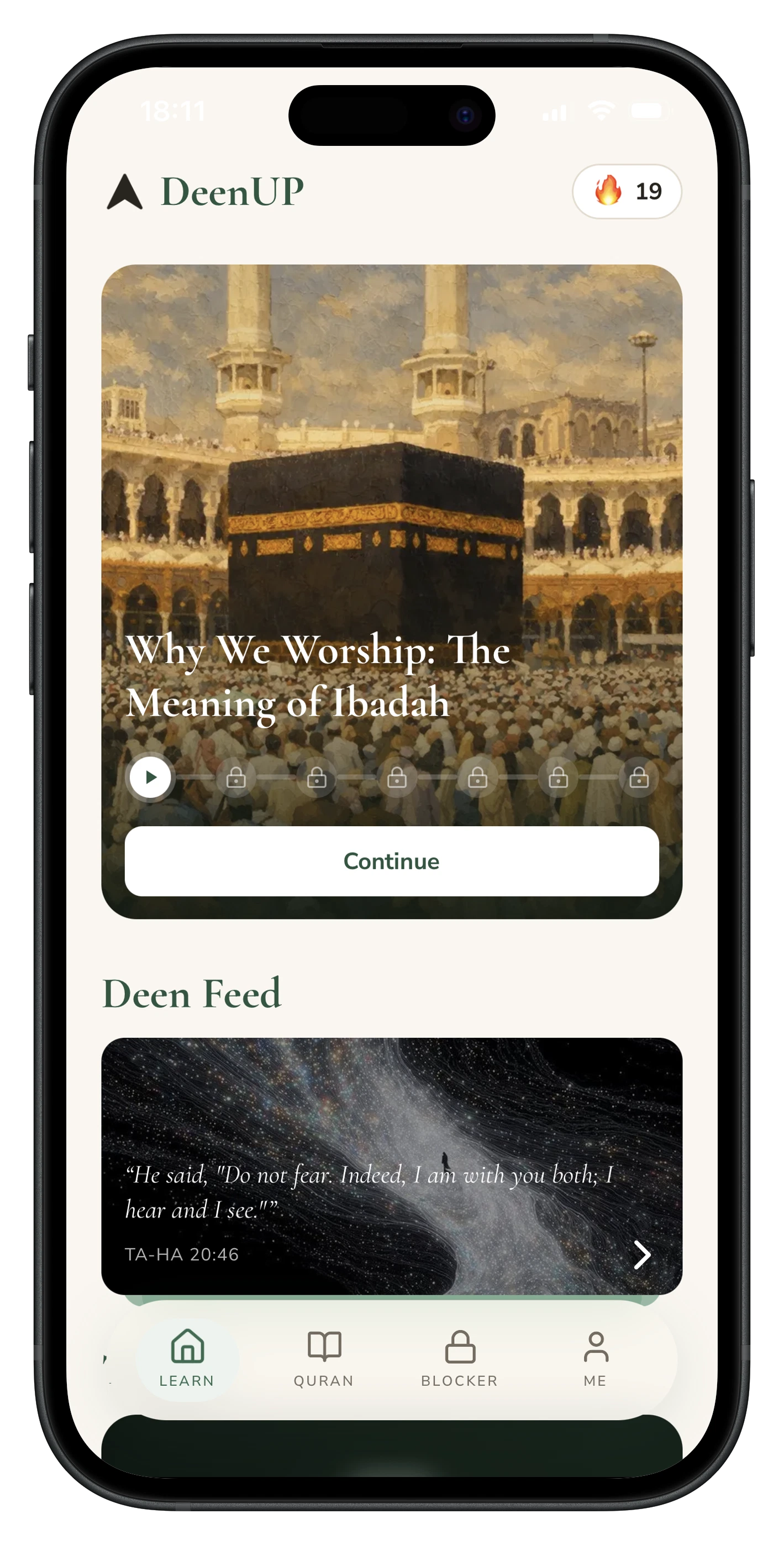
Commonly Misunderstood Connections Between Quran and Hadith
The Salah Connection
The Quran mentions salah (prayer) over eighty times. Yet the word itself does not appear with a step-by-step description of how to pray. This is intentional: Allah commanded the practice; the Prophet ﷺ demonstrated it. When a companion asked the Prophet ﷺ how to pray, he replied, "Pray as you have seen me pray" (Sahih al-Bukhari 631). The Quran issues the command; the Sunnah is the instruction manual.
For anyone learning to pray or refining their prayer, resources like DeenUp's blog on how to read Quran for beginners or the detailed breakdown of benefits of reading Quran daily show how consistent Quran engagement naturally draws you into hadith study.
Asbab al-Nuzul: The Reasons Behind Revelation
Many verses were revealed in direct response to events in the early Muslim community. Knowing these reasons — asbab al-nuzul — unlocks layers of meaning. Surah Al-Masad (111) was revealed in response to Abu Lahab's open hostility to the Prophet ﷺ. Knowing this does not change the verse's words but transforms how you read it: from an abstract condemnation to a specific historical moment where Allah defended His Prophet.
The companion Ibn Abbas رضي الله عنهما became known as tarjuman al-Quran (the Interpreter of the Quran) because the Prophet ﷺ made dua for him: "O Allah, give him understanding of the religion and teach him the interpretation of the Quran" (Musnad Ahmad 3049). The Companions understood Quranic interpretation as inseparable from the Prophet's teaching.
Building the Habit of Integrated Study
The gap between knowing you should study Quran with hadith and actually doing it is usually a habit problem, not a knowledge problem. A few principles help:
- Start small. After your Fajr prayer, spend five minutes reading one verse and looking up one related hadith. Consistency matters more than volume.
- Use a study sequence. Choose a surah and commit to understanding it fully before moving on. Shorter surahs — Al-Fatihah, Al-Ikhlas, Al-Kursi — are rich in hadith connections and perfect starting points.
- Use good tools. The best Quran application features and best Quran translation comparisons on this blog can help you choose the right resources for your learning style.
- Review the hadith with context. When you encounter a hadith, note the narrator chain briefly — was this narrated by a companion who witnessed the event directly? That context enriches the meaning.
The Prophet ﷺ said: "The best of you are those who learn the Quran and teach it" (Sahih al-Bukhari 5027). Learning it well means learning it the way the Prophet ﷺ intended it to be understood — with his own words alongside it.
Want the Qur'an to feel easier to understand?
Read with clear contextual insights, revisit the verses that matter to you, and build a steady daily Qur'an habit with DeenUp.
Take the Qur'an QuizSigns You Are Growing in Integrated Quran-Hadith Study
You notice that you naturally look for hadith when a verse raises a practical question. You recognize surah names cited in hadith and can place them in context. You start distinguishing between Quranic principles (broad, eternal) and hadiths (specific, circumstantial applications). And most importantly, verses begin to reshape your behavior — not because you memorized rulings, but because you understand the wisdom behind them.
The knowledge of hadith about knowledge itself reflects this: seeking understanding is an act of worship. The Prophet ﷺ said, "Whoever follows a path in pursuit of knowledge, Allah will make easy for him a path to Paradise" (Sahih Muslim 2699). Integrated Quran-hadith study is one of the clearest paths to that goal.
Explore more on understanding key Quranic passages — such as Ayatul Kursi meaning and benefits — to see how hadith enriches even the most familiar verses of the Quran.
Frequently Asked Questions
What does it mean to study the Quran with hadith?
Studying the Quran with hadith means reading Quranic verses alongside the Prophet's sayings and actions that explain them. The hadith literature — especially Sahih al-Bukhari and Sahih Muslim — records how the Prophet ﷺ and his companions understood and applied specific verses in daily life.
Why is hadith necessary to understand the Quran?
The Quran was revealed to the Prophet ﷺ, who demonstrated its meaning through his words and deeds. Many Quranic commands — such as how to pray salah or calculate zakat — are not fully detailed in the Quran itself. Hadith fills that gap, making the Prophet's practice the living commentary on the Book.
Where can I find hadith that explain specific Quran verses?
The most accessible starting point is sunnah.com, which organizes many hadith by topic and chapter alongside Arabic text and translations. Classical tafsir works — such as Ibn Kathir's Tafsir al-Quran al-Azim — also draw heavily on hadith to explain each verse in sequence.
Which hadith collections are most reliable for studying with the Quran?
The six major collections (Kutub al-Sittah) are the most trusted: Sahih al-Bukhari, Sahih Muslim, Sunan Abu Dawud, Jami al-Tirmidhi, Sunan al-Nasa'i, and Sunan Ibn Majah. Bukhari and Muslim are considered the most rigorously authenticated; together they are called the Sahihayn.
Can I understand the Quran without studying hadith?
You can read the Quran's general message — its call to worship Allah, its moral teachings, its accounts of previous nations — without extensive hadith study. But to understand precise rulings, the reasons behind specific verses (asbab al-nuzul), and how Muslims are meant to practice, hadith is essential.
How long does it take to learn to study the Quran with hadith properly?
You can begin meaningfully within weeks by pairing a good Quran translation with basic hadith access online. Deeper fluency — understanding isnad (chain of narration), grading levels, and cross-referencing — takes years. Most Muslims benefit from starting with a structured tafsir or guided app that surfaces relevant hadith automatically.
Is it permissible to rely only on the Quran and ignore hadith?
The scholarly consensus holds that rejecting authentic hadith contradicts the Quran itself, which commands believers to obey the Prophet ﷺ (Surah Al-Hashr, 59:7). A position that discards hadith is considered a minority fringe view and is not accepted by any of the major Islamic schools of jurisprudence.