

- Authors

- Name
- Ahmad
- Role
- Senior Marketing Manager, Islamic education • DeenUp
بِسْمِ اللهِ الرَّحْمٰنِ الرَّحِيْمِ
In the name of God, the Most Gracious, the Most Merciful.
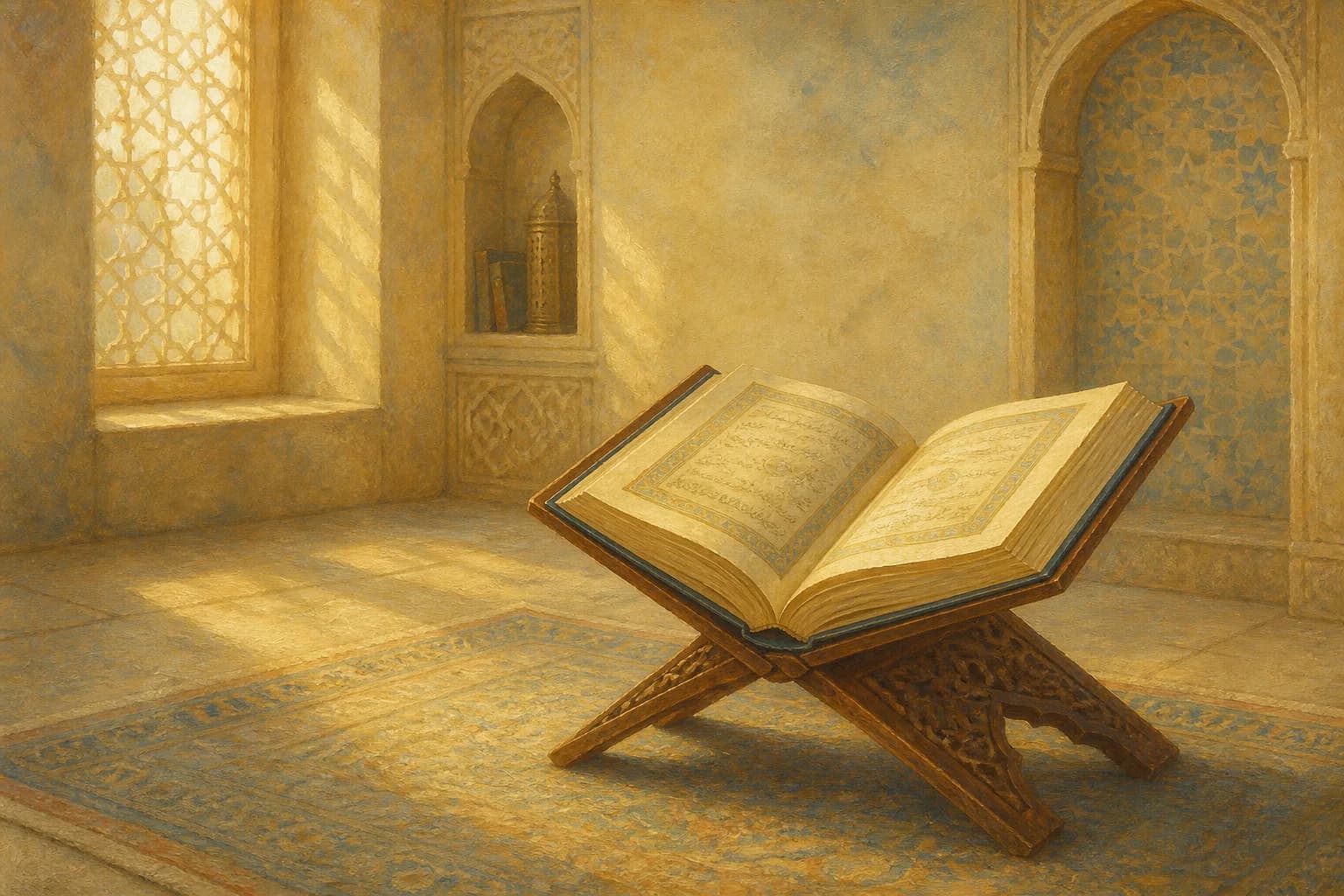

A Surah Designed for the Trials You Are Already Facing
Most Muslims know Surah Al-Kahf (سورة الكهف) as the chapter to read on Fridays. You might have it bookmarked on your phone, or a teacher once mentioned it, and it has since settled into the rhythm of your week. But what often goes unsaid is this: this surah was not revealed simply to fill a weekly timeslot. It was revealed as a direct response to the four most persistent threats to a believer's faith — and it carries within it a blueprint for navigating each one.
Surah Al-Kahf is Chapter 18 of the Quran, comprising 110 verses. Its name comes from the Arabic word for "cave" — al-kahf — because its opening story follows a group of young believers who sought refuge in a cave to protect their faith from a society that had abandoned the truth. That starting point is not incidental. It is the surah's declaration of intent: this chapter is for people whose convictions are under pressure.
Understanding what this surah actually contains — and why it was structured this way — changes the practice from a weekly checkbox into one of the most useful tools a Muslim can carry.
The Four Stories and What They Guard Against
Scholars have consistently identified four major trials in Surah Al-Kahf, each addressed through a distinct narrative. These four tests are not historical curiosities — they describe the same pressures that pull people away from Allah today.
The People of the Cave — Trial of Faith
Young men discover that the world around them has rejected the truth. Rather than compromise, they withdraw to a cave and turn to Allah with this dua:
رَبَّنَا آتِنَا مِن لَّدُنكَ رَحْمَةً وَهَيِّئْ لَنَا مِنْ أَمْرِنَا رَشَدًا
"Our Lord, grant us from Yourself mercy and prepare for us from our affair right guidance." — (Surah Al-Kahf, 18:10)
Allah preserves them in that cave for 309 years. When they wake, the world has changed — but their faith has not. This is a story about holding your ground when the culture around you is moving in a different direction. Social pressure to dilute your practice, to hide your beliefs, to blend in — the cave dwellers faced this directly. Their response was not withdrawal out of cowardice but a conscious choice to protect what mattered most.
The Owner of Two Gardens — Trial of Wealth
A wealthy man shows his companion two flourishing gardens and begins to treat his prosperity as a personal achievement rather than a trust from Allah. He even suggests he is unlikely to face any consequence. His gardens are eventually destroyed.
His companion had cautioned him to say:
مَا شَاءَ اللَّهُ لَا قُوَّةَ إِلَّا بِاللَّهِ
"What Allah wills — there is no power except through Allah." (Surah Al-Kahf, 18:39)
The trial of wealth is not simply about greed. It is about the slow, subtle shift that happens when comfort becomes identity — when prosperity starts to feel earned rather than loaned.
Musa and Al-Khidr — Trial of Knowledge
One of the most compelling stories in the Quran. Musa — a prophet, a man who spoke to Allah directly — is sent by Allah to learn from a servant named Al-Khidr. Throughout their journey, Al-Khidr takes actions that appear unjust: damaging a ship, killing a child, repairing a wall for ungrateful people. Each time, Musa objects. Each time, there is a wisdom Musa could not see in the moment.
The trial of knowledge is the assumption that you understand enough to judge. This story asks whether you can act while holding the possibility that your understanding is incomplete — whether you can resist the urgency to have an opinion about everything you encounter.
Dhul-Qarnayn — Trial of Power
A king of tremendous authority travels to the ends of the earth. He uses his power not to accumulate but to serve — building a great barrier to protect vulnerable communities from Gog and Magog. When people offer him payment, he declines. When the barrier is complete, he credits Allah entirely: "This is a mercy from my Lord." (Surah Al-Kahf, 18:98)
Power becomes dangerous the moment its holder begins to feel like the source of it. Dhul-Qarnayn demonstrates the alternative: authority held as a trust, used for others, credited entirely to Allah.
Why These Stories Matter Right Now
Each of these four trials maps directly onto pressures present in modern Muslim life. The pressure to blend in and not seem "too religious" — trial of faith. The way a growing income or social status gradually changes how a person carries themselves — trial of wealth. The confident certainty of people who consume enormous amounts of information and begin to assume they understand most things — trial of knowledge. The pull of influence, platforms, and public authority — trial of power.
Surah Al-Kahf was revealed to a young Muslim community navigating exactly these pressures in a different era. The significance of Friday in Islam is that it is a weekly reset — and Surah Al-Kahf is positioned at the center of that reset to help believers recalibrate before the next week begins.
The protective benefit of this surah is also specific and documented. As recorded in Sahih Muslim 809, the Prophet ﷺ said: "Whoever memorizes ten verses from the beginning of Surah Al-Kahf will be protected from the Dajjal." This is one of the most concrete protections against the Dajjal mentioned in authentic hadith, and it hinges on actual engagement with the text — not just an intention, but real words carried in the heart.
For comparison, the article on Surah Al-Mulk's protective qualities explores how that chapter carries specific protection from the punishment of the grave when recited nightly — showing the Quran as a practical, living guide rather than a ceremonial text.
The DeenBack resource on morning duas and adhkar explores how building Quranic practice into the early part of the day creates a stronger foundation for everything that follows — directly relevant if you choose Fajr time as your Al-Kahf window.
Building the Practice Week by Week
Knowing about the surah and actually making it part of your week are different things. Here is what tends to work.
Anchor the recitation to something fixed. The most reliable approach is pairing it with a post-Jumu'ah routine or reading it before or after Fajr on Friday morning. If the timing is attached to something you already do consistently, the habit sustains itself without requiring willpower every week.
Start with the first ten verses if memorization feels distant. The Dajjal protection narration centers on these opening verses. Ten verses is an accessible goal — short enough to review in five minutes, meaningful enough that the effort compounds over time.
Engage one story per week as a reflection. Pick the trial that feels most currently relevant. If you have been wrestling with how success has changed your self-perception, spend the week with the garden owner. If you have found yourself quick to judge a situation you did not fully understand, return to Musa and Al-Khidr. The surah is built for this kind of active reading.
Gradually build toward Arabic fluency. Reciting in Arabic carries the specific reward mentioned in hadith. If you are still building your reading, the guide to reading the Quran for beginners walks through how to approach Arabic text while comprehension is still developing.
The Demi Manifest guide to Islamic morning routines covers how structured worship early in the day — Quran, dhikr, dua — reshapes the quality of everything that follows, a principle that applies equally to a dedicated Jumu'ah morning practice.
The full text of Surah Al-Kahf on Quran.com includes Arabic, transliteration, and multiple translations for reference.
The Surah Yasin guide is a natural companion — it covers a surah with deep roots in themes of resurrection and faith, often recited on Friday mornings alongside Al-Kahf by those who want a fuller Jumu'ah Quran practice.
Want the Qur'an to feel easier to understand?
Read with clear contextual insights, revisit the verses that matter to you, and build a steady daily Qur'an habit with DeenUp.
Take the Qur'an Quiz
Signs the Surah Is Working in You
A Quran practice is maturing when it starts shaping how you think — not just how you organize your week. With Surah Al-Kahf, you will notice it when:
The cave dwellers' dua (18:10) surfaces naturally in moments of disorientation — when you are facing a decision and you find yourself genuinely asking Allah for guidance without consciously deciding to recite anything.
You start recognizing which of the four trials you are currently navigating. Not abstractly — but with enough specificity to know which story to return to for grounding this week.
Fridays feel different. Not heavier — clearer. The surah becomes the container for reflecting on the previous week and orienting toward the next, which is exactly what a Jumu'ah practice is designed to do.
The benefits of reading Quran daily covers how sustained engagement with the Quran changes not just individual moments but the overall quality of a person's inner life — what happens when the Quran moves from occasional reading to genuine companion.
A Map for Every Week
Surah Al-Kahf is the Quran's response to the four oldest and most persistent threats to faith: pressure from the crowd, the pull of material comfort, the arrogance of knowledge, and the intoxication of power. Each story addresses one of these threats directly — not with abstract theology but through characters in situations that feel immediately recognizable.
Read it once a week. Understand why you are reading it. Let each Friday be a fresh encounter with a chapter that was revealed for times exactly like this.
Want the Qur'an to feel easier to understand?
Read with clear contextual insights, revisit the verses that matter to you, and build a steady daily Qur'an habit with DeenUp.
Take the Qur'an QuizFrequently Asked Questions
Why is Surah Al-Kahf especially recommended on Fridays?
The Prophet is reported to have said that whoever recites Surah Al-Kahf on Friday will have a light shining from one Friday to the next. This makes it one of the most distinctive Friday acts of worship alongside the Jumu'ah prayer.
How many verses of Surah Al-Kahf protect from the Dajjal?
Sahih Muslim 809 records that whoever memorizes ten verses from the beginning of Surah Al-Kahf will be protected from the Dajjal. Some narrations also mention the last ten verses — scholars recommend learning both.
What are the four stories in Surah Al-Kahf and what do they represent?
The four stories are: the People of the Cave (trial of faith), the Owner of Two Gardens (trial of wealth), Musa and Al-Khidr (trial of knowledge), and Dhul-Qarnayn (trial of power). Each corresponds to a major test believers face throughout life.
Can I read Surah Al-Kahf in sections throughout Thursday night and Friday?
Yes. The recitation window begins at Maghrib on Thursday and extends until Maghrib on Friday. Reading it in parts across that period is permissible and does not reduce the reward.