

- Authors

- Name
- Ahmad
- Role
- Senior Marketing Manager, Islamic education • DeenUp
بِسْمِ اللهِ الرَّحْمٰنِ الرَّحِيْمِ
In the name of God, the Most Gracious, the Most Merciful.
You open your eyes at 2 a.m. The house is quiet. Your mind is clear in that way it rarely is during the day. For many Muslims, this moment feels significant — but they are not sure what to do with it. Is there something specific to say? Is this the time for Tahajjud? Should they go back to sleep?
The Prophet Muhammad ﷺ left precise, beautiful guidance for exactly this moment.
What Is the Dua for Waking Up at Night?
The dua for waking up at night is a comprehensive declaration of tawhid and praise recorded in Sahih al-Bukhari 1154. The Prophet ﷺ said: "Whoever wakes up at night and says this, then supplicates, will be answered. And if they perform wudu and pray, their prayer will be accepted."
The dua consists of tahlil, tahmid, tasbih, takbir, and laa hawla — covering every fundamental form of remembrance — in roughly 30 seconds of sincere recitation.
The Complete Prophetic Dua
لَا إِلَهَ إِلَّا اللَّهُ وَحْدَهُ لَا شَرِيكَ لَهُ، لَهُ الْمُلْكُ وَلَهُ الْحَمْدُ، وَهُوَ عَلَى كُلِّ شَيْءٍ قَدِيرٌ، سُبْحَانَ اللَّهِ، وَالْحَمْدُ لِلَّهِ، وَلَا إِلَهَ إِلَّا اللَّهُ، وَاللَّهُ أَكْبَرُ، وَلَا حَوْلَ وَلَا قُوَّةَ إِلَّا بِاللَّهِ
La ilaha illallahu wahdahu la sharika lah, lahul mulku wa lahul hamdu, wa huwa ala kulli shay'in qadir. Subhanallah, wal hamdu lillah, wa la ilaha illallah, wallahu akbar, wa la hawla wa la quwwata illa billah.
"There is no god but Allah, alone with no partner. His is the dominion, His is the praise, and He is over all things capable. Glory be to Allah. All praise is for Allah. There is no god but Allah. Allah is the Greatest. There is no power or might except with Allah." — (Sahih al-Bukhari 1154)
After reciting this, the hadith specifies: "then if he says: Allahummaghfir li — O Allah, forgive me, or supplicates, he will be answered. And if he performs wudu and prays, his prayer will be accepted."
This is not a passive nighttime whisper — it is a full gateway to answered du'a.
Why Does Waking at Night Have This Status?
The last third of the night holds a unique spiritual weight in the Sunnah. The Prophet ﷺ described it as the time when Allah descends to the lowest heaven and calls out: "Who is making du'a to Me, that I may respond? Who is asking Me, that I may give? Who is seeking My forgiveness, that I may forgive?" (Sahih al-Bukhari 1145)
Your involuntary waking at 2 a.m. is an invitation.
The Quran specifically honors those who pull themselves from sleep:
"Their sides forsake their beds, calling upon their Lord in fear and hope." — (Surah As-Sajdah, 32:16, quran.com)
This verse refers to the awliya — the close friends of Allah — who are known precisely by their night worship. It is not describing a weekly Tahajjud session but a consistent orientation of the heart toward Allah at night.
Tahajjud: What to Do After the Dua
If you wake up and recite the dua above, you are already fulfilling the Sunnah. What you do next depends on the time and your capacity:
| Step | What to Do | Notes |
|---|---|---|
| Recite the dua | The Bukhari 1154 dua immediately on waking | Do this from bed, no wudu required |
| Make personal du'a | Ask Allah for whatever is on your heart | The gateway is open after the dua |
| Perform wudu | If you are able | Increases reward; makes prayer valid |
| Pray Tahajjud | Minimum 2 rakahs, maximum 8 | In pairs; end with Witr if you haven't prayed it |
| Return to sleep | If Fajr is not close | Sleeping again is permissible |
For Tahajjud, the Prophet ﷺ used to begin with two short rakahs, then lengthen his prayer. He never fixed the number rigidly. What he fixed was the opening dua of the night prayer itself:
اللَّهُمَّ لَكَ الْحَمْدُ أَنْتَ قَيِّمُ السَّمَوَاتِ وَالأَرْضِ
Allahumma lakal-hamd, anta qayyimus-samawati wal-ard
"O Allah, all praise is for You. You are the Sustainer of the heavens and the earth." — (Sahih al-Bukhari 1120)
The full version of this Tahajjud opening dua continues for several lines. This is what the Prophet ﷺ recited standing before beginning his rakahs, and it is distinct from the waking dua above. Both are part of the complete prophetic night routine. See Surah Al-Isra, 17:79 for the Quranic foundation of Tahajjud as an additional obligation specifically for the Prophet ﷺ and a highly recommended act for his followers.
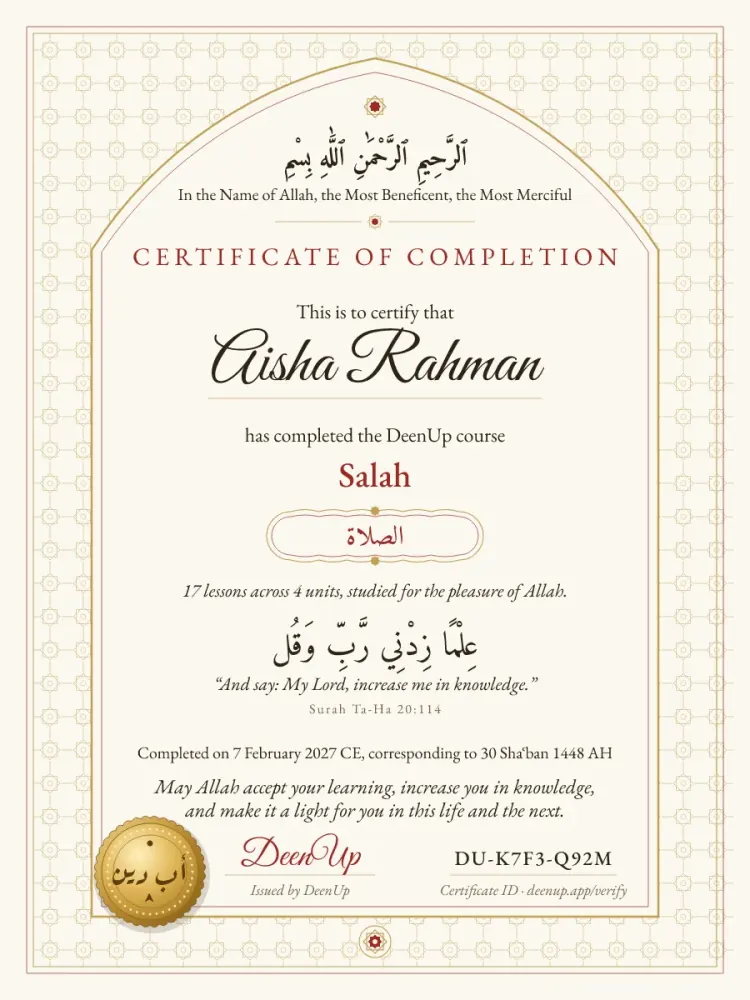
Your personal 28-Day Deen Plan
Learn your deen in 28 days, 5 minutes a day
The essentials of salah, fiqh and faith, step by step from authentic sources. Finish all 28 days and earn a verifiable Certificate of Completion.
Take the free quizAnswer a few questions and get your personal plan.
What If You Wake Up Multiple Times?
Waking at night can happen for many reasons — your child cries, you need water, your mind races. The scholars note that the hadith does not restrict the dua to a single waking or to waking specifically for worship. Any nighttime waking is an opportunity to recite it.
If you recite the dua and make personal supplication each time you wake — even briefly — you transform interruptions into acts of worship. This is the Islamic practice of turning every moment into dhikr (ذِكْر), remembrance of Allah.
For more on building a consistent nighttime dhikr routine, see the guidance on adhkar before sleeping and dua for sleeping, which cover the supplications that bookend the night. The tahajjud prayer benefits post goes deeper into the spiritual fruits of consistent night worship.
Making This a Consistent Practice
The gap between knowing a dua and saying it at 2 a.m. is real. Here is what actually helps:
Before sleep:
- Recite the sleeping dua (see dua for wakeup) and the full bedtime adhkar
- Set a sincere intention to wake for worship
- Keep your phone or a card with the nighttime dua within arm's reach
On waking:
- Before reaching for your phone, recite the dua above quietly
- Give yourself 30 seconds to follow it with any personal supplication
- Don't evaluate whether the moment "feels spiritual" — just say the words
Building to Tahajjud:
- Pick one night a week to perform full Tahajjud
- Gradually extend to two nights, then more, following the Prophet's pattern of increasing worship gradually
The Prophet ﷺ said: "The most beloved deeds to Allah are those performed consistently, even if they are small." (Sahih al-Bukhari 6464)
For practical inspiration on building nighttime dhikr into a daily habit, building daily Islamic habits and the qiyam al-layl spiritual benefits guide offer helpful frameworks.
A Feed Worth Scrolling
Swipe through short, scholar-approved Islamic lessons instead of mindless doom-scrolling.
Learn Through Play
Bite-sized lessons, quizzes, levels, and daily streaks make growing your Deen a habit.
Scholar-Approved
Every lesson is rooted in the Quran and authentic Sunnah and reviewed by qualified scholars.
The Night as Your Appointment With Allah
The concept of suhoor — the pre-dawn waking for Ramadan — trains Muslims annually to wake before Fajr. Outside Ramadan, that same time slot is the nighttime invitation described in the hadith. The last third of the night, roughly 1–2 hours before Fajr depending on your location and the time of year, is when the divine call goes out.
You don't need to wake every night. You don't need to pray hours of Tahajjud. You need one sincere dua — the 30-second declaration of tawhid from Sahih al-Bukhari 1154 — and the openness to follow it with whatever your heart carries.
For deeper understanding of the Quran's treatment of patience and worship through difficulty, Surah Al-Imran 3:200 — quran.com/3:200 — offers one of the most direct calls to perseverance and trust. And the dua as a daily habit post explores how to anchor supplications like this nighttime dua into a sustainable daily structure.
The night is quiet. Allah is near. The dua is short. Begin.
Your personal 28-Day Deen Plan
Learn your deen in 28 days, 5 minutes a day
The essentials of salah, fiqh and faith, step by step from authentic sources. Finish all 28 days and earn a verifiable Certificate of Completion.
Take the free quizAnswer a few questions and get your personal plan.
Frequently Asked Questions
What dua should I read when I wake up at night in Islam?
The Prophet ﷺ taught: 'La ilaha illallahu wahdahu la sharika lah, lahul mulku wa lahul hamdu, wa huwa ala kulli shay-in qadir...' — then if you supplicate, you will be answered. This dua is recorded in Sahih al-Bukhari 1154 and is the primary supplication for those who wake at night.
Is there a reward for waking up at night in Islam?
Yes. The Prophet ﷺ said that whoever recites the nighttime waking dua and then makes dua, they will be answered. If they perform wudu and pray, their prayer will be accepted. Allah also praises those who leave their beds to worship Him (Surah Al-Sajdah, 32:16).
What is Tahajjud and how is it connected to waking at night?
Tahajjud is the voluntary night prayer performed after Isha and before Fajr, ideally in the last third of the night. When you wake up at night and recite the prescribed dua, you can then perform Tahajjud — the Prophet ﷺ described it as the most virtuous prayer after the obligatory five.
Can I read any dua when I wake up at night, or is there a specific one?
There is a specific prophetic dua recorded in Sahih al-Bukhari 1154. It opens with 'La ilaha illallahu wahdahu la sharika lah' and continues with tahmid, tasbih, takbir and laa hawla. After this, any personal supplication is recommended — the hadith says Allah will respond.
What if I wake up at night but am unable to perform wudu?
If wudu is not possible, you can still recite the nighttime waking dua and make personal supplication from bed. The dua itself has no purification requirement. Wudu and praying afterward is an additional Sunnah — missing it does not invalidate the dhikr and dua you already made.
Is waking up at night for prayer obligatory in Islam?
Tahajjud and voluntary night prayers are Sunnah, not obligatory, for the general Muslim community. They were obligatory for the Prophet ﷺ alone. However, Allah specifically praises those who worship at night and scholars widely consider regular night prayer among the signs of the righteous.
How do I establish a habit of waking up at night for dhikr and prayer?
Begin with one night per week — set an alarm for the last third of the night (roughly 90 minutes before Fajr). Keep a wudu-ready state before bed when possible. DeenUp can send a reminder at a time you choose so the habit becomes anchored to a consistent trigger each night.