

- Authors

- Name
- Ahmad
- Role
- Senior Marketing Manager, Islamic education • DeenUp
بِسْمِ اللهِ الرَّحْمٰنِ الرَّحِيْمِ
In the name of God, the Most Gracious, the Most Merciful.
You know the feeling: the afternoon slips by in work, family, errands — and suddenly you realize Asr is almost over. For many Muslims, the mid-afternoon prayer is the one that gets away most often. Life is in full swing, and stopping to pray takes real intention.
The good news is that once you know the steps clearly, Asr namaz becomes something you look forward to rather than rush through. This guide walks you through every step — from intention to tasleem — so you can pray it correctly and consistently.
How Do You Perform Asr Namaz?
Asr namaz consists of 4 obligatory (fard) rakats, optionally preceded by 4 recommended (sunnah ghair muakkadah) rakats. Each rakat follows the same structure: standing recitation of Al-Fatihah, bowing (ruku), two prostrations (sujud), and sitting. After the second rakat you pause for tashahhud; after the fourth, you complete the full supplication and end with the tasleem (salaam) in both directions. The entire prayer takes roughly five to seven minutes.
Why Asr Namaz Matters
The Quran singles out Asr prayer directly: "Guard strictly the prayers, especially the middle prayer, and stand before Allah in devout obedience" (Surah Al-Baqarah, 2:238).
Most scholars — including Ibn Masud, Ibn Abbas, and the majority of the Companions — identified the salat al-wusta (middle prayer) as Asr. Its position in the middle of the day's cycle makes it the one most likely to be missed, which is precisely why the Quran highlights it.
The Prophet ﷺ reinforced this: "Whoever misses the Asr prayer, it is as if he has lost his family and wealth" (Sahih al-Bukhari 552). This is not meant to cause fear but to show how precious this daily pause with Allah is.
If you are building your prayer consistency, start with understanding how Asr prayer fits into the five daily prayers.
Step-by-Step: How to Perform Asr Namaz
Before You Begin
- Make sure you have performed wudu (ablution). Check the complete guide to wudu if you need a refresher.
- Face the Qibla (direction of the Kaaba in Makkah).
- Intention (niyyah) is in your heart: "I intend to pray the four rakats of Asr fard for Allah."
Rakat 1
1. Takbir al-Ihram Raise both hands to your earlobes, palms forward, and say: "Allahu Akbar" — this opens the prayer.
2. Opening Dua (Thana) In a low voice, recite:
سُبْحَانَكَ اللَّهُمَّ وَبِحَمْدِكَ وَتَبَارَكَ اسْمُكَ وَتَعَالَى جَدُّكَ وَلَا إِلَهَ غَيْرُكَ
Subhanakallahumma wa bihamdika wa tabarakasmuka wa ta'ala jadduka wa la ilaha ghayruk
"Glory be to You, O Allah, and all praise. Blessed is Your name and exalted is Your majesty. There is no god but You."
3. Surah Al-Fatihah Recite Al-Fatihah in full. After it, say "Ameen" (quietly if praying behind an imam).
4. Additional Surah Recite any other surah. A short surah such as Al-Ikhlas, Al-Asr, or Al-Kawthar works well.
5. Ruku (Bowing) Say "Allahu Akbar" and bow. Place your hands on your knees and recite:
سُبْحَانَ رَبِّيَ الْعَظِيمِ (Subhana Rabbiyal Azeem) x3
"Glory be to my Lord, the Most Great."
6. Rising from Ruku Straighten up saying: "Sami Allahu liman hamidah" — then say: "Rabbana lakal hamd".
7. First Sujud (Prostration) Say "Allahu Akbar" and go down. Your forehead, nose, both palms, both knees, and toes must all touch the ground. Recite:
سُبْحَانَ رَبِّيَ الْأَعْلَى (Subhana Rabbiyal A'la) x3
"Glory be to my Lord, the Most High."
8. Brief Sitting Rise saying "Allahu Akbar," sit briefly, then go into the second sujud with the same recitation.
9. Rise for Rakat 2 Stand up saying "Allahu Akbar."
Rakat 2
Repeat steps 3–8 (Fatihah + surah + ruku + two sujud).
10. First Tashahhud After the second rakat's sujud, sit and recite:
التَّحِيَّاتُ لِلَّهِ وَالصَّلَوَاتُ وَالطَّيِّبَاتُ، السَّلَامُ عَلَيْكَ أَيُّهَا النَّبِيُّ وَرَحْمَةُ اللَّهِ وَبَرَكَاتُهُ، السَّلَامُ عَلَيْنَا وَعَلَى عِبَادِ اللَّهِ الصَّالِحِينَ، أَشْهَدُ أَنْ لَا إِلَهَ إِلَّا اللَّهُ وَأَشْهَدُ أَنَّ مُحَمَّدًا عَبْدُهُ وَرَسُولُهُ
(At-tahiyyatu lillahi was-salawatu wat-tayyibat, as-salamu 'alayka ayyuhan-nabiyyu wa rahmatullahi wa barakatuh, as-salamu 'alayna wa 'ala 'ibadillahis-salihin, ashhadu an la ilaha illallah wa ashhadu anna Muhammadan 'abduhu wa rasuluh)
Raise your right index finger when you say the shahada.
Rakats 3 and 4
Stand up for rakats 3 and 4. In these rakats you recite only Surah Al-Fatihah — no additional surah.
11. Final Tashahhud After the fourth rakat's sujud, sit and recite the full tashahhud again, then add durood (Ibrahimiyyah):
اللَّهُمَّ صَلِّ عَلَى مُحَمَّدٍ وَعَلَى آلِ مُحَمَّدٍ كَمَا صَلَّيْتَ عَلَى إِبْرَاهِيمَ وَعَلَى آلِ إِبْرَاهِيمَ
Allahumma salli 'ala Muhammadin wa 'ala ali Muhammadin kama sallayta 'ala Ibrahima wa 'ala ali Ibrahim
Then recite a short dua, such as: "Allahumma inni zalamtu nafsi zulman kathira..." (Sahih al-Bukhari 834).
12. Tasleem (Ending the Prayer) Turn your head right: "As-salamu alaikum wa rahmatullah." Turn your head left: "As-salamu alaikum wa rahmatullah."
The prayer is complete.
Asr Namaz at a Glance
| Rakat | Fatihah | Extra Surah | Tashahhud |
|---|---|---|---|
| 1 | Yes | Yes | No |
| 2 | Yes | Yes | First (short) |
| 3 | Yes | No | No |
| 4 | Yes | No | Full + durood |
For a deeper look at how the number of rakats works across the five prayers, see how many rakats is Asr prayer.
Building a Consistent Asr Namaz Habit
The hardest part of Asr prayer is not the method — it is the timing. Here are three practical steps:
- Set a specific alarm. Not just "afternoon" but a fixed time 15 minutes after the Asr adhan in your city. This becomes a Pavlovian trigger.
- Identify your Asr spot. A prayer mat in a fixed location removes friction. You do not have to decide where to pray — your body already knows.
- Link it to something you already do. If you take a mid-afternoon break, make it your Asr break. Consistency compounds quickly.
The Prophet ﷺ said: "The most beloved deeds to Allah are those done regularly, even if small" (Sahih al-Bukhari 6464). Missing occasionally is human. What matters is returning immediately without self-condemnation.
If you struggle to keep track of your prayers and want reminders at the right time, DeenUp can help with daily prayer tracking and habit streaks.
Your personal 28-Day Deen Plan
Learn your deen in 28 days, 5 minutes a day
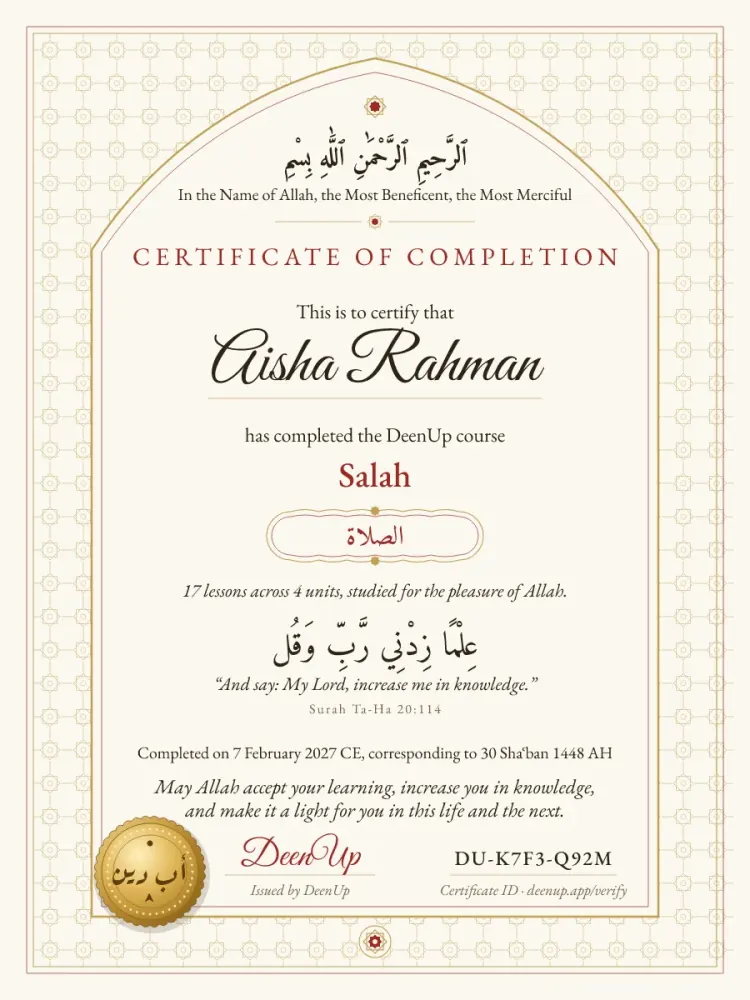
The essentials of salah, fiqh and faith, step by step from authentic sources. Finish all 28 days and earn a verifiable Certificate of Completion.
Take the free quizAnswer a few questions and get your personal plan.
For more on the spiritual benefits of maintaining the afternoon prayer, read about Asr prayer for beginners and the benefits of Fajr prayer for inspiration on your overall salah practice.
Common Mistakes in Asr Namaz
1. Skipping the opening dua (thana) Many people go directly from the takbir to Al-Fatihah. The thana is sunnah and takes five seconds — keep it in.
2. Reading an additional surah in rakats 3 and 4 The additional surah is only for the first two rakats. Rakats 3 and 4 have only Al-Fatihah. This is easy to forget in a hurry.
3. Lifting feet during sujud Both feet must touch the ground during prostration. Curling the toes is correct — the toes face the Qibla — but lifting the heels is not an issue, as long as the toes remain down.
4. Rushing the ruku and sujud The Prophet ﷺ instructed: "Pray as you have seen me pray" (Sahih al-Bukhari 631). This includes holding each position until the limbs are still. A ruku lasting less than a second is considered invalid by most scholars.
Learn more in the basics of Asr prayer in Islam.
Common Questions About Asr Namaz
Can I pray Asr namaz at home instead of the mosque? Yes. Congregational prayer is highly rewarded but not obligatory for Asr specifically (Friday Jumu'ah is the exception). Praying at home is valid.
How do I know the direction of Qibla? Most smartphones have a Qibla compass built into prayer-time apps. In a pinch, the sun sets roughly in the west — Makkah is to the southeast from Europe and North America, and to the west-southwest from South and Southeast Asia.
What is the difference between Asr namaz and Zuhr namaz? Both have 4 fard rakats. The main differences: Zuhr is prayed early afternoon (after midday), Asr in the mid-to-late afternoon. Zuhr also has confirmed sunnah rakats before and after, whereas Asr's sunnah is non-confirmed (ghair muakkadah).
Do women pray Asr namaz the same way? The structure is identical. Scholars differ on some details of body position (such as the placement of arms), but the rakats, recitations, and time are the same.
Is there a dua specifically after Asr namaz? After any fard prayer, it is sunnah to say Subhanallah 33 times, Alhamdulillah 33 times, and Allahu Akbar 34 times. See dhikr after namaz for the full post-prayer adhkar.
How many rakats should I pray in total for Asr? The 4 fard rakats are obligatory. Praying 4 additional sunnah rakats before the fard is encouraged. The Prophet ﷺ said: "May Allah have mercy on the one who prays four [sunnah] before Asr" (Abu Dawud 1271). So 8 total is ideal.
Closing
Asr namaz is one of the five daily appointments with Allah — and it is the one the Quran asks us to guard most carefully. Learning the steps is only the first part. The real growth comes from showing up daily, forgiving yourself when you miss, and coming back the next day.
You have the steps. Now make Asr the prayer you never skip.
Your personal 28-Day Deen Plan
Learn your deen in 28 days, 5 minutes a day
The essentials of salah, fiqh and faith, step by step from authentic sources. Finish all 28 days and earn a verifiable Certificate of Completion.
Take the free quizAnswer a few questions and get your personal plan.
Frequently Asked Questions
How many rakats is Asr namaz?
Asr namaz consists of 4 obligatory (fard) rakats. Many scholars also recommend 4 optional (sunnah ghair muakkadah) rakats before the fard, making 8 total. The 4 fard rakats are the core obligation every Muslim must perform.
What time is Asr namaz?
Asr namaz begins when the shadow of an object equals its own length (Shafi'i, Hanbali, Maliki) or twice its length (Hanafi), and ends at sunset. In practice, prayer apps and local mosque schedules provide the exact start and end times for your city.
What do you recite in Asr namaz?
In every rakat of Asr namaz you recite Surah Al-Fatihah. In the first two rakats you add another surah or verses after Al-Fatihah. After the second rakat you sit for the first tashahhud. After the fourth rakat you recite the full tashahhud and durood before giving salaam.
What if I miss Asr namaz?
If Asr namaz is missed, it must be made up (qada) as soon as possible. The Prophet ﷺ said: "Whoever misses the Asr prayer, it is as if he has lost his family and wealth" (Sahih al-Bukhari 552). Missing it is serious, but it can still be made up sincerely.
Can I pray Asr namaz late, close to Maghrib?
Asr namaz should be prayed before its time ends at sunset. Praying it at the very last moment is discouraged but valid. The Prophet ﷺ said: "That is the prayer of the hypocrite" for one who delays until the sun turns yellow (Sahih Muslim 622). Pray as soon as you are able.
Can I combine Asr and Zuhr namaz while traveling?
Yes. Travelers may combine Zuhr and Asr namaz (jam' al-taqdir or jam' al-taqdim) according to the Shafi'i, Hanbali, and Maliki madhabs. Under the Hanafi madhab, only the apparent combining of two prayers at their shared time is permitted during extreme hardship.
Is Asr namaz the same as the middle prayer (salat al-wusta)?
According to the strongest opinion among scholars, Asr namaz is the "middle prayer" (salat al-wusta) that the Quran specifically commands to guard: "Guard strictly the prayers, especially the middle prayer, and stand before Allah in devout obedience" (Surah Al-Baqarah, 2:238). This gives Asr special importance.