

- Authors

- Name
- Ahmad
- Role
- Senior Marketing Manager, Islamic education • DeenUp
بِسْمِ اللهِ الرَّحْمٰنِ الرَّحِيْمِ
In the name of God, the Most Gracious, the Most Merciful.
After the final tasleem of your prayer, you turn your face to the right and left, and the salah is complete. But the connection with Allah does not have to end there. For those two or three minutes when you are still seated on the prayer mat, the Prophet Muhammad ﷺ left a gift: a brief sequence of remembrance that carries a reward almost too large to comprehend.
This is the tasbih after salah — thirty-three glorifications, thirty-three expressions of praise, thirty-three declarations of greatness, sealed with the most powerful statement in Islam.
What Is the Tasbih After Salah?
The tasbih after salah is the practice of saying Subhanallah (Glory be to Allah) 33 times, Alhamdulillah (All praise belongs to Allah) 33 times, and Allahu Akbar (Allah is the Greatest) 33 times after each of the five daily prayers — 99 phrases total, completed with the full tahlil declaration. Narrated by Abu Hurairah in Sahih Muslim 597, the Prophet ﷺ said this practice erases sins even if they were as numerous as the foam of the sea.
The Tasbih: Arabic, Transliteration, and Translation
Recite the following after each of the five daily prayers:
33 times:
سُبْحَانَ اللهِ
Subhanallah — "Glory be to Allah."
33 times:
الْحَمْدُ لِلَّهِ
Alhamdulillah — "All praise belongs to Allah."
33 times:
اللهُ أَكْبَرُ
Allahu Akbar — "Allah is the Greatest."
Complete the hundred (the 100th phrase) with:
لَا إِلَهَ إِلَّا اللهُ وَحْدَهُ لَا شَرِيكَ لَهُ، لَهُ الْمُلْكُ وَلَهُ الْحَمْدُ وَهُوَ عَلَى كُلِّ شَيْءٍ قَدِيرٌ
La ilaha illallahu wahdahu la sharika lah, lahul mulku wa lahul hamdu wa huwa ala kulli shay'in qadir
"There is no god but Allah, alone, with no partner. His is the dominion, His is the praise, and He is over all things Omnipotent."
— (Sahih Muslim 597)
The Prophet ﷺ said whoever says this after every prayer will have their sins forgiven even if they were as numerous as the foam of the sea.
How to count: Count on the fingers of your right hand — this is the authenticated Sunnah method reported in Abu Dawud 1502. Each finger can count up to three times (the top, middle, and base of each finger joint), or simply track 11 phrases per finger across three fingers.
The Story Behind This Practice
A group of poor Companions (muhajirun) came to the Prophet ﷺ with a concern: wealthy Muslims were giving more in charity than they could afford, and they felt left behind in earning reward. The Prophet ﷺ gave them this practice as their answer — a form of generosity available to everyone, requiring nothing but presence and intention.
When the wealthy Companions heard it, they adopted it too. The poor Companions returned to the Prophet ﷺ troubled: "They have done as we have done." His response: "That is the grace of Allah which He gives to whomever He wills" (Sahih Muslim 597). The tasbih after salah was not a consolation prize — it was a profound gift the Prophet ﷺ gave to everyone.
Making Tasbih After Salah Part of Your Daily Life
The five daily prayers are five natural anchors in your day. Attaching the tasbih to each one turns it into a habit that happens automatically — not something you have to remember separately. Here is how to build it:
Use the prayer mat as your cue. Stay seated after the tasleem. The moment you stand up, the cue is gone. Even 60 seconds of seated dhikr after salah is easier to maintain than trying to do it later.
Count on your fingers, not your phone. The physical act of counting engages your body and keeps you present. When you reach the base of your fifth finger on the third count, the tasbih is complete — no app required.
Start with one prayer. If the full practice after all five prayers feels like too much, begin with just Fajr. Once it becomes automatic, add Maghrib. Then the others follow naturally.
Understand what you are saying. Subhanallah — Allah is free from all imperfection. Alhamdulillah — every good thing comes from Him. Allahu Akbar — He is greater than whatever is preoccupying your mind. Each phrase is a small recalibration of your perspective.
Your personal 28-Day Deen Plan
Learn your deen in 28 days, 5 minutes a day
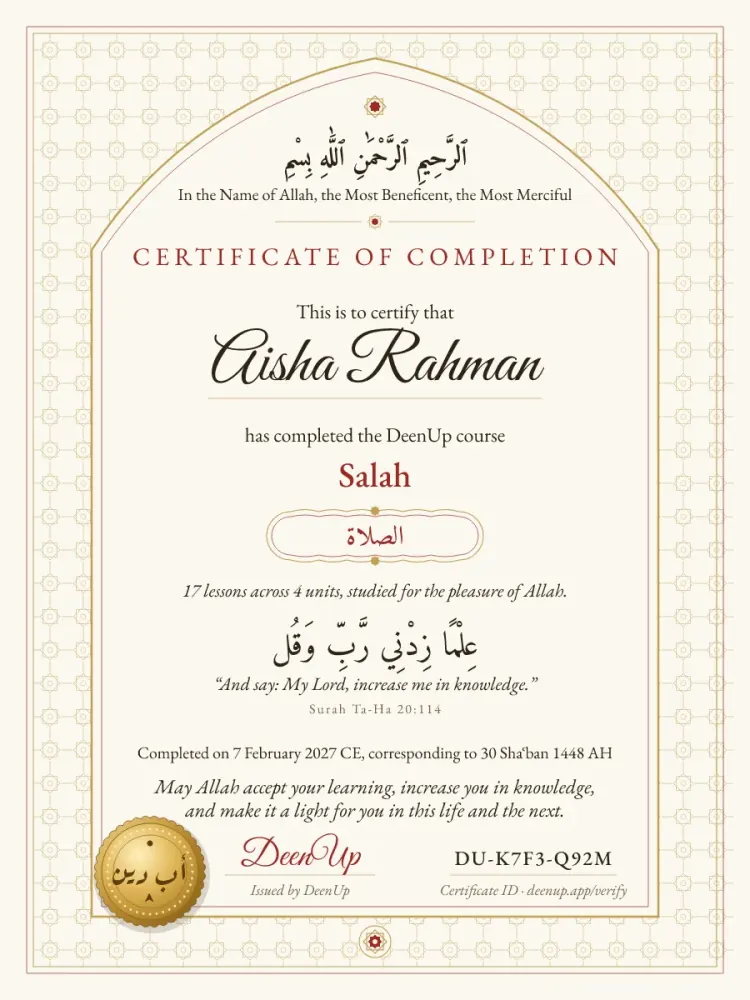
The essentials of salah, fiqh and faith, step by step from authentic sources. Finish all 28 days and earn a verifiable Certificate of Completion.
Take the free quizAnswer a few questions and get your personal plan.
For a deeper look at weaving dhikr into your day beyond the prayer mat, DeenBack's guide to building daily dhikr habits is a practical companion. DemiManifest's piece on post-prayer rituals explores how the minutes after salah shape the character of your whole day.
Related Post-Prayer Remembrances
The tasbih is the foundation, but the Prophet ﷺ taught several other remembrances for after salah:
| Dhikr | When to Recite | Source |
|---|---|---|
| Tasbih (33+33+34) | After every prayer | Sahih Muslim 597 |
| Ayat al-Kursi (2:255) | After every prayer | Al-Nasai 9929 (from Sahih al-Bukhari chain) |
| Surah Al-Ikhlas + Al-Falaq + An-Nas | 3x after Fajr and Maghrib | Abu Dawud 5082 |
| Dua for forgiveness (Allahumma antassalam...) | After tasleem, before moving | Sahih Muslim 591 |
| Istighfar (3x) | Immediately after tasleem | Sahih Muslim 591 |
For the full sequence of post-prayer adhkar with Arabic and transliteration, see our guide on adhkar after salat and duas to read after salah.
The Sunnah after-prayer routine from these sources:
- Say Astaghfirullah three times and Allahumma antassalam wa minkassalam tabarakta ya dhal jalali wal-ikram (Sahih Muslim 591)
- Recite the 33+33+34 tasbih
- Recite Ayat al-Kursi
- After Fajr and Maghrib, recite Surah Al-Ikhlas, Al-Falaq, and An-Nas three times each
For more on the complete daily dhikr practice, see our guide on daily dhikr.
Common Questions About Tasbih After Salah
What if I lose count? Most scholars say to assume the lower number (what you are certain of) and continue from there. Some scholars allow continuing from your best estimate. Missing a phrase or two does not invalidate the practice or reduce its core reward.
Can I do the tasbih after a qada (make-up) prayer? Yes. The tasbih applies after every salah, whether prayed at its time or as a make-up. The same reward is sought either way.
What if I am in a hurry? You may shorten the remembrance in a genuine rush. Abu Hurairah narrated a shorter version: saying Subhanallah 10 times, Alhamdulillah 10 times, and Allahu Akbar 10 times (Sunan al-Nasai). But if you can, those two to three minutes of tasbih are among the most high-yield moments in your day.
Is there a different tasbih for Friday prayer? The standard 33+33+34 tasbih applies after Jumu'ah prayer as well. Some scholars also recommend reciting Surah Al-Kahf on Fridays as a weekly practice, though that is not specifically linked to the post-prayer tasbih sequence.
Closing
The tasbih after salah is one of the most accessible forms of worship in Islam — requiring nothing but a few minutes and a willing heart. Five prayers, five opportunities, one powerful practice. The Prophet ﷺ gave it to the poorest of his Companions as a way to earn reward that no amount of wealth could surpass.
If you have never made this a regular practice, today's next prayer is a perfect place to start. Stay seated after the tasleem. Raise your hand. Begin:
Subhanallah... Subhanallah... Subhanallah...
اللَّهُمَّ اجْعَلْنِي مِنَ الذَّاكِرِينَ وَالذَّاكِرَاتِ
"O Allah, make me among those men and women who remember You abundantly."
For further reading, see sunnah.com's collection of post-prayer adhkar and the Yaqeen Institute's research on Islamic devotional practices.
Your personal 28-Day Deen Plan
Learn your deen in 28 days, 5 minutes a day
The essentials of salah, fiqh and faith, step by step from authentic sources. Finish all 28 days and earn a verifiable Certificate of Completion.
Take the free quizAnswer a few questions and get your personal plan.
Frequently Asked Questions
What is the tasbih after salah?
The tasbih after salah is a set of remembrances taught by the Prophet ﷺ: saying Subhanallah 33 times, Alhamdulillah 33 times, and Allahu Akbar 33 times after each of the five daily prayers, then completing 100 with La ilaha illallah. Source: Sahih Muslim 597.
How many times do you say Subhanallah after prayer?
You say Subhanallah 33 times after each of the five daily prayers as part of the post-salah tasbih. Following it with Alhamdulillah 33 times and Allahu Akbar 33 times brings the count to 99, completed with the full declaration of tawhid (La ilaha illallah).
What are the benefits of tasbih after salah?
The Prophet ﷺ said this tasbih of 33+33+34 causes sins to be forgiven even if they were as numerous as the foam of the sea (Sahih Muslim 597). It deepens awareness of Allah's glory, gratitude, and greatness — the three themes embedded in the words themselves.
Do you have to use prayer beads for tasbih after salah?
No. The Prophet ﷺ counted tasbih on his fingers (Abu Dawud 1502), and scholars agree this is the most recommended method. Prayer beads (misbaha) are permissible as a counting aid but are not required. Using the right hand's fingers is the authenticated Sunnah method.
Is the tasbih after salah done silently or aloud?
Both are permitted. The Prophet ﷺ recited post-prayer dhikr audibly at times and silently at others. The majority of scholars say reciting quietly is preferable to avoid disturbing others, while some scholars note that a moderate voice can help maintain focus and count.
What comes after the tasbih — what else should I recite?
After the 33+33+34 tasbih, scholars recommend reciting Ayat al-Kursi (Surah Al-Baqarah, 2:255), which the Prophet ﷺ said ensures nothing prevents the reciter from entering Paradise except death (Sahih al-Bukhari, via Al-Nasai). Surah Al-Ikhlas, Al-Falaq, and An-Nas are also sunnah after Fajr and Maghrib.
Can you do the tasbih after salah in a different order?
The authenticated narrations give the sequence as Subhanallah, then Alhamdulillah, then Allahu Akbar. Keeping this order follows the Sunnah most closely. The companion Abu Hurairah narrated it in this order in Sahih Muslim 597, and this is the position of the majority of scholars.