

- Authors

- Name
- Ahmad
- Role
- Senior Marketing Manager, Islamic education • DeenUp
بِسْمِ اللهِ الرَّحْمٰنِ الرَّحِيْمِ
In the name of God, the Most Gracious, the Most Merciful.

Every ruling you follow, every hadith you quote, every dua you recite — these reached you through a human chain. Someone learned it, verified it, taught it, and passed it on. That chain is what the Islamic tradition calls ʿulamaʾ (علماء) — scholars. When Muslims talk about "what Islam says," what they mean in practice is what qualified scholars, working from the Quran and authenticated hadith, have understood Islam to require. Knowing what a Muslim scholar actually is — their training, roles, and diversity — is the foundation of engaging with your deen with both sincerity and accuracy.
What Is a Muslim Scholar in Islam?
A Muslim scholar (ʿalim, عالم; plural ʿulamaʾ, علماء) is a person formally trained in the Islamic sciences — Quran, hadith, Arabic, jurisprudence, and theology — and recognised by the tradition as a qualified religious authority. The Quran asks directly: "Are those who know equal to those who do not know?" (Surah Az-Zumar, 39:9). The Prophet ﷺ established their status plainly: "The scholars are the heirs of the prophets" (Abu Dawud 3641). Islamic scholarship is not a profession in the modern sense — it is the continuation of prophetic guidance through trained human transmission.
The Different Types of Muslim Scholars
Muslim scholarship is not monolithic. The tradition produced distinct specialists, each serving a specific function in preserving and transmitting Islamic knowledge.
| Title | Arabic | Specialisation |
|---|---|---|
| ʿAlim | عالم | General Islamic scholar; trained across the core sciences |
| Mufti | مفتي | Qualified to issue formal legal rulings (fatwas) |
| Muhaddith | محدث | Specialist in hadith authentication and transmission sciences |
| Mufassir | مفسر | Specialist in Quranic interpretation (tafsir) |
| Faqih | فقيه | Specialist in Islamic jurisprudence and legal reasoning |
| Qadi | قاضي | Islamic judge who applies fiqh in legal proceedings |
| Muqri | مُقرئ | Master of Quranic recitation and the canonical readings |
Many of the greatest scholars of the Islamic tradition held multiple titles simultaneously. Imam al-Bukhari was both a muhaddith and a faqih. Al-Ghazali was a theologian, jurist, and spiritual guide. The overlap was not accidental — the Islamic sciences are deeply interconnected, and mastery in one area often demands working knowledge of several others.
For a deeper portrait of the scholars who shaped Islamic jurisprudence and hadith science, our guide to famous Muslim scholars profiles the founding Imams and their lasting legacy.
How Muslim Scholars Are Trained: The Ijazah System
Traditional Islamic scholarship does not operate through self-study or online certifications alone. It moves through a structured chain of authorised transmission.
The ijazah (إجازة) is a formal authorisation granted by a qualified teacher to a student, certifying that the student has mastered a specific text or science and is permitted to transmit and teach it onward. An ijazah for Sahih al-Bukhari, for example, comes with a chain (isnad) tracing every link of transmission back through the centuries to Imam al-Bukhari himself — and through him to the Prophet ﷺ.
The Prophet ﷺ warned: "It is enough of a lie for a person to narrate everything they hear." (Sahih Muslim, introduction). The ijazah system is the tradition's answer to that warning: not everything attributed to Islam is authentic, and the chain of human verification is what separates knowledge from hearsay.
A student pursuing scholarship typically spends years covering Quranic memorisation (hifz), Arabic grammar (nahw and sarf), hadith sciences (mustalah al-hadith), Islamic jurisprudence (fiqh), and legal theory (usul al-fiqh). Many pass through formal madrasas; others follow the traditional model of sitting directly under individual teachers. The endpoint in both cases is the same: a scholar traceable to a qualified teacher, who traced back to theirs, in an unbroken chain.
For a practical introduction to how Muslims engage with this tradition of knowledge today, our guide on the importance of seeking knowledge in Islam covers the Quranic and hadith foundations in full.
Why Qualified Scholarship Matters for Muslims Today
The internet gives every Muslim instant access to Quranic translations, hadith databases, and explanations of Islamic rulings from thousands of sources. This accessibility is a genuine blessing — but it carries a risk the classical tradition anticipated.
The Quran warns against speaking about Allah without knowledge:
قُلْ إِنَّمَا حَرَّمَ رَبِّيَ الْفَوَاحِشَ ... وَأَن تَقُولُوا عَلَى اللَّهِ مَا لَا تَعْلَمُونَ
"Say, my Lord has only forbidden ... that you say about Allah what you do not know." — (Surah Al-Aʿraf, 7:33)
A Quranic verse read without its context of revelation (asbab al-nuzul), without knowledge of abrogating and abrogated verses (nasikh wa mansukh), or without grounding in how the Prophet ﷺ explained and applied it — that verse can point in an entirely wrong direction. This is not a hypothetical risk. It has produced real distortions in Islamic understanding throughout history.
Imam al-Shafi'i — founder of one of the four Sunni schools of jurisprudence — said: "Every question on which I have an opinion, I do not want others to follow me in until they know my evidence." Even the founding scholars insisted that their rulings be traced to their source, not taken on personal authority alone.
This is not an argument for passivity in your own learning. It is an argument for discernment about whose knowledge you receive. The ʿulamaʾ of every era were not meant to replace your personal relationship with Allah — they were meant to give you the tools to build it on solid ground.
How to Benefit From Islamic Scholarship Every Day
You do not need to study for twenty years to benefit from what Muslim scholars have built. What you need is intentionality about whose knowledge you receive and how you receive it.
Follow a recognised school of thought (madhab). Each of the four Sunni schools — Hanafi, Maliki, Shafi'i, Hanbali — represents centuries of carefully systematised legal reasoning. Following one means your practice has internal coherence and traces to a continuous scholarly tradition. Our article on what fiqh means in Islam explains why this structure exists and what it offers the everyday Muslim.
Seek verified sources. When you read a hadith online, check that it has a collection reference and an authentication status. When you encounter a ruling, ask where it comes from and whether the person giving it is qualified. DeenBack's guide on seeking Islamic knowledge walks through the practical habit of building knowledge literacy in daily life.
Learn from biographies, not just rulings. When you know that Imam Ahmad ibn Hanbal was imprisoned rather than declare the Quran created by political decree, his rulings carry a different weight. Scholarship becomes personal, not abstract. The Demi Manifest piece on cultivating wisdom in Muslim life explores how studying the scholars connects to building a principled life of continuous learning.
Build a daily habit of learning. The Prophet ﷺ said: "Whoever follows a path seeking knowledge, Allah will make easy for him a path to Paradise." (Sahih al-Bukhari 79). One hadith understood is better than ten memorised without context. Our guide on how to study Islamic knowledge effectively gives a structured approach. And for the Prophetic narrations that motivated scholars across fourteen centuries, our collection of hadith about knowledge covers the core texts.
Your personal 28-Day Deen Plan
Learn your deen in 28 days, 5 minutes a day
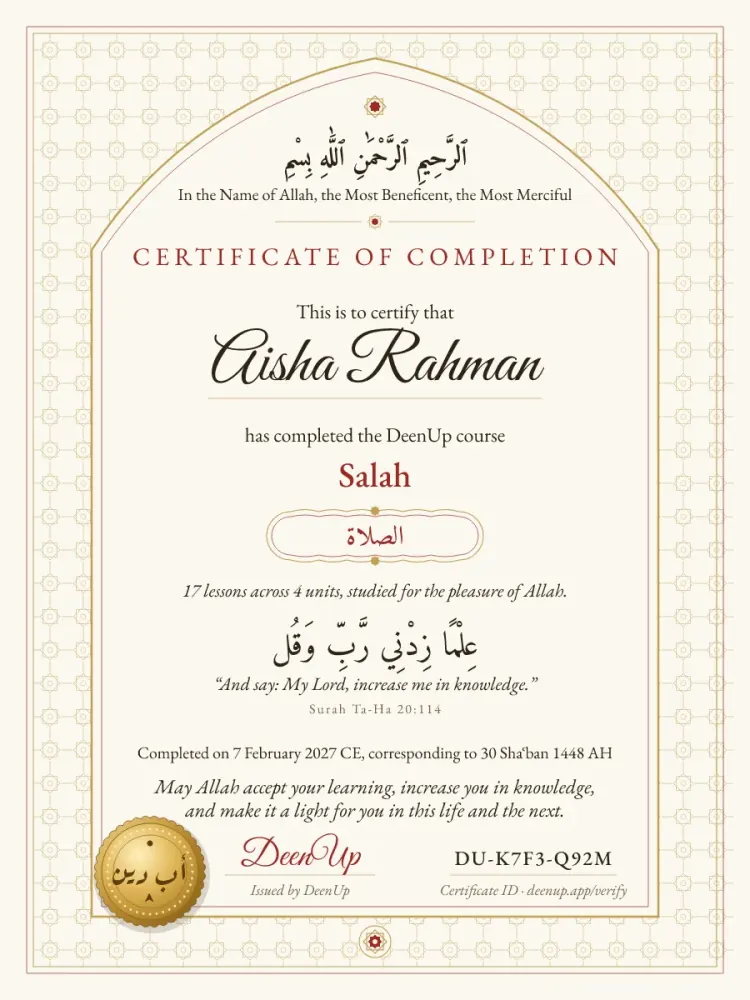
The essentials of salah, fiqh and faith, step by step from authentic sources. Finish all 28 days and earn a verifiable Certificate of Completion.
Take the free quizAnswer a few questions and get your personal plan.
For well-sourced, academically rigorous English-language Islamic scholarship, the Yaqeen Institute publishes research that connects this heritage to contemporary Muslim life. For structured learning directly from classical texts, SeekersGuidance offers free courses taught by qualified scholars.
Signs You Are Engaging With Scholarship Well
You know your engagement with Islamic scholarship is maturing when:
- You instinctively ask for the source when you encounter a ruling or hadith, not just the conclusion
- You can name the school of thought your practice follows and roughly why it holds its positions
- You read a verse and feel its depth — knowing there is commentary, context, and scholarly discussion behind what you are reading
- You feel gratitude rather than frustration when scholars present different views — recognising nuance as a sign of the tradition's integrity, not its failure
- You find yourself wanting to know more — not to win arguments, but because the scholarship genuinely draws you closer to Allah
Common Questions
Are all Islamic rulings the same across schools? No. Scholars within and across the four schools sometimes hold different positions, particularly on detailed legal questions. These differences are legitimate — they reflect different methodologies for applying the Quran and Sunnah, not contradictions in revelation. The vast majority of Islamic practice, from prayer to fasting to hajj to zakat, is agreed upon across all schools.
Is following a specific scholar obligatory? Following a qualified madhab is the majority scholarly position — it provides a coherent, internally consistent framework for practice. Following no school and picking rulings from different scholars based on convenience (talfiq) is generally discouraged, as it can produce contradictions in practice. The key principle is that rulings should trace to qualified scholarship rather than personal preference.
How do I find a reliable Muslim scholar to follow? Look for scholars with verified traditional credentials — a recognisable chain of teachers, affiliation with a known institution or school of thought, and a reputation for citing sources. Online platforms like SeekersGuidance (seekersguidance.org) provide free access to qualified scholars and structured Islamic learning at no cost.
What about scholars who disagree publicly with each other? Scholarly disagreement within the tradition is a feature, not a flaw. What matters is that the disagreement is conducted with evidence and within the recognised limits of usul al-fiqh. Treat public disagreements as an opportunity to learn both positions, not a reason to dismiss scholarship altogether or to form your own independent ruling without training.
The Chain Still Runs
Fourteen centuries after the Prophet ﷺ, the chain of Islamic knowledge is unbroken. Scholars alive today hold ijazas traced back through generations of teachers to companions who received knowledge directly from the Prophet ﷺ. That is not a metaphor — it is a documented historical reality.
You are the recipient of everything those scholars preserved, corrected, and transmitted. What you do with it — how carefully you receive it, how honestly you apply it, how faithfully you pass it on — is your contribution to the chain.
Your personal 28-Day Deen Plan
Learn your deen in 28 days, 5 minutes a day
The essentials of salah, fiqh and faith, step by step from authentic sources. Finish all 28 days and earn a verifiable Certificate of Completion.
Take the free quizAnswer a few questions and get your personal plan.
Frequently Asked Questions
What is a Muslim scholar?
A Muslim scholar, known in Arabic as an alim (plural ulama), is someone formally trained in the Islamic sciences — Quran, hadith, Arabic, fiqh, and theology — and recognised by the tradition as a qualified religious authority. The Quran asks: 'Are those who know equal to those who do not know?' (Surah Az-Zumar, 39:9).
What are the different types of Muslim scholars?
Muslim scholars specialise by field: a mufti issues formal legal rulings (fatwas); a muhaddith specialises in hadith authentication; a mufassir interprets the Quran through tafsir; a faqih derives legal rulings from the Quran and Sunnah; and a qadi serves as an Islamic judge. Many classical scholars mastered multiple disciplines simultaneously.
How does someone become a Muslim scholar in Islam?
Becoming a Muslim scholar traditionally requires years of formal study under qualified teachers, covering Quran memorisation, classical Arabic grammar, hadith sciences, jurisprudence, and Islamic theology. The process culminates in an ijazah — a formal authorisation certifying the student has mastered the material and is permitted to teach it onward to others.
What is an ijazah in Islamic scholarship?
An ijazah is a formal certificate granted by a qualified Islamic teacher to a student, authorising them to transmit and teach specific texts or sciences. The ijazah system creates unbroken chains of transmission (isnad) connecting modern Muslims back through the centuries to the Prophet, peace be upon him, himself.
Why should Muslims follow qualified scholars rather than interpreting Islam independently?
Qualified Muslim scholars spend decades mastering the Quran, Arabic, hadith sciences, and legal methodology before issuing rulings. The Prophet said: 'The scholars are the heirs of the prophets' (Abu Dawud 3641). Without scholarly guidance, individuals risk applying Quranic verses out of context or acting on unreliable or fabricated narrations.
How is a Muslim scholar different from a mufti?
A Muslim scholar (alim) is qualified broadly in the Islamic sciences; a mufti is a scholar specifically trained and authorised to issue formal legal rulings called fatwas. All muftis are scholars, but not all scholars hold the additional specialisation in fiqh and usul al-fiqh required to give fatwas on complex legal questions.
Can women be Muslim scholars in Islam?
Yes. Islamic history includes many distinguished female scholars. Aisha bint Abi Bakr was one of the most prolific hadith transmitters and a trusted religious authority whose rulings companions sought. Fatima al-Fihri founded Al-Qarawiyyin in Fez, Morocco in 859 CE, considered the world's oldest continuously operating university. Female scholars are documented across every classical period.