

- Authors

- Name
- Ahmad
- Role
- Senior Marketing Manager, Islamic education • DeenUp
بِسْمِ اللهِ الرَّحْمٰنِ الرَّحِيْمِ
In the name of God, the Most Gracious, the Most Merciful.

One of the most striking facts about Prophet Muhammad ﷺ is how thoroughly documented his life was. Within two generations of his passing, scholars had recorded his sayings, his actions, and the events of his life in more detail than almost any figure of late antiquity. Yet for many Muslims, this history remains a blur of episodes — the Cave of Hira, the Hijra, the Conquest of Mecca — without the chronological backbone that makes it a coherent story. Understanding the Muhammad timeline — the actual sequence of events, their dates, and what drove them — changes how you read the Quran, understand the Sunnah, and connect with the man whose example Muslims are asked to follow.
What Is the Timeline of Prophet Muhammad's Life?
Prophet Muhammad ﷺ was born in Mecca around 570 CE and died in Medina in 632 CE at the age of 63. His prophethood lasted 23 years — 13 years of preaching in Mecca under persecution, then 10 years building the Muslim community in Medina after the Hijra of 622 CE. The Quran names him the final prophet: "Muhammad is not the father of any of your men, but he is the Messenger of Allah and the Seal of the Prophets" (Surah Al-Ahzab, 33:40).
Prophet Muhammad's Life: Complete Chronological Timeline
| Year (CE) | Year (AH) | Event |
|---|---|---|
| ~570 CE | Before Hijra | Born in Mecca; father Abdullah died before his birth |
| ~576 CE | Before Hijra | Mother Aminah dies; raised by grandfather Abd al-Muttalib |
| ~578 CE | Before Hijra | Abd al-Muttalib dies; guardianship passes to uncle Abu Talib |
| ~595 CE | Before Hijra | Marries Khadijah; she is the first Muslim |
| 605 CE | Before Hijra | Arbitrates the placement of the Black Stone; known as Al-Amin (the Trustworthy) |
| 610 CE | Before Hijra | First revelation in Cave of Hira during Ramadan; Surah Al-Alaq 96:1-5 |
| 610–613 CE | Before Hijra | Private preaching begins; first Muslims include Khadijah, Ali, Abu Bakr, Zayd |
| 613 CE | Before Hijra | Public preaching; sustained opposition from Quraysh leadership grows |
| 615 CE | Before Hijra | First migration to Abyssinia — small group of Muslims seek protection from Negus |
| 616–619 CE | Before Hijra | Economic and social boycott of Banu Hashim clan enforced by Quraysh |
| 619 CE | Before Hijra | Year of Sorrow (ʿAam al-Huzn): Khadijah and Abu Talib both die |
| 620 CE | Before Hijra | Night Journey and Ascension (Isra wal Miraj); five daily prayers prescribed |
| 621–622 CE | Before Hijra | First and Second Pledge of Aqaba; Medinan tribes offer protection and support |
| 622 CE | 1 AH | The Hijra: migration to Medina; Islamic calendar begins |
| 622–623 CE | 1 AH | Constitution of Medina signed; masjid built; call to prayer (adhan) established |
| 624 CE | 2 AH | Battle of Badr — first major Muslim military engagement; decisive Muslim victory |
| 625 CE | 3 AH | Battle of Uhud; death of Hamza ibn Abd al-Muttalib |
| 627 CE | 5 AH | Battle of the Trench (Khandaq); Medina defended against confederate army |
| 628 CE | 6 AH | Treaty of Hudaybiyyah — strategic peace with Quraysh; Surah Al-Fath revealed |
| 629 CE | 7 AH | Letters sent to neighbouring rulers; first Umrah performed after the treaty |
| 630 CE | 8 AH | Conquest of Mecca; general amnesty declared; Kaaba cleansed of idols |
| 630 CE | 8–9 AH | Battle of Hunayn; delegations from across Arabia begin to pledge Islam |
| 631 CE | 9 AH | Year of Delegations (ʿAam al-Wufud); Hajj established under Abu Bakr |
| 632 CE | 10 AH | Farewell Pilgrimage (Hajjat al-Wida); Farewell Sermon at Arafat |
| 632 CE | 11 AH | Passes away on 12 Rabi al-Awwal; buried in Medina |
The Makkan Period (570–622 CE): Patience Under Pressure
The first forty years of the Prophet's ﷺ life were preparation. He earned the title Al-Amin (الأمين — the Trustworthy) before he ever preached a word of Islam. His reputation for honesty was not incidental — it was the foundation on which an entire community would be built.
When the first revelation came in 610 CE, it came to a man already defined by his character. The command was direct:
اقْرَأْ بِاسْمِ رَبِّكَ الَّذِي خَلَقَ
"Read in the name of your Lord who created." — (Surah Al-Alaq, 96:1)
The years that followed were defined by persecution. The small Muslim community faced social ostracism, physical harm, and an economic boycott that lasted three years. Some were tortured. Some migrated to Abyssinia. The Prophet ﷺ himself, shielded by his uncle's tribal protection, bore the pressure of leading a community that believed when almost no one around them did.
The Year of Sorrow (619 CE) brought the deaths of both Khadijah رضي الله عنها and Abu Talib in quick succession — his greatest personal support and his tribal protector, in one year. It was in the wake of this grief that Allah granted him the Night Journey and Ascension, prescribing the five daily prayers as a direct gift from beyond the heavens. Our article on the Night Journey and Ascension covers this pivotal event in full.
For a detailed account of the cave that began everything, our article on the Cave of Hira and the first revelation provides complete context.
The Medinan Period (622–632 CE): Building a Society
The Hijra of 622 CE was not merely a geographical move. It was the beginning of a functioning Islamic society. In Medina, the Prophet ﷺ established a mosque, negotiated the Constitution of Medina — a governance charter between Muslims and the city's tribes — introduced the adhan, and began the full revelation of Islamic law governing every dimension of life.
For a detailed account of this founding migration, our guide to the migration to Medina covers the journey and its significance in full.
The years that followed tested and refined the community through both military engagement and diplomatic statecraft. The battles of Badr (624 CE), Uhud (625 CE), and the Trench (627 CE) each produced distinct lessons — about trust in Allah, about the consequences of disobeying the Prophet ﷺ, about defensive strategy. The Treaty of Hudaybiyyah (628 CE), dismissed by some companions as a concession, proved to be the strategic opening for Islam's spread across the entire Arabian Peninsula.
The Conquest of Mecca in 630 CE is one of the most studied events in the timeline. After more than a decade of persecution, the Prophet ﷺ entered his birthplace at the head of approximately 10,000 Muslims and declared a general amnesty for those who had spent years trying to destroy the Muslim community. Our full account of the Conquest of Mecca details what that amnesty meant and who received it.
The Farewell Sermon: The Final Charge
In his final year, the Prophet ﷺ performed the Farewell Pilgrimage (Hajjat al-Wida) and delivered a sermon at Arafat to over 100,000 people. It is among the most significant speeches in human history.
He said: "O people, your Lord is one, and your father is one. There is no superiority of an Arab over a non-Arab, nor of a non-Arab over an Arab, except through taqwa." He charged the gathering to maintain prayer, uphold the rights of women, treat those under their care with justice, and hold fast to the Quran and his Sunnah.
He then asked: "Have I conveyed the message?" The crowd replied: "Yes." He said: "O Allah, bear witness."
Shortly after, the final verses of the Quran were revealed:
الْيَوْمَ أَكْمَلْتُ لَكُمْ دِينَكُمْ وَأَتْمَمْتُ عَلَيْكُمْ نِعْمَتِي
"This day I have perfected for you your religion and completed My favour upon you." — (Surah Al-Maidah, 5:3)
For the full account of his last address, our guide to the Farewell Sermon covers every dimension of what he said and why it matters for Muslims today.
Why the Timeline Matters for Muslims Today
Knowing the sequence of the Prophet's ﷺ life changes how you read the Quran. Many Quranic verses were revealed in direct response to specific events in this timeline — the boycott, the battles, the negotiations, the losses. Reading Surah Al-Anfal without knowing it was revealed after Badr, or Surah Al-Ahzab without knowing about the Battle of the Trench, is like reading a letter without knowing what it was written in response to.
The timeline also answers a question that troubles many thoughtful Muslims: how do I know what the Prophet's ﷺ life was actually like? The answer is that it was documented with unusual historical care — not mythology, but recorded testimony from companions who witnessed it in person.
For the most complete account of his life woven together from Quranic and hadith sources, our guide to who was Prophet Muhammad covers the biographical narrative in full detail.
For academically rigorous English-language work on the historical and spiritual dimensions of the Prophet's biography, the Yaqeen Institute's seerah research is a recommended next step for anyone who wants to go deeper into the scholarship.
How to Connect With the Timeline Daily
Engaging with the Muhammad timeline is not an academic exercise — it is a living practice.
Read Seerah contextually. When you encounter a Quranic verse, look up when it was revealed and what was happening in the timeline at that point. The experience of reading shifts entirely — the words carry the weight of real circumstances. DeenBack's guide on morning dua routine connects daily Prophetic practices directly to their roots in the timeline.
Mark key dates on the Islamic calendar. The Night Journey (27 Rajab), the Prophet's birthday (12 Rabi al-Awwal), and the anniversary of Badr (17 Ramadan) are living points in the Islamic year that anchor the timeline to your present — transforming historical memory into annual practice.
Study the Sahaba alongside the events. Each companion's story unfolds within this timeline — Abu Bakr at the Hijra, Bilal during the boycott, Khadijah during the first revelation. For more on the companions and their roles in the Prophet's life, our guide to the Sahaba, companions of the Prophet is a natural companion to this timeline. The Demi Manifest piece on tawakkul in daily life draws on how the Prophet's consistent trust in Allah throughout these events translates into a daily practice of complete reliance.
Use DeenUp as your daily anchor. For consistent daily engagement with the Quran and Sunnah — the living text and practice that this timeline produced — DeenUp delivers the connection every morning and evening.
Your personal 28-Day Deen Plan
Learn your deen in 28 days, 5 minutes a day
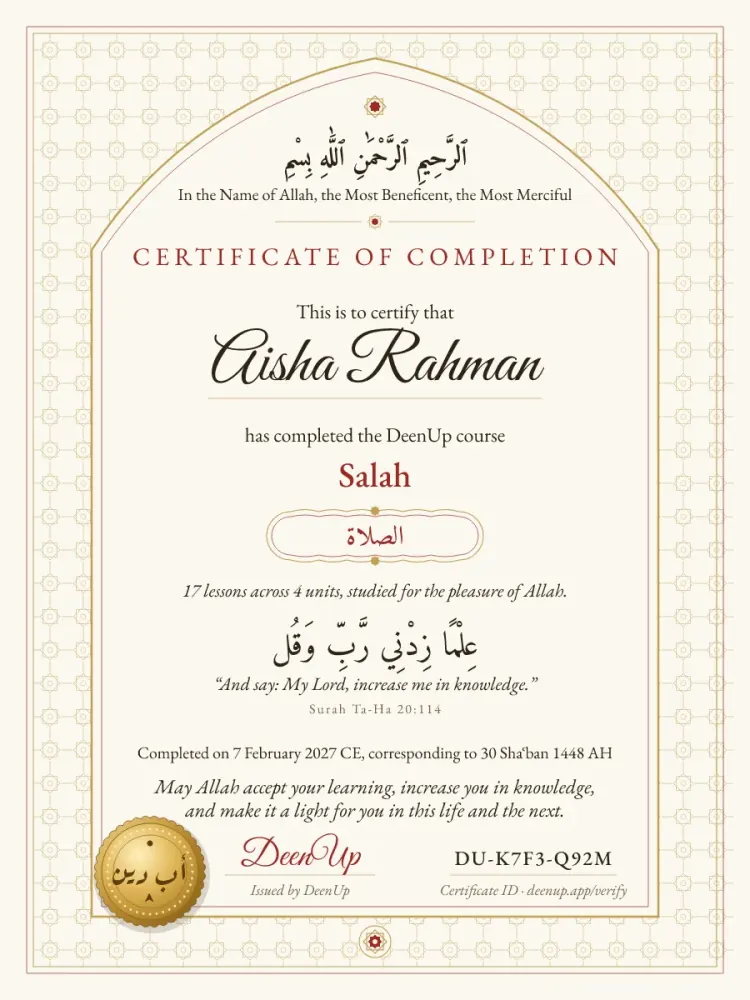
The essentials of salah, fiqh and faith, step by step from authentic sources. Finish all 28 days and earn a verifiable Certificate of Completion.
Take the free quizAnswer a few questions and get your personal plan.
Signs the Timeline Is Taking Root
You know the Prophet's ﷺ timeline is becoming part of how you understand Islam when:
- You read a Quranic verse and instinctively wonder when in the timeline it was revealed
- The names of companions feel like people you have met, not distant historical figures
- The battles and negotiations feel like chapters in a coherent story, not isolated episodes
- You find yourself referencing the timeline when explaining Islam to others — grounding abstract teachings in real historical context
- The Farewell Sermon carries the weight of a final message, not just an ancient speech
Common Questions
Are the dates in the Prophet's timeline accurate? The broad dates are well-established through multiple historical sources. Some specific dates within years carry scholarly discussion — the exact day of the Prophet's birth, for example, is debated, though the year (around 570 CE) and the month (Rabi al-Awwal) are accepted. The Islamic calendar's precision increases significantly from the Hijra onward, as the established community kept more systematic records.
What is the Islamic year of the Prophet's birth? The Prophet ﷺ was born before the Hijra, so his birth year is referred to as "50 BH" (Before Hijra) or approximately 570 CE in the Gregorian calendar. For a full treatment of the scholarly discussion, our article on when was Prophet Muhammad born covers the evidence in detail.
How long did revelation continue after the Prophet began receiving it? Revelation began when the Prophet ﷺ was 40 years old (610 CE) and continued for 23 years until shortly before his death in 632 CE. The Quran was revealed in stages over this entire period, with different surahs and verses revealed in response to different circumstances in the timeline — which is why the order of revelation differs from the order of the compiled Quran.
What happened to Islam after the Prophet's death? The Prophet ﷺ left no designated successor in an explicit written form, though his companions understood Abu Bakr رضي الله عنه to be the natural choice for leadership. The caliphate was established immediately after his passing. Within a century, Islam had spread from Arabia to Persia, the Levant, North Africa, and the Iberian Peninsula — a spread rooted in the community and principles the Prophet ﷺ had spent 23 years building.
A Life Still Unfolding
The Muhammad timeline does not end in 632 CE. His words, his practices, his character — documented in the Quran and the Sunnah — continue to shape the daily lives of nearly two billion people. The timeline is not a historical record of something finished. It is the foundation of something still being built.
You are part of what comes after the last entry. How you understand his life determines how you live yours.
Your personal 28-Day Deen Plan
Learn your deen in 28 days, 5 minutes a day
The essentials of salah, fiqh and faith, step by step from authentic sources. Finish all 28 days and earn a verifiable Certificate of Completion.
Take the free quizAnswer a few questions and get your personal plan.
Frequently Asked Questions
What is the timeline of Prophet Muhammad's life?
Prophet Muhammad was born in Mecca around 570 CE, received the first revelation at age 40 in 610 CE, migrated to Medina in 622 CE (the Hijra), re-entered Mecca in the Conquest of 630 CE, and passed away in Medina in 632 CE at age 63. His prophethood lasted 23 years — 13 in Mecca and 10 in Medina.
When was Prophet Muhammad born?
Prophet Muhammad was born in Mecca around 570 CE, in the Year of the Elephant — when Abraha's army marched on the Kaaba and was repelled, as described in Surah Al-Fil (105:1-5). His birth date in the Islamic calendar is traditionally observed on the 12th of Rabi al-Awwal, before the Hijri calendar's start point.
When did Prophet Muhammad receive his first revelation?
Prophet Muhammad received the first revelation in 610 CE, at age 40, during the month of Ramadan in the Cave of Hira above Mecca. The angel Jibril appeared and commanded 'Iqra' — Read — delivering the opening verses of Surah Al-Alaq (96:1-5), the first words of the Quran to be revealed to him.
What was the Year of Sorrow in Prophet Muhammad's life?
The Year of Sorrow (619 CE, known as 'Aam al-Huzn) refers to the year the Prophet lost both his wife Khadijah, his greatest personal support, and his uncle Abu Talib, who had provided tribal protection for over a decade. These two losses in a single year marked one of the most difficult periods of his entire prophethood.
What was the significance of the Hijra in 622 CE?
The Hijra (622 CE) was the Prophet's migration from Mecca to Medina, marking the founding of the first Muslim community as a functioning society with governance and a social charter. It is so foundational that the Islamic calendar begins at this date — year 1 AH (After Hijra). The Quran affirms those who emigrated in Allah's cause (Surah Al-Baqarah, 2:218).
When did Prophet Muhammad conquer Mecca?
Prophet Muhammad entered Mecca in January 630 CE (8 AH), leading approximately 10,000 Muslims. Rather than exacting revenge on those who had persecuted the early Muslim community, he declared a general amnesty. The event is known as the Conquest of Mecca (Fath Makkah) and stands as one of the most remarkable acts of prophetic clemency in history.
When did Prophet Muhammad die?
Prophet Muhammad passed away on the 12th of Rabi al-Awwal, 11 AH — corresponding to June 8, 632 CE — at the age of 63 in Medina. He was buried in his home, which is now incorporated into the Masjid al-Nabawi. His final words included an instruction to maintain prayer and to treat those under one's care with justice.