

- Authors

- Name
- Ahmad
- Role
- Senior Marketing Manager, Islamic education • DeenUp
بِسْمِ اللهِ الرَّحْمٰنِ الرَّحِيْمِ
In the name of God, the Most Gracious, the Most Merciful.
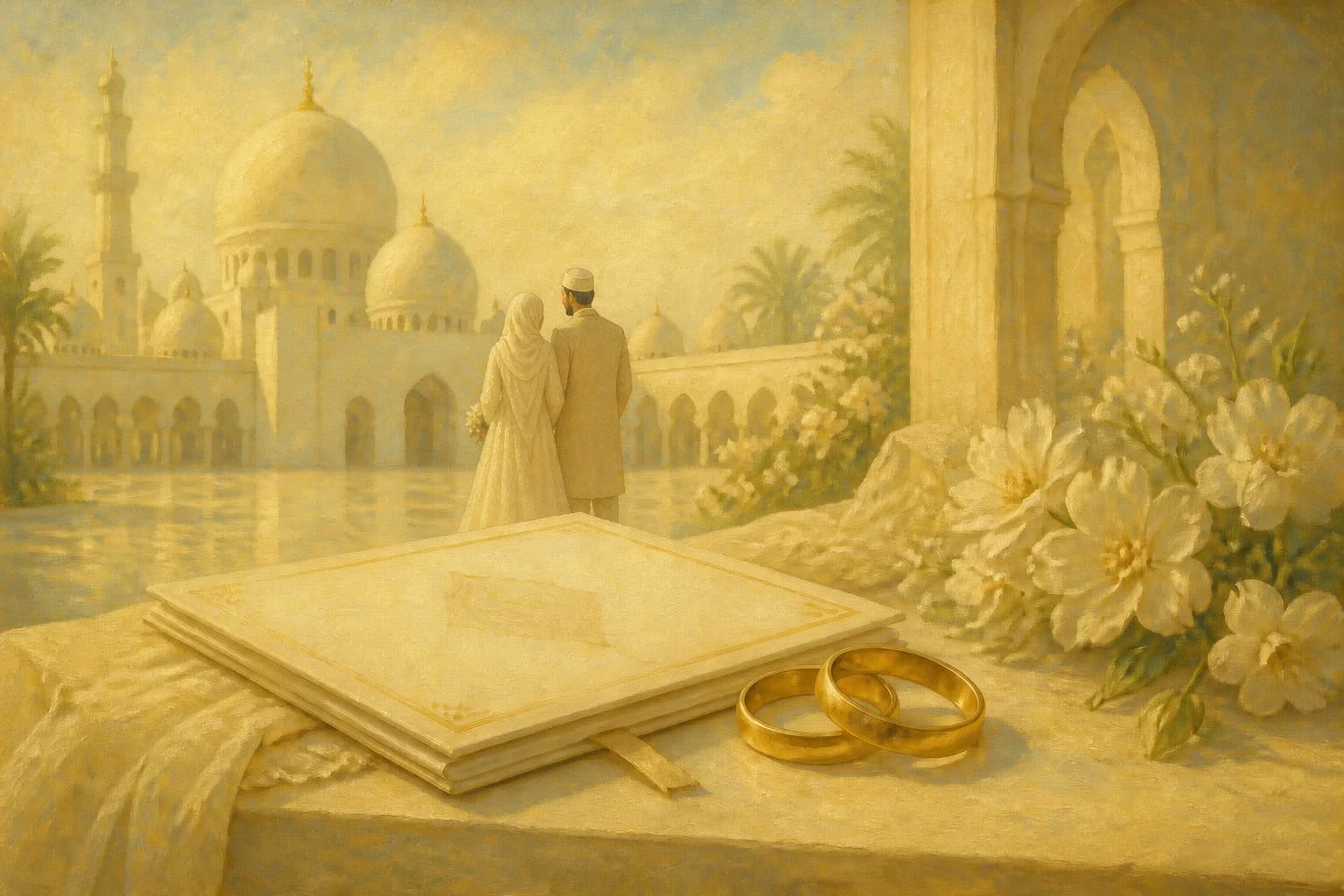

A Muslim wedding is one of the most significant occasions in a believer's life — a moment when two people begin a journey together under the blessings of Allah. Knowing what to say, how to say it, and which supplications are rooted in the Prophetic tradition makes your presence at a Muslim wedding a genuine act of worship, not just a social obligation.
What Are Islamic Wedding Wishes?
Islamic wedding wishes are the prayers, blessings, and congratulatory phrases used to honor a couple at their nikah (marriage contract) and the celebrations around it. The most important of these is not a culturally invented phrase but a specific supplication taught by the Prophet Muhammad ﷺ himself — recorded in authentic hadith collections and used by Muslims across every language and culture for fourteen centuries.
What Is the Sunnah Dua for Newlyweds?
The Prophet Muhammad ﷺ taught a specific supplication for congratulating newlyweds. This dua — not "Congratulations" in Arabic, not a cultural phrase, but a genuine supplication — is the authentic Islamic wedding wish:
بَارَكَ اللهُ لَكُمَا وَبَارَكَ عَلَيْكُمَا وَجَمَعَ بَيْنَكُمَا فِي خَيْرٍ
Barak Allahu lakuma wa baraka alaykuma wa jama'a baynakuma fi khayr
"May Allah bless you both, shower His blessings upon you, and unite you in goodness." — (Abu Dawud 2130; confirmed in Tirmidhi 1091)
This supplication asks for three distinct blessings: that Allah bless the couple themselves, that He shower external blessings upon them, and that He unite them in goodness — not merely in marriage, but in a life of shared righteousness.
Note what this dua does NOT say: it does not wish for wealth, beauty, or happiness in the secular sense. It asks for khayr — goodness — in the broadest sense. It is asking Allah to orient the entire marriage toward what is beneficial, righteous, and pleasing to Him.
For context on the Islamic understanding of marriage and its foundations, see our detailed guide on the importance of marriage in Islam.
Islamic Wedding Wishes at a Glance
| Phrase | Arabic | Meaning | When to Use |
|---|---|---|---|
| Barak Allahu lakuma | بَارَكَ اللهُ لَكُمَا | May Allah bless you both | To the couple directly |
| Wa baraka alaykuma | وَبَارَكَ عَلَيْكُمَا | And shower His blessings upon you | Part of the full sunnah dua |
| Wa jama'a baynakuma fi khayr | وَجَمَعَ بَيْنَكُمَا فِي خَيْرٍ | And unite you in goodness | Completing the dua |
| Mabrook | مَبْرُوك | Congratulations | General greeting to anyone |
| Barakallah feekum | بَارَكَ اللهُ فِيكُمْ | May Allah bless all of you | To the family at the wedding |
The Quranic Foundation of Marriage
The Islamic understanding of marriage is not simply legal or social — it is built on a Quranic reality:
وَمِنْ آيَاتِهِ أَنْ خَلَقَ لَكُم مِّنْ أَنفُسِكُمْ أَزْوَاجًا لِّتَسْكُنُوا إِلَيْهَا وَجَعَلَ بَيْنَكُم مَّوَدَّةً وَرَحْمَةً
"And among His signs is that He created for you from yourselves mates that you may find tranquility in them; and He placed between you affection and mercy." (Surah Ar-Rum, 30:21)
When you offer the sunnah wedding dua, you are invoking divine blessings over a relationship that the Quran itself describes as a sign (ayah) of Allah's mercy. The dua is not a formality — it is a request for Allah to fulfill the potential He built into this union.
This also explains why the Islamic wedding wish focuses on khayr (goodness) rather than happiness or wealth. The goal of a Muslim marriage is not merely personal fulfillment but a shared journey toward Allah.
Why Islamic Wedding Wishes Matter for Modern Muslims
In an age of generic "Best wishes" and emoji-laden messages, the sunnah dua stands apart. It matters for several reasons:
It revives a practice that connects you to the Prophet ﷺ. Every time you say Barak Allahu lakuma wa baraka alaykuma wa jama'a baynakuma fi khayr, you are doing something the Prophet himself did — and you join an unbroken chain of Muslims making this same supplication at weddings across fourteen centuries.
It reorients the moment. Wedding celebrations can easily become more about display than devotion. Offering the prophetic dua — sincerely, to the couple's face — anchors the moment in its spiritual purpose.
It transforms your attendance into worship. The Prophet ﷺ said: "When a Muslim is invited to a wedding feast, he should attend it." (Sahih al-Bukhari 5173). Attending the walimah (wedding feast) and making dua for the couple is itself an act of worship, not just a social event. For more on Muslim wedding traditions and their Islamic grounding, see that full guide.
How to Use Islamic Wedding Wishes in Practice
At the nikah ceremony: When the couple signs the marriage contract, turn to them directly and offer the full sunnah dua: Barak Allahu lakuma wa baraka alaykuma wa jama'a baynakuma fi khayr. Say it facing them, with eye contact and sincerity. This is the moment the dua was designed for.
In a wedding card: Write the dua in Arabic — even if you copy it carefully from this article — followed by the English translation. Then add a personal note. The Arabic text of the dua is a genuine gift; many couples frame it.
At the walimah: Congratulate the couple again with the dua, and also greet their parents and families with Barakallah feekum — may Allah bless all of you. The walimah is a communal celebration, and extending blessings to the family honors the full occasion.
In a text message or social media post: Write the dua transliteration followed by the translation. Avoid responding only with generic congratulations — the Islamic community generally knows the sunnah, and a short, sincere dua is far more meaningful.
When you do not know the couple well: Even if you are not close to the couple, the sunnah dua is always appropriate. It does not require a personal relationship — it is a supplication to Allah, not a personal endorsement.
For practical ways to build your daily dua practice so that beautiful supplications like these feel natural rather than formal, the DeenBack guide to daily dhikr habits is a helpful companion. And for a grounded perspective on how tawakkul — trusting in Allah's plan — supports both marriage and life more broadly, the Demi Manifest piece on tawakkul in daily life is worth reading.
Before the next wedding, learn the Sunnah greeting you may be missing.
What to Pray for the Couple Beyond the Dua
The sunnah dua is the essential blessing. But after you have said it, you can continue making personal dua for the couple. Consider asking Allah for:
- A marriage rooted in shared iman and practice
- Patience and mercy in times of difficulty
- Righteous children who will be a sadaqah jariyah for their parents
- Protection from external pressures and the whispers of shaytan
For the specific duas that support marriage and the desire for a righteous partner, our articles on dua for a good spouse and dua for marriage proposal cover the prophetic supplications in detail.
Signs You Are Getting This Right
You are genuinely bringing Islamic wedding wishes to life when:
- The sunnah dua comes naturally to your lips, not from a note
- You offer it with eye contact and sincerity, not as a performance
- You extend blessings to the family as naturally as to the couple
- You use the occasion to reflect on the Quranic verse on marriage (Surah Ar-Rum, 30:21) and what you are asking Allah for
- Younger Muslims around you see how you greet the couple and begin to learn the practice from you
Common Questions About Islamic Wedding Wishes
Is "Mabrook" sufficient as a wedding congratulation? Mabrook (congratulations) is culturally common across the Arab world but is not a specifically Islamic formulation. It is fine to use as a general greeting, but it should be paired with or preceded by the sunnah dua. The dua is what transforms a greeting into a supplication, and that is what the occasion calls for.
Can women offer the wedding dua to the groom? Yes. The wedding dua is offered by all attendees regardless of gender. It is not gender-specific. If cultural context limits direct interaction between unrelated men and women, the dua can be offered in the couple's general direction or through a family member.
Is there a dua specifically for an Islamic naming ceremony? Yes. For the aqiqah or naming ceremony (aqeeqah), related supplications exist for the new child and the parents. Our guide on the Islamic naming ceremony covers these in detail, including the appropriate blessings for the family.
Can you make dua in English at a Muslim wedding? Supplications in English or any language are valid. However, the sunnah dua recorded from the Prophet ﷺ is the preferred form for weddings — making the effort to learn and use it in Arabic carries its own reward and follows the prophetic example directly. For the Arabic text and transliteration, see Abu Dawud 2130 at sunnah.com. For the Quranic verse about marriage as a divine sign, see Surah Ar-Rum 30:21 at quran.com.
Conclusion: A Blessing That Comes From the Sunnah
When you say Barak Allahu lakuma wa baraka alaykuma wa jama'a baynakuma fi khayr at a Muslim wedding, you are not simply being polite. You are making a real supplication to Allah, asking Him to bless a relationship He built into the fabric of human creation.
The sunnah dua is simple enough to learn in five minutes and meaningful enough to last a lifetime. Share it with the couple, teach it to your children, and say it with sincerity every time you witness a Muslim marriage.
That is what an Islamic wedding wish looks like at its best — a moment of genuine connection between the couple, the community, and Allah.
Frequently Asked Questions
What are Islamic wedding wishes?
Islamic wedding wishes are the prayers, supplications, and congratulatory phrases used to bless a couple on their wedding day. The most important is the sunnah dua taught by the Prophet Muhammad, beginning with Barak Allahu lakuma. These wishes combine sincere spiritual blessings with congratulations rooted in authentic Islamic tradition and hadith.
What is the sunnah dua for newlyweds?
The sunnah dua for newlyweds is: Barak Allahu lakuma wa baraka alaykuma wa jamaa baynakuma fi khayr — May Allah bless you both, shower His blessings upon you, and unite you in goodness. This supplication was taught by the Prophet Muhammad and is recorded in Abu Dawud 2130 and Tirmidhi 1091. It is the most authentic Islamic blessing for a newly married couple.
What is the meaning of Barak Allahu lakuma?
Barak Allahu lakuma means May Allah bless you both. It is the opening phrase of the complete sunnah wedding supplication. The full phrase — Barak Allahu lakuma wa baraka alaykuma wa jamaa baynakuma fi khayr — asks Allah to bless the couple, shower blessings upon them, and unite them in goodness throughout their married life.
Can non-Arabic speakers use Islamic wedding wishes?
Yes. Non-Arabic speakers are encouraged to learn and use the Islamic wedding dua even if Arabic is not their first language. The Prophet Muhammad taught that sincere supplication reaches Allah regardless of language. However, learning the Arabic dua earns additional reward for the effort. Many Muslims find it helpful to memorize short Arabic prayers step by step with apps like DeenUp.
What should you write in an Islamic wedding card?
In an Islamic wedding card, include the sunnah wedding dua in Arabic and its English translation, followed by a heartfelt personal message. Common phrases include Mabrook, Barak Allahu lakuma, and May Allah bless your union with love, mercy, and joy. Keep the tone warm, sincere, and centered on asking for divine blessings rather than relying on generic sentiments.
What is the walimah and what do you say at it?
The walimah is the wedding feast hosted by the groom after the marriage contract, which the Prophet declared a sunnah act. When attending, greet the couple with the sunnah dua: Barak Allahu lakuma wa baraka alaykuma wa jamaa baynakuma fi khayr. Attending the walimah when invited is itself considered a communal responsibility in Islamic tradition.
Are there specific wishes for the family of the newlyweds?
For the family of the newlyweds, the appropriate phrase is Barakallah feekum — May Allah bless all of you. This extends blessings to the parents, siblings, and extended family at the wedding. You can also make a specific dua for the parents, asking Allah to reward them for raising righteous children and to keep the extended family united in love and faith.