

- Authors

- Name
- Ahmad
- Role
- Senior Marketing Manager, Islamic education • DeenUp
بِسْمِ اللهِ الرَّحْمٰنِ الرَّحِيْمِ
In the name of God, the Most Gracious, the Most Merciful.
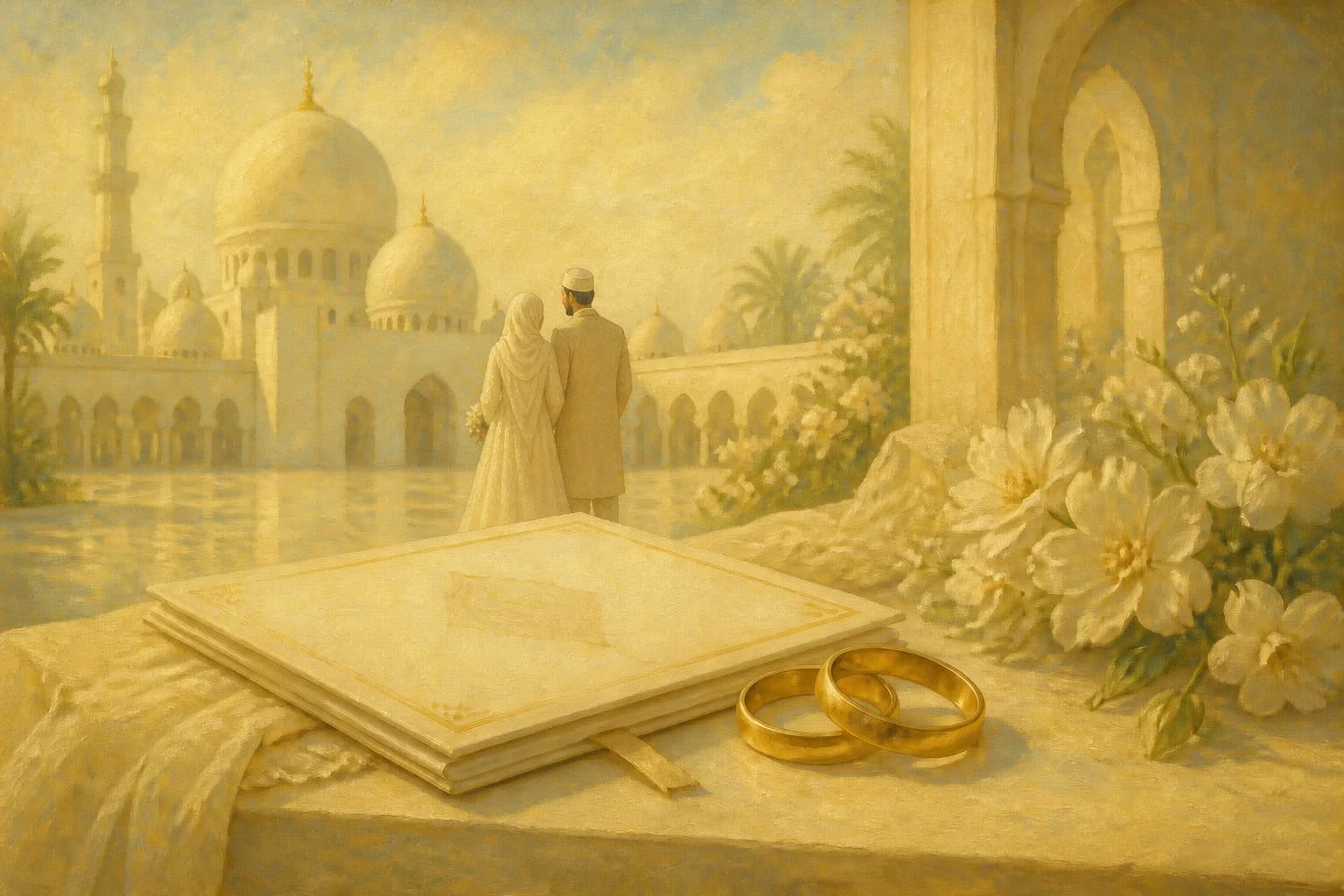

Why Marriage Is More Than a Milestone
Marriage is often discussed as a life goal — something to achieve, a stage to move through. In Islam, it is something far more significant. It is described as completing half of your faith, as a sign of Allah's power and mercy, and as a covenant that mirrors divine love itself.
Understanding the importance of marriage in Islam reshapes more than just how you approach finding a spouse. It transforms how existing spouses treat each other daily, how families are built, and how the Muslim community renews itself across generations.
What Islam Teaches About Marriage
A Sign Among the Signs of Allah
The Quran contains one of the most profound descriptions of marriage in any tradition:
وَمِنْ آيَاتِهِ أَنْ خَلَقَ لَكُم مِّنْ أَنفُسِكُمْ أَزْوَاجًا لِّتَسْكُنُوا إِلَيْهَا وَجَعَلَ بَيْنَكُم مَّوَدَّةً وَرَحْمَةً
"And among His signs is this: that He created for you spouses from yourselves that you may find tranquility in them, and He placed between you love and mercy." — (Surah Ar-Rum, 30:21)
The Quran calls marriage one of the ayat (signs) of Allah — in the same category as the creation of the heavens and the earth. And the two qualities Allah places within a properly-built marriage are mawaddah (love, warmth, affection) and rahmah (mercy, compassion). These are not feelings you manufacture — they are gifts Allah places in a marriage oriented toward Him.
Completing Half of Your Deen
The Prophet Muhammad ﷺ said:
مَنْ تَزَوَّجَ فَقَدِ اسْتَكْمَلَ نِصْفَ الدِّينِ، فَلْيَتَّقِ اللَّهَ فِي النِّصْفِ الْبَاقِي
"Whoever gets married has completed half of the deen, so let them fear Allah regarding the remaining half." — (Al-Bayhaqi, Shu'ab al-Iman)
This is not merely encouragement to marry — it is a statement about the structure of a believer's spiritual life. Marriage addresses a vast domain of human experience: desire, companionship, vulnerability, patience, and sacrifice. Living this relationship with integrity is itself a sustained form of worship. Our collection of hadith about marriage explores this and related narrations in depth.
The Nikah as a Sacred Covenant
The Quran uses the word mithaq (مِيثَاق) — the same word used for the covenant between Allah and the prophets — to describe the marriage contract:
وَأَخَذْنَ مِنكُم مِّيثَاقًا غَلِيظًا
"And they have taken from you a solemn covenant." — (Surah An-Nisa, 4:21)
The nikah is not a legal formality. It is a witnessed covenant before Allah that transforms the relationship from forbidden into worship. Every act within marriage — kindness, patience, intimacy, financial provision — becomes spiritual currency when offered with the right intention.
Why This Matters for Muslims Today
Many Muslims delay or struggle with marriage for reasons that are real: financial pressure, incompatible expectations, fear of divorce, or the influence of cultures that treat marriage as optional or secondary to career. Islam does not dismiss these challenges, but it offers a clear framework.
The purpose of marriage in Islam is not personal fulfillment in the modern sense — it is mutual growth toward Allah, within a structure of clearly defined rights and responsibilities. When this purpose is genuinely shared by both spouses, it transforms how they navigate hardship together rather than against each other.
Understanding muslim family values — the broader context of which marriage is the cornerstone — helps clarify why Islam treats this institution with such seriousness. The family is the building block of the ummah, and marriage is its foundation.
How to Approach Marriage as a Believer
Whether you are unmarried and seeking, already married, or simply reflecting on your relationship, there are active steps rooted in the Sunnah.
Choose for deen first. The Prophet ﷺ advised:
"A woman is married for four things: her wealth, her family status, her beauty, and her deen. Choose the one with deen, may your hands be blessed." — (Sahih Bukhari 5090)
Character and commitment to faith are the most reliable predictors of a blessed marriage. The same principle applies equally to men.
Make sincere dua. Before finding a spouse, or as you navigate your current marriage, ask Allah for what you need. The dua for a good spouse and dua for marriage proposal are part of a well-established tradition of turning to Allah in deeply personal matters.
Learn your rights and responsibilities. Marriage in Islam is built on clearly defined mutual rights. The husband has responsibilities of provision and kind leadership. The wife has rights to be honored, consulted, and treated with tenderness. Both have the right to the best character their spouse can offer. Explore muslim wedding traditions for a deeper look at how these mutual commitments begin at the nikah itself.
Invest in the relationship actively. The Prophet ﷺ said the best of you is the best to his family (Sunan At-Tirmidhi 3895). Marriage requires daily investment — kind words, shared prayers, checking in on each other's state of faith, and choosing to forgive quickly.
Ready to seek marriage?
Explore Quran- and Sunnah-grounded guidance for choosing a spouse, understanding rights, communicating well, and handling difficult decisions.
Take the Marriage Quiz
Signs of a Marriage Grounded in Islam
- Disputes are resolved with mercy rather than with a need to win
- Both spouses make dua for each other — you hear your name in your partner's supplication
- The home feels like a place of sakinah (tranquility) rather than tension
- Children in the home see the Quran opened, prayers prayed, and genuine kindness modeled daily
- Hardship draws the couple closer to Allah and to each other rather than driving them apart
These are not impossible ideals. They are the natural fruits of a marriage where both people consciously submit to the Quranic framework — and where both understand that the goal is not a perfect partnership but a righteous one.
Common Questions
Is marriage obligatory in Islam? Scholars generally classify marriage as highly recommended (sunnah muakkadah). It becomes obligatory if a person genuinely fears falling into major sin without it and is able to fulfill the responsibilities of marriage.
What if I cannot afford to get married? The Prophet ﷺ recommended fasting as a means to lower desire for those who cannot yet marry. Islamic scholars also emphasize that the mahr (dowry) should be affordable — the Prophet ﷺ himself facilitated marriages with minimal mahr when circumstances required it.
What does Islam say about divorce? Divorce is permitted but described by the Prophet ﷺ as the most disliked of the permissible acts (Abu Dawud 2178). Islam provides a structured process of reconciliation — involving family mediation and a waiting period (iddah) — before divorce is finalized.
Can I pray istikhara when considering a marriage proposal? Yes. Istikhara is specifically recommended for major decisions, including marriage. After performing it sincerely, trust that Allah is guiding your heart. See our full guide on dua for istikhara for the complete supplication and method.
What makes a nikah valid? A valid nikah requires an offer and acceptance, two Muslim witnesses, the free consent of both parties, and an agreed-upon mahr. Consult a knowledgeable imam for your specific situation and school of thought.
Marriage Is Worship — When Approached as Such
The importance of marriage in Islam is not primarily about companionship or family-building, though both are genuine gifts. At its core, marriage is a structure within which a believer practices love, patience, sacrifice, and gratitude — all in the sight of Allah. When entered with that intention, it becomes one of the most sustained forms of worship available to a Muslim.
For deeper academic reading on Islamic marriage ethics, Yaqeen Institute offers rigorous research-backed resources. You can also explore community perspectives on building a Muslim marriage at DeenBack and personal reflections at Demi Manifest.
May Allah bless every Muslim seeking a righteous spouse, and strengthen the bonds of every believing household. Ameen.
Ready to seek marriage?
Explore Quran- and Sunnah-grounded guidance for choosing a spouse, understanding rights, communicating well, and handling difficult decisions.
Take the Marriage QuizFrequently Asked Questions
Is marriage obligatory in Islam?
Marriage is highly recommended (sunnah muakkadah) for those who are able. It becomes obligatory if a person genuinely fears falling into major sin without it.
What is the spiritual purpose of marriage in Islam?
Marriage is described as completing half of your deen. It provides a lawful foundation for companionship, spiritual growth, and raising the next generation of believers.
What does the Quran say about marriage?
The Quran describes spouses as garments for each other (2:187), says Allah placed love and mercy between them (30:21), and commands they be treated with kindness (4:19).
How should a Muslim choose a spouse?
The Prophet (peace be upon him) advised choosing primarily for deen (religious character), as this leads to lasting barakah and success in marriage.
What is the significance of the nikah contract?
The nikah is a solemn covenant (mithaq) witnessed before Allah and the community. It transforms the relationship into an act of worship and establishes clear mutual rights and responsibilities.