

- Authors

- Name
- Ahmad
- Role
- Senior Marketing Manager, Islamic education • DeenUp
بِسْمِ اللهِ الرَّحْمٰنِ الرَّحِيْمِ
In the name of God, the Most Gracious, the Most Merciful.
Some of the most meaningful words in a Muslim's daily life are not long sermons or complex rulings — they are the small phrases of protection and blessing passed between people who care for one another. "May Allah keep you safe." "Fi aman Allah." "Hafizakallahu."
These phrases carry weight precisely because of what they acknowledge: that safety does not come from us. We cannot truly protect the people we love. We can only entrust them to the One who can.
What Does "May Allah Keep You Safe" Mean in Islam?
"May Allah keep you safe" is an Islamic supplication asking Allah to guard a person from physical harm, illness, spiritual corruption, and all forms of evil. The Arabic equivalent حفظك الله (hafizakallahu) means "may Allah protect you," while في أمان الله (fi aman Allah) — "in Allah's protection" — is used especially at parting. Both phrases reflect the foundational Islamic belief that all safety and protection belong exclusively to Allah (Surah Al-Baqarah, 2:255), making these expressions acts of sincere supplication, not mere social courtesy.
The Quranic Foundation of Divine Protection
The idea that Allah alone provides real protection runs throughout the Quran. The most powerful single verse on this theme is Ayatul Kursi (آية الكرسي), which the Prophet ﷺ described as the greatest verse in the Quran:
اللَّهُ لَا إِلَٰهَ إِلَّا هُوَ الْحَيُّ الْقَيُّومُ ۚ لَا تَأْخُذُهُ سِنَةٌ وَلَا نَوْمٌ
"Allah — there is no god except Him, the Ever-Living, the Sustainer of all existence. Neither drowsiness overtakes Him nor sleep." — (Surah Al-Baqarah, 2:255)
The verse continues to describe how nothing in the heavens or earth is beyond His knowledge and custody. The Prophet ﷺ taught that whoever recites Ayatul Kursi at night, Allah appoints an angel to guard them until morning (Sahih al-Bukhari 5010).
The last two surahs of the Quran — Surah Al-Falaq (سورة الفلق) and Surah An-Nas (سورة الناس) — are explicitly protection surahs. Allah taught the Prophet ﷺ to seek His refuge from the evil of creation, the harm of darkness, those who blow on knots, the envier, the whispering of the shaytan, and all human and jinn harms. The Prophet ﷺ recited these three times each morning and evening and blew over his hands and wiped over his body — a practice his companions maintained.
Common Islamic Expressions of Protection and Their Meaning
Muslims have a rich vocabulary of protection blessings, each reflecting a slightly different aspect of divine care. When you understand what each one means, using them becomes a genuine act of supplication rather than a cultural habit.
| Expression | Arabic | Meaning | When Used |
|---|---|---|---|
| Hafizakallahu | حفظك الله | May Allah protect you | General blessing for safety |
| Fi aman Allah | في أمان الله | In Allah's protection | At parting; farewell |
| A'adhakallahu | أعاذك الله | May Allah grant you refuge | Protection from specific harm |
| Barakallahu fik | بارك الله فيك | May Allah bless you | General blessing; gratitude |
| Astawdi'ukallah | أستودعك الله | I entrust you to Allah | Bidding farewell on a journey |
| Rahimakallah | رحمك الله | May Allah have mercy on you | Response to sneezing; grief |
The phrase astawdi'ukallah deserves special attention. When the Prophet ﷺ parted from a companion for a journey, he would say:
أَسْتَوْدِعُكَ اللَّهَ الَّذِي لَا تَضِيعُ وَدَائِعُهُ
"I entrust you to Allah, Whose trusts are never lost." — (Sunan Abu Dawud 2600)
This is not empty well-wishing — it is a sincere act of placing someone you love under divine guardianship, acknowledging that your ability to protect them ends where your arms end, and Allah's does not.
Duas for Asking Allah to Keep Someone Safe
The Comprehensive Protection Dua
The Prophet ﷺ taught this supplication for seeking refuge from all created harms:
أَعُوذُ بِكَلِمَاتِ اللَّهِ التَّامَّاتِ مِنْ شَرِّ مَا خَلَقَ
"I seek refuge in Allah's perfect words from the evil of everything He has created." — (Sahih Muslim 2708)
The Prophet ﷺ said that whoever recites this three times in the evening will not be harmed by anything that night. It is one of the most concise and comprehensive protection supplications in the Sunnah.
The Morning and Evening Shield
This dua, recited three times each morning and evening, is narrated to protect from sudden harm:
بِسْمِ اللَّهِ الَّذِي لَا يَضُرُّ مَعَ اسْمِهِ شَيْءٌ فِي الْأَرْضِ وَلَا فِي السَّمَاءِ وَهُوَ السَّمِيعُ الْعَلِيمُ
"In the name of Allah with Whose name nothing in the earth or sky can cause harm, and He is the All-Hearing, the All-Knowing." — (Sunan Abu Dawud 5088; Ibn Majah 3869)
Maintaining this dua alongside the other morning and evening adhkar builds a daily practice of protection that the Prophet ﷺ consistently observed and taught.
Making Protection Duas Part of Your Daily Life
The beautiful thing about Islamic protection supplications is that they are not reserved for crises. They are woven into ordinary daily rhythms — waking up, leaving the house, before sleeping, saying goodbye. This design reflects something profound: Allah wants to be in every moment of your day, not just the frightening ones.
Here is how to build the habit:
Morning adhkar (after Fajr): Recite Ayatul Kursi, Surah Al-Ikhlas, Al-Falaq, and An-Nas three times each. These are specifically narrated as sufficient for all matters of that day.
Before leaving the house: The dua "Bismillahi, tawakkaltu alallah, wa la hawla wa la quwwata illa billah" — "In the name of Allah, I place my trust in Allah, and there is no power or might except with Allah" — is narrated to cause the shaytan to turn away from you (Sunan Abu Dawud 5095).
When parting from family: Replace a simple "take care" with fi aman Allah or hafizakallahu. It costs nothing and transforms a farewell into a supplication.
Before sleeping: Recite Ayatul Kursi, blow gently on your hands, and wipe them over your body three times as the Prophet ﷺ taught. This is narrated in Sahih al-Bukhari 5017.
When worried about someone: Recite Surah Al-Falaq and Surah An-Nas on their behalf and ask Allah specifically. Allah hears the supplication you make for another person in their absence — and angels say "and to you as well" (ameen to your wish; Sahih Muslim 2732).
For detailed guidance on building a consistent morning routine of supplications and remembrance, see our complete guide on morning adhkar in Islam. The benefits of Surah Al-Falaq and benefits of Surah An-Nas offer deeper understanding of the specific protections these surahs provide.
Your personal 28-Day Deen Plan
Learn your deen in 28 days, 5 minutes a day
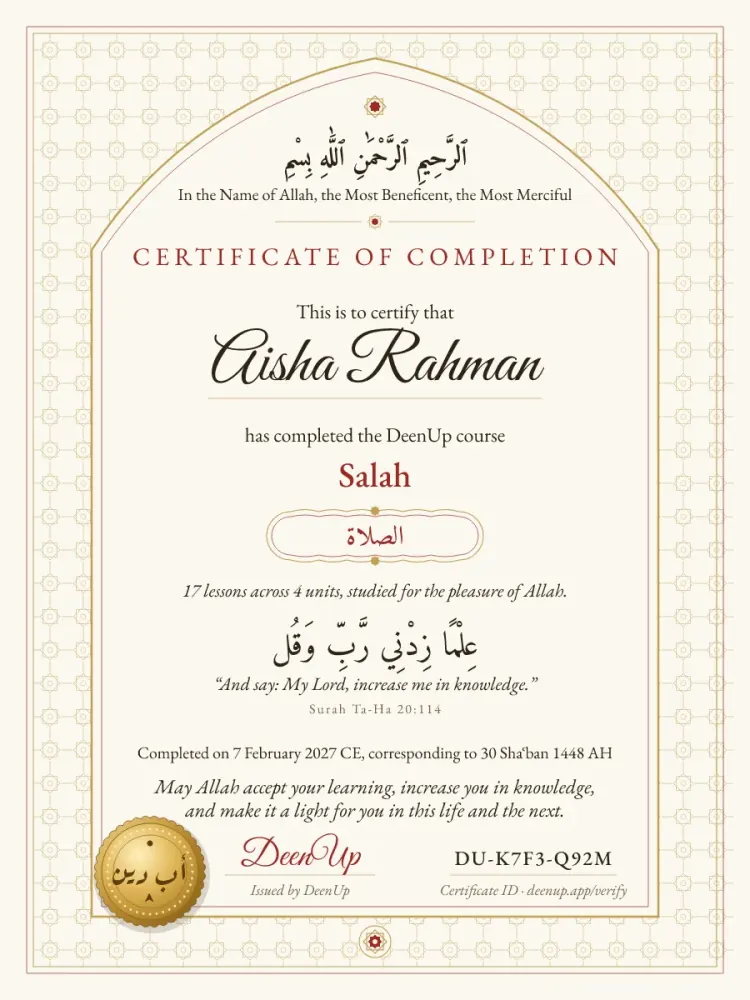
The essentials of salah, fiqh and faith, step by step from authentic sources. Finish all 28 days and earn a verifiable Certificate of Completion.
Take the free quizAnswer a few questions and get your personal plan.
Why Turning to Allah for Safety Matters
There is a difference between asking someone to keep you in their prayers and genuinely entrusting them to Allah. The first is a kind social gesture; the second is an act of tawakkul — placing real reliance on Allah because you understand that He is the only One who can truly keep anyone safe.
The Quran describes Allah as Al-Hafiz (الحفيظ) — the Preserver, the Protector — in Surah Hud (11:57). It is one of the 99 names of Allah, and meditating on it changes how you approach protection. When you say hafizakallahu, you are invoking an attribute of Allah Himself — His power to preserve what He wills from every harm.
This is also why Islamic protection is not superstition. Wearing an amulet or charm with no Quranic basis treats protection as though it comes from an object rather than from Allah. The Prophet ﷺ prohibited this (Musnad Ahmad 17440), not because recitation and remembrance are ineffective, but because misplacing trust in created things is a subtle form of shirk — attributing Allah's power to something else.
Real protection comes from real connection: reciting what the Prophet ﷺ recited, asking in the way he taught, and genuinely believing that Allah hears.
For comprehensive guidance on dua for protection and safety, and the meaning and benefits of Ayatul Kursi — the single most powerful verse for divine protection — explore our related articles. Additional resources on Islamic supplication can be found at seekersguidance.org and sunnah.com for verified hadith collections on these duas.
Also see deenback.com's guide on daily adhkar for protection and demimanifest.com on seeking Allah's protection for further practical guidance.
Common Questions About "May Allah Keep You Safe"
Can I say "fi aman Allah" to anyone, Muslim or non-Muslim? Using this phrase with a fellow Muslim is straightforwardly a supplication for their wellbeing. For a non-Muslim, many scholars consider it permissible as a sincere wish and gentle reminder of Allah's care. The key is sincerity — using it as genuine supplication, not empty social habit.
What if I forget the Arabic — does English work? Yes. Supplications in any language are valid. Allah understands every tongue. That said, learning the Arabic of core duas carries additional benefit: the Prophet ﷺ's exact words are preserved in them, and Arabic formulation has a specificity that translations can approximate but sometimes soften. Even beginning with phonetic transliteration while learning the Arabic is a worthwhile step.
Is Ayatul Kursi really the greatest verse for protection? Yes — this is narrated explicitly in Sahih al-Bukhari 5010 and Muslim 810. The Prophet ﷺ stated that it is the greatest verse in the Quran, and that consistent recitation at night ensures angelic protection. This makes it the single highest-priority verse for anyone serious about daily protection practice.
What is the dua when you're genuinely afraid? The Prophet ﷺ would say "Hasbunallahu wa ni'mal wakil" — "Allah is sufficient for us and He is the best disposer of affairs" (Surah Al-Imran, 3:173) — in moments of fear and difficulty. It is narrated that Ibrahim (alayhi al-salam) said this when thrown into the fire, and the Prophet ﷺ said it when warned that the enemy had gathered against him.
Closing
When you say "may Allah keep you safe" — in whatever language, in whatever form — you are doing something genuinely important. You are acknowledging that the safety of the people you love rests with Allah, and you are asking Him directly to exercise His power of protection on their behalf.
That is du'a in its most essential form: turning to the One who can actually do something, with sincerity and trust.
Build these expressions into your daily life. Say fi aman Allah at genuine farewells. Recite Ayatul Kursi before sleep. Keep the morning and evening adhkar. Each small act is a thread of connection to the One who preserves all things.
Your personal 28-Day Deen Plan
Learn your deen in 28 days, 5 minutes a day
The essentials of salah, fiqh and faith, step by step from authentic sources. Finish all 28 days and earn a verifiable Certificate of Completion.
Take the free quizAnswer a few questions and get your personal plan.
Frequently Asked Questions
What does 'may Allah keep you safe' mean in Islam?
The phrase 'may Allah keep you safe' is a sincere Islamic supplication asking Allah to guard someone from harm, illness, danger, and spiritual corruption. The Arabic equivalent is 'hafizakallahu' (حفظك الله) or 'fi aman Allah' (في أمان الله), meaning 'Allah protect you' and 'in Allah's protection' respectively. It reflects the Islamic belief that all safety comes from Allah alone.
What is the Arabic for 'may Allah keep you safe'?
The most common Arabic expressions are حفظك الله (hafizakallahu) — 'may Allah protect you' — and في أمان الله (fi aman Allah) — 'in Allah's protection' — used especially when parting. Another phrase is أعاذك الله (a'adhakallahu), meaning 'may Allah grant you refuge.' These are authentic Islamic expressions grounded in the belief that protection belongs only to Allah.
Is there a dua specifically for someone's protection?
Yes. The Prophet Muhammad (peace be upon him) would recite 'A'udhu bikalimat-illah il-tammati min sharri ma khalaq' — seeking refuge in Allah's perfect words from every evil He created — as a protection dua. Ayatul Kursi (Quran 2:255) is also among the most powerful protection recitations, as the Prophet taught that reciting it at night ensures an angel guards you until morning.
What should I say when someone is traveling or in danger?
When seeing someone off on a journey, say 'fi aman Allah' (في أمان الله) — in Allah's protection. For general wishes of safety, 'hafizakallahu' (حفظك الله) is appropriate. If you want to also include a dua for their return, the Prophet taught 'Astawdi'ukallah alladhi la tadi'u wada'i'uh' — I entrust you to Allah, Whose trusts are never lost. (Sunan Abu Dawud 2600)
How do I ask Allah to protect my family?
Recite the morning and evening adhkar, which include comprehensive protection supplications. The evening dua 'Bismillahilladhi la yadurru ma'asmihi shay'un' — in the name of Allah with Whose name nothing can cause harm — is narrated to protect from sudden affliction. Reading Ayatul Kursi and the three Quls (Surah Al-Ikhlas, Al-Falaq, An-Nas) regularly provides broad spiritual protection for yourself and your household.
What is the difference between asking Allah for protection and superstitious protection?
Islamic protection is rooted in tawakkul — genuine reliance on Allah — through authenticated Quranic recitations, supplications, and trust that harm and safety both come from Allah alone. Superstitious protection relies on amulets, charms, or rituals without Quranic basis and is discouraged in Islam. The Prophet prohibited wearing amulets (Musnad Ahmad 17440) unless they contain Quran, and even then scholars differ.
Can non-Muslims use the phrase 'may Allah keep you safe'?
A Muslim addressing a non-Muslim can use this phrase as a sincere wish and invitation to reflect on Allah's protection. Some scholars distinguish between general good wishes and specific supplications that presuppose the person's Islam; for a non-Muslim, saying 'may Allah guide and protect you' is considered acceptable by many scholars as it also carries the hope of guidance.