

- Authors

- Name
- Ahmad
- Role
- Senior Marketing Manager, Islamic education • DeenUp
بِسْمِ اللهِ الرَّحْمٰنِ الرَّحِيْمِ
In the name of God, the Most Gracious, the Most Merciful.

There is a moment many Muslims know well — standing in front of something uncertain, wanting to do the right thing, but unsure exactly where the line is. Is this haram? How do scholars decide? And why did Allah forbid certain things in the first place?
Understanding the rules of haram is not just about avoiding sin. It is about developing the kind of inner compass that lets you navigate daily life with clarity, confidence, and genuine connection to Allah. When you understand the principles behind what is forbidden, rulings stop feeling like arbitrary restrictions and start feeling like guidance from One who knows you deeply.
What Are the Rules of Haram in Islam?
The rules of haram in Islam are the principles established through the Quran and authentic Sunnah that define what Allah has strictly forbidden. Something is haram when it is explicitly prohibited by a clear verse (Surah Al-Baqarah, 2:173; Surah Al-A'raf, 7:33) or an authentic hadith, and avoiding it out of obedience earns reward while committing it carries a sin. Islamic jurisprudence also establishes that all things are presumed permissible (halal) unless a specific prohibition is proven — meaning doubt and silence never automatically make something haram.

What the Quran and Sunnah Say About What Is Forbidden
The Quran establishes categories of the forbidden with remarkable clarity. In Surah Al-A'raf, Allah sets the foundational principle:
قُلْ إِنَّمَا حَرَّمَ رَبِّيَ الْفَوَاحِشَ مَا ظَهَرَ مِنْهَا وَمَا بَطَنَ
"Say: My Lord has only forbidden indecencies — what is apparent of them and what is concealed." — (Surah Al-A'raf, 7:33)
The verse continues to list arrogance, associating partners with Allah, and speaking about Allah without knowledge. These are not arbitrary rules — they are protections for human dignity, society, and the believer's relationship with Allah.
The Prophet Muhammad ﷺ gave Muslims a practical framework for navigating uncertainty in daily life:
"What is halal is clear and what is haram is clear. Between them are matters that are ambiguous and many people do not know about them. Whoever avoids the ambiguous matters has protected his religion and his honor." — (Sahih al-Bukhari 52)
This hadith does two things at once. It acknowledges that most of life falls clearly into permitted or forbidden. And it offers a practical principle for the grey zone: when genuinely uncertain, caution is a form of piety.
Surah Al-Baqarah gives specific examples that illustrate the pattern: carrion, blood, the meat of swine, and what has been dedicated to other than Allah are forbidden (2:173), and in the same breath Allah adds that necessity lifts the prohibition when no alternative exists. The rulings are firm but not inflexible.
Understanding the Wisdom Behind Islamic Prohibitions
Islam does not forbid things randomly. Islamic jurisprudence recognizes five essential interests (al-daruriyyat al-khams) that every ruling is designed to protect:
| Essential Interest | Arabic | What the Rules of Haram Protect |
|---|---|---|
| Religion | الدين (ad-din) | Prohibitions on shirk, apostasy, and practices that corrupt worship |
| Life | النفس (an-nafs) | Prohibitions on murder, suicide, and harmful substances |
| Intellect | العقل (al-aql) | Prohibition on alcohol, intoxicants, and what clouds the mind |
| Lineage | النسب (an-nasab) | Prohibition on fornication, adultery, and false parentage |
| Wealth | المال (al-mal) | Prohibition on theft, riba (interest), fraud, and bribery |
This framework means that when you encounter a ruling you do not yet fully understand, the question to ask is: which of these essential interests does this prohibition protect? Almost always, the answer is clear — and the wisdom behind the ruling becomes visible.
Surah Al-Isra lists a remarkable cluster of prohibitions together — do not take unjust wealth, do not kill, do not come near zina (fornication) — and frames each one with the reason: "Indeed, it was an abomination and an evil way" (17:32). The Quran consistently pairs the ruling with the rationale, inviting understanding rather than demanding blind compliance.
Islamic Legal Categories: Where Haram Fits
Haram is one of five legal rulings (al-ahkam al-khamsah) in Islamic jurisprudence. Understanding where it sits among them prevents the common mistake of treating everything that is disliked or discouraged as though it were forbidden.
| Ruling | Arabic | Meaning | Consequence |
|---|---|---|---|
| Wajib | واجب | Obligatory — must be done | Sin if left; reward if performed |
| Mustahabb | مستحب | Recommended — good to do | Reward if performed; no sin if left |
| Mubah | مباح | Neutral — permitted | No reward or sin either way |
| Makruh | مكروه | Disliked — better to avoid | Reward if avoided; no sin if done |
| Haram | حرام | Forbidden — must not be done | Sin if done; reward if avoided |
The distance between makruh and haram is significant. Many Muslims conflate them, treating something disliked as though it were strictly forbidden. This can lead either to unnecessary guilt or to dismissing genuine prohibitions as mere cultural preference. Precision here matters.
How Scholars Determine What Is Haram
Islamic scholars use a structured methodology to determine whether something is forbidden. The primary sources are the Quran and the authenticated Sunnah. When those are silent, scholars look to scholarly consensus (ijma) and analogical reasoning (qiyas) — applying a known ruling to a new case that shares the same underlying cause.
A critical principle governs the whole process: the default is permissibility. The legal maxim al-asl fi al-ashya' al-ibaha states that everything is halal unless a specific prohibition is established by evidence. This prevents scholars from inventing restrictions and protects ordinary Muslims from being burdened with unfounded rulings.
For the prohibition to be established, the evidence must be clear and authentic. A weak hadith cannot make something haram. A single minority scholarly opinion cannot override a broad consensus. And the prohibition applies to the specific harm identified — not expansively to everything loosely associated with it.
This is why careful scholarship matters. Well-meaning but imprecise conclusions — declaring entire categories haram on the basis of shaky evidence — do a disservice to both the deen and the people seeking guidance. For specific rulings in your life, turn to qualified scholars rather than relying solely on internet summaries. Resources like SeekersGuidance and Yaqeen Institute offer well-sourced answers on contemporary questions.
Practical Guidance: Living by the Rules of Haram
Understanding the principles is one thing — applying them daily is another. Here is how the rules of haram translate into everyday Muslim life:
When something is clearly haram, avoid it. This is the clearest case: alcohol, pork, fornication, theft, and lying are explicitly prohibited. No amount of rationalization changes the ruling. The believer's response is acceptance and avoidance — which itself earns reward from Allah.
When something is ambiguous, seek knowledge before acting. The hadith of Sahih al-Bukhari 52 advises caution with the ambiguous, not paralysis. Research the ruling, consult a qualified scholar, and act with intention. DeenUp's AI companion draws on Quranic citations and scholarly sources to help you find answers to questions like these at any hour.
When necessity genuinely applies, understand the conditions. The exception for necessity (darura) is narrow and specific: it requires that the harm you face is real, severe, and immediate; that no permissible alternative exists; and that you take only as much of the forbidden thing as the need demands. It is not a loophole — it is a mercy from Allah.
Keep perspective on categories. Not everything that is unpleasant is haram. Not everything culturally normal is halal. Refer back to the five essential interests — if something genuinely threatens your religion, life, intellect, lineage, or wealth, the ruling will likely reflect that.
Your personal 28-Day Deen Plan
Learn your deen in 28 days, 5 minutes a day
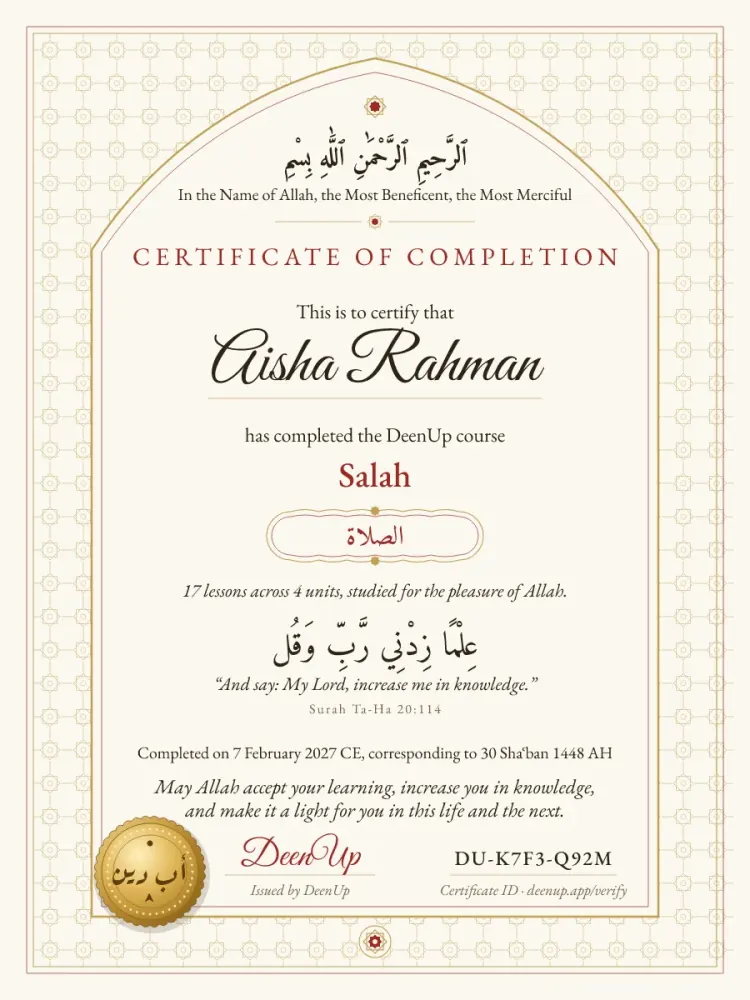
The essentials of salah, fiqh and faith, step by step from authentic sources. Finish all 28 days and earn a verifiable Certificate of Completion.
Take the free quizAnswer a few questions and get your personal plan.
For a deeper understanding of the distinction between what is permitted and what is forbidden across everyday situations, see our guide to halal vs haram and how to know if something is halal or haram. Many Muslims also find it helpful to understand what is forbidden in Islam more broadly before working through specific rulings.
Related Dua for Guidance and Uprightness
When navigating uncertainty about rulings, this dua — narrated in Sunan Abu Dawud — asks Allah for the ability to worship and remember Him rightly:
اللَّهُمَّ أَعِنِّي عَلَى ذِكْرِكَ وَشُكْرِكَ وَحُسْنِ عِبَادَتِكَ
"O Allah, help me to remember You, to give thanks to You, and to worship You in the best manner." — (Abu Dawud 1522)
This supplication connects directly to the spirit behind the rules of haram: they are not obstacles but pathways to better worship. Asking Allah to help you worship Him well naturally includes asking for the clarity and strength to avoid what He has forbidden.
Common Questions About the Rules of Haram
What makes something haram vs. just disliked? A ruling of haram requires explicit evidence — a clear Quranic verse or authenticated hadith stating the prohibition. Something that is merely discouraged (makruh) does not carry a sin if done. When scholars are unsure whether a prohibition is firm or just cautionary, they typically note the difference in their ruling.
Can a Muslim accidentally do something haram? Yes, and Islamic law accounts for this. Accidental consumption of something haram — eating pork unknowingly, for example — does not carry the sin that intentional, knowing violation would. The Prophet ﷺ taught that Allah is merciful with mistakes made in error or forgetfulness (Sahih Muslim 127).
Is interest (riba) really haram? Yes. The prohibition on riba is among the most explicit in the Quran, stated in Surah Al-Baqarah across multiple verses including 2:275–279. Allah declares war on those who persist in it after the prohibition is known. Islamic finance has developed a range of alternatives that allow participation in mortgages, investments, and business without riba — exploring these options is well worth the effort.
Are all haram things also criminal in Islamic societies? No. The shari'ah distinguishes between sins (which are between a person and Allah) and crimes (which require a court, witnesses, and due process). Many things that are haram — such as lying, arrogance, or missing prayers — are spiritual matters between the individual and Allah, not legal cases.
Does the ruling on something haram change over time? The core prohibitions established in the Quran and authenticated Sunnah do not change. What can evolve is scholarly application to new situations — determining, for example, whether a new type of financial product constitutes riba, or whether a new food additive is permissible. The principles remain constant; their application to new facts requires ongoing scholarship.
Closing
The rules of haram are ultimately an expression of divine care. Allah did not burden His servants with vague prohibitions or unknowable standards. He revealed the principles clearly, explained the wisdom behind them, and built in a framework of mercy for genuine need and unintentional error.
Understanding these rules — and internalizing the why behind them — transforms compliance from obligation into genuine love of what Allah loves and avoidance of what He dislikes. That is the heart of taqwa, and it is worth cultivating with patience and consistent learning.
For everyday guidance on Islamic rulings, our related articles on is everything haram in Islam and understanding halal food may help you think through specific questions in your daily life. External scholarly resources like deenback.com and demimanifest.com also offer reliable guidance on contemporary questions.
Your personal 28-Day Deen Plan
Learn your deen in 28 days, 5 minutes a day
The essentials of salah, fiqh and faith, step by step from authentic sources. Finish all 28 days and earn a verifiable Certificate of Completion.
Take the free quizAnswer a few questions and get your personal plan.
Frequently Asked Questions
What does haram mean in Islam?
Haram (حرام) means something that is strictly forbidden in Islam. It refers to any action, food, speech or transaction that Allah explicitly prohibited. Engaging in haram carries a sin, while avoiding it out of obedience to Allah earns reward. The ruling is established through clear Quranic verses or authentic hadith.
What are the main rules for determining if something is haram?
Islamic scholars use four main sources — the Quran, the Sunnah, consensus (ijma), and analogical reasoning (qiyas) — to determine what is haram. Something is only considered strictly forbidden when there is an explicit, authentic prohibition. Where there is genuine doubt, scholars apply the principle that all things are permissible until proven otherwise.
Is everything makruh the same as haram?
No. Makruh (مكروه) means disliked or discouraged but not forbidden. Doing something makruh does not carry a sin, though avoiding it is better. Haram, by contrast, is a firm prohibition that carries a sin if violated. The difference is significant in Islamic jurisprudence and should not be confused in practice.
Can something be haram in one context and halal in another?
Yes. Islamic law recognizes that necessity (darura) can lift a prohibition in life-threatening situations. For example, consuming pork or alcohol is haram but becomes temporarily permissible if someone faces starvation or death with no alternative. This exception is narrow and does not apply simply for preference or convenience.
What is the Islamic ruling on things not explicitly mentioned in the Quran or Sunnah?
The default Islamic legal principle (al-ibaha al-asliyya) states that all things are considered halal unless a clear prohibition exists. This means that newly arising situations, modern foods, or unfamiliar activities are presumed permissible unless scholars identify a specific harm or textual basis to restrict them.
Why does Islam have rules of haram?
The rules of haram exist to protect five essential interests Islam preserves: life, intellect, lineage, wealth, and religion. Every prohibition traces to protecting one of these from harm. Understanding the wisdom behind prohibitions — not just the ruling itself — helps Muslims internalize and practice them sincerely.
Does avoiding haram count as worship?
Yes. The Prophet Muhammad (peace be upon him) taught that leaving something haram out of fear of Allah is an act of worship that earns reward. Abstaining from what Allah forbade — even when it is tempting or socially normalized — is one of the clearest expressions of taqwa and closeness to Allah.