

- Authors

- Name
- Ahmad
- Role
- Senior Marketing Manager, Islamic education • DeenUp
بِسْمِ اللهِ الرَّحْمٰنِ الرَّحِيْمِ
In the name of God, the Most Gracious, the Most Merciful.

Why Tasbih Is Worth Understanding
There are acts of worship that require time, preparation, and specific conditions. Then there are acts that travel with you everywhere — that cost nothing but a moment of attention and transform the quality of your day.
Tasbih (تسبيح) is one of those. It is among the most versatile forms of worship in Islam: accessible at any time, in any state, requiring no wudu, no specific location, and no set duration. Yet the Prophet ﷺ called the words of tasbih among the most beloved utterances to Allah and among the heaviest on the Scale of deeds.
If you have thought of tasbih as a side practice — something for older Muslims with beads in hand — this article is worth reading. It is actually one of the most direct ways to keep your heart connected to Allah through an ordinary day.
What Tasbih Actually Means
Tasbih comes from the Arabic root س-ب-ح (s-b-h), carrying the sense of swimming, floating, or moving swiftly through something — the image being a heart that moves freely through the glorification of Allah without getting caught on anything lesser.
In practice, tasbih means saying Subhanallah (سُبْحَانَ اللَّهِ — "Glory be to Allah" or "Allah is far above any imperfection"). This short phrase is an affirmation that Allah is completely free of all limitation, weakness, and deficiency that might be attributed to His creation.
The Quran places tasbih at the center of all creation's relationship with Allah:
"The seven heavens and the earth and all that is in them glorify Him. There is nothing that does not glorify His praise, but you do not understand their glorification." (Surah Al-Isra, 17:44)
Rocks, rivers, birds, and stars — everything around us is in a constant state of tasbih. When we say Subhanallah, we are joining a chorus that has never stopped since the moment of creation.
Allah also commands this glorification directly:
"Glorify the Name of your Lord, the Most High." (Surah Al-A'la, 87:1)
The word sabbih in this verse is a command form of the same root as tasbih — it is an instruction to actively, intentionally glorify Allah, not just passively observe that He is glorious.
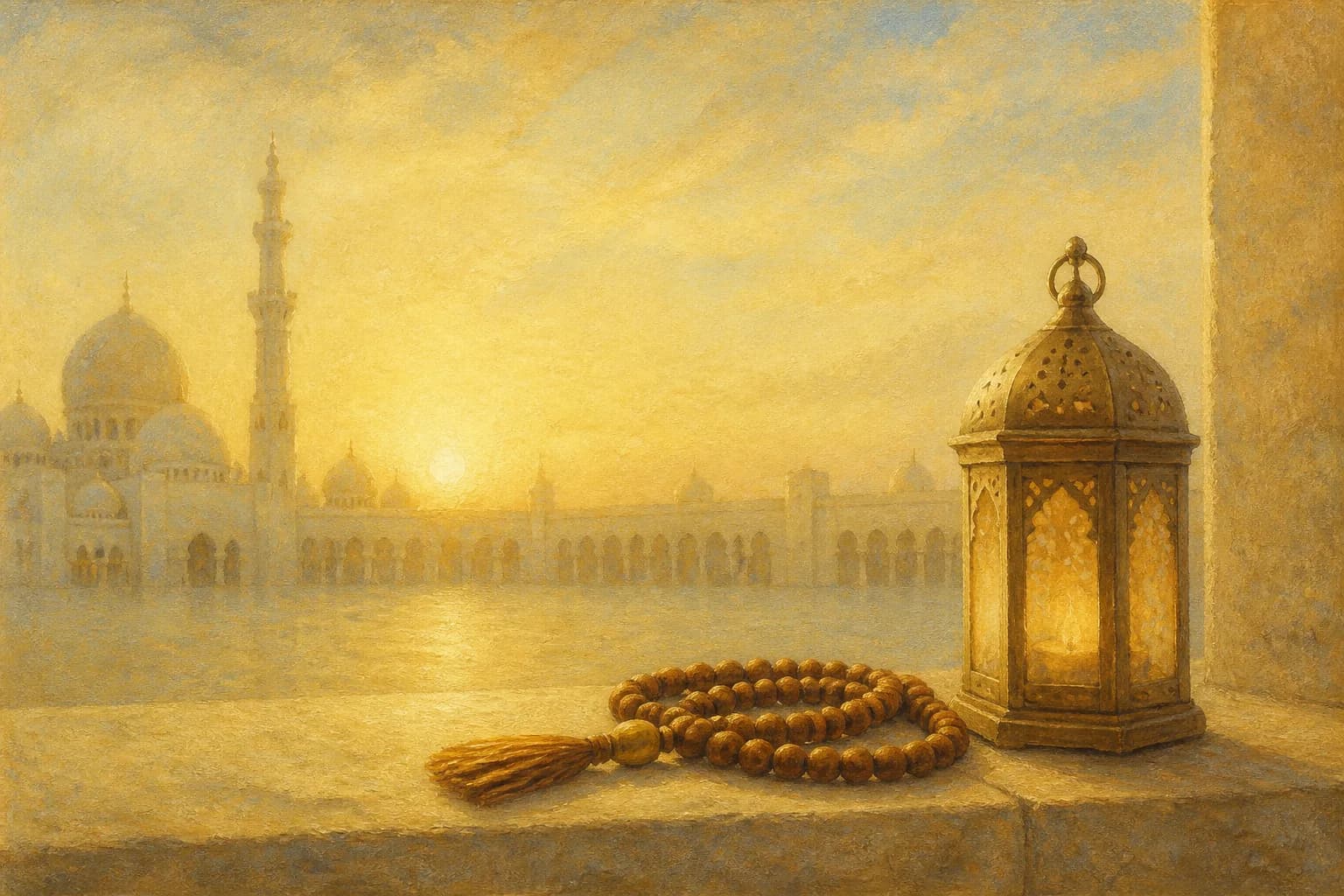
The word tasbih also refers to the physical prayer beads — known as misbaha (مسبحة) or subha — used to count repetitions of dhikr. This is a secondary meaning that has become attached to the word because the beads are the tool most associated with the practice.
Why Tasbih Matters for Muslims Today
The Prophet ﷺ described the words of tasbih with language that stops you in your tracks. He said:
"Two words are light on the tongue, heavy on the Scale, and beloved to the Most Merciful: Subhanallahi wa bihamdihi (Glory be to Allah and praise be to Him), Subhanallahil 'Azim (Glory be to Allah, the Magnificent)." — (Sahih al-Bukhari 6406)
Light on the tongue. Heavy on the Scale. Beloved to Allah. This is not a marginal practice — it is at the heart of what Islam asks of us in the spaces between the formal acts of worship.
Modern life fills silence. Notifications, conversations, tasks, media — the mind is rarely given a chance to settle. Tasbih offers a specific alternative: when your hands are occupied but your tongue is free, when you are walking between places, waiting in a queue, or lying down before sleep, these are moments that can be reclaimed for dhikr.
The importance of dhikr in Islam is not just spiritual — it is psychological. Remembering Allah is described in the Quran as the very thing that brings hearts to rest (Surah Ar-Ra'd, 13:28). Tasbih is one of the most immediate ways to access that tranquility.
The DeenBack guide to daily dhikr habits explores how consistent remembrance shifts the texture of a Muslim's day — from reactive to rooted. And this reflection from Demimanifest on tawakkul in daily life shows how glorifying Allah connects directly to trusting Him with outcomes we cannot control.
How to Practice Tasbih Daily
The Post-Salah Tasbih
The most established form of tasbih in the Sunnah comes after each of the five daily prayers. The Prophet ﷺ taught his daughter Fatimah (RA) this gift when she asked for a servant to help with household work:
"Say Subhanallah 33 times, Alhamdulillah 33 times, and Allahu Akbar 34 times after each prayer — that is better for you than what you have asked." — (Sahih al-Bukhari 3113)
The full post-salah sequence runs:
- Subhanallah (سُبْحَانَ اللَّهِ) — 33 times
- Alhamdulillah (الْحَمْدُ لِلَّهِ) — 33 times
- Allahu Akbar (اللَّهُ أَكْبَرُ) — 33 times
Then complete with:
لَا إِلَهَ إِلَّا اللَّهُ وَحْدَهُ لَا شَرِيكَ لَهُ، لَهُ الْمُلْكُ وَلَهُ الْحَمْدُ، وَهُوَ عَلَى كُلِّ شَيْءٍ قَدِيرٌ
La ilaha illallahu wahdahu la sharika lah, lahul-mulku wa lahul-hamd, wa Huwa 'ala kulli shay'in Qadir
"There is no god but Allah alone, with no partner. His is the dominion and the praise, and He has power over all things." — (Sahih Muslim 597)
The Prophet ﷺ said this tasbih, when said after each prayer, wipes away sins even if they are like the foam of the sea.
Tasbih at Other Times
Beyond salah, tasbih fits naturally into many moments:
- In the morning, alongside morning adhkar
- Before sleeping, alongside evening adhkar
- During work pauses — a few repetitions of Subhanallahi wa bihamdihi while the mind shifts between tasks
- While walking, cooking, or doing any physical work where the tongue is free
- During travel, as the Prophet ﷺ frequently made tasbih on journeys
Counting: Fingers or Beads?
The Prophet ﷺ counted tasbih on his fingers, and a companion narrated that he ﷺ said:
"Count on your fingers, for they will be questioned and will be made to speak." — (Abu Dawud 1501)
Using the right hand, starting from the thumb, is the prophetically taught method. Prayer beads (misbaha) are widely used by Muslims worldwide as a permissible counting aid. The scholarly consensus is that beads are neutral to recommended — what matters is sincerity and consistency, not the tool.

Keep learning your deen with short, sourced lessons in DeenUp.
A Feed Worth Scrolling
Swipe through short, scholar-approved Islamic lessons instead of mindless doom-scrolling.
Learn Through Play
Bite-sized lessons, quizzes, levels, and daily streaks make growing your Deen a habit.
Scholar-Approved
Every lesson is rooted in the Quran and authentic Sunnah and reviewed by qualified scholars.
Building the Habit
The challenge with tasbih is not learning it — the phrases are short and easy to memorize. The challenge is remembering to do it in the ordinary moments of the day.
A few approaches that work:
- Anchor it to salah. The post-salah tasbih is the most structured form — do it immediately after every prayer without standing up. This alone gives you five built-in tasbih sessions daily.
- Pair it with something physical. Some people keep prayer beads near their desk or in their pocket as a visual reminder. Others count while they are doing dishes or folding laundry.
- Start with one phrase. If the full post-salah sequence feels overwhelming, begin with just Subhanallahi wa bihamdihi ten times at the end of each prayer. Build from there.
- Connect it to concentration in salah. The same focus you bring to salah carries into the tasbih that follows. If you are working on improving concentration in salah, the transition into post-salah tasbih becomes more natural.
Signs That Tasbih Is Taking Root
How do you know your tasbih practice is becoming real rather than mechanical? A few markers:
- Your tongue moves to dhikr in quiet moments without prompting. This is the sign the Prophet ﷺ pointed to when he described those who are like green trees — always producing.
- The phrases carry meaning when you say them. You feel what it means to declare that Allah is far above imperfection, rather than pushing words past your lips while your mind is elsewhere.
- Your anxiety about outcomes decreases. Tasbih is an act of placing Allah's greatness above your own circumstances. Over time, this shifts how you hold your worries.
- You reach for dhikr in difficulty. When something goes wrong and Subhanallah comes to your tongue first, the practice has gone past your lips and into your response to life.
The benefits of istighfar and the benefits of salawat on the Prophet complement tasbih closely — these three forms of dhikr form a natural trio for the Muslim who wants their tongue busy with remembrance throughout the day.
For deeper scholarly reading on dhikr and its place in the Islamic tradition, the Yaqeen Institute has produced thorough research on the spiritual science of remembrance. And the full hadith on post-salah tasbih can be read directly at Sahih Muslim 597 on sunnah.com.
Common Questions
Do I need to be in wudu to do tasbih?
No. Wudu is not required for dhikr, including tasbih. You can say Subhanallah in any state of ritual purity or impurity. This is one of the things that makes tasbih so accessible — it has no prerequisites beyond intention.
Can I do tasbih silently?
Yes. Both silent and audible tasbih are valid. The Prophet ﷺ made dhikr aloud in some contexts and silently in others. Many scholars note that silent dhikr in places where speaking would be disruptive is actually preferred.
Is there a best time for tasbih?
Any time is good, but certain times carry particular blessing: after salah, in the last third of the night, between adhan and iqamah, on Fridays, and during the blessed months and days of the Islamic calendar. Consistency matters more than timing — a daily practice across ordinary moments builds more than occasional bursts.
How is tasbih different from saying Alhamdulillah or Allahu Akbar?
Each of these is a distinct form of dhikr. Tasbih (Subhanallah) declares Allah free of imperfection. Tahmid (Alhamdulillah) expresses gratitude and praise. Takbir (Allahu Akbar) affirms that Allah is greater than everything. Together they form the core vocabulary of the Muslim heart. The post-salah sequence includes all three — and the Prophet ﷺ described each of them as filling the heavens and earth with reward.
Making Tasbih a Part of Who You Are
There is a reason the Prophet ﷺ called Subhanallahi wa bihamdihi beloved to Allah. It is not a formula recited to check a box. It is an act of seeing — of pausing in the middle of ordinary life to declare that Allah, the One who created everything, is far above any limitation.
Every time you say it with meaning, you are reorienting yourself. You are choosing the remembrance of the Eternal over the noise of the temporary. That is not a small thing.
Start with the five post-salah sessions. Let the practice expand naturally from there. When a free moment comes and your tongue moves toward Subhanallah without effort, you will know the habit has become part of how you move through the world.
Keep learning your deen with short, sourced lessons in DeenUp.
Frequently Asked Questions
What does tasbih mean in Islam?
Tasbih means glorifying Allah by saying Subhanallah (Glory be to Allah). The word also refers to the prayer beads used to count dhikr. It is one of the most beloved acts of remembrance in Islam.
How many times should I say Subhanallah?
After each salah, the Prophet taught saying Subhanallah 33 times, Alhamdulillah 33 times, and Allahu Akbar 33 times (Muslim 597). Outside of salah, there is no fixed number — the more, the better.
Are prayer beads (misbaha) allowed in Islam?
Yes, prayer beads are permissible as a counting aid. Many scholars consider them neutral or recommended. Counting on the fingers of the right hand is also a Sunnah and is praised in some hadith.
What is the difference between tasbih and dhikr?
Dhikr is the broader term for all forms of remembrance of Allah. Tasbih is a specific type of dhikr — the glorification of Allah using Subhanallah or similar phrases.