

- Authors

- Name
- Ahmad
- Role
- Senior Marketing Manager, Islamic education • DeenUp
بِسْمِ اللهِ الرَّحْمٰنِ الرَّحِيْمِ
In the name of God, the Most Gracious, the Most Merciful.
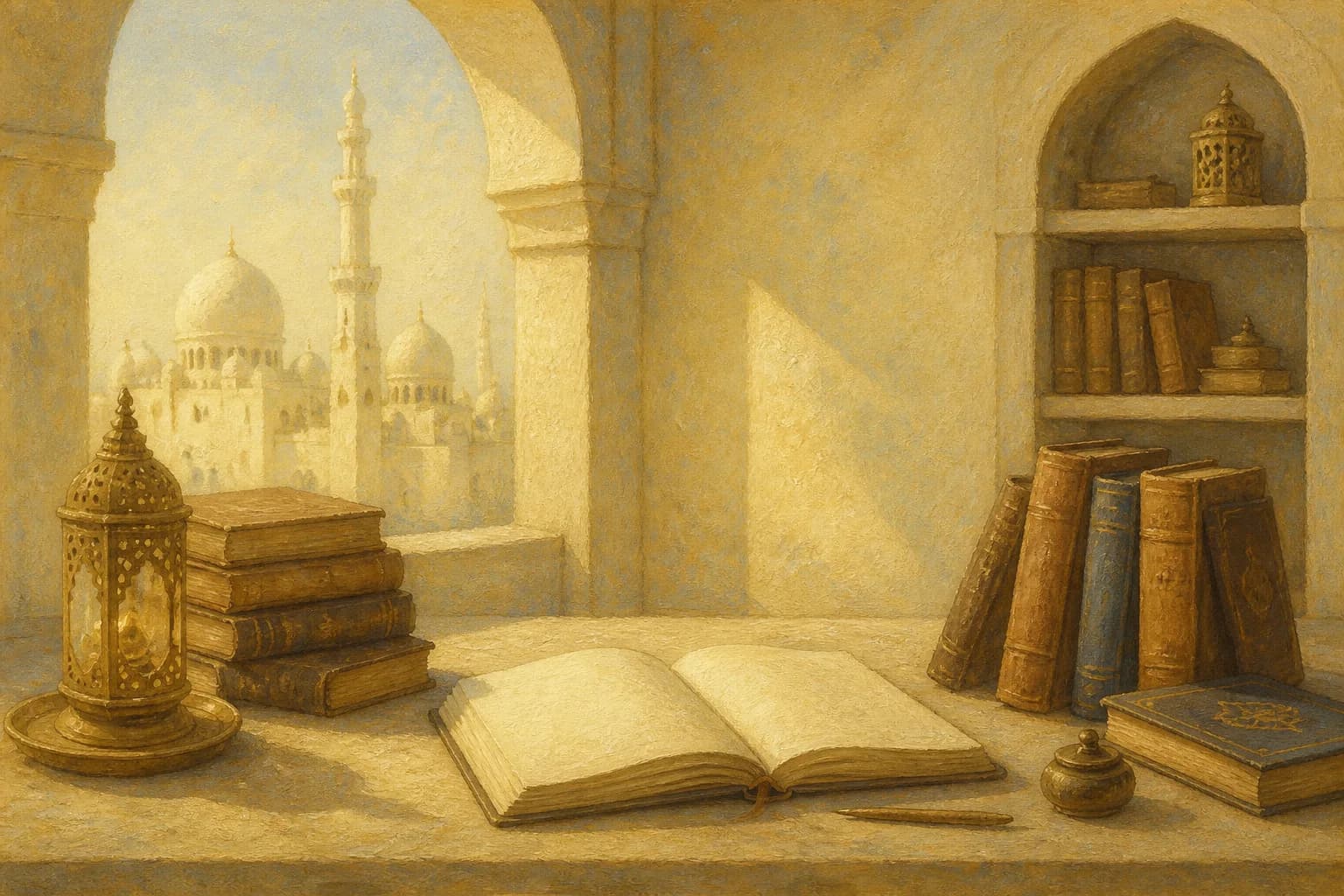

The Islamic Golden Age is most often remembered for algebra, optics, and medicine — the scientific breakthroughs that entered European universities through Latin translations. But the civilization that produced those sciences also built something equally remarkable: a culture of extraordinary beauty, literary depth, and educational ambition rooted directly in the Quran.
The same scholars who calculated the circumference of the earth also wrote poetry. The same caliphs who funded medical research funded libraries. The architecture they raised still shapes how humans build sacred spaces today.
What Were the Cultural Achievements of the Islamic Golden Age?
The Islamic Golden Age (roughly 750-1258 CE / 2nd-7th century AH) produced cultural achievements across art, architecture, literature, and education. The Abbasid Caliphate funded the Bayt al-Hikma (House of Wisdom) in Baghdad — a library and translation center holding thousands of manuscripts. Al-Qarawiyyin university in Fez (859 CE) became the world's oldest continuously operating institution of higher learning. Arabic calligraphy was codified into classical scripts. Geometric art and architecture reached levels of technical sophistication unmatched in any contemporary civilization.
What Made Islamic Art Distinct?
Islamic visual culture developed two art forms with no equivalent elsewhere: calligraphy and geometric pattern.
Calligraphy (al-khatt al-arabi, الخط العربي) became the highest of the visual arts because it renders the words of the Quran in visual form. Where figural representation was restricted in religious contexts, the beauty of the Arabic letter became the medium for divine expression. During the Golden Age, six classical calligraphic scripts were codified — Naskh, Thuluth, Kufic, Nastaliq, Ruq'a, and Diwani — each with its own proportional rules and uses. A master calligrapher spent decades mastering a single script.
Geometric art (al-arabesque, الأرابيسك) emerged from Islamic mathematics and theology together. The infinite repeating patterns that tile mosques, madrasas, and palaces are not merely decorative — they carry a theological meaning: the infinite complexity of creation pointing toward the unity of the Creator. The mathematics behind these patterns (tessellations, symmetry groups) anticipates work that European mathematicians would not formalize until centuries later.
The Prophet ﷺ grounded this aesthetic culture in a theological principle: "Allah is beautiful and loves beauty." (Sahih Muslim 91) Ihsan (إحسان) — excellence and beauty in all acts — was not reserved for worship. It applied to the craftsman at his tile, the calligrapher at her reed pen, the architect at his drawing.
For a visual overview of how this art tradition developed, the Islamic art paintings guide traces major styles and their Quranic foundations.
What Architecture Did the Islamic Golden Age Produce?
Islamic architecture introduced forms and techniques that spread across the entire world:
- Muqarnas (مقرنصات): the geometric honeycomb vaulting system used in ceilings and portals — structurally elegant and visually overwhelming
- The pointed arch: used in Islamic structures centuries before European Gothic cathedrals adopted it
- Elaborate tilework: geometric mosaics (zillij) covering entire walls and floors with mathematical precision
- The hypostyle hall: vast columned prayer halls such as the Great Mosque of Cordoba (784 CE)
The Great Mosque of Cordoba, the Alhambra palace (13th-14th century CE), and the Süleymaniye Mosque in Istanbul are three surviving monuments that give a direct sense of this tradition's scale and refinement. The Taj Mahal — built in Mughal India in the 17th century — carries the Golden Age architectural vocabulary forward by several centuries.
What Literature Did the Islamic Golden Age Produce?
The Islamic Golden Age was also a literary civilization. The Abbasid court at Baghdad was a center of poetic patronage, and caliphs competed to attract the finest poets.
Al-Mutanabbi (915-965 CE) is widely considered the greatest classical Arabic poet. His diwan (collected poems) is still memorized and quoted across the Arab world. He wrote with a linguistic precision and psychological depth that defined the classical Arabic literary standard.
One Thousand and One Nights (Alf Laylah wa-Laylah, ألف ليلة وليلة) was compiled and expanded largely during the Abbasid period, drawing on Persian, Indian, and Arabic sources. It became one of the most influential narrative collections in world literature — its frame story, characters, and tales appearing in Western literature through the 20th century.
Arabic also developed as a world language of scholarship during this era. The translation movement at the House of Wisdom rendered Greek, Syriac, Persian, and Sanskrit texts into Arabic — not merely preserving them but integrating them into a living intellectual culture that then produced new advances.
The Quran itself grounds this literary culture:
إِنَّا أَنزَلْنَاهُ قُرْآنًا عَرَبِيًّا لَّعَلَّكُمْ تَعْقِلُونَ
"Indeed, We have sent it down as an Arabic Quran so that you may understand." (Surah Yusuf, 12:2 — quran.com/12/2)
The Arabic language was not incidental to the Golden Age cultural achievement. It was the medium through which the Quran arrived, and that gave it a sacred status that made literary excellence a form of devotion.
What Institutions Did Islamic Culture Build?
| Institution | Location | Founded | Significance |
|---|---|---|---|
| Bayt al-Hikma (House of Wisdom) | Baghdad | c. 830 CE | Major library, translation center, intellectual hub |
| Al-Qarawiyyin (جامعة القرويين) | Fez, Morocco | 859 CE | World's oldest continuously operating university |
| Al-Azhar (الأزهر) | Cairo, Egypt | 970 CE | Oldest Islamic university still active as a center of scholarship |
| Dar al-Hikmah | Cairo, Egypt | 1004 CE | Fatimid library holding over 100,000 manuscripts |
| Great Library of Cordoba | Cordoba, Spain | 10th century CE | Reported 400,000+ volumes; largest library in medieval Europe |
The founding of Al-Qarawiyyin by Fatima al-Fihri, a Muslim woman, in 859 CE deserves particular note. The world's oldest university was established not by a king or a caliph but by a woman of faith acting on the Quranic mandate to seek knowledge — a fact as important as any scientific discovery of the era.
Still searching for a clear Islamic answer?
Explore sourced answers rooted in the Quran, authentic hadith, and respected scholarship—without getting lost in conflicting search results.
Take the Islam Quiz
Why Do These Cultural Achievements Matter for Muslims Today?
Understanding the cultural achievements of the Golden Age is not nostalgia — it is an inheritance that reframes how a Muslim approaches their work.
The craftsmen who laid Islamic geometric tiles were not expressing artistic ego. They were embodying ihsan — the command to do everything with excellence because Allah sees it. The calligraphers who spent decades perfecting a script were serving the Quran's words. The scholars at the House of Wisdom who translated Greek texts were answering the Quranic command:
اقْرَأْ بِاسْمِ رَبِّكَ الَّذِي خَلَقَ
"Read in the name of your Lord who created." (Surah Al-Alaq, 96:1 — quran.com/96/1-5)
Every Muslim who pursues their craft — writing, design, teaching, building — with care and precision is in continuity with that tradition.
The Arab Golden Age guide traces how this cultural flowering developed across different regions, and the Muslim Golden Age inventions covers the technological dimension that paralleled the cultural achievements here.
The DeenBack article on living the Islamic intellectual tradition and the Demimanifest piece on Islamic heritage and modern purpose both connect this history to practical life today.
Closing: Beauty as an Act of Worship
The cultural achievements of the Islamic Golden Age were not separate from religious life — they were an expression of it. When al-Mutanabbi composed a perfect line of Arabic poetry, when Fatima al-Fihri endowed a university, when a craftsman placed a tile in its exact position within a geometric pattern that had been calculated for months — all of it was ibadah.
The same Quran that commands prayer commands excellence. The same Prophet ﷺ who established salah taught that Allah loves beauty. The Golden Age took those commands seriously and built a civilization around them.
That inheritance belongs to every Muslim alive today.
Still searching for a clear Islamic answer?
Explore sourced answers rooted in the Quran, authentic hadith, and respected scholarship—without getting lost in conflicting search results.
Take the Islam QuizFrequently Asked Questions
What were the main cultural achievements of the Islamic Golden Age?
The Islamic Golden Age (750-1258 CE) produced calligraphy as the highest visual art form, geometric and arabesque patterns that transformed architecture, the House of Wisdom library and translation center in Baghdad (c. 830 CE), Al-Qarawiyyin university in Fez (859 CE), classical Arabic poetry, and One Thousand and One Nights — a literary collection that shaped world storytelling.
Why is calligraphy considered the highest art form in Islam?
Calligraphy holds the highest place in Islamic art because it renders the words of the Quran in visual form. Since figural representation was traditionally restricted in religious contexts, Arabic calligraphy became the primary medium for expressing divine beauty. Six classical scripts — Naskh, Thuluth, Kufic, Nastaliq, Ruq'a, and Diwani — were codified during the Golden Age.
What role did the House of Wisdom play in Islamic culture?
The Bayt al-Hikma (House of Wisdom) in Baghdad, established under Caliph Harun al-Rashid and expanded by al-Ma'mun (c. 830 CE), was the intellectual heart of the Islamic Golden Age. It housed thousands of manuscripts, employed translators and scholars from multiple traditions, and produced the Arabic translations that preserved Greek knowledge and enabled new Islamic advances.
What famous literature came from the Islamic Golden Age?
The Islamic Golden Age produced al-Mutanabbi's celebrated Arabic poetry (10th century CE), considered the pinnacle of classical Arabic verse. It also produced One Thousand and One Nights (Alf Laylah wa-Laylah), compiled largely during the Abbasid period. The period's literary culture was supported by the court patronage of caliphs who prized poets and scholars equally.
How did Islamic architecture influence world building?
Islamic architecture introduced muqarnas (geometric honeycomb vaulting), pointed arches, and elaborate tilework that influenced European Gothic architecture, Spanish colonial building, and Mughal monuments like the Taj Mahal. The Great Mosque of Cordoba (784 CE), the Alhambra palace (13th-14th century CE), and the Blue Mosque in Istanbul demonstrate the scale and refinement of this tradition.
What was the first university in the Islamic world?
Al-Qarawiyyin (جامعة القرويين) in Fez, Morocco, founded in 859 CE by Fatima al-Fihri, is recognized as the world's oldest continuously operating university. Al-Azhar in Cairo, founded in 970 CE, followed as a major center of Islamic scholarship. Both emerged from the Golden Age culture that saw learning as a religious obligation rooted in the Quran.
How do Islamic cultural achievements connect to the Quran?
Islamic cultural achievements are directly rooted in two Quranic principles: the command to read and seek knowledge (Surah Al-Alaq, 96:1) and the concept of ihsan — excellence and beauty in all things, based on the Prophet's ﷺ teaching that "Allah is beautiful and loves beauty" (Sahih Muslim 91). These drove calligraphy, architecture, poetry, and learning as forms of worship.