

- Authors

- Name
- Ahmad
- Role
- Senior Marketing Manager, Islamic education • DeenUp
بِسْمِ اللهِ الرَّحْمٰنِ الرَّحِيْمِ
In the name of God, the Most Gracious, the Most Merciful.
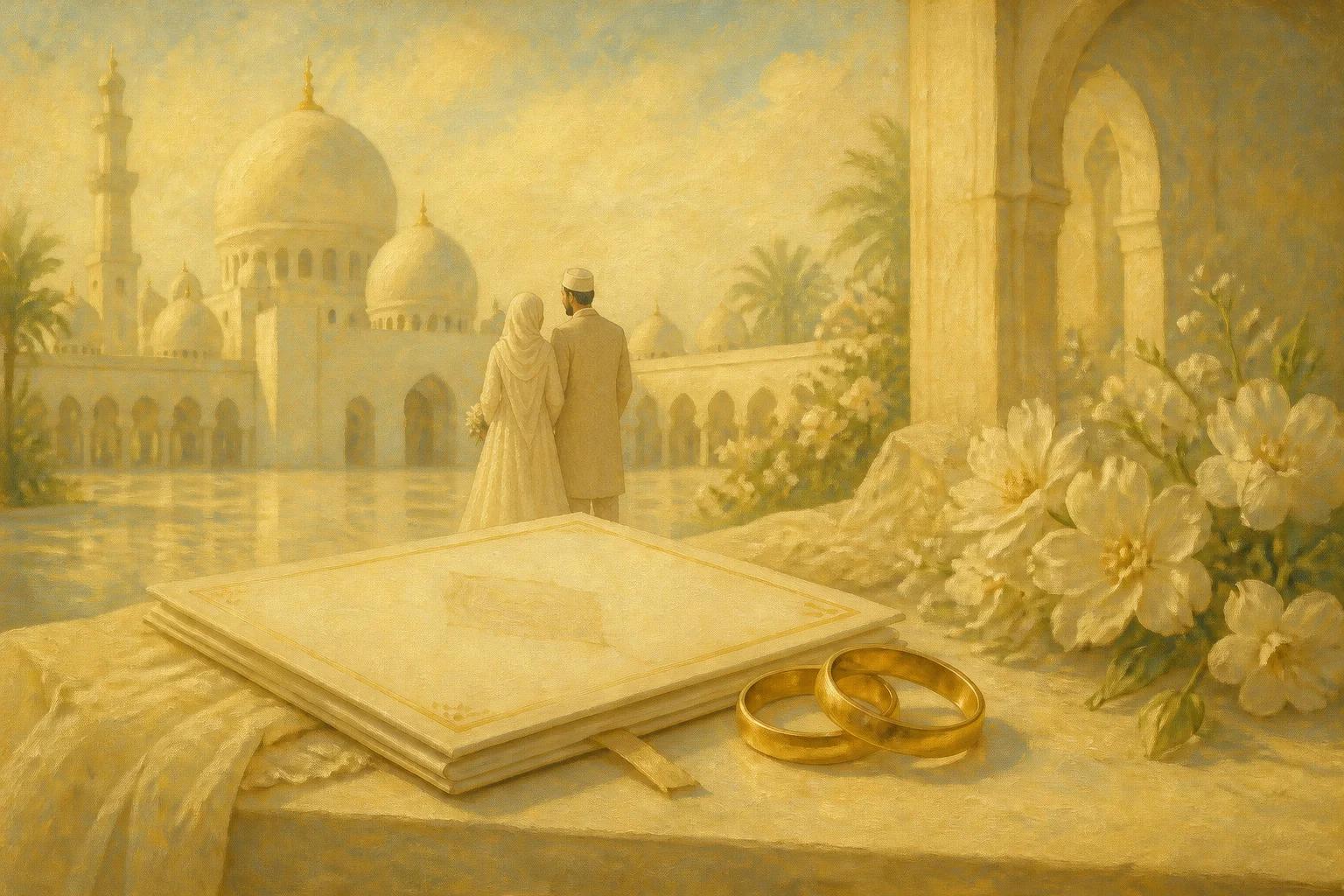
Marriage in Islam is not just a social custom or a legal formality — it is an act of worship. The Quran calls it a mithaqan ghalizha — a solemn covenant (Surah An-Nisa, 4:21). Understanding the Islamic marriage contract means understanding not just the legal mechanics, but the spiritual weight that the nikah carries.
What Is the Islamic Marriage Contract?
The Islamic marriage contract, aqd al-nikah (عقد النكاح), is a binding agreement between a man and woman that makes their union lawful under Islamic law. It is simultaneously a spiritual covenant, a legal contract, and an act of sunnah. The Quran describes it as a "solemn covenant" in Surah An-Nisa (4:21) — the same word used for the covenant Allah took from the prophets. It requires a formal offer and acceptance, a mahr (bridal gift), two witnesses, and in most legal schools, a wali (guardian) for the bride. Without these elements, the marriage is not Islamically valid regardless of what a civil court may recognize.
Your personal 28-Day Deen Plan
Learn your deen in 28 days, 5 minutes a day
The essentials of salah, fiqh and faith, step by step from authentic sources. Finish all 28 days and earn a verifiable Certificate of Completion.
Take the free quizAnswer a few questions and get your personal plan.

The Five Pillars of a Valid Nikah
Classical Islamic jurisprudence identifies five essential conditions for a valid marriage contract:
| Pillar | What It Means | Notes |
|---|---|---|
| Offer and acceptance (ijab wa qubul) | A clear verbal or written proposal and acceptance in the same sitting | Must be unambiguous; modern written contracts with signatures are accepted by most scholars |
| Mahr | A gift of money, gold, or property given to the bride | Obligatory; becomes her sole property |
| Two witnesses | Two adult, sane Muslim witnesses present at the contract | Hanafi accepts two men or one man and two women; some require two men |
| Wali (guardian) | The bride's guardian gives formal consent | Required in Maliki, Shafi'i, Hanbali schools; Hanafi allows the woman to contract herself |
| No legal impediment | Neither party is in a prohibited relationship | No blood relation, no existing prohibited marriage, no iddat period |
Understanding whether all five pillars are present is essential before concluding a nikah. For the broader spiritual dimension of why marriage matters in Islam, see the importance of marriage in Islam.
What Is Mahr and How Is It Determined?
The mahr (مهر) is the bridal gift — an obligatory payment to the wife that is her right alone. Allah says:
وَآتُوا النِّسَاءَ صَدُقَاتِهِنَّ نِحْلَةً
"And give the women their mahr as a gift." — (Surah An-Nisa, 4:4)
The Prophet ﷺ emphasized that the mahr need not be large:
اِلْتَمِسْ وَلَوْ خَاتَمًا مِنْ حَدِيدٍ
"Seek [a mahr], even if it is an iron ring." — (Sahih al-Bukhari 5121)
Key rules about mahr:
- It must be agreed before or at the time of the nikah
- It becomes the wife's exclusive property — the husband cannot take it back without her consent
- It can be paid immediately (mahr muajjal) or deferred to a future date (mahr mu'ajjal)
- If the marriage ends in divorce before consummation, the wife receives half the mahr; she keeps the full amount after consummation
The mahr is not a price for the bride — it is a symbol of the husband's commitment and a financial protection for the wife. Many scholars today encourage a meaningful mahr that provides genuine security.
The Wali: Why a Guardian Matters
The wali is the bride's guardian who formally consents to the marriage on her behalf. The Prophet ﷺ said:
لَا نِكَاحَ إِلَّا بِوَلِيٍّ
"There is no nikah except with a wali." — (Abu Dawud 2085, Ibn Majah 1881)
This hadith is the basis for the wali requirement in Maliki, Shafi'i, and Hanbali schools. The Hanafi school takes a different position: a mature, sane woman may contract her own marriage, though the presence of a wali remains strongly recommended.
The order of wali is: father → paternal grandfather → brother → paternal uncle → paternal cousin, in descending order. If no wali is available or if the wali is preventing a valid marriage without just cause, an Islamic judge (qadi) can serve as wali.
The wali is a protector, not a barrier. His role is to ensure the marriage is beneficial for the bride — if he refuses without valid grounds, he is in the wrong.
Customizing the Contract: Lawful Stipulations
One of the most empowering — and often underused — aspects of the nikah is the right of either party to add lawful conditions to the contract. The Prophet ﷺ taught:
إِنَّ أَحَقَّ الشُّرُوطِ أَنْ تُوفُوا بِهِ مَا اسْتَحْلَلْتُمْ بِهِ الْفُرُوجَ
"The conditions most deserving of fulfillment are those through which intimacy was made lawful to you." — (Sahih al-Bukhari 5151)
This hadith means that conditions agreed at the time of nikah have the highest claim on fulfillment in Islamic law. Common stipulations include:
- The wife's right to initiate divorce (tafwid al-talaq) — transferring the right to divorce to the wife
- The right to continue education or employment
- Geographic restrictions — agreement to live in a specific city or country
- Prohibition of polygamy without her consent
- Financial arrangements beyond the standard nafaqa (maintenance)
Any condition that does not violate Islamic law is binding. If the husband later breaks a lawful condition, the wife has the right to seek dissolution of the marriage. This is not a modern addition — it is an established right in classical fiqh, reinforced by the hadith above.
If you are preparing for marriage and want to think through your deen goals together, take the free DeenUp quiz — it helps you identify where your Islamic practice stands and what to build next.
Rights Created by the Marriage Contract
The nikah establishes a framework of mutual rights:
The husband owes the wife:
- Mahr — the agreed bridal gift
- Nafaqa — financial maintenance: food, clothing, housing appropriate to his means
- Kind, equitable treatment — Allah says "live with them in kindness" (Surah An-Nisa, 4:19)
- Fulfillment of her intimate rights
The wife owes the husband:
- Respect and cooperation in managing the household
- Fidelity and protection of his honor
- Fulfillment of his intimate rights within Islamic bounds
These rights are covered in depth in the rights of the husband in Islam and the rights of the wife in Islam. For the hadith specifically on spousal rights, see hadith about marriage.
Islamic Marriage Contract vs. Civil Marriage
A civil marriage ceremony — a courthouse signing or a civil registrar ceremony — does not fulfill the requirements of the Islamic nikah. The nikah requires offer and acceptance in front of witnesses, mahr, and in most schools a wali. Many Muslims in Western countries hold both a civil ceremony and a separate nikah to satisfy both legal and religious requirements.
Scholars strongly recommend registering the Islamic marriage with the civil authorities as well, to protect both parties' legal rights — especially the wife's rights to inheritance, maintenance enforcement, and civil divorce. The Islamic nikah and the civil contract can and should coexist.
For the customs and spiritual meaning around the marriage ceremony itself, see Muslim wedding traditions and what is walimah in Islam.
For further practical guidance on navigating marriage in accordance with Islamic values, DeenBack's resources on marriage duas offer helpful duas for every stage of the marriage journey, and DemiManifest's guide to Islamic marriage habits covers building a spiritually grounded marriage.
A Dua for a Blessed Marriage
The sunnah dua for a new couple is:
بَارَكَ اللهُ لَكَ وَبَارَكَ عَلَيْكَ وَجَمَعَ بَيْنَكُمَا فِي خَيْرٍ
"May Allah bless you, and bless upon you, and join you both in goodness." — (Abu Dawud 2130, authenticated by al-Albani)
Reciting this dua for a couple at their nikah is sunnah. For a full collection of duas for marriage, see dua for marriage.
Your personal 28-Day Deen Plan
Learn your deen in 28 days, 5 minutes a day
The essentials of salah, fiqh and faith, step by step from authentic sources. Finish all 28 days and earn a verifiable Certificate of Completion.
Take the free quizAnswer a few questions and get your personal plan.
Frequently Asked Questions
What is the Islamic marriage contract?
The Islamic marriage contract, called nikah, is a binding verbal and written agreement between a man and woman that makes their union lawful in Islam. It requires a formal offer and acceptance, the mahr (bridal gift), two witnesses, and — in most schools — a wali (guardian) for the bride. The Quran calls it a solemn covenant (Surah An-Nisa, 4:21).
What are the pillars of a valid Islamic marriage contract?
The main pillars are: a formal offer and acceptance (ijab wa qubul) spoken in the same sitting; the mahr paid or promised to the bride; two adult Muslim witnesses; a wali (guardian) for the bride — required in Maliki, Shafi'i, and Hanbali schools; and no legal impediment such as a blood relationship or existing prohibited marriage.
What is mahr in an Islamic marriage contract?
Mahr is the bridal gift — a payment of money, gold, or any agreed-upon item given exclusively to the wife as her right. It is obligatory and must be agreed before or at the time of the nikah. The Prophet said to seek a mahr even if it is an iron ring (Sahih al-Bukhari 5121). It becomes the wife's property alone and cannot be taken back without her consent.
Can a Muslim woman add conditions to the marriage contract?
Yes. Both parties can add lawful stipulations to the nikah contract, and fulfilling them is obligatory. Common conditions women add include: the right to continue working, the right to initiate divorce (tafwid al-talaq), a specific city of residence, and no second marriage. The Prophet said the conditions most deserving of fulfillment are those through which marriage was made lawful (Sahih al-Bukhari 5151).
Is a civil marriage ceremony sufficient in Islam?
A civil ceremony alone does not fulfill the requirements of an Islamic nikah. The nikah requires offer and acceptance, witnesses, and mahr according to Islamic law. Many Muslims hold both a civil ceremony and a separate nikah to satisfy both legal and religious requirements. The nikah itself is the Islamically valid contract.
What is the role of the wali in an Islamic marriage contract?
The wali is the bride's guardian — typically her father, then paternal grandfather, then other male relatives — who formally gives consent in the nikah. The Maliki, Shafi'i, and Hanbali schools require the wali's presence for the contract to be valid. The Hanafi school allows a mature woman to contract her own marriage, though a wali's presence is still strongly recommended.
What rights does the Islamic marriage contract create?
The nikah creates mutual rights and responsibilities. The husband owes the wife: mahr, financial maintenance (nafaqa), kind treatment, and fulfillment of her rights. The wife owes the husband: respect, care of the household, and fidelity. Both have rights over each other in intimacy. These rights are enshrined in Surah An-Nisa (4:19) and reinforced by the final sermon of the Prophet.