

- Authors

- Name
- Ahmad
- Role
- Senior Marketing Manager, Islamic education • DeenUp
بِسْمِ اللهِ الرَّحْمٰنِ الرَّحِيْمِ
In the name of God, the Most Gracious, the Most Merciful.
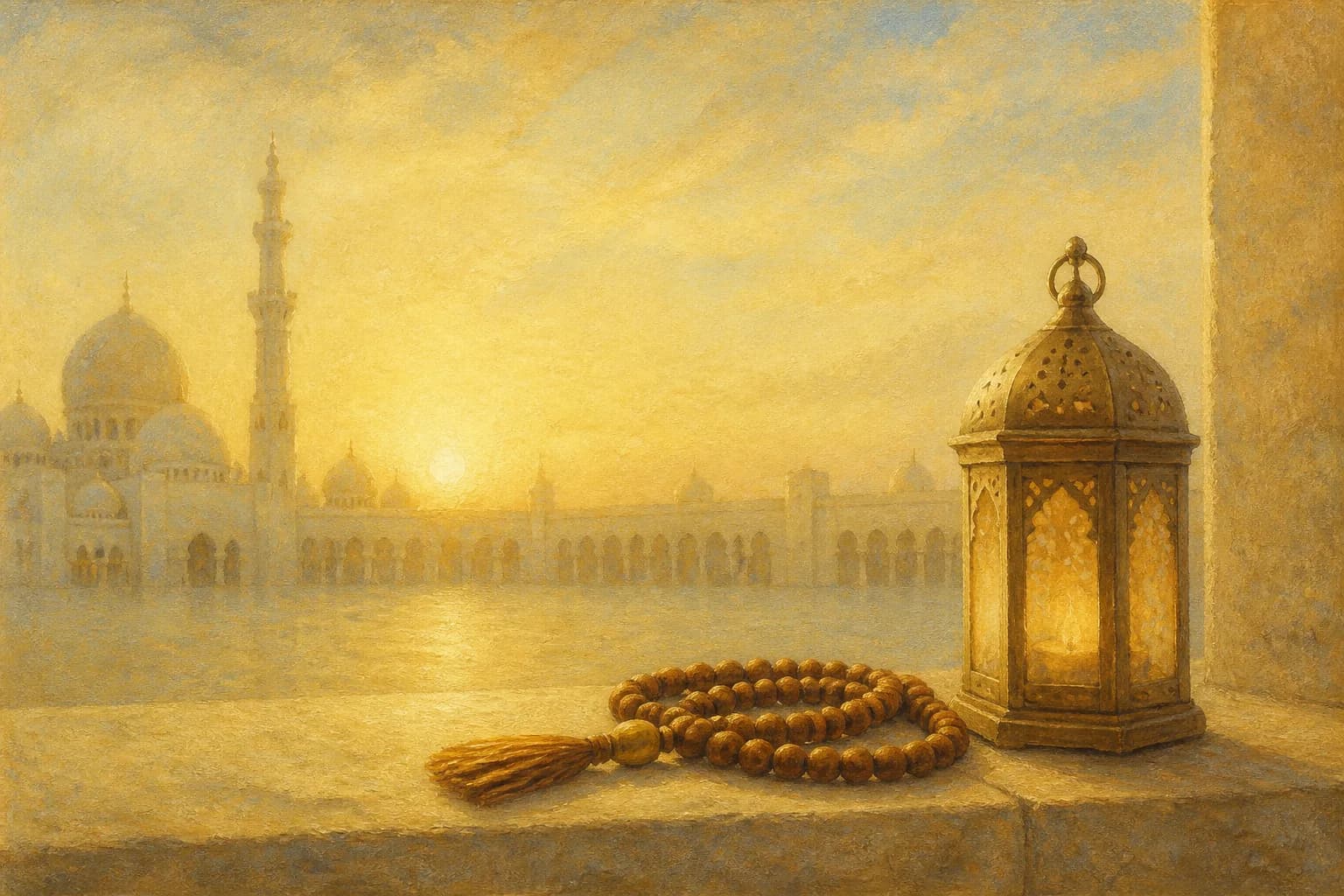

Most mornings start reactively — the alarm, the phone, the first task of the day. Islamic tradition offers a different entry point: a collection of authenticated supplications that frame the morning as a gift from Allah and orient the heart before the world rushes in.
These are the adhkar al-sabah (أذكار الصباح — morning remembrances), transmitted from the Prophet ﷺ through centuries of daily use. The Arabic word for morning supplication carries within it the understanding that every new day is not routine continuation but a renewed act of divine mercy.
What is the morning supplication in Islam?
The morning supplication in Islam refers to a collection of authenticated duas and dhikr recited after Fajr prayer, during the period from dawn until the sun rises. The central morning supplication is: Allāhumma bika aṣbaḥnā wa bika amsaynā wa bika naḥyā wa bika namūtu wa ilayka-n-nushūr — "O Allah, by You we enter the morning, by You we enter the evening, by You we live, by You we die, and to You is the resurrection" (Abu Dawud 5068). It is a declaration of tawḥīd (oneness of Allah) built into the first moments of the day, answering the implicit question every new morning raises: whose day is this?
The Central Morning Supplication
The Prophet ﷺ taught a supplication for the morning and a corresponding one for the evening, establishing the practice of bookending each day with remembrance of Allah.
اللَّهُمَّ بِكَ أَصْبَحْنَا، وَبِكَ أَمْسَيْنَا، وَبِكَ نَحْيَا، وَبِكَ نَمُوتُ، وَإِلَيْكَ النُّشُورُ
Allāhumma bika aṣbaḥnā wa bika amsaynā wa bika naḥyā wa bika namūtu wa ilayka-n-nushūr
"O Allah, by You we enter the morning, by You we enter the evening, by You we live, by You we die, and to You is the resurrection." — (Abu Dawud 5068)
When to recite it: Upon waking, before engaging with anything else. This is not only a prayer — it is an acknowledgment that the morning, the evening, life itself, and its ending all belong to Allah.
A second key morning supplication is recited immediately upon waking from sleep:
الْحَمْدُ لِلَّهِ الَّذِي أَحْيَانَا بَعْدَ مَا أَمَاتَنَا وَإِلَيْهِ النُّشُورُ
Alḥamdulillāhilladhī aḥyānā ba'da mā amātanā wa ilayhin-nushūr
"All praise is for Allah who gave us life after having taken it from us, and unto Him is the resurrection." — (Sahih al-Bukhari 6312)
The word amātanā — "having taken it from us" — treats sleep as a form of minor death. The Prophet ﷺ taught this supplication as a way of experiencing each morning not as automatic continuation but as a deliberate gift. Reciting it while still in bed, before the day has taken hold, reframes everything that follows.
The Prophetic Practice of Morning Remembrance
The Prophet ﷺ described the morning dhikr as a form of daily protection. He said: "Whoever recites the morning adhkar will be in the protection of Allah until evening" (Abu Dawud 5074). This is an invitation to seek that protection actively — not a passive guarantee, but a practice that opens the day under divine care.
The Companions understood this as a communal norm, not a private devotion. The morning supplication set was modeled openly and transmitted carefully. The full collection preserved in hadith books at sunnah.com (Abu Dawud 5068) shows the detail with which the Prophet ﷺ taught these words.
The Quran also links morning remembrance to spiritual health. Allah says: "And remember your Lord much, and exalt Him in the evening and the morning" (Surah Al-Imran, 3:41). The pairing of evening and morning in this verse reflects the Islamic understanding that spiritual maintenance requires consistent timing — regular remembrance at the two transitions of each day, as documented at quran.com/3/41.
For context on why consistent dhikr matters beyond the morning, see our guide on the importance of dhikr in daily life.
How to Build a Morning Supplication Routine
The full set of adhkar al-sabah takes five to ten minutes when recited at a natural pace. Here is a practical entry-point structure for building the habit:
Step 1 — Upon waking, before picking up your phone: Recite Alḥamdulillāhilladhī aḥyānā ba'da mā amātanā (Sahih al-Bukhari 6312). One sentence, before anything else, reframes the morning.
Step 2 — After Fajr prayer: Recite the central morning supplication (Abu Dawud 5068) and then Ayat al-Kursi (Surah Al-Baqarah, 2:255). The Prophet ﷺ said that whoever recites Ayat al-Kursi after each obligatory prayer will be in the protection of Allah until the next prayer (Nasai, al-Sunan al-Kubra 9928).
Step 3 — The morning tasbih sequence: Recite SubḥānAllāh 33 times, Alḥamdulillāh 33 times, and Allāhu Akbar 34 times. This is the sequence the Prophet ﷺ described as praise that fills the space between the heavens and the earth (Sahih Muslim 597).
Step 4 — Dua for protection: Recite A'ūdhu bi-kalimātillāhit-tāmmāti min sharri mā khalaq — "I seek refuge in the perfect words of Allah from the evil of what He has created" — three times (Sahih Muslim 2708).
These four steps take roughly five minutes and cover the core of what the Prophet ﷺ taught. Consistency over time matters more than length; even one authenticated supplication recited daily with presence of heart is more valuable than a rushed full set.
For the complete Arabic text of morning adhkar in Islam and the specific compilation of adhkar al-sabah, our dedicated guides provide the full authenticated set. For the practical side of waking for Fajr as the anchor for morning supplication, see how to wake up for Fajr and the spiritual benefits of Fajr prayer.
For additional frameworks around building morning Islamic habits, DeenBack's Fajr morning routine guide and DemiManifest's reflection on adhkar al-sabah offer complementary perspectives.
Do you feel your duas are unanswered?
Have you read the dua properly? Learn authentic duas, understand their meanings, and call upon Allah with greater confidence through DeenUp.
Take the Dua Quiz
Morning Supplications at a Glance
| Supplication | When to Recite | Source |
|---|---|---|
| Waking dua (Alhamdulillah alladhi ahyana) | Immediately on waking | Sahih al-Bukhari 6312 |
| Morning supplication (Allahumma bika asbahna) | After waking, before the day begins | Abu Dawud 5068 |
| Ayat al-Kursi | After Fajr prayer | Nasai, al-Sunan al-Kubra 9928 |
| Morning tasbih (33 SubhanAllah + 33 Alhamdulillah + 34 Allahu Akbar) | After Fajr | Sahih Muslim 597 |
| Protection dua (A'udhu bi-kalimatiLlah) | Three times, morning | Sahih Muslim 2708 |
| Sayyid al-Istighfar (master forgiveness dua) | Morning and evening | Sahih al-Bukhari 6306 |
A Feed Worth Scrolling
Swipe through short, scholar-approved Islamic lessons instead of mindless doom-scrolling.
Learn Through Play
Bite-sized lessons, quizzes, levels, and daily streaks make growing your Deen a habit.
Scholar-Approved
Every lesson is rooted in the Quran and authentic Sunnah and reviewed by qualified scholars.
What if You Miss the Morning Supplication?
The morning supplications are sunnah mu'akkadah — a confirmed, consistently practiced sunnah — not fard (obligatory). Missing them does not invalidate your prayer or require qada (making up). If you miss the morning adhkar, pick up the evening adhkar at their time and recommit the next morning.
The Prophet ﷺ was gentle with the ummah about supererogatory practices. Consistency over many months matters more than perfection in any single day. A person who recites one morning supplication sincerely every day for a year has built something more lasting than one who completes the full set sporadically.
For the full morning and evening practice together, our guide on morning and evening adhkar covers both sets in detail.
The Morning That Belongs to Allah
The morning supplication is not a ritual that earns credit and then releases you into a secular day. It is a reorientation — a few minutes that establish whose morning this is before anything else claims it.
Reciting Allāhumma bika aṣbaḥnā each day is not complicated. It is not long. It asks only that you stop, for the length of a sentence, and acknowledge where the morning came from. That acknowledgment — held daily, built into the first moments of consciousness — is what the Prophet ﷺ modeled as the foundation of a connected life.
Do you feel your duas are unanswered?
Have you read the dua properly? Learn authentic duas, understand their meanings, and call upon Allah with greater confidence through DeenUp.
Take the Dua QuizFrequently Asked Questions
What is the morning supplication in Islam?
The central morning supplication is "Allahumma bika asbahna wa bika amsayna wa bika nahya wa bika namutu wa ilayka-n-nushur" — "O Allah, by You we enter the morning, by You we enter the evening, by You we live, by You we die, and to You is the resurrection" (Abu Dawud 5068). It is recited after waking, before engaging with the day, and affirms that the new morning belongs entirely to Allah.
What is the first dua to recite after waking up in Islam?
The first dua after waking is "Alhamdulillahilladhi ahyana ba'da ma amatana wa ilayhin-nushur" — "All praise is for Allah who gave us life after having taken it from us, and unto Him is the resurrection" (Sahih al-Bukhari 6312). The phrase after having taken it refers to sleep as a form of minor death, making each morning a renewed gift from Allah.
When is the morning supplication period in Islam?
The morning supplication period runs from Fajr (dawn) until the sun rises fully — approximately 90 minutes depending on season and location. Supplications recited after Fajr prayer and before sunrise are the classical adhkar al-sabah. Some scholars extend the window to include the post-sunrise duha time.
Can women recite morning supplications during menstruation?
Yes. Morning supplications are dhikr (remembrance), not Quranic recitation for prayer. Women may recite all authentic morning adhkar during menstruation. The authenticated morning duas transmitted as hadith are not affected by the restrictions on formal Quranic recitation that apply during this period.
How long do the morning supplications take?
The core morning supplications — waking dua, central morning supplication, Ayat al-Kursi, morning tasbih sequence, and protection dua — take three to five minutes. The full set of adhkar al-sabah takes five to ten minutes. Building from one or two supplications and adding gradually is the recommended approach for lasting consistency.
What is the difference between morning adhkar and morning supplication?
Both terms describe the same practice. Adhkar (أذكار) is the Arabic plural of dhikr (remembrance) and includes both prescribed phrases and direct duas. Morning supplication is the English equivalent used by those unfamiliar with Arabic terminology. The authenticated morning set includes dhikr phrases, Quranic verses, and direct supplications.
Is it sunnah to recite morning supplications aloud or silently?
The authenticated morning supplications may be recited aloud or silently — no specific prescription exists for volume. Most scholars recommend a low voice or silent recitation to maintain focus and sincerity. The presence of heart matters more than volume; morning supplication should feel like genuine address to Allah, not mechanical recitation.