

- Authors

- Name
- Ahmad
- Role
- Senior Marketing Manager, Islamic education • DeenUp
بِسْمِ اللهِ الرَّحْمٰنِ الرَّحِيْمِ
In the name of God, the Most Gracious, the Most Merciful.
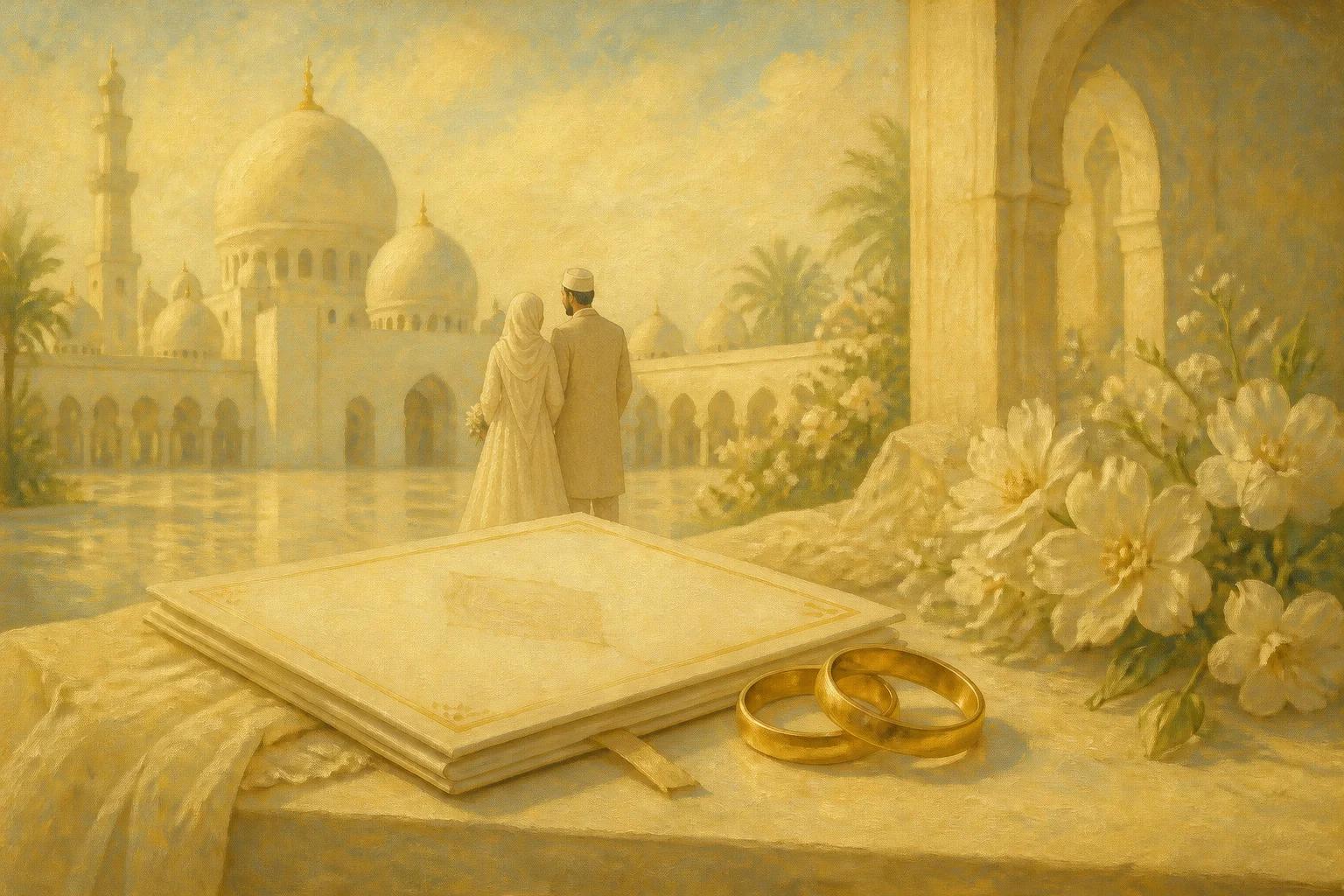
Marriage in Islam carries a weight the Quran makes unmistakable. It calls it mithaqan ghalizha — a solemn covenant (Surah An-Nisa, 4:21). That phrase is used only twice in the entire Quran: once for the covenant Allah took with the Prophets, and once for marriage.
That framing matters. Understanding Muslim marriage rules is not just about legal correctness — it is about building a relationship on the foundation Allah designed for it.
Take the free DeenUp quiz to explore how Islamic values can guide your most important relationships and daily habits.
What Are the Rules for Muslim Marriage?
Muslim marriage rules — ahkam al-nikah — govern who may marry whom, what a valid marriage contract requires, and what obligations each spouse holds. A valid nikah requires offer and acceptance (ijab wa qabul), two Muslim witnesses, the bride's guardian (wali) according to the majority of scholars, and payment or agreement of a mahr (bridal gift). Both spouses must give free, informed consent.
Your personal 28-Day Deen Plan
Learn your deen in 28 days, 5 minutes a day
The essentials of salah, fiqh and faith, step by step from authentic sources. Finish all 28 days and earn a verifiable Certificate of Completion.
Take the free quizAnswer a few questions and get your personal plan.

The Core Conditions of a Valid Nikah
A nikah rests on several conditions that the majority of scholars treat as non-negotiable. Missing any one of them renders the marriage legally void in Islamic jurisprudence.
Offer and Acceptance
The groom or his representative makes an offer (ijab), and the bride or her representative accepts (qabul). Both must occur in the same session, in clear language that both parties understand.
Two Muslim Witnesses
At least two adult Muslim witnesses of sound mind must be present. The Quran establishes the principle of witnessing important agreements in Surah Al-Baqarah (2:282), and scholarly consensus applies it to marriage.
The Wali (Guardian)
The Prophet ﷺ said:
لَا نِكَاحَ إِلَّا بِوَلِيٍّ
"There is no marriage without a guardian (wali)." — (Abu Dawud 2085, graded hasan sahih by al-Albani)
The Shafi'i, Maliki, and Hanbali schools treat the wali — usually the father — as a condition of validity. The Hanafi school permits a mature woman to contract her own marriage without a wali. This is a genuine difference among the major legal schools; if you are unsure which applies to your situation, consult a knowledgeable scholar.
The Mahr
وَآتُوا النِّسَاءَ صَدُقَاتِهِنَّ نِحْلَةً
"Give women their bridal gifts (mahr) as a free gift." — (Surah An-Nisa, 4:4)
Mahr is the groom's mandatory gift to the bride. It becomes her exclusive property upon the marriage contract and cannot be taken back without her consent. There is no Quranic minimum — the Prophet ﷺ accepted iron rings and the teaching of Quran verses as mahr in authentic narrations (Sahih Bukhari 5121).
Muslim Marriage Rules at a Glance
| Condition | Requirement | Scholarly Basis |
|---|---|---|
| Offer and acceptance | Verbal or written, same session | Scholarly consensus |
| Two witnesses | Adult, Muslim, sound mind | Majority ruling |
| Wali (guardian) | Required by Shafi'i/Maliki/Hanbali | Abu Dawud 2085 |
| Mahr | Mandatory; amount agreed by both | Quran 4:4 |
| Consent | Free and informed from both parties | Quran 4:19 |
| No prohibited relations | No mahram or existing iddah | Quran 4:22–24 |
Who Can Muslims Marry?
Surah Al-Baqarah (2:221) establishes the core principle:
وَلَا تَنكِحُوا الْمُشْرِكَاتِ حَتَّىٰ يُؤْمِنَّ
"Do not marry polytheist women until they believe." — (Surah Al-Baqarah, 2:221)
Muslim men may marry Muslim women, or chaste Jewish or Christian women — this permission appears in Surah Al-Maidah (5:5). Many scholars note that such marriages often carry practical challenges around raising children in Islam, and encourage careful reflection before proceeding.
Muslim women may only marry Muslim men. This ruling is based on Surah Al-Mumtahanah (60:10) and scholarly consensus.
Prohibited marriages include marrying a blood relative within the mahram degrees (mother, sister, daughter, aunt), a foster-mother or foster-sister, a woman currently within her iddah waiting period, and a woman whose husband is still living.
Rights and Responsibilities in an Islamic Marriage
Islam frames marriage not as the ownership of one person by another, but as a covenant of mutual rights and responsibilities. The Quran states this symmetry plainly:
وَلَهُنَّ مِثْلُ الَّذِي عَلَيْهِنَّ بِالْمَعْرُوفِ
"Women have rights similar to those over them, in kindness." — (Surah Al-Baqarah, 2:228)
The husband is obligated to:
- Provide financial maintenance (nafaqa): food, housing, and clothing appropriate to his means
- Treat his wife with kindness — the Prophet ﷺ said, "The best of you is the one who is best to his family" (Sahih al-Tirmidhi 3895)
- Pay her mahr in full as agreed
- Not prevent her from maintaining family ties
The wife is obligated to:
- Guard the household and her husband's trust
- Cooperate in building a home based on mutual respect
- Fulfill the marital right of intimacy, as her husband must equally fulfill hers
For a detailed look at what the Islamic marriage contract covers, see our guide on the Islamic marriage contract. The importance of marriage in Islam covers the deeper spiritual purpose behind these rules.
Divorce Provisions in Islam
Marriage in Islam is designed to be stable. But the Quran permits divorce precisely because forcing people to remain in harmful or broken situations contradicts the mercy Allah has built into every ruling.
The standard divorce process (talaq) begins with the husband pronouncing talaq once. An iddah waiting period of three menstrual cycles follows, during which reconciliation is encouraged and the divorce can be revoked. If the iddah passes without reconciliation, the divorce becomes final.
A woman who wants to end the marriage may seek khul — she returns the mahr and the husband agrees to release her. If a husband refuses, Islamic jurisprudence provides for judicial dissolution through the judge or an Islamic arbitration body.
For the full breakdown of grounds, process, and scholarly positions, see our detailed article on divorce in Islam.
Building a Marriage on a Strong Foundation
The Prophet ﷺ described a righteous spouse as among the best of this world's provisions (Sahih Muslim 1467). That framing places marriage squarely in the domain of worship — not just social arrangement.
A marriage that begins with correct Islamic foundations is better positioned to weather the pressures of modern life. Reading the hadith about marriage gives you the Prophet's own descriptions of what a good marriage looks and feels like. Making regular supplication — including the dua for marriage — keeps the relationship anchored in reliance on Allah.
The Quran's description of spouses as garments for one another (Surah Al-Baqarah, 2:187) is not incidental. Each covers the other's weaknesses, keeps each other warm, and is closest to each other's body. That is the Islamic template.
For Muslim couples wanting to deepen their shared faith, Yaqeen Institute publishes excellent scholarly pieces on marriage and family at yaqeeninstitute.org. DeenBack's guide on the foundations of an Islamic marriage offers practical frameworks for building together, and Demi Manifest's piece on choosing a spouse in Islam covers the spiritual dimensions of the selection process.
Ready to build your faith for every dimension of life — including marriage? Take the free DeenUp quiz and get a personalized Islamic practice plan.
Your personal 28-Day Deen Plan
Learn your deen in 28 days, 5 minutes a day
The essentials of salah, fiqh and faith, step by step from authentic sources. Finish all 28 days and earn a verifiable Certificate of Completion.
Take the free quizAnswer a few questions and get your personal plan.
Frequently Asked Questions
What are the essential conditions for a valid Muslim marriage?
A valid Muslim marriage (nikah) requires an offer and acceptance, two Muslim witnesses, the bride's guardian (wali) according to the majority view, the payment or agreement of a mahr (bridal gift), and free informed consent from both parties. Without these conditions, the nikah is not considered valid in Islamic law.
Is a wali (guardian) required for a Muslim marriage?
According to the Shafi'i, Maliki, and Hanbali schools, a wali (male guardian, usually the father) is required for a woman's marriage to be valid. The Hanafi school allows a mature woman to contract her own marriage. The Prophet said there is no marriage without a guardian (Abu Dawud 2085), though this narration is applied differently across schools.
What is mahr in an Islamic marriage?
Mahr is a mandatory bridal gift from the groom to the bride, commanded in the Quran (4:4). It becomes the wife's exclusive property upon marriage and cannot be taken back without her consent. There is no prescribed minimum or maximum — the Prophet accepted iron rings and Quran teaching as mahr in authentic narrations (Sahih Bukhari 5121).
Can a Muslim man marry a non-Muslim woman?
According to scholarly consensus, a Muslim man may marry a chaste Jewish or Christian woman (Ahl al-Kitab) based on Surah Al-Maidah (5:5). He may not marry a polytheist or atheist. A Muslim woman, by scholarly consensus, may only marry a Muslim man. These rules are drawn from Surah Al-Baqarah (2:221) and Surah Al-Mumtahanah (60:10).
What financial rights does a wife have in an Islamic marriage?
A wife in an Islamic marriage has the right to her full mahr, ongoing financial maintenance (nafaqa) including housing, food, and clothing appropriate to the husband's means, and to keep her own wealth and income entirely for herself. These rights are established in the Quran (4:4, 4:34) and cannot be waived by the husband.
Is a civil marriage legally recognized in Islam?
A civil marriage performed without the Islamic conditions — offer, acceptance, two witnesses, and mahr — does not constitute a valid nikah according to Islamic law, even if legally binding in the country. Muslims are encouraged to have both a civil ceremony and a valid Islamic marriage contract (nikah) to satisfy both legal and religious requirements.
What is the Islamic process for divorce?
Islamic divorce (talaq) is initiated by the husband with one pronouncement, after which a waiting period (iddah) of three menstrual cycles applies. During iddah, reconciliation is encouraged and divorce can be revoked. A woman may seek divorce through khul by returning her mahr. Pronouncing triple talaq in one sitting is considered a grave error by many scholars.