

- Authors

- Name
- Ahmad
- Role
- Senior Marketing Manager, Islamic education • DeenUp
بِسْمِ اللهِ الرَّحْمٰنِ الرَّحِيْمِ
In the name of God, the Most Gracious, the Most Merciful.
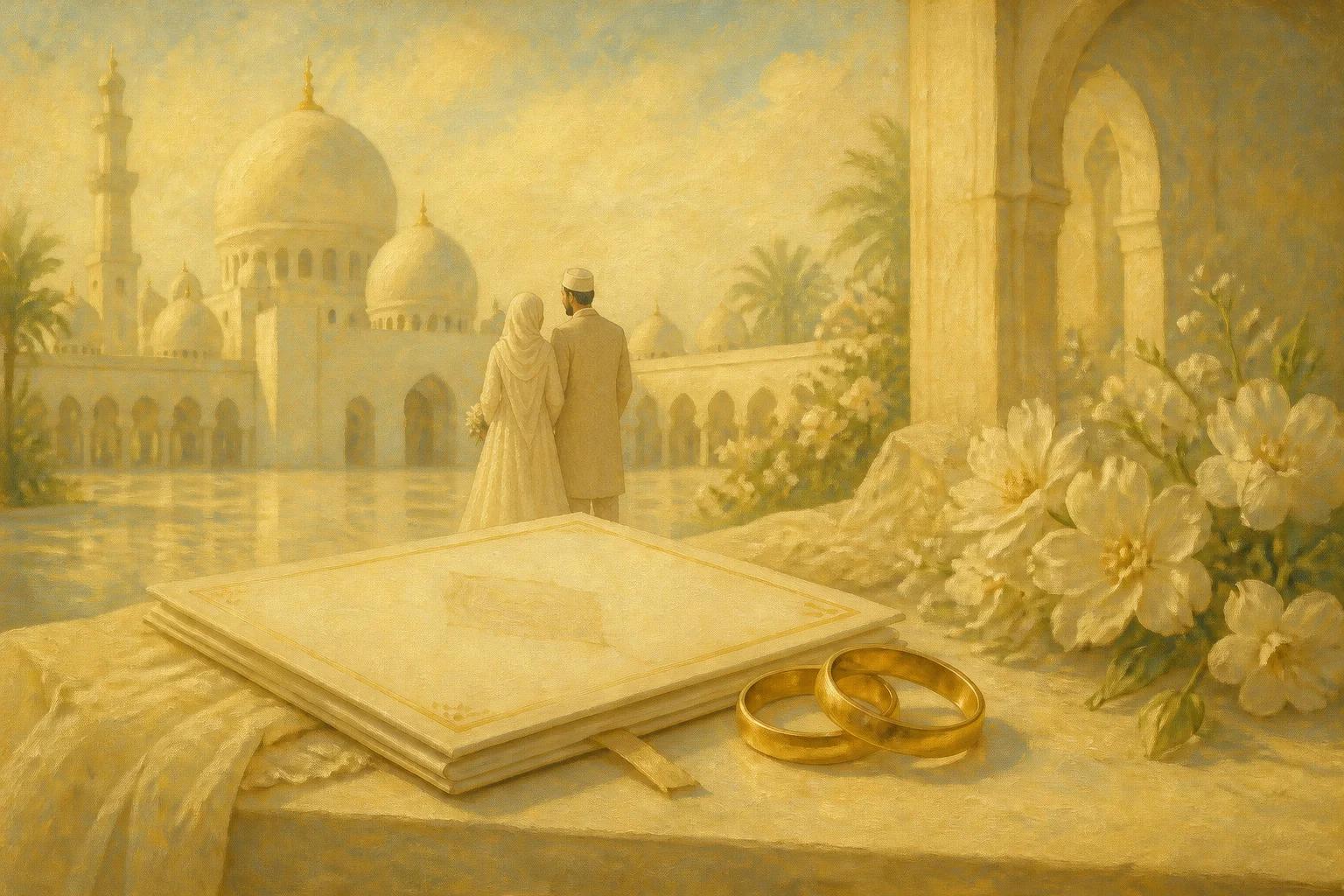
Marriage in Islam is not simply a social arrangement. It is an act of worship, a commitment witnessed by Allah, and the beginning of a household built on Quranic values. For Muslim couples, the nikah ceremony is the moment this covenant becomes real. Yet many people approach it with uncertainty: What exactly must happen? Who needs to be present? What words are spoken? This guide walks through every essential element so you can approach your nikah — or help a loved one prepare for theirs — with clarity and confidence.
Take the free DeenUp quiz to explore the Islamic foundations that strengthen a marriage before and after the nikah.
What Is the Nikah Ceremony?
The nikah is the Islamic marriage contract — a verbal agreement between a man and woman, witnessed publicly, that creates the legal and spiritual bond of marriage in Islam. The Quran calls it a mithaq ghaleez — مِيثَاقًا غَلِيظًا — a "firm covenant" (Surah An-Nisa, 4:21), the same term used for the covenant between Allah and the Prophets. It is not merely paperwork; it is a declaration before Allah, family, and community that two people are committing to one another.
The Essential Pillars of a Valid Nikah
Scholars across all four Sunni madhabs agree on the core requirements, though they differ on some details. The table below shows the essential and recommended elements:
| Element | Arabic | Status | Key Detail |
|---|---|---|---|
| Offer & Acceptance | إِيجَابٌ وَقَبُولٌ | Required (all schools) | Must occur in one sitting |
| Bride's Guardian | وَلِيٌّ | Required (majority) | Father or appointed male guardian |
| Two Witnesses | شُهُودٌ | Required (all schools) | Must hear the offer and acceptance |
| Mahr (Dowry) | مَهْرٌ | Required | Bride's exclusive right; flexible amount |
| Nikah Sermon | خُطْبَةُ النِّكَاح | Recommended | Three Quranic verses recited before contract |
| Walimah (Feast) | وَلِيمَةٌ | Strong sunnah | Wedding feast within three days |
The Islamic marriage contract details what should be included in the written agreement, while Muslim marriage rules covers the full range of conditions and prohibitions.
How the Nikah Ceremony Unfolds
Opening: Khutbat al-Nikah
A nikah typically begins with a short sermon — the khutbat al-nikah — delivered by the officiating imam or scholar. It includes three Quranic verses: Surah An-Nisa (4:1), Surah Al-Imran (3:102), and Surah Al-Ahzab (33:70–71). These verses remind both spouses and witnesses that this covenant is rooted in taqwa (God-consciousness) and responsibility.
The Offer and Acceptance
The core of the nikah is the offer (ijab) and acceptance (qabul). The wali says something to the effect of: "I give my daughter [Name] in marriage to you for a mahr of [amount]." The groom responds: "I accept her in marriage." Both must happen in a single sitting, and the words must be clear and explicit. Neither party can be coerced.
The Mahr
The mahr — مَهْرٌ — is the gift the groom gives exclusively to the bride. It is not a bride price paid to her family; it belongs entirely to her. The Prophet ﷺ said: "Give women their mahr as a free gift" (Surah An-Nisa, 4:4). The mahr can be paid in full at the time of the nikah, deferred, or split. It can be money, jewelry, or even something intangible — one companion's mahr was his teaching his new wife the Quran.
Two Witnesses
Two adult Muslim men of sound mind must witness the offer and acceptance. They must be present and attentive — not simply nearby. Without witnesses, the nikah is considered invalid by unanimous scholarly agreement.
Your personal 28-Day Deen Plan
Learn your deen in 28 days, 5 minutes a day
The essentials of salah, fiqh and faith, step by step from authentic sources. Finish all 28 days and earn a verifiable Certificate of Completion.
Take the free quizAnswer a few questions and get your personal plan.
Duas for the Nikah Ceremony
The most well-known dua recited at a nikah is:
بَارَكَ اللَّهُ لَكُمَا وَبَارَكَ عَلَيْكُمَا وَجَمَعَ بَيْنَكُمَا فِي خَيْرٍ
Baaraka Allahu lakumaa wa barakaa alaykumaa wa jamaa baynakumaa fee khayr
"May Allah bless you both, shower blessings upon you both, and bring you together in goodness." — (Sunan Abu Dawud 2130, Jami al-Tirmidhi 1091 — graded hasan sahih)
Those attending the ceremony say this dua for the couple. It is also the Prophet's ﷺ sunnah dua upon hearing of a marriage.
On the wedding night, the groom is encouraged to place his hand on his wife's forehead and recite:
اللَّهُمَّ إِنِّي أَسْأَلُكَ خَيْرَهَا وَخَيْرَ مَا جَبَلْتَهَا عَلَيْهِ وَأَعُوذُ بِكَ مِنْ شَرِّهَا وَشَرِّ مَا جَبَلْتَهَا عَلَيْهِ
"O Allah, I ask You for her goodness and the goodness You have created in her nature, and I seek Your protection from her evil and the evil You have created in her nature." — (Sunan Abu Dawud 2160)
The Walimah: Celebrating the Union
After the nikah, the groom is strongly encouraged to host a walimah — وَلِيمَةٌ — a wedding feast to announce and celebrate the marriage publicly. The Prophet ﷺ said: "Announce the marriage and beat the drum" (Sunan Ibn Majah 1895), and the walimah is a collective celebration of the community's new family. The walimah in Islam has its own detailed rulings, but the key point is that it should be held within three days of the nikah.
Deenback has a thoughtful piece on preparing spiritually for Islamic marriage that covers the inner readiness both spouses should cultivate. For a broader reflection on building a marriage on Islamic foundations, Demimanifest offers a spiritual guide to marriage in Islam.
Why the Nikah Matters for Modern Muslim Couples
Scholars at Yaqeen Institute note that the nikah ceremony frames marriage not as a romantic transaction but as a ibadah — an act of worship. This framing shapes the entire relationship: disagreements become occasions for patience, service to a spouse is rewarded, and the home becomes a space of sakeenah (tranquility) described in Surah Ar-Rum, 30:21.
The rights of a husband in Islam and the rights of a wife in Islam both flow from this understanding — each spouse has divinely ordained responsibilities that the nikah activates.
For more on the broader context of an Islamic marriage and its traditions, see Muslim wedding traditions and the Muslim marriage rules guide.
The nikah is also authenticated through civil registration in most countries. See your local Islamic authority or imam for guidance on how to ensure your nikah meets both religious and legal requirements in your jurisdiction.
Building a Marriage on Daily Islamic Practice
A nikah is a beginning, not an endpoint. The duas, the mahr, the witnesses — they establish the covenant. What sustains it is daily practice: dhikr together, shared salah, honest communication rooted in Islamic values, and consistent renewal of the intention behind the marriage.
Take the free DeenUp quiz to find out how well-prepared you are for the Islamic responsibilities of marriage, and build a personalized plan for your daily deen.
Your personal 28-Day Deen Plan
Learn your deen in 28 days, 5 minutes a day
The essentials of salah, fiqh and faith, step by step from authentic sources. Finish all 28 days and earn a verifiable Certificate of Completion.
Take the free quizAnswer a few questions and get your personal plan.
Frequently Asked Questions
What is the nikah ceremony in Islam?
The nikah is the Islamic marriage contract, completed through a verbal offer (ijab) and acceptance (qabul) in the presence of a wali and two witnesses. It is a solemn covenant the Quran calls a 'firm covenant' (Quran 4:21) — not just a legal arrangement but a spiritual bond before Allah.
What are the required pillars of a valid nikah?
A valid nikah requires four elements: an offer and acceptance (ijab wa qabul) in one sitting, a wali (the bride's guardian) according to the majority view, two male witnesses, and an agreed mahr (dowry) for the bride. Without these elements, most scholars consider the marriage invalid.
Can a nikah be performed without a wali?
According to the Shafii, Maliki, and Hanbali schools, a wali is required for a valid nikah. The Hanafi school permits a woman to contract her own marriage. The Prophet said: 'There is no nikah except with a wali' (Sunan Abu Dawud 2085, graded sahih by al-Albani).
What is the dua said at the nikah ceremony?
The sunnah dua at a nikah is: Baaraka Allahu lakuma wa barakaa alaykuma wa jamaa baynakuma fee khayr — 'May Allah bless you both, pour blessings upon you both, and bring you together in goodness.' This dua is recorded in Sunan Abu Dawud 2130 and Jami al-Tirmidhi 1091.
How much should the mahr (dowry) be in a nikah?
The mahr is the bride's exclusive right and can be any agreed amount — money, gold, property, or even a service such as teaching her the Quran. There is no Quranic minimum, though scholars recommend a meaningful amount. The mahr becomes the bride's sole property at the moment the nikah is contracted.
Is a civil marriage required alongside the nikah?
The nikah fulfills the Islamic religious obligation for marriage. In many countries, a separate civil registration is also required to establish legal rights such as inheritance, medical decisions, and child custody. Muslims typically perform the nikah and then complete civil registration to secure both Islamic and legal standing.
Can the nikah be performed outside a mosque?
Yes — the nikah has no requirement to be held in a mosque, though mosques are common and are considered a blessing. It can be performed at a home, community hall, or any dignified setting. What matters are the essential elements: the offer, acceptance, wali, witnesses, and mahr — not the venue.