

- Authors

- Name
- Ahmad
- Role
- Senior Marketing Manager, Islamic education • DeenUp
بِسْمِ اللهِ الرَّحْمٰنِ الرَّحِيْمِ
In the name of God, the Most Gracious, the Most Merciful.
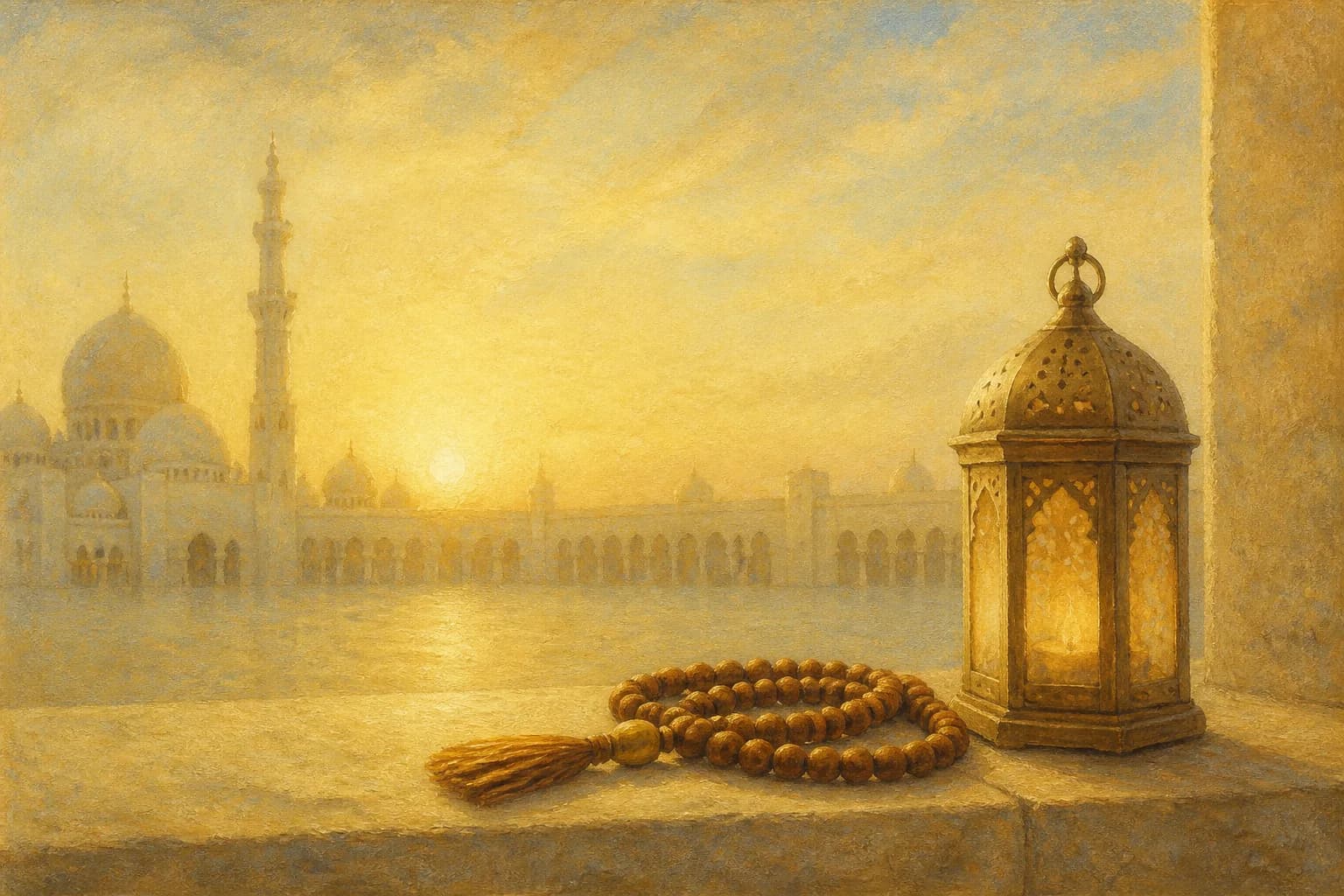

There is a conversation you can have with Allah at any moment — while waiting, while walking, while lying down before sleep. It does not require wudu or a prayer mat. All it requires is your tongue and your heart. That conversation is dhikr: the remembrance of Allah through the praise He taught us in the Quran and through the Prophet ﷺ.
What Does "Praising Allah in Arabic" Mean?
Praising Allah in Arabic refers to the practice of dhikr — remembering Allah through specific revealed phrases. These are not just spiritual expressions; they are words the Prophet ﷺ taught with precise instructions on when, how many times, and what reward they carry. The Quran commands: "O you who believe, remember Allah with much remembrance and exalt Him morning and afternoon." (Surah Al-Ahzab, 33:41-42)
The Core Arabic Phrases for Praising Allah
There are five foundational phrases that every Muslim should know. Each carries a distinct meaning and is used in slightly different contexts:
| Arabic Phrase | Transliteration | Meaning | Category |
|---|---|---|---|
| سُبْحَانَ اللَّهِ | SubhanAllah | Glory be to Allah | Tasbih (glorification) |
| الْحَمْدُ لِلَّهِ | Alhamdulillah | All praise is for Allah | Tahmid (praise) |
| اللَّهُ أَكْبَرُ | Allahu Akbar | Allah is the Greatest | Takbir (magnification) |
| لَا إِلَهَ إِلَّا اللَّهُ | La ilaha illallah | There is no god but Allah | Tahlil (declaration) |
| أَسْتَغْفِرُ اللَّهَ | Astaghfirullah | I seek forgiveness from Allah | Istighfar (seeking forgiveness) |
These phrases appear throughout the Quran and hadith literature. They form the backbone of both the obligatory prayers and the voluntary remembrance that surrounds them throughout the day.
For a deep dive into the meaning of individual phrases, see our guides on what SubhanAllah means and what Alhamdulillah means.
What the Quran and Sunnah Say About Praising Allah
The command to praise Allah is not a footnote in Islamic teaching — it is woven throughout revelation.
Allah tells the believers directly:
"So remember Me; I will remember you. And be grateful to Me and do not deny Me." — (Surah Al-Baqarah, 2:152)
This is a remarkable promise: when you praise and remember Allah, He remembers you. The Prophet ﷺ elaborated on this in a hadith qudsi: "I am as My servant thinks of Me, and I am with him when he remembers Me. If he remembers Me in himself, I remember him in Myself; if he remembers Me in a gathering, I remember him in a better gathering." (Sahih al-Bukhari 7405)
The Prophet ﷺ also taught that two phrases in particular are among the most beloved words to Allah and the heaviest on the scale of deeds, despite being light on the tongue:
سُبْحَانَ اللَّهِ وَبِحَمْدِهِ، سُبْحَانَ اللَّهِ الْعَظِيمِ
SubhanAllahi wa bihamdihi, SubhanAllahil-Azeem
"Glory be to Allah and His is the praise; glory be to Allah, the Most Great." — (Sahih Muslim 2694)
The consistent message across the Quran and Sunnah is that dhikr transforms the heart. "Verily, in the remembrance of Allah do hearts find rest." (Surah Ar-Ra'd, 13:28) For a broader understanding of why dhikr holds such a central place in Muslim life, see our article on the importance of dhikr.
When and How to Use Each Phrase in Daily Life
Knowing the phrases is only the beginning — the question is when to reach for them naturally:
SubhanAllah when you witness something beautiful or amazing — a sunset, the birth of a child, a moment of unexpected grace. It is the reflex of a heart that sees the creation and immediately turns to the Creator.
Alhamdulillah after every blessing — after a meal, after waking up, after receiving good news, after completing a task. The Prophet ﷺ would say Alhamdulillah after every action and state (Sunan Abu Dawud 5075). It frames the entire life as a gift.
Allahu Akbar at the start of every rakat of salah (the takbir), when things feel overwhelming — because saying "Allah is Greater" is a reminder that whatever you face is smaller than your Lord — and when you are grateful beyond words.
La ilaha illallah as the bedrock declaration of tawheed, woven through all dhikr. The Prophet ﷺ said the best thing he and the prophets before him ever said was "La ilaha illallah wahdahu la sharika lah" — there is no god but Allah alone, with no partner. (Muwatta Malik)
Astaghfirullah in moments of awareness of shortcoming, after sin, and abundantly in the mornings and evenings. The Prophet ﷺ would seek forgiveness more than seventy times a day (Sahih al-Bukhari 6307).
For the specific dhikr to recite after the five daily prayers, our guide on tasbih in Islam has the full post-prayer routine.
How to Build a Daily Habit of Praising Allah
The power of dhikr multiplies with consistency. The Prophet ﷺ said the most beloved deeds to Allah are those done consistently, even if small (Sahih al-Bukhari 6464). Here is a sustainable structure for making dhikr part of your day:
Morning and evening adhkar — a specific set of Quranic supplications and dhikr taught in the Sunnah for the morning (after Fajr) and evening (after Asr). These take 10-15 minutes and cover protection, gratitude, and glorification. See our full guide on morning adhkar in Islam.
Post-prayer tasbeeh — 33 times SubhanAllah, 33 times Alhamdulillah, and 34 times Allahu Akbar after every fard prayer. This single practice — done five times a day — brings the reward of having sins forgiven even if they are as numerous as the foam of the sea (Sahih Muslim 597).
Idle-moment dhikr — replacing unconscious scrolling or mental chatter with SubhanAllah and Alhamdulillah. The tongue can be busy with praise while the hands do other work. The Prophet ﷺ said: "The difference between a person who remembers his Lord and one who does not is like the difference between the living and the dead." (Sahih al-Bukhari 6407)
Resources at DeenBack and DemiManifest offer additional practical frameworks for building consistent dhikr around your daily prayers.

Keep learning your deen with short, sourced lessons in DeenUp.
A Feed Worth Scrolling
Swipe through short, scholar-approved Islamic lessons instead of mindless doom-scrolling.
Learn Through Play
Bite-sized lessons, quizzes, levels, and daily streaks make growing your Deen a habit.
Scholar-Approved
Every lesson is rooted in the Quran and authentic Sunnah and reviewed by qualified scholars.
Signs That Your Dhikr Is Taking Root
Progress in dhikr is subtle but real. You begin to notice:
- The phrases come without effort — your tongue moves to SubhanAllah before the thought is fully formed
- You reach for Alhamdulillah instinctively in good moments and difficult ones alike
- The space between prayers feels less empty because dhikr fills it
- Distressing thoughts settle faster, because your anchor is in Allah
This is the effect the Quran describes in Surah Ar-Ra'd (13:28): hearts finding rest in the remembrance of Allah. It is not an abstract promise — it is something you experience in your chest when the habit takes hold.
Explore the broader practice and its spiritual dimensions in our guide on the importance of dhikr, and for the authenticated Arabic phrases, Quran.com and Sunnah.com provide the primary source texts.
Keep learning your deen with short, sourced lessons in DeenUp.
Frequently Asked Questions
What does praising Allah in Arabic mean?
Praising Allah in Arabic refers to forms of dhikr — the remembrance of Allah through specific revealed phrases. The main categories are tasbih (glorification: SubhanAllah), tahmid (praise: Alhamdulillah), and takbir (magnification: Allahu Akbar). The Quran commands believers to remember Allah with much remembrance (Surah Al-Ahzab, 33:41).
What is the most common phrase for praising Allah in Arabic?
The most widely used phrase for praising Allah is SubhanAllah (سُبْحَانَ اللَّهِ) — Glory be to Allah. The Prophet Muhammad said SubhanAllah and Alhamdulillah are among the most beloved words to Allah and the heaviest on the scale of deeds on the Day of Judgment (Sahih Muslim 2694).
What is the difference between SubhanAllah, Alhamdulillah, and Allahu Akbar?
SubhanAllah (سُبْحَانَ اللَّهِ) declares that Allah is free from all imperfection — this is tasbih, glorification. Alhamdulillah (الْحَمْدُ لِلَّهِ) attributes all praise and gratitude to Allah — this is tahmid. Allahu Akbar (اللَّهُ أَكْبَرُ) affirms that Allah is greater than everything — this is takbir. Together they cover three dimensions of praising Allah.
When should I say SubhanAllah?
SubhanAllah is said when witnessing something that reflects the greatness or beauty of creation, on hearing good news, or any time you want to glorify Allah. After each fard prayer, the Sunnah is to say SubhanAllah 33 times as part of the post-prayer tasbeeh taught by the Prophet (Sahih al-Bukhari 843).
How many times should I say SubhanAllah, Alhamdulillah, and Allahu Akbar after prayer?
After each fard prayer, the Sunnah is to say SubhanAllah 33 times, Alhamdulillah 33 times, and Allahu Akbar 34 times — totalling 100. The Prophet taught that whoever does this after every prayer, their sins will be forgiven even if they are as numerous as the foam of the sea (Sahih Muslim 597).
What is the best dhikr for praising Allah throughout the day?
Many scholars consider the tasbih combination of SubhanAllah, Alhamdulillah, and Allahu Akbar to be among the best daily dhikr, especially the post-prayer count of 33-33-34. The phrase La ilaha illallah wahdahu la sharika lah is also among the most praised in authentic narrations for its weight in the scale.
Can I praise Allah in English instead of Arabic?
You can praise Allah in any language in personal dua and informal remembrance. However, the specific dhikr phrases taught in authentic hadith carry the most spiritual weight in their original Arabic form. Learning even just SubhanAllah, Alhamdulillah, and Allahu Akbar in Arabic is a small investment with enormous ongoing reward.