

- Authors

- Name
- Ahmad
- Role
- Senior Marketing Manager, Islamic education • DeenUp
بِسْمِ اللهِ الرَّحْمٰنِ الرَّحِيْمِ
In the name of God, the Most Gracious, the Most Merciful.
When people ask about the rules for women in Islam, they often carry a mix of genuine curiosity and exposure to competing narratives. The honest answer is that Islamic rules for women are both rights and obligations — a framework that recognizes the spiritual dignity, legal capacity, and social contributions of Muslim women. These rules come directly from the Quran and authentic Sunnah, and they look quite different from common misconceptions.
Understanding them fully helps every Muslim woman — and anyone curious about Islam — see the complete picture rather than a fragment of it.
What Are the Rules for Women in Islam?
In Islam, women have equal spiritual standing with men before Allah. The Quran grants women rights to own property, receive education, choose their marriage partner, and inherit. Muslim women observe the same five daily prayers as men, with exemptions during menstruation. The dress code — hijab — is rooted in Surah An-Nur (Quran 24:31). Overall, Islamic rules for women balance clearly defined spiritual obligations with equally clear legal rights.
Your personal 28-Day Deen Plan
Learn your deen in 28 days, 5 minutes a day
The essentials of salah, fiqh and faith, step by step from authentic sources. Finish all 28 days and earn a verifiable Certificate of Completion.
Take the free quizAnswer a few questions and get your personal plan.
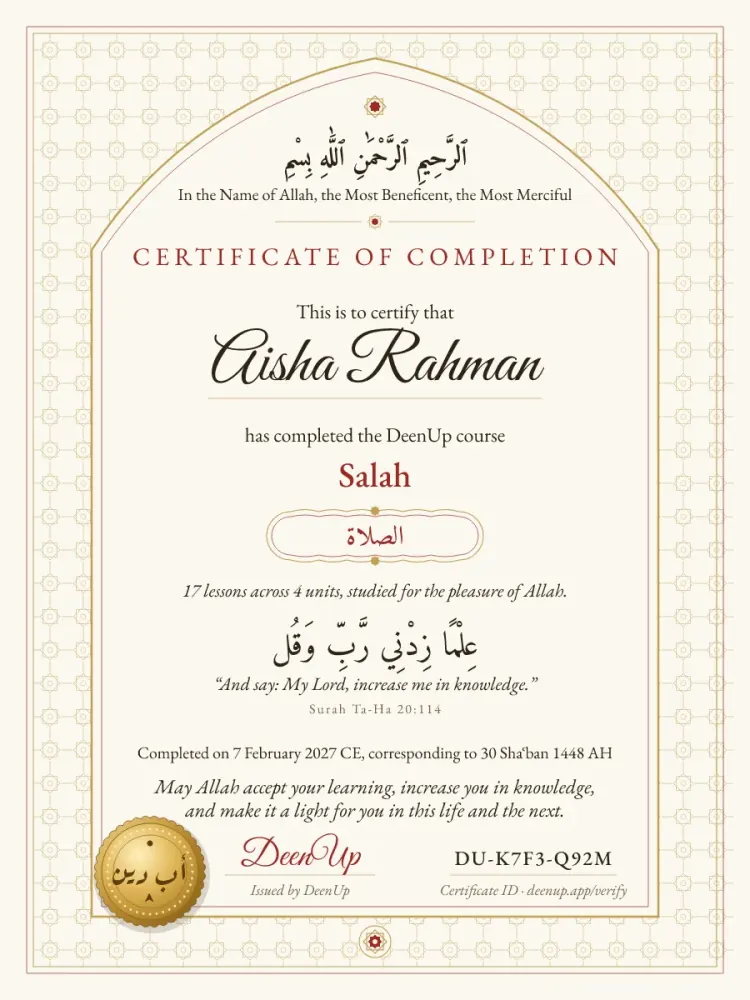
If you're unsure where to start strengthening your daily Islamic practice, take the free DeenUp quiz to get a personalized plan aligned with your faith goals.
Are Women Spiritually Equal to Men in Islam?
This is the foundation of everything else. The Quran answers it plainly:
إِنَّ الْمُسْلِمِينَ وَالْمُسْلِمَاتِ وَالْمُؤْمِنِينَ وَالْمُؤْمِنَاتِ...
"Indeed, the Muslim men and Muslim women, the believing men and believing women... for them Allah has prepared forgiveness and a great reward." — (Quran 33:35)
Every spiritual act — prayer, fasting, charity, remembrance — earns equal reward for men and women. The Quran also states: "And do not wish for that by which Allah has made some of you exceed others" (Quran 4:32), affirming that each person is rewarded for their own efforts.
This spiritual equality forms the basis from which all other rules extend.
What Rights Do Muslim Women Have?
Islamic law (fiqh) grants women a comprehensive set of rights that were, historically, far ahead of many contemporary legal systems:
| Area | Right | Key Reference |
|---|---|---|
| Spiritual status | Equal reward to men before Allah | Quran 33:35 |
| Education | Obligatory to seek knowledge | Hadith, Ibn Majah 224 |
| Property and wealth | Full right to own, earn, and invest | Quran 4:32 |
| Inheritance | Guaranteed fixed share | Quran 4:11 |
| Marriage consent | Cannot be married without consent | Sahih Muslim 1421 |
| Divorce (khul') | Can initiate separation | Quran 2:229 |
| Financial support | Husband is obligated to provide | Quran 4:34 |
A married Muslim woman keeps her own wealth entirely. Her husband has no legal claim over it. If she earns a salary, inherits property, or runs a business, that belongs solely to her — a legal protection enshrined in the Quran over 1,400 years ago.
What Are Women's Worship Obligations in Islam?
Muslim women observe the same five pillars as men, with some practical accommodations:
Prayer (Salah): Five daily prayers are obligatory — Fajr (2 rakahs), Dhuhr (4), Asr (4), Maghrib (3), Isha (4). Women pray the same prayers with identical recitations and movements. They are exempt during menstruation (hayd) and postpartum bleeding (nifas) — these prayers do not need to be made up afterward, unlike fasting.
Fasting (Sawm): Women fast during Ramadan and make up missed days later. Those who are pregnant, breastfeeding, or unwell may postpone fasting with an obligation to make up the days or pay fidyah if unable.
Zakat and Hajj: Both are obligatory when conditions are met — nisab threshold for zakat, and ability (physical, financial, and having a mahram for Hajj according to most scholars) for the pilgrimage.
Women are encouraged to offer voluntary prayers such as Tahajjud and Duha, attend the mosque, and join congregational worship — participation in communal religious life is a right, not just a permission.
Does Islam Require Women to Wear Hijab?
The majority scholarly position is that hijab is obligatory, based on two clear Quranic verses:
وَقُل لِّلْمُؤْمِنَاتِ يَغْضُضْنَ مِنْ أَبْصَارِهِنَّ وَيَحْفَظْنَ فُرُوجَهُنَّ وَلَا يُبْدِينَ زِينَتَهُنَّ...
"And tell the believing women to lower their gaze and guard their private parts and not expose their adornment..." — (Quran 24:31)
And Surah Al-Ahzab (33:59) instructs women to draw their outer garments close so they are recognized and not harassed.
Most scholars define hijab as covering the hair and body while leaving the face and hands visible, though the niqab (face covering) is considered obligatory by a minority view. The wisdom behind hijab is not restriction — it is protection of dignity and a visible affirmation of identity and modesty. You can read a deeper exploration in our guide to hijab in Islam.
Women in Marriage and Family
Islamic marriage law grants women specific, enforceable rights. For a full breakdown, see our article on the rights of a wife in Islam.
Before marriage: A woman must give free, informed consent. No guardian can force her into a marriage she opposes.
During marriage: The husband is obligated to provide financially (nafaqah). The wife's own wealth remains hers. Physical harm is prohibited by both Quranic injunction and unanimous scholarly opinion.
Ending a marriage: A woman may seek khul' (she initiates by returning the mahr) or faskh (court annulment for cause). The Prophet ﷺ himself granted women divorce when harm was established.
Women in Islamic history were not passive bystanders — they were scholars, traders, and community leaders. Women in Islamic history gives a fuller picture of their contributions.
How Can Muslim Women Deepen Their Practice?
Building a consistent Islamic practice is about small, sustainable steps:
- Morning and evening adhkar: Recite the morning supplications after Fajr and the evening ones after Asr or Maghrib. These protect and center the day.
- Daily Quran: Even five minutes of Quran with reflection is consistent practice. See our guide on modest dress in Islam for how outward practice connects to inner growth.
- Learning: The Prophet ﷺ said, "Seeking knowledge is an obligation upon every Muslim" (Ibn Majah 224) — this includes women equally. Use resources like our guide on Islamic marriage practices to deepen specific areas.
- Community: Attending lectures, women's circles, and the mosque all count as worship and contribute to spiritual growth.
Whether you're just beginning to understand your obligations or deepening an existing practice, the DeenUp quiz can help you identify what to focus on and build a plan that fits your life.
Your personal 28-Day Deen Plan
Learn your deen in 28 days, 5 minutes a day
The essentials of salah, fiqh and faith, step by step from authentic sources. Finish all 28 days and earn a verifiable Certificate of Completion.
Take the free quizAnswer a few questions and get your personal plan.
Frequently Asked Questions
What are the main rules for women in Islam?
Muslim women are obligated to pray five times daily, observe the hijab dress code from adulthood, fast during Ramadan, give zakat if eligible, and perform Hajj if able. Women also have the right to own property, receive an education, choose their husband, and keep their own earnings.
Do Muslim women pray the same prayers as men?
Muslim women pray the same five daily prayers as men — Fajr, Dhuhr, Asr, Maghrib, and Isha — with the same number of rakahs. Women are exempt from the Friday congregational Jumu'ah prayer, though they may attend, and are exempt from prayer during menstruation and postpartum bleeding.
Is hijab compulsory for Muslim women?
According to the majority of Islamic scholars, hijab is an obligation for Muslim women, based on Surah An-Nur (24:31) and Surah Al-Ahzab (33:59). It refers to modest dress that covers the hair and body, leaving the face and hands visible according to most schools of thought.
Do women have equal rights in Islam?
Islam grants women equal spiritual standing before Allah. Quran 33:35 explicitly lists women alongside men for every spiritual reward. Women have legal rights to own property, receive inheritance, choose marriage, and seek divorce. Family roles may differ, but spiritual accountability and reward are equal.
Can a Muslim woman refuse a marriage proposal?
Yes. A woman's consent is a legal requirement for a valid marriage contract in Islam. A marriage performed without her free consent is invalid under Islamic law. The Prophet Muhammad taught that a virgin's silence counts as consent, but a previously married woman must verbally agree.
What is a Muslim woman's right to divorce?
Muslim women can seek divorce through khul' (initiated by the wife, usually by returning the mahr) or faskh (judicial annulment). Scholars agree women cannot be trapped in a marriage; Islamic courts exist to facilitate dissolution when a marriage has irretrievably broken down.
Are women allowed to work in Islam?
Islam permits Muslim women to work in lawful professions. The Prophet's first wife Khadijah was a successful businesswoman. Islamic history includes prominent female scholars, traders, and educators. The main conditions are that the work does not involve anything prohibited and that family obligations are respected.