

- Authors

- Name
- Ahmad
- Role
- Senior Marketing Manager, Islamic education • DeenUp
بِسْمِ اللهِ الرَّحْمٰنِ الرَّحِيْمِ
In the name of God, the Most Gracious, the Most Merciful.
Why Mahr Is the First Right the Quran Gives a Bride
Before the nikah is solemnised, one financial obligation is already in place: the groom must give the bride a gift — مَهْر (mahr). Not her parents. Not the family. Her.
This is not custom. It is a Quranic command, repeated across multiple surahs, with precise rules about what happens to it in every situation — divorce before consummation, divorce after consummation, the husband's death, and the wife's right to waive it voluntarily. Mahr is one of the most concrete financial rights Islam establishes for women, and understanding it is essential for anyone approaching a Muslim marriage seriously.
Whether you are preparing for nikah, reviewing what your Islamic marriage contract should include, or studying Islamic marriage law, this guide covers everything: the definition, the Quranic foundation, the types, the amounts by school of thought, and your rights at every stage.
What Is Mahr in Islam?
Mahr (مَهْر) is the mandatory bridal gift a groom gives to his bride at the time of nikah. It is a divine right established in the Quran: "Give the women their bridal gifts willingly" (Surah An-Nisa, 4:4). Mahr belongs solely to the bride — not her family — and is a legally enforceable financial obligation. It has no maximum and a school-dependent minimum, and it remains a binding debt even if left unspecified at the time of the marriage contract.
What the Quran and Sunnah Say About Mahr
The obligation appears directly in Surah An-Nisa:
وَآتُوا النِّسَاءَ صَدُقَاتِهِنَّ نِحْلَةً
Wa aatuu an-nisaa'a saduqaatihinna nihlatan
"And give the women their bridal gifts willingly." — (Surah An-Nisa, 4:4)
The word nihlah is crucial. It describes a gift given freely and unconditionally — not in exchange for the bride, not as a transaction with her family, but as her inherent right. The same surah adds: "If you wish to substitute one wife for another and you have given one of them a great amount of gold, do not take anything of it back" (An-Nisa, 4:20) — confirming that mahr, once paid, cannot be reclaimed.
For divorce before consummation, Allah provides a specific ruling: "If you have already fixed a mahr for them and then divorce them before consummation, pay half of what you fixed" (Surah Al-Baqarah, 2:237).
The Prophet ﷺ reinforced simplicity: when a Companion wanted to marry but had nothing, the Prophet asked whether he had memorised any Quran and married him with that as his mahr (Sahih al-Bukhari 5029). He also said: "The best mahr is the one that is easiest" — removing any cultural pressure toward excessive payments that burden young families before they have begun.
If you want to explore more of the prophetic guidance on marriage, see our collection of hadith about marriage.
Your personal 28-Day Deen Plan
Learn your deen in 28 days, 5 minutes a day
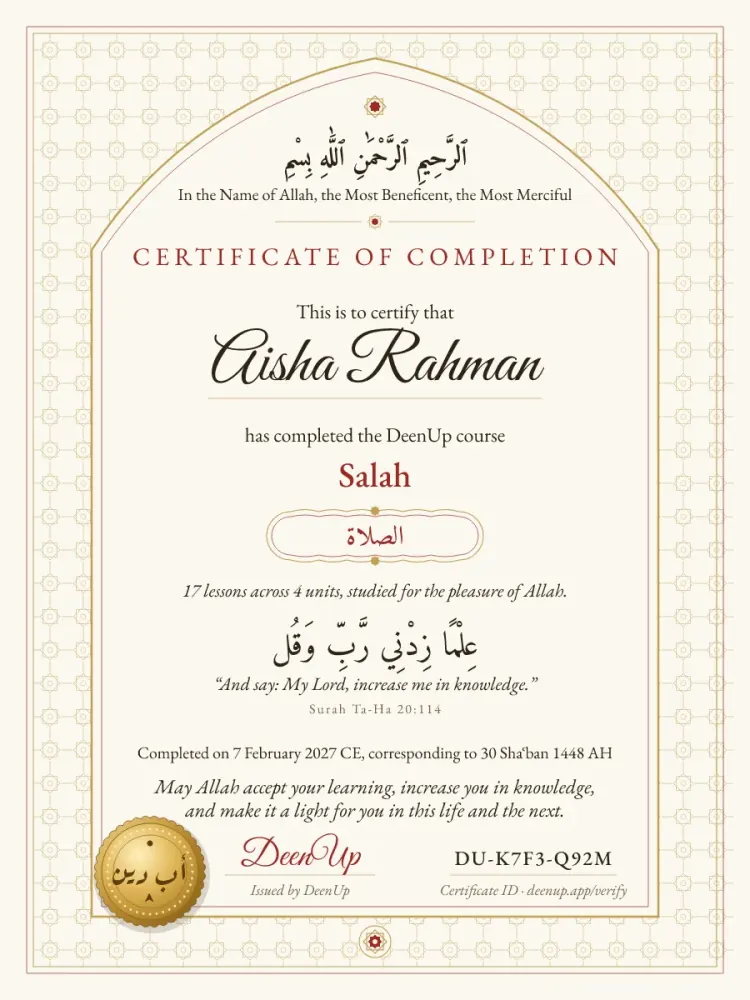
The essentials of salah, fiqh and faith, step by step from authentic sources. Finish all 28 days and earn a verifiable Certificate of Completion.
Take the free quizAnswer a few questions and get your personal plan.
Why Mahr Matters for Modern Muslim Marriages
In many Muslim-majority cultures, the mahr has been reduced to a nominal figure — a token amount agreed quickly before the nikah and never paid, or handed to the bride's family who keep it. This contradicts Islamic law directly: the mahr is the bride's right, and paying it to her family without her agreement does not fulfil the obligation.
For Muslim women in Western contexts especially, mahr is worth understanding not as tradition but as an enforceable financial right that:
- Establishes the wife's economic independence from day one. She begins married life with an asset that is hers entirely.
- Makes divorce a considered act. A substantial deferred mahr means the husband carries a real financial obligation — which discourages impulsive or unjust divorce.
- Differs entirely from dowry. Dowry (a payment from the bride's family to the groom) is not Islamic. Mahr flows the other way — from groom to bride — and is her possession alone.
For a broader perspective on what Islam says about the rights and responsibilities within marriage, see the importance of marriage in Islam.
Not sure how Islamic principles apply to your own relationships and decisions? Take the free DeenUp quiz for a personalised plan grounded in Quranic values.
Types of Mahr and How Much Is Required
| Type | Description | When Paid |
|---|---|---|
| Mahr muajjal (prompt) | Agreed portion paid at or before the nikah | At the time of marriage |
| Mahr muajjal (deferred) | Portion paid at a future agreed date | At divorce or death |
| Mahr al-mithl | Fair equivalent if no amount was specified | Determined by scholars/court |
How Much Is the Mahr?
There is no Quranic maximum — a groom may give as much as he is able. The minimum differs by school:
- Hanafi: Ten silver dirhams (approximately the value of 30g of silver). Less than this is not valid as mahr in this school.
- Maliki: Any sum of real value, however small. Even a date or a sip of water has been debated, though the spirit is a meaningful gift.
- Shafi'i and Hanbali: Any agreed sum of financial value with no fixed minimum.
The Prophet's guidance is consistent across schools: make it easy, make it real, and make it hers. In practice, mahr in many communities is specified in gold, local currency, or property, with a prompt portion paid before the wedding and a deferred portion documented in the nikah ceremony contract.
For DeenBack's detailed exploration of how to prepare spiritually and practically for Islamic marriage, including mahr conversations, see preparing for your nikah. The DemiManifest guide on marriage in Islam as a spiritual journey also offers a thoughtful perspective on building a marriage on its proper foundation.
How to Handle Mahr in Your Nikah
Mahr should never be an afterthought. Here is how to approach it practically:
- Agree the amount before the nikah. The mahr is part of the marriage offer (ijab) and acceptance (qabul). It should be discussed openly between both families, with the bride's consent as the central requirement.
- Specify both a prompt and a deferred portion. A common structure is: a prompt portion paid before or at the nikah, and a deferred portion specified clearly in writing.
- Document it in the marriage contract. An Islamic marriage contract should name the mahr, its form, and its payment terms. This protects both parties legally.
- Give it directly to the bride. Hand the mahr — or the documentation of the deferred portion — to the bride herself, not to her parents.
- Choose what is meaningful, not what is impressive. A mahr that you can actually pay is worth far more than one that remains a debt for years.
If you are building the daily habits that sustain a spiritually grounded marriage, see our guide on duas for newly married couples. And for Islamic jurisprudence resources on mahr and nikah from certified scholars, SeekersGuidance publishes detailed answers across all four schools.
What Happens to Mahr in Divorce?
Mahr rules are precise at every stage of marriage:
Before consummation: If the marriage is dissolved before consummation and a mahr was agreed, the wife receives half (Surah Al-Baqarah, 2:237). If no mahr was fixed, she is entitled to a reasonable gift (mut'ah) instead. Either party may voluntarily waive their half.
After consummation: The wife keeps the full mahr. This applies regardless of who initiated the divorce — whether the husband pronounced talaq, the wife obtained khul', or the marriage was dissolved by a court (faskh).
Deferred mahr: This becomes immediately due and payable upon divorce or the death of the husband. It cannot be waived except by the wife herself.
Death of the husband: The wife inherits from the estate, and any unpaid mahr is settled as a debt before the estate is distributed to other heirs.
For a full explanation of Islamic divorce rules, rights, and the iddah waiting period, see our guide on divorce in Islam.
Common Questions About Mahr
Can parents negotiate the mahr on behalf of their daughter without her knowledge? No. Mahr is the bride's right; she must agree to its amount. Parents may assist in the conversation, but the bride's consent is essential.
Can a wife waive her mahr after marriage? Yes — she may gift it back to her husband at any time. The Quran acknowledges this in Surah An-Nisa (4:4): "If they give back any of it willingly, then take it in good cheer." The key word is willingly — it cannot be coerced or assumed.
Is mahr the same as a wedding gift from the groom's family? No. Wedding gifts are separate gestures. Mahr is a legal obligation defined in the nikah contract. Giving jewelry or presents is generous but does not substitute for mahr unless both parties explicitly agree it is the mahr.
What if mahr was never paid and years have passed? It remains a debt. The wife may demand it at any time, and it is settled before the estate in the event of the husband's death.
Conclusion
Mahr is not a formality. It is the first financial right the Quran establishes for a bride — a concrete expression of the groom's commitment, her economic independence, and the seriousness of the marriage covenant. Getting it right, documenting it properly, and paying it fully is an act of ihsan (excellence) that sets the foundation for the marriage you are building.
For more on the rights and responsibilities that come with Islamic marriage, explore our guide on the importance of marriage in Islam. And when you are ready to build the daily Islamic habits that sustain a healthy family life, start with the free DeenUp quiz for a personalised plan.
Your personal 28-Day Deen Plan
Learn your deen in 28 days, 5 minutes a day
The essentials of salah, fiqh and faith, step by step from authentic sources. Finish all 28 days and earn a verifiable Certificate of Completion.
Take the free quizAnswer a few questions and get your personal plan.
Frequently Asked Questions
What is mahr in Islam?
Mahr (مَهْر) is the mandatory bridal gift a groom gives to his bride at nikah. It is a divine right established in the Quran: 'Give the women their bridal gifts willingly' (Surah An-Nisa, 4:4). It belongs solely to the bride — not her family — and is a legally enforceable financial obligation that forms part of the Islamic marriage covenant.
Is mahr required for a valid nikah?
Mahr is an obligatory condition of a valid Islamic marriage. If the amount was not agreed at nikah, the wife is still entitled to mahr al-mithl — a fair equivalent based on comparable cases in her family. Scholars agree that a nikah without an agreed mahr is still valid, but the obligation to pay it remains binding and cannot be waived by others.
What is the minimum mahr in Islam?
The Hanafi school sets a minimum of ten silver dirhams. The Maliki, Shafi'i, and Hanbali schools accept any mutually agreed amount of real financial value. The Prophet encouraged simplicity, once accepting an iron ring as mahr for a Companion who could afford nothing else (Sahih al-Bukhari 5029). Extravagance is not required or encouraged.
Who owns the mahr — the bride or her family?
The mahr belongs exclusively to the bride. The Quran uses the word nihlah — a freely given, unconditional gift — in Surah An-Nisa (4:4). No family member can claim it or waive it on her behalf. The wife may choose to return it to her husband voluntarily (An-Nisa 4:4), but that decision is hers alone and cannot be imposed by anyone.
What happens to mahr if the couple divorces before consummation?
If divorce occurs before consummation and a mahr was agreed, the wife receives half (Surah Al-Baqarah, 2:237), unless either party waives their share voluntarily. If no mahr was fixed, she receives a mut'ah — a reasonable gift at the husband's discretion. After consummation, the wife keeps the full mahr regardless of who initiated the divorce.
What is deferred mahr?
Deferred mahr is a portion of the agreed mahr not paid at the time of nikah but at a later date — typically upon divorce or the death of the husband. It is documented in the marriage contract alongside the prompt portion. Deferred mahr provides financial security for the wife and acts as a practical deterrent against hasty or unjustified divorce.
Can mahr be paid in non-cash forms?
Yes. Mahr can be cash, gold, silver, property, or a service of real value — including teaching the Quran, as was used for one Companion (Sahih al-Bukhari 5121). Both parties must agree to the form and amount, and it must be clearly specified in the nikah contract. Vague or unenforceable mahr creates disputes and should be documented in writing.