

- Authors

- Name
- Ahmad
- Role
- Senior Marketing Manager, Islamic education • DeenUp
بِسْمِ اللهِ الرَّحْمٰنِ الرَّحِيْمِ
In the name of God, the Most Gracious, the Most Merciful.
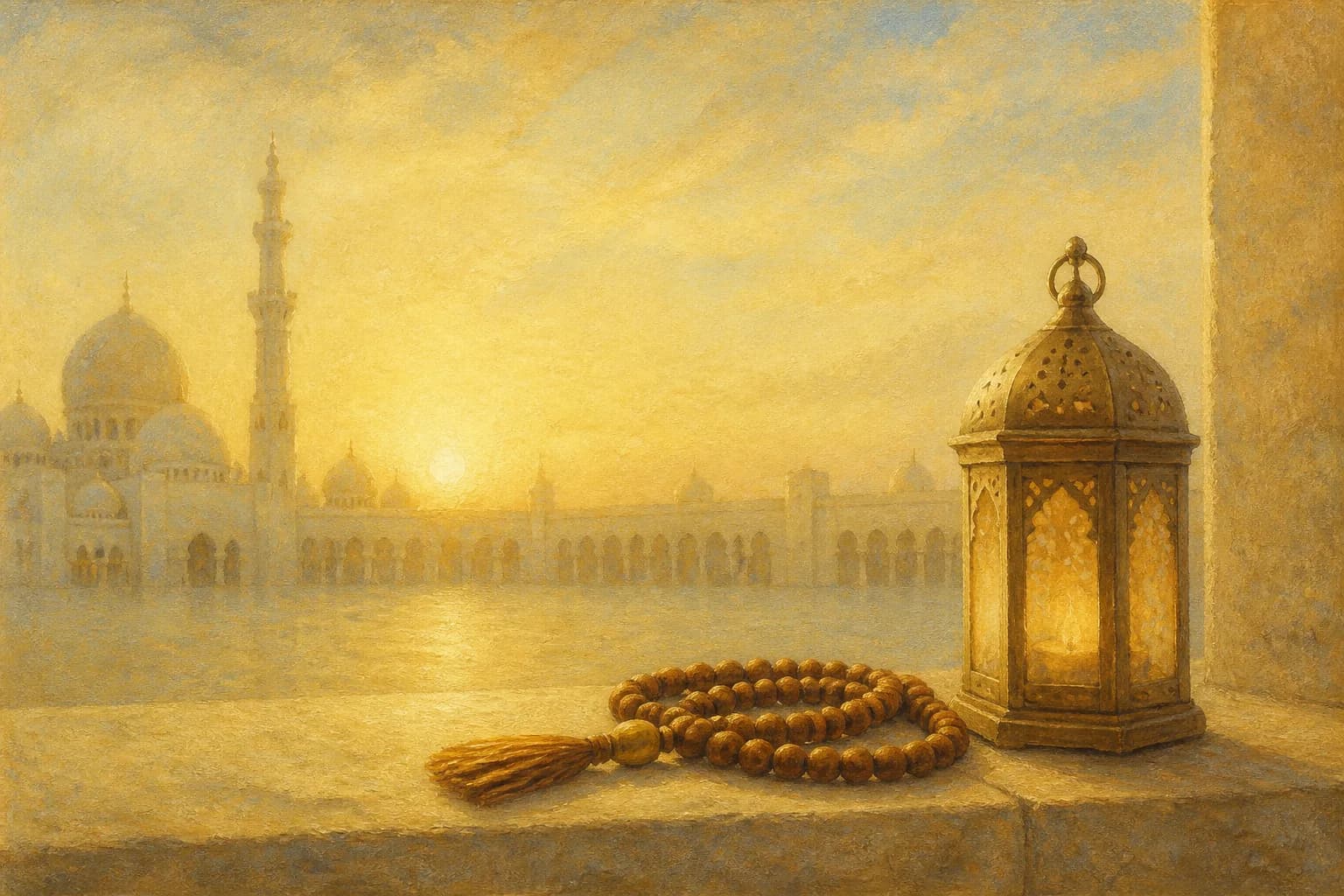

You have just completed your prayer. The salam is done, the mat is still warm, and most people reach for their phone. What the Prophet ﷺ taught is to reach for something else first: thirty-three counts each of glorification, gratitude, and exaltation — three short phrases that take under two minutes and carry a reward that, in the words of the hadith, forgives sins like the foam of the sea.
This is the tasbeeh after salat. It is one of the most consistently recommended acts in the sunnah, performed five times daily by millions of Muslims, and one of the easiest habits to build because it is already anchored to an existing action. But for many Muslims, the specific words, counts, and method are unclear. This guide covers everything precisely.
What Is the Tasbeeh After Salat?
The tasbeeh after salat is a specific sequence of post-prayer dhikr taught by the Prophet Muhammad ﷺ: SubhanAllah (Glory be to Allah) repeated 33 times, Alhamdulillah (All praise is for Allah) 33 times, and Allahu Akbar (Allah is the Greatest) 33 times — totalling 99 — completed with a full declaration of tawheed that brings the count to 100. The Prophet said that whoever performs this after every fard prayer will have their sins forgiven even if they are as numerous as the foam of the sea (Sahih Muslim 597). This makes it one of the most accessible and powerful acts of forgiveness available to every Muslim five times each day.
The Three Phrases of Tasbeeh
Each phrase carries its own meaning and its own standing in Islamic worship.
SubhanAllah — سُبْحَانَ اللهِ
سُبْحَانَ اللهِ
Subḥānallāh
"Glory be to Allah — He is far above any imperfection."
Tasbih in Arabic comes from a root meaning to swim freely, to move without obstruction. When you say SubhanAllah, you are declaring that Allah is completely free of any limitation, fault, or comparable. It is why the concept is called tasbih — the mind swims to contemplate a reality that transcends every human category.
Alhamdulillah — الْحَمْدُ لِلَّهِ
الْحَمْدُ لِلَّهِ
Alḥamdulillāh
"All praise belongs to Allah."
This is not merely thanks for good outcomes. It is an unconditional acknowledgement that all praise — for everything, always — belongs to Allah. The Prophet said that Alhamdulillah fills the scales of deeds (Sahih Muslim 223). After prayer, saying it 33 times re-anchors the heart in gratitude before returning to the world.
Allahu Akbar — اللهُ أَكْبَرُ
اللهُ أَكْبَرُ
Allāhu Akbar
"Allah is the Greatest."
Akbar is a comparative: not merely great, but greater than anything you are comparing Him to. Every concern, every ambition, every fear you carry as you leave the prayer mat is being measured against this statement. It is the posture that sets the rest of the day.
The Step-by-Step Tasbeeh After Salat
| Step | Arabic | Transliteration | Meaning | Count |
|---|---|---|---|---|
| 1 | سُبْحَانَ اللهِ | SubhanAllah | Glory be to Allah | 33x |
| 2 | الْحَمْدُ لِلَّهِ | Alhamdulillah | All praise is for Allah | 33x |
| 3 | اللهُ أَكْبَرُ | Allahu Akbar | Allah is the Greatest | 33x |
| 4 | لَا إِلَهَ إِلَّا اللهُ وَحْدَهُ لَا شَرِيكَ لَهُ، لَهُ الْمُلْكُ وَلَهُ الْحَمْدُ وَهُوَ عَلَى كُلِّ شَيْءٍ قَدِيرٌ | La ilaha illallah wahdahu la sharika lahu, lahul mulku wa lahul hamdu wa huwa ala kulli shay'in qadir | There is no god but Allah alone, with no partner; to Him belongs dominion and all praise, and He has power over all things | 1x (completing 100) |
Alternative count: Some hadith narrate SubhanAllah 33, Alhamdulillah 33, Allahu Akbar 34, totalling 100 without the final completion phrase. Both forms are authentically reported. The first (33+33+33+completion) is the more commonly cited version in Sahih Muslim.
How to Count the Tasbeeh
Counting on the fingers of the right hand is the method the Prophet ﷺ explicitly approved. He told a Companion who was counting on pebbles that fingers are preferable because they will bear witness on the Day of Resurrection.
The traditional finger-counting method: start with the thumb pressing the base of the index finger (1), then middle (2), ring (3), little (4), then the tips: little (5), ring (6), middle (7), index (8), thumb base (9), then once across the thumb for the 10th count — though different regional traditions use slightly different methods. The goal is reaching 33 before moving to the next phrase.
Using a tasbih (prayer beads) is also valid. Most tasbih have 33 or 99 beads. The scholars of the four major madhabs accept this as permissible, since the Prophet permitted using pebbles when that was all that was available.
What matters is mindfulness, not the counting mechanism. The Prophet described the heart's presence (khushoo) as the soul of dhikr.
The Hadith Evidence
The foundational hadith for this practice is reported by Abu Hurairah (may Allah be pleased with him):
The Prophet ﷺ said: "Whoever glorifies Allah (SubhanAllah) 33 times after every prayer, praises Him (Alhamdulillah) 33 times, and magnifies Him (Allahu Akbar) 33 times — that is 99 — then completes it to 100 by saying La ilaha illallah wahdahu la sharika lahu, lahul mulku wa lahul hamdu wa huwa 'ala kulli shay'in qadir — his sins will be forgiven, even if they were like the foam of the sea." (Sahih Muslim 597)
Allah also commands remembrance after completing the prayer, saying: "When you have finished the prayer, remember Allah while standing, sitting, and [lying] on your sides." (Surah An-Nisa 4:103) And in Surah Al-Baqarah: "So remember Me; I will remember you." (Al-Baqarah 2:152)
The tasbeeh after salat is the direct prophetic instruction for how to fulfil this Quranic command immediately after the prayer ends.
Do you feel your duas are unanswered?
Have you read the dua properly? Learn authentic duas, understand their meanings, and call upon Allah with greater confidence through DeenUp.
Take the Dua Quiz
Making the Tasbeeh a Daily Habit
The reason many Muslims skip the post-prayer tasbeeh is not intention — it is friction. The phone is right there. The next task is calling. The key is reducing the gap between finishing the salam and beginning the first SubhanAllah.
A few approaches that work:
- Stay on the mat. The physical location of the prayer mat is the cue. The moment you stand or reach for your phone, the habit window closes. Make it a rule: tasbeeh before anything else.
- Start with one prayer. Trying to add the full tasbeeh to all five prayers at once creates the same failure as trying to run a marathon on day one. Pick Fajr or Maghrib — the prayers where you are least rushed — and anchor the habit there first.
- Count silently in meetings. For Dhuhr or Asr at work, the tasbeeh can be completed quietly without disrupting anything.
- Learn the counts before the phrases. If you are still learning the exact Arabic, start by simply counting thirty-three breaths while thinking of the meanings. Then gradually replace the counting with the words.
Our dedicated articles on dhikr after salah and duas to read after salah cover the broader post-prayer routine, of which the tasbeeh is the central pillar. For the full morning and evening adhkar framework that surrounds daily prayer, see the importance of dhikr in Islam and what is tasbih in Islam.
The DeenBack guide to daily dhikr habits offers a practical plan for establishing a consistent post-prayer routine. The Demi Manifest piece on post-prayer rituals explores how anchoring this tasbeeh to each salah reshapes the texture of the entire day — not just the two minutes after prayer.
What Consistent Tasbeeh Does to the Heart
The scholars describe a phenomenon they call riqqa — a softness of the heart that comes from consistent dhikr. It is not an emotion you produce. It is what happens when you have said SubhanAllah 165 times in a day, every day, for months. The tongue trains the heart, and the heart begins to recognise the presence it has been pointing to.
The Prophet ﷺ said: "The deeds most beloved to Allah are those done consistently, even if they are small." (Sahih al-Bukhari 6464) The post-prayer tasbeeh is exactly this: small, consistent, and among the highest acts per unit of time in the entire sunnah.
Five prayers a day, two minutes each: the tasbeeh takes under ten minutes of your entire day and, according to the hadith, has the capacity to wipe clean what accumulated through the hours between.
Do you feel your duas are unanswered?
Have you read the dua properly? Learn authentic duas, understand their meanings, and call upon Allah with greater confidence through DeenUp.
Take the Dua QuizFrequently Asked Questions
What is the tasbeeh after salat?
The tasbeeh after salat is the prescribed post-prayer dhikr taught by the Prophet Muhammad: SubhanAllah (Glory be to Allah) 33 times, Alhamdulillah (All praise is for Allah) 33 times, and Allahu Akbar (Allah is the Greatest) 33 times, totalling 99, completed with a full declaration of tawheed to reach 100. It is narrated in Sahih Muslim (597).
How many times do you say SubhanAllah after salat?
After every fard prayer, SubhanAllah is said 33 times. This is followed by Alhamdulillah 33 times and Allahu Akbar 33 times, making 99 in total. The 100th count is completed by reciting La ilaha illallah wahdahu la sharika lahu, lahul mulku wa lahul hamdu wa huwa ala kulli shay'in qadir. Some hadith narrate Allahu Akbar 34 times without the completion phrase, also totalling 100.
Can I count the tasbeeh on my fingers?
Yes, and the Prophet Muhammad explicitly approved counting dhikr on the fingers. He told a companion who was using pebbles to count SubhanAllah: use your fingers, as they will bear witness on the Day of Resurrection. Counting on the right hand, moving through each finger joint, is the traditional method. Using a tasbih (prayer beads) is also widely accepted among scholars as a permissible tool.
Do I have to complete the full tasbeeh for it to count?
The reward of the complete tasbeeh (all 99 or 100 counts) is specifically tied to completing it. However, every individual glorification of Allah has its own reward. If you are interrupted or time does not permit the full sequence, what you did complete has value. The prophetic encouragement is toward completing the full sequence after each fard prayer as a consistent daily practice.
Does the tasbeeh after salat need to be in Arabic?
The words SubhanAllah, Alhamdulillah, and Allahu Akbar are Arabic phrases taught and recited by the Prophet in their original form. Most scholars hold that dhikr is most complete in the Arabic in which it was taught, since translation can shift meaning. For those learning, the Arabic words are short enough to learn with transliteration and memorise quickly — the DeenUp app can help with guided reminders.
What is the reward for completing the tasbeeh after every prayer?
The Prophet Muhammad said that whoever completes this tasbeeh — SubhanAllah 33, Alhamdulillah 33, Allahu Akbar 33, then the full La ilaha illallah declaration — after every prayer will have their sins forgiven even if they are as numerous as the foam of the sea (Sahih Muslim 597). It is among the most concise and comprehensive acts of forgiveness available after every single prayer.
Is the tasbeeh after salat an obligation or a sunnah?
The tasbeeh after salat is a confirmed sunnah (sunnah muakkadah), not a fard obligation. The Prophet performed it regularly and encouraged it strongly, so leaving it consistently without reason is considered makruh (disliked). A Muslim who misses it occasionally has not sinned, but whoever makes it a daily habit gains a significant and accessible source of reward five times every day.